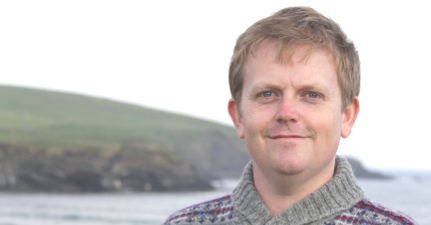
Peter Moerters is a Professor of Applied Mathematics at the University of Cologne , specializing in probability theory and its applications. His research spans random graphs, large deviations, Brownian motion, stochastic processes in random media, and geometric measure theory. He has extensive collaborations and editorial service, including contributions to journals like Stochastic Processes and their Applications and Journal of Theoretical Probability . Research Interests : Probability theory, random graphs, large deviations, Brownian motion, stochastic processes in random media, and geometric measure theory. Notable Coauthors : Yuval Peres, Jochen Blath, Wolfgang König, and others. Publications : Recent works include studies on percolation phase transitions, competing growth processes, tangent graphs, and branching with selection and mutation. Editorial Service : Serves on the editorial boards of Journal of Theoretical Probability and Stochastic Processes and Applications .
Jonathan Mace is a tenure-track faculty member heading the Cloud Software Systems Group at the Max Planck Institute for Software Systems and University of Saarland. His research develops systems for operating cloud infrastructure, distributed systems, and serverless architectures. Key projects include Blueprint for reconfigurable microservices, Hindsight for distributed tracing of edge cases, and Clockwork for predictable DNN serving. His work addresses observability, performance predictability, and resource management in cloud environments. Mace has received the Distinguished Artifact Award at OSDI, Facebook PhD Fellowship, and SOSP Best Paper Award. He teaches courses on distributed systems and cloud computing and has supervised multiple PhD students.
Jan Henrik Röwekamp is a researcher at the Department of Computer Science, University of Hamburg. His work focuses on theoretical computer science with emphases on Petri nets, distributed systems, algorithm design, and computational geometry. He holds a Master's (2013) and Bachelor's (2011) degree from the same institution. His research includes distributed simulation of Petri nets via web-based stateless services, containerization strategies for Petri net simulations, and applying Petri nets to computer vision tasks like Euclidean distance approximation. He has contributed to modeling IoT/Edge Computing architectures using Petri nets and explored distributed execution frameworks for reference nets using virtual machines. Publications span international workshops such as PNSE'19, PNSE'18, and AWPN 2017. His work bridges theoretical foundations with practical implementations in distributed systems and software engineering.
Prof. Dr.-Ing. Walter Fichter is Director of the Institute of Flight Mechanics and Flight Control at the University of Stuttgart, within the Faculty of Aerospace Engineering and Geodesy. With 17 years of industrial experience at Airbus Defence and Space and Mitsubishi Electric, he has contributed to six satellite control systems and holds 14 patents. His research focuses on advanced flight control systems, autonomous UAVs, helicopter dynamics, and spacecraft navigation. Notable projects include the LISA Pathfinder mission's drag-free system and the MosaicGPS receiver for geostationary orbits. His expertise spans satellite aerodynamics, nonlinear control theory, and AI-driven autonomous flight. Current research includes energy-efficient soaring algorithms, distributed propulsion systems (e.g., Icaré aircraft), and real-time evasion maneuvers for eVTOLs. Prof. Fichter actively pilots aircraft (EU/US certifications) and serves on the AIAA Journal of Guidance, Control, and Dynamics advisory board. Key achievements include pioneering tilt-to-length noise estimation techniques for gravitational wave observatories and developing stall-prevention systems for gliders. His work bridges academic research with industrial applications, addressing challenges in space exploration, urban air mobility, and sustainable aviation technologies.
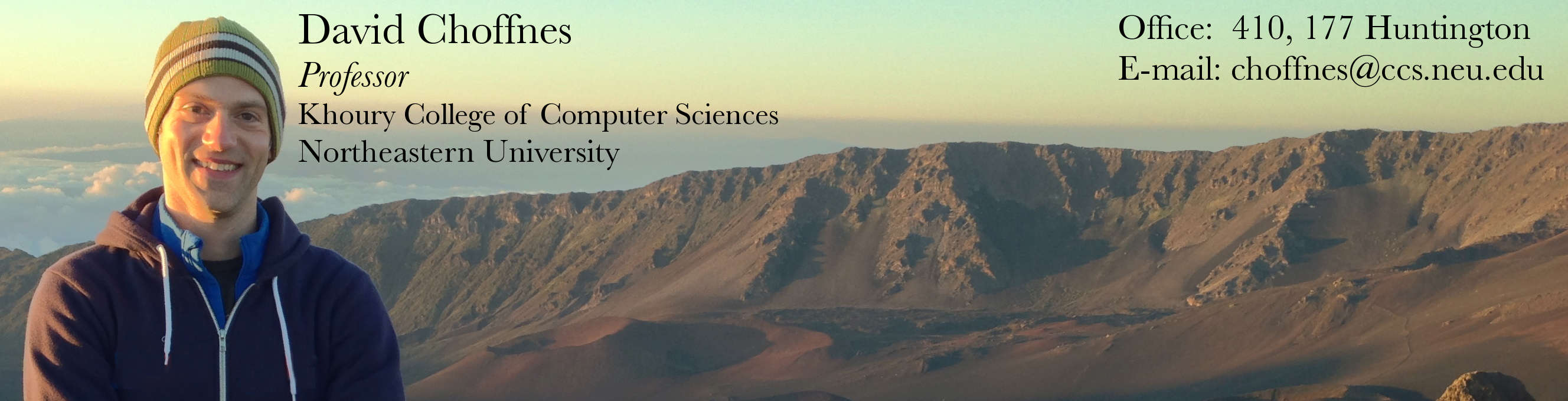
David Choffnes is a Professor at Northeastern University's Khoury College of Computer Sciences and Executive Director of the Cybersecurity and Privacy Institute (2021-2023). He is affiliate faculty at the Center for Law, Innovation and Creativity (CLIC). His research spans Distributed Systems, Networking, Privacy, Security, and Mobile Computing , with emphasis on IoT, transparency, and policy-relevant empirical studies. His research has produced software with over 1 million users , including the net neutrality tool Wehe and ReCon for mobile privacy control. He has received major grants like a $10M NSF SaTC Frontier grant and industry support from Google, Comcast, and Verizon. Recent publications focus on smart speaker profiling , data localization , and gig economy privacy risks , with papers accepted at top venues like PETS and IMC. He has won multiple best paper awards and serves on program committees for SIGCOMM, IMC, and IEEE S&P. Awards include the Caspar Bowden PET Runner-Up (2024) IMC Best Paper Award (2023) NSF CAREER (2018) ACM Senior Member (2021) 10M NSF SaTC Frontier grant He advises PhD students like Tianrui Hu (recently graduated), and leads the Mon(IoT)r Lab analyzing IoT privacy and security implications. His work bridges technical solutions with policy debates , collaborating with regulators and legislators.
K Narayan Kumar is a full-time Professor of Computer Science at the Chennai Mathematical Institute (CMI) in Chennai, India. He has been affiliated with CMI since at least 2003, where he teaches courses ranging from programming fundamentals to advanced topics in automata theory and verification. His research focuses on automata models for distributed systems, logic, and verification methods. Research Interests: Automata models for distributed systems Logic and formal verification Theoretical computer science Professional Activities: Active in organizing and participating in international conferences (e.g., FSTTCS, CONCUR, ATVA) Co-Chair of 29th FSTTCS (2009) and 3rd AATS (2011) Member of scientific committees for Informatics Olympiads Teaching: Current courses: Introduction to Programming in Python, Algorithms Past courses: Haskell programming, Automata Theory, Verification, Networks, and more
Igor Walukiewicz is a Researcher at the Laboratoire Bordelais de Recherche en Informatique (LaBRI) , affiliated with Université de Bordeaux , France. His work focuses on Concurrency Theory , Model Checking , Timed Automata , Higher-Order Model Checking , and Automata Theory . His recent research explores parametric systems , timed automata , and higher-order concurrency . Articles highlight advancements in verification techniques , synthesis of distributed algorithms , and partial-order reduction methods . Key subfields include deadlock avoidance , active learning , and logical frameworks for timed systems . He has secured significant ANR grants such as FREDDA (FoRmal Methods for Distributed Algorithms) and Ticktac (Verification of Real-Time Systems). He contributes to tools like TChecker , a model-checking tool for real-timed systems developed at LaBRI. Walukiewicz participates in editorial and organizational roles, including the Fundamenta Informaticae editorial board and HIGHLIGHTS conference steering committee. He has presented at major venues like LICS , CONCUR , and ICALP .
Farinaz Koushanfar is a Professor in the Electrical Engineering and Computer Science department at the University of Michigan's College of Engineering. With an impressive h-index of 65 and over 27,000 citations, she has established herself as a leading researcher in hardware security and privacy-preserving computing. Her research interests span hardware security, integrated circuit protection, physical unclonable functions, hardware trojans, logic locking, and privacy-preserving machine learning. Koushanfar's work addresses critical security challenges throughout the semiconductor supply chain, developing innovative solutions for IP protection, anti-counterfeiting, and secure hardware design. Analysis of her recent publications reveals a strong focus on the intersection of hardware security and machine learning, particularly in federated learning security and privacy-preserving deep neural network inference. Her research shows a clear trajectory from foundational hardware security mechanisms toward more complex systems-level security challenges in emerging computing paradigms. Throughout her career, Koushanfar has made significant contributions to both theoretical frameworks and practical implementations in hardware security, with numerous highly influential publications that have shaped the field.
Stelios Piperidis is a prominent researcher at the Athena Research and Innovation Center, specializing in language technologies and digital language equality initiatives across European frameworks. His work spans machine translation, language resource development, and multilingual infrastructure projects including the European Language Grid (ELG), European Language Equality (ELE) program, and META-SHARE infrastructure. His research interests focus on overcoming language barriers through advanced computational methods, with particular emphasis on scientific domain machine translation , parliamentary corpus analysis , and digital language equality metrics . He has pioneered methodologies for constructing specialized parallel corpora from scientific abstracts, news metadata, and parliamentary debates, addressing challenges in domain adaptation and multilingual resource scarcity. His publication trends reveal consistent contributions to language resource standardization, metadata schemas, and European language technology policy frameworks. Recent work centers on the European Language Data Space initiative and sustainability models for digital language equality. Piperidis has played key roles in numerous European Commission-funded projects, contributing to strategic agendas for language resource coordination and technological infrastructure development. His collaborative work spans over 50 institutions across Europe, focusing on practical implementations of language technology solutions for public sector applications and academic research. He actively participates in major language resource conferences including LREC and EAMT, contributing to community-building efforts through workshop organization and editorial work. His leadership in European language technology initiatives has helped shape strategic roadmaps for achieving full digital language equality by 2030.
Jacek Rak is a Professor at the Department of Communications and Computer Networks within the Faculty of Electronics, Telecommunications and Informatics at Gdańsk University of Technology. His research career spans over two decades with continuous contributions to network resilience engineering, evidenced by over 50 publications in top-tier IEEE and Springer journals. He serves as a leading authority in optical network design, vehicular communications, and disaster-resilient systems, frequently collaborating with international institutions including Hungarian Academy of Sciences, University of Lisbon, and Polish-Japanese Academy of Information Technology. Professor Rak's research focuses on network resilience engineering across multiple domains. His work establishes foundational frameworks for protecting communication systems against disasters, with significant contributions to optical network survivability, 5G/6G fronthaul optimization, and vehicular network security. His research methodology integrates mathematical modeling with practical implementation, particularly evident in his development of the κ-Penalty approach for disjoint path calculation and eFRADIR disaster resilience framework. Recent work emphasizes the convergence of wireless and optical technologies for next-generation networks, addressing critical challenges in energy efficiency and cost modeling for 6G infrastructure. His publication portfolio reveals a clear evolution from VANET security (2010-2015) to comprehensive disaster resilience frameworks (2016-present), culminating in the 2020 Springer monograph Guide to Disaster-Resilient Communication Networks co-edited with David Hutchison. Current research examines optical fronthaul optimization for 6G systems, with multiple 2023-2025 publications establishing new methodologies for cost-energy tradeoff analysis in next-generation wireless infrastructure. IEEE Communications Society Distinguished Lecturer (2018-2020) Editor-in-Chief, Optical Switching and Networking special issue on Disaster-Resilient Optical Networks (2021) Technical Program Committee Chair, International Workshop on Reliable Networks Design and Modeling (RNDM 2012-2015) Professor Rak actively mentors next-generation researchers through collaborative projects like RECODIS (Resilient Communication Services Protecting End-user Applications from Disaster-based Failures) and coordinates international research efforts through EU-funded initiatives. His work demonstrates consistent leadership in establishing resilience metrics and validation methodologies for critical communication infrastructure, with increasing focus on climate change adaptation and sustainable network design principles in recent publications.
Patrik Vagovic is a Staff Scientist at the European XFEL GmbH, affiliated with the Center for Free-Electron Laser Science (CFEL), a collaborative research center between DESY, the University of Hamburg, and the Max Planck Society. He leads research in the Coherent Imaging Team, focusing on advanced X-ray imaging techniques using X-ray free-electron lasers. His work bridges the gap between fundamental physics and practical applications in materials science, biology, and fluid dynamics. Dr. Vagovic's research interests center around developing and applying cutting-edge X-ray imaging methodologies, particularly high-speed and phase-sensitive techniques. His work encompasses X-ray phase contrast imaging, coherent diffractive imaging, tomography, and advanced data processing methods. He has pioneered MHz frame rate X-ray imaging capabilities at the European XFEL, enabling unprecedented observation of ultrafast phenomena previously impossible to capture with conventional X-ray sources. Analyzing his recent publication record reveals a strong focus on pushing the temporal and spatial boundaries of X-ray imaging. His work demonstrates a consistent progression from developing fundamental imaging techniques to applying them to complex scientific problems across multiple disciplines. The research shows increasing sophistication in both hardware development (optical systems, detectors) and computational methods (phase retrieval, machine learning). Dr. Vagovic actively collaborates with international research teams across Europe and beyond, contributing to numerous high-impact publications in top journals including Optics Express, Journal of Synchrotron Radiation, and Nature Communications. His work on MHz X-ray microscopy has particularly advanced the field of time-resolved imaging of irreversible phenomena. As part of the Coherent Imaging Team at European XFEL, Dr. Vagovic works with state-of-the-art instrumentation including the SPB/SFX instrument, where he has developed pump-probe capabilities and advanced diagnostics for megahertz pulse trains. His research group utilizes advanced computational approaches alongside experimental innovations to solve complex imaging challenges.
Ashwin Rao is a Research Professor at the University of Southern California's Information Sciences Institute (ISI) within the Viterbi School of Engineering. With a research career spanning over two decades, his work bridges computer science, social sciences, and political science, focusing on understanding human behavior through digital footprints. His academic journey began with signal processing research in the 1990s before evolving into network protocols and mobile computing, and most recently into computational social science and AI ethics. Rao's research interests encompass Social Media Analysis, Online Political Polarization, Misinformation Detection, Network Protocols, Mobile Computing, Privacy in Mobile Applications, Natural Language Processing, and AI Ethics. His work demonstrates a consistent trajectory from technical networking research to the societal implications of technology. His most recent publications reveal a strong focus on understanding political discourse online, particularly examining polarization, emotional responses to events, and the impact of social media algorithms on information ecosystems. His interdisciplinary approach combines computational methods with social science theories to address pressing issues in digital society. Rao has published extensively across top venues including ICWSM, WWW, ACL, IEEE Transactions, and numerous conferences in networking and systems. His work often appears with Kristina Lerman, with whom he collaborates closely at USC ISI. His recent research portfolio shows a sophisticated integration of machine learning techniques with social science questions, particularly examining how language models reflect and potentially amplify societal biases. Rao has made significant contributions to understanding privacy issues in mobile applications, network protocols, and social media dynamics. His research has been influential in both technical communities studying network performance and social science communities examining online behavior. His work on BitTorrent performance, mobile privacy, and social media analysis has been widely cited across disciplines. His laboratory work appears to focus on computational social science methodologies, developing tools and frameworks for analyzing large-scale social media data while addressing ethical considerations in AI and data analysis. Recent projects suggest strong connections with public health research through social media analysis during the pandemic.
Amit Kumar is a Professor in the Department of Computer Science and Engineering at Indian Institute of Technology Delhi . He teaches several core and advanced courses including Mathematical Programming (COL 756) , Advanced Algorithms (COL 758) , Approximation Algorithms (COL 754) , Introduction to Automata and Theory of Computation (COL 352) , Design and Analysis of Algorithms (COL 351) , Data Structures (COL 106) , Discrete Mathematics (COL 202) , and Numerical Analysis and Scientific Computing (COL 726) . His office is located in Room 417, Bharti Building, and he uses email amitk@cse.iitd.ac.in for communication. His research lies primarily in combinatorial optimization and online algorithms , with recent work focusing on clustering problems with side constraints, understanding biases in evaluation processes, and online allocation with additional constraints. He has made significant contributions to approximation algorithms, stochastic optimization, and fairness in algorithmic systems. His research interests span theoretical foundations and practical applications in algorithm design. The recent publications (2023–2025) reflect a strong trend in fairness-aware algorithms , learning-augmented online algorithms , and advanced clustering techniques . The work spans top-tier venues such as STOC, FOCS, SODA, ICML, and NeurIPS, indicating high impact and interdisciplinary reach. Topics include bias in evaluation, fair service allocation, consensus clustering, and robust sorting, showing a shift toward socially aware and data-driven algorithmic solutions. Scientific Awards: Best paper award at International Symposium on Algorithms and Computation (ISAAC), 2023 Advising and Grants: While specific students and grants are not listed in the provided texts, Amit Kumar has supervised or co-supervised numerous publications with junior collaborators, suggesting active mentoring. His extensive collaboration network (e.g., with Anupam Gupta, Debmalya Panigrahi, Ragesh Jaiswal) indicates leadership in research projects and likely involvement in funded grants, though specific grant details are not mentioned. Labs and Teams: No specific lab or research group name is mentioned in the provided materials. However, his frequent collaborations and supervision of research projects suggest he is part of or leads a research team in theoretical computer science and algorithms at IIT Delhi.
Shaofeng Jiang is an Assistant Professor at Peking University, affiliated with the School of Computer Science and the Center on Frontiers of Computing Studies. He previously held an assistant professor position at Aalto University and was a postdoctoral researcher at the Weizmann Institute of Science under Robert Krauthgamer. He earned his PhD from the University of Hong Kong under Hubert Chan and completed his bachelor's at Shandong University. PhD: University of Hong Kong, supervised by Hubert Chan Bachelor's: Shandong University His research lies in theoretical computer science, focusing on algorithm design for massive and high-dimensional data. Key interests include approximation algorithms, online algorithms, streaming algorithms, clustering, coresets, and dimensionality reduction. His work often bridges theoretical guarantees with practical applications in distributed and parallel computing environments. The recent publications reveal a strong trend in developing efficient and scalable algorithms for clustering problems, particularly through coreset construction, dimensionality reduction, and distributed models like MPC. There is a growing emphasis on fairness, robustness, and dynamic settings, indicating a forward-looking research agenda in adaptive and responsible algorithmic systems. He actively mentors PhD students and teaches both undergraduate and graduate courses in programming and computational social science. He has served on program committees for top conferences including NeurIPS, ICML, and STOC, and co-organized a Dagstuhl seminar on clustering. Scientific Service and Leadership: Co-organizer, Dagstuhl Seminar on New Trends in Clustering (2026) Area Chair, NeurIPS 2024 and 2025 Program Committee, IPDPS 2019, SWAT 2022, COCOA 2024, ICALP 2026 He has received no explicitly mentioned scientific awards. His grants and funding sources are not detailed in the text. He leads a research group focused on theoretical foundations of data-efficient algorithms, collaborating with students on cutting-edge problems in high-dimensional and streaming data analysis.
David Broneske is a Researcher at the Otto von Guericke University of Magdeburg , Germany. His work spans Database Systems , Heterogeneous Computing , and Machine Learning Applications , with a focus on GPU/FPGA Acceleration and Non-volatile Memory (NVM) Optimization . He has contributed to projects like ADAMANT (co-processor integration) and GridTables (H2TAP data stores). Key Research Areas : Database acceleration via specialized hardware, Graph database applications in clinical/biological domains, and AutoML for domain-aware model selection. Collaborations : Frequent co-author with Gunter Saake, Bala Gurumurthy, and Sajad Karim on topics like NVM Storage and GPU-based Query Execution . Publications : Over 105 papers (2012–2025) covering Protein Identification Systems , Entity Resolution , and Software Evolution Datasets . Workshops : Co-organized the Workshop on Novel Data Management Ideas on Heterogeneous (Co-)Processors (NoDMC) and contributed to standards like Backlogs/Interval Timestamps for temporal graph queries.