Tal Micah August is an Assistant Professor at the Siebel School of Computing and Data Science, University of Illinois. His research focuses on Natural Language Processing, Plain Language Summarization, and Human-Computer Interaction, emphasizing audience-adaptive communication and AI-driven educational tools. Key research interests include developing intelligent writing assistants, evaluating AI-generated summaries across audiences, and leveraging large language models for legal and mathematical education. He collaborates on projects involving user-centered design and curriculum-grounded AI assessment. His work has been presented at major conferences like CHI and EMNLP, addressing topics such as interactive writing systems, plain-language metrics, and educational storytelling. No specific grants or student advisees are listed in the provided materials. Research highlights include the MathFish framework for math reasoning evaluation and studies on audience-specific plain language generation.
Nazune Menka is an Assistant Professor of Law and Faculty Director of the Northwest Center for Indigenous Law at Seattle University School of Law. Formerly the Executive Director of Berkeley Law’s Center for Indigenous Law & Justice, she has held roles including Supervising Attorney in the Environmental Law Clinic and Lecturer. Her work focuses on Indigenous self-determination, tribal sovereignty, and decolonization. Education: J.D., University of Arizona, Indigenous Peoples Law & Policy Certificate (2018) M.S., University of Arizona, Soil, Water, & Environmental Science (2013) B.A., North Carolina State University, Communications (2002) Research Interests: Professor Menka’s scholarship addresses Indigenous legal frameworks, environmental justice, and constitutional law. She advocates for tribal sovereignty through legal reforms and coalition-building. Her environmental science background informs her work on toxicology and public health risks in tribal communities. Professional Contributions: She serves as Board Treasurer for the California Indian Law Association, Water Protector Legal Collective, and SACNAS. Her advocacy spans policy work in Alaska and Hawaii legislatures, and internships at federal agencies like the EPA and CDC. Labs/Teams: Leads the Northwest Center for Indigenous Law, advancing Native Nations’ legal capacity and decolonizing legal education. Founded UC Berkeley’s Decolonizing UC Berkeley course and collaborates on tribal cultural resource policy initiatives.
Circe Sturm is Professor of Anthropology at the University of Texas at Austin's College of Liberal Arts and affiliate faculty in Native American and Indigenous Studies. With 25 years of teaching experience spanning the University of Oklahoma and UT Austin, her scholarship examines race-sovereignty-citizenship intersections in Native and African American communities through settler colonial frameworks. Education: Ph.D., University of California, Davis Her research critically analyzes racial formation , tribal sovereignty , and indigenous identity politics across Native North America, Central America, and Europe. Fieldwork with Cherokee and Freedmen communities informs her exploration of dominance-resistance dynamics and subjectivity within colonial structures, consistently bridging academic theory and social justice praxis. Recent publications (2016-2023) demonstrate evolving engagement with ontological anthropology, Black-Indigenous relations, and demographic politics of race. Key themes include sovereignty recognition struggles, racial classification systems, and the material consequences of settler colonial logics across legal, demographic, and cultural domains. Author of award-winning books Blood Politics (2002) and Becoming Indian (2011), her work is widely cited by scholars, tribal citizens, legal professionals, and journalists. Public intellectual contributions include New York Times features and NPR interviews. Sturm has mentored generations of students through courses including Cultural Anthropology, Mapping Indigenous Austin, and Oral History of Native Texas. Her public lectures for entities like the US Forest Service and New York Public Library demonstrate deep commitment to community-engaged scholarship beyond academia.
Micah Pawling is an Associate Professor of History & Native American Studies at the University of Maine. He specializes in ethnohistory with a focus on the Wabanaki people of the Northeast. His research examines Indigenous sovereignty, environmental history, and colonial interactions, particularly through collaborative projects with the Penobscot and Passamaquoddy Nations. Education: Ph.D., University of Maine, 2010 M.A., University of Maine, 1999 B.A., University of Delaware, 1996 Research Interests: Wabanaki ethnohistory and waterscapes Indigenous legal and land rights Nineteenth-century colonialism in northern New England Indigenous women’s roles in proprietorship Awards: 2018 Canadian Historical Association Prize for Indigenous History (2017 article) Recipient of Whiting Public Engagement Fellowship Teaching: Teaches courses on Native American history, Maine Indian history, and Indigenous legal history. Recent courses include HTY 481: Amerindians of the Northeast and HTY 550: Indigenous Legal History . Collaborations: Works with the Passamaquoddy Tribe of Indian Township and co-edited Wabanaki Homeland and the New State of Maine with the Penobscot Nation.
Jordi Guitart Fernández is a Professor at the Department of Computer Architecture, Barcelona School of Informatics (FIB), Universitat Politècnica de Catalunya (UPC). He is also affiliated with the Barcelona Supercomputing Center (BSC-CNS), a leading national supercomputing facility. He leads the CROMAI research group, focusing on Computing Resources Orchestration and Management for AI. His work bridges high-performance computing, cloud systems, and artificial intelligence. Research Interests: Cloud Computing and Edge Computing Green and Energy-Efficient Computing Containerization and Virtualization for HPC Resource Orchestration and Management Autonomic and Self-Adaptive Systems Machine Learning Workflow Management AI-Driven System Optimization His recent publications reveal a strong focus on intelligent management of computing resources across cloud, edge, and HPC environments using machine learning and agent-based frameworks. He investigates performance, efficiency, and reliability in containerized AI and HPC workloads, particularly within Kubernetes and distributed infrastructures. His work increasingly integrates human-in-the-loop and trustworthiness aspects into AI systems. Scientific Awards: CLOUD Conference 2025 Best Paper Award VISIGRAPP 2025 Best Student Paper Award Premi Extraordinari de Doctorat 2025 - Àmbit d'Enginyeria de les TIC Test of Time Award Honorable Mention (e-Energy) Reconeixement als Mèrits Docents d'Especial Qualitat Top reviewers for Polytechnic University of Catalonia (Computer Science) - September 2017 Advising and Grants: He has advised doctoral students, including Peini Liu. He leads and participates in numerous competitive R+D+i projects, such as CROMAI and DALEST, funded by national and European programs like HORIZON 2020 and the Spanish State Research Plans. His work is supported by grants focused on knowledge generation and industrial leadership in computing technologies. Labs and Teams: He is the leader of the CROMAI - Computing Resources Orchestration and Management for AI research group at UPC. He also collaborates closely with the Barcelona Supercomputing Center (BSC-CNS), contributing to large-scale computing initiatives and strategic research agendas in Europe.
Patricia D. McGuire is an Associate Professor at the School of Social Work , Carleton University , with a PhD in Sociology from the University of Saskatchewan (2013). Her academic work centers on Indigenous knowledge systems, community-based research methodologies, and decolonizing practices within Canadian sociological and social work frameworks. Doctor of Philosophy (Sociology) , University of Saskatchewan (2013) Master of Arts , Lakehead University (2003) Bachelor of Arts (Political Science) and Honours Bachelor of Social Work , Lakehead University (1988) McGuire's research focuses on Indigenous resilience , decolonizing methodologies , and community-driven solutions , particularly examining Anishinaabe societies. She has contributed extensively to sociology and social work literature through book chapters and peer-reviewed articles addressing Indigenous epistemologies, structural barriers in education, and reconciliation processes. Her publications explore topics like urban Indigenous youth safety , land-based education , and Indigenous women's leadership . McGuire has collaborated with the Ontario Native Women’s Association (ONWA) on CIHR-funded projects, including land-based camps and restorative justice practices. Supervision & Education : Supervised PhD and MSW students on CIHR projects (2019–2020), including eight MSW research assistants and one practicum student. Her teaching emphasizes Indigenous community engagement and structural analysis.
James Rice serves as the Walter S. Dickson Professor of English and American History in the Department of History at Tufts University's School of Arts and Sciences. Appointed in 2016 and serving as Department Chair from 2018-2024, he holds a prominent position in early American historical scholarship. His academic credentials include a BA in History from Colorado College (1985), followed by an MA (1989) and PhD (1994) in History from the University of Maryland, College Park. Prior to Tufts, he taught at SUNY Plattsburgh, Washington College, and Tübingen University. Rice's research dismantles traditional boundaries between American history and Native American history, colonial history and prehistory, and national histories across North America. His work bridges historical scholarship with environmental studies and interdisciplinary approaches, currently focusing on two major book projects: a comprehensive synthesis of Native American environmental history spanning from Oaxaca to the Arctic since first human habitation, and a critical reassessment of England's first permanent American colony titled Founding Massacres: Violence, Ambition, and the Birth of Virginia . His publication record reveals a sustained emphasis on Indigenous perspectives in colonial America, with recurring themes of environmental change, intercultural violence, and political diplomacy. Recent works increasingly integrate environmental history frameworks with ethnohistorical methods, particularly examining Powhatan expansionism, Bacon's Rebellion, and captivity narratives within broader Atlantic World contexts. His scholarly recognition includes: OAH Binkley-Stephenson Award for best article in the Journal of American History (2015) State University of New York Chancellor’s Award for Excellence in Scholarship (2016) Professional service demonstrates significant field leadership through editorial board membership for Environmental History journal (2025-2029), prize committee roles for the American Society for Environmental History and American Society for Ethnohistory, and advisory positions including the Commonwealth of Virginia's 2019 Commemoration Historian Council and Historic Jamestowne project. His teaching portfolio at Tufts spans advanced seminars on North American history, colonial America, and environmental humanities.
Dr. Siqi Ma is a Senior Lecturer at the UNSW Institute for Cyber Security (IFCYBER) within the School of Systems & Computing at the University of New South Wales (UNSW). He previously served as a Lecturer at the University of Queensland's School of Information Technology and Electrical Engineering (ITEE). He holds a Ph.D. in Information Systems from Singapore Management University (2018) and was a Postdoctoral Research Fellow at Data61, CSIRO. He also visited Carnegie Mellon University (CMU) in 2015. Current Role: Senior Lecturer, UNSW Institute for Cyber Security Former Role: Lecturer, University of Queensland Education: Ph.D. (Singapore Management University), Postdoc (Data61, CSIRO) His research spans automated vulnerability detection, mobile security, IoT security, network authentication, and graph-based adversarial robustness. Recent work focuses on drone configuration bugs, Android malware analysis via GNNs, federated learning privacy, and credential leakage in open-source projects. Key trends in his 2024-2025 publications include automated security analysis for embedded systems, deepfake detection in multimedia, and privacy-preserving mechanisms for distributed networks. He collaborates with institutions like Purdue University, Singapore Management University, and CSIRO Data61.
Jennifer Kramer is an Associate Professor in the Department of Anthropology at the University of British Columbia, holding a joint position as a museum curator at the UBC Museum of Anthropology (MOA). Her work bridges sociocultural anthropology and critical museology, emphasizing Indigenous knowledge systems and decolonizing practices. She specializes in the visual and material culture of Northwest Coast First Nations, particularly the Nuxalk, Heiltsuk, Wuikinuxv, and Kwakwaka’wakw. Her research focuses on representation, cultural property, repatriation, and Indigenous modernity. Notable projects include collaborative exhibitions like *Kesu’: The Art and Life of Doug Cranmer* and *Shake Up: Preserving What We Value*, which integrate Indigenous epistemologies with museum practices. She has received prestigious awards for her co-edited volume *Native Art of the Northwest Coast: A History of Changing Ideas*, including the Canada Prize in the Humanities. Kramer’s teaching spans courses on Indigenous issues in BC, museum methods, and visual anthropology. Her current projects include co-curating the *Nuxalk Strong* exhibition (2022-23) and a book exploring Nuxalk Nation collaborations with museum collections. She has secured grants from the Smithsonian, Bill Holm Center, and Peter Wall Centre to advance Indigenous-led research on language, art, and cultural heritage preservation. Awards: Canada Prize in Humanities (2015), Jeanne Clark Award (2015), Melva J. Dwyer Award (2014) Grants: Smithsonian Recovering Voices, Bill Holm Center, Jacobs Research Council, Peter Wall Centre Key Collaborations: Nuxalk Cultural Coordinator, U’mista Cultural Centre, MOA exhibitions Her work prioritizes ethical relationality, Indigenous sovereignty, and the transformative potential of museums in addressing historical injustices.
Robin Wall Kimmerer is a Distinguished Teaching Professor of Environmental Biology and Founding Director of the Center for Native Peoples and the Environment at the SUNY College of Environmental Science and Forestry . Of European and Anishinaabe ancestry, she is an enrolled member of the Citizen Potawatomi Nation. Her work bridges scientific ecology and indigenous environmental philosophy , with a focus on mosses and culturally significant plant restoration . BS in Botany, SUNY ESF MS and PhD in Botany, University of Wisconsin Her research integrates traditional ecological knowledge (TEK) with conservation science, examining: Moss community dynamics in northern forests and harvested habitats Cultural plant recovery for Native American communities Epiphytic ecosystem resilience after logging activities Indigenous land stewardship principles Scientific publications span disturbance ecology , TEK applications , and indigenous sovereignty across journals like The Bryologist , Restoration Ecology , and Ecological Applications . Literary works appear in Orion , Minding Nature , and anthologies exploring the grammar of animacy and ecological reciprocity . Scientific honors include: John Burroughs Medal for Gathering Moss (2005) Sigurd Olson Nature Writing Award for Braiding Sweetgrass (2013) SUNY Distinguished Teaching Professor title Current graduate advisees include: Kaya DeerInWater (MS in Conservation Biology) Dineh Judd (MS in Coupled Natural and Human Systems) Tusha Yakovleva (MS in Environmental Science)
Jon Taylor is a Professor of Political Science and Chair of the Department of Political Science and Geography at the University of Texas at San Antonio (UTSA), where he also serves as Associate Dean for Faculty Success within the College of Liberal and Fine Arts. His academic career focuses on Chinese politics and public policy, Chinese and U.S. urban politics and urbanization, and comparative public sector ethics. Taylor received his academic training at the University of Oklahoma, where he earned his B.A. in Political Science and History (1983) M.A. in Political Science (1987) Ph.D. in Political Science (1993) Dr. Taylor's research spans several interconnected areas with a strong emphasis on comparative politics. His primary research interests include Chinese politics and public policy, with particular focus on urban development in Western China, China's national urbanization plan, the Communist Party's online accountability system, and provincial-level public corruption in China. He has made significant contributions to understanding the role of indigenous Chinese political science within the global discipline. As a native Texan, he also maintains an active research agenda on Texas and San Antonio politics and government, frequently contributing opinion and analysis pieces to both Chinese and U.S. media. His scholarly work demonstrates a consistent engagement with questions of governance, political development, and the interplay between global academic trends and local political contexts. Taylor's publication record reveals a consistent trajectory of scholarly engagement with Chinese political development, particularly focusing on urbanization, governance, and the evolution of political science as a discipline within China. His work often bridges theoretical frameworks with practical policy analysis, demonstrating expertise in both Chinese political systems and American politics, particularly at the state and local levels. A notable pattern in his scholarship is the examination of how Chinese political institutions adapt and evolve while maintaining distinctive characteristics. While specific major awards are not listed in the available information, Dr. Taylor has been an active participant in academic discourse through numerous presentations at prestigious venues including the Asia Society Texas, the Naoko Shirane Foundation Leadership Lecture Series, and the UTSA Model UN. His presentations often address timely topics in U.S.-China relations and contemporary political developments. As Department Chair and Associate Dean for Faculty Success, Dr. Taylor plays a significant leadership role in mentoring junior faculty and shaping the academic direction of his department. His teaching portfolio includes courses on Texas Politics and Society, Foreign Policy Analysis, Democracy and World Politics, Current Issues in World Politics, Seminar in Chinese Foreign Policy, and Urban Planning and Development, reflecting the breadth of his expertise across American politics, comparative politics, and international relations.
Patrick Barron is a Professor in the Department of English at the University of Massachusetts Boston, based in Wheatley Hall, Floor 06. His academic expertise spans twentieth-century American and Italian poetry, environmental literature, Native American literature, professional writing, and literary translation. Education: PhD, University of Nevada, Reno MS in Geography, University of Nevada, Reno MA, Queen's University of Belfast BA, University of Oregon Barron's research integrates literary studies with geography and environmental humanities, focusing on spatial representations in poetry and prose. His work examines agropastoral landscapes, urban wastelands ("terrain vague"), and cross-cultural literary exchanges between American and Italian traditions. He specializes in ecocritical approaches to Native American literature and environmental writing. His publication trajectory reveals consistent engagement with spatial theory across American and Italian contexts, from Edward Dorn's Western poetry to Fellini's cinematic Rome. Barron's translations of Andrea Zanzotto and Gianni Celati highlight his bridging of literary traditions through environmental and spatial lenses.
Dr. Yolande E. Chan is the Dean and James McGill Professor at McGill University's Desautels Faculty of Management. She previously served as Associate Dean of Research and held the E. Marie Shantz Chair at Queen’s University’s Smith School of Business. Her academic career spans roles in research leadership, including Associate Vice-Principal (Research) at Queen’s and directorships in innovation centers. Chan’s expertise lies in digital strategy, business-IT alignment, and knowledge-driven innovation. She holds a PhD from Western University’s Ivey Business School, an M.Phil. from Oxford (as a Rhodes Scholar), and degrees in Electrical Engineering from MIT. Education: Ph.D. in Business Administration (MIS), Ivey Business School, Western University (1992) M.Phil. in Management Studies, University of Oxford (1984) S.M. & S.B. in Electrical Engineering & Computer Science, MIT (1982) Her research focuses on digital innovation, IT alignment, and strategic improvisation. Over 100 peer-reviewed articles appear in top journals like Journal of Strategic Information Systems and MIS Quarterly . Awards include the AIS LEO Award, Distinguished Cum Laude membership, and the James McGill Professorship. Chan’s work bridges theory and practice, emphasizing technology’s role in fostering agility and societal impact. Her leadership spans grants totaling millions, including SSHRC-funded projects on inclusive innovation and rural economic development. She co-edits the Journal of Strategic Information Systems and advocates for diversity and equity in academia. Chan’s career reflects a commitment to advancing both scholarly rigor and real-world business challenges.
Patrick T. Brandt is a Professor of Political Science, Public Policy, and Political Economy at the University of Texas at Dallas , affiliated with the School of Economic, Political and Policy Sciences . His work integrates advanced statistical methods with political science, focusing on time series analysis, machine learning, and Bayesian modeling to study political dynamics. His research spans international relations , political economy , terrorist targeting , and conflict forecasting . He specializes in developing novel models for event count time series, including the Bayesian Poisson Vector Autoregression and MS-BVAR packages for R. His NSF-funded projects focus on event data generation and real-time conflict forecasting. Recent publications emphasize domain-specific language models (ConfliBERT variants), graph neural networks for conflict prediction, and machine translation challenges in political text analysis. He maintains the OpenEvent Data Repository and develops software like MSBVAR and PESTS for academic use. Scientific Awards : Robert H. Durr Award for Best Methodology Paper, Midwest Political Science Association (2006)
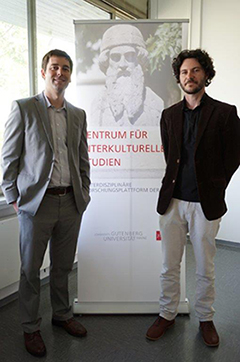
David C. Posthumus is an Assistant Professor of Anthropology and Native American Studies at the University of South Dakota. He specializes in Lakota ontology, ritual, and belief systems, blending ethnography with archival research. His work reinterprets Lakota culture through an animist framework inspired by Philippe Descola's theories. Key works include his 2018 monograph All My Relatives , examining Lakota ontology through the lens of mitákuye oyásʾį ('all my relatives'). His research focuses on the transformation of Indigenous spiritual traditions in contemporary America, particularly under post-Fordist societal pressures. He has conducted fieldwork with the Oglala Lakota and collaborates with institutions like the Red Cloud Indian School. During his 2019 visiting professorship at Johannes Gutenberg University Mainz (JGU), he explored intercultural exchanges between Lakota and European Shamanic practices, aligning with host Jun.-Prof. Mirko Uhlig's research on alternative cultural techniques. Posthumus has published widely on Lakota healing, historical relations with neighboring tribes, and environmental ontology. He also organized a workshop for JGU's Graduate School on methodological challenges in cross-cultural studies, emphasizing ethical and practical considerations in ethnographic research.