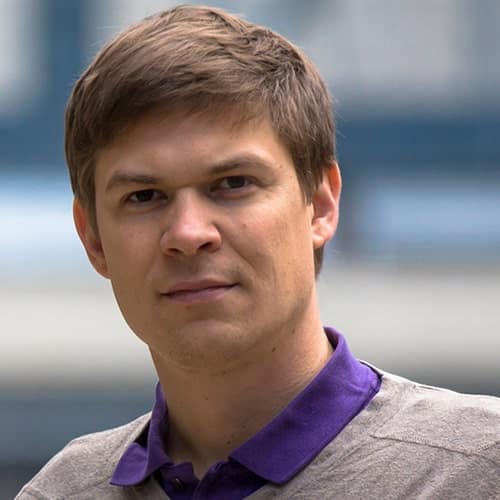
Mateja Đumić is an Assistant Professor at the School of Applied Mathematics and Informatics , Josip Juraj Strossmayer University of Osijek, Croatia. With a PhD in Computing from University of Zagreb (2020) and MSc/BSc in Mathematics from University of Osijek, she specializes in genetic programming , automated heuristic design , and combinatorial optimization problems. PhD in Computing (2020), University of Zagreb MSc in Mathematics (2014), University of Osijek BSc in Mathematics (2011), University of Osijek Her research focuses on solving container relocation problems and resource-constrained scheduling through evolutionary computation techniques. She has pioneered automated design of relocation rules using genetic programming , achieving superior performance over manual methods while exploring multi-objective optimization (including energy consumption), ensemble learning for heuristic improvement, and rollout algorithms to enhance solution quality. Recent work demonstrates how genetic programming can outperform traditional metaheuristics in maritime logistics, while her 2024 studies investigate multitask learning approaches for container relocation scenarios. She also explores fitness landscape analysis to optimize genetic programming parameters and develops automated priority rules for both static and dynamic scheduling environments. Professor Đumić teaches computer science , heuristic algorithms , database systems , and mathematical competitions at both undergraduate and graduate levels. She actively participates in international conferences including GECCO , CEC , and COST Action Training Schools .
Qiaochu Zhang serves as Assistant Professor in the Charles L. Brown Department of Electrical and Computer Engineering at the University of Virginia, joining in Summer 2024 after industry experience at NXP Semiconductors. His research spans analog/mixed-signal IC design, electronic design automation, and hardware acceleration for complex computational problems. Education: B.S. in Physics (Hons.), Fudan University (2017) Ph.D. in Electrical Engineering, University of Southern California (2024) Research focuses on four interconnected domains: Mixed-Signal VLSI Design : Advanced data converters, frequency synthesizers, and transceivers enabling high-speed wireless systems Electronic Design Automation : Machine learning-driven frameworks for automating analog circuit customization and performance optimization Mixed-Signal Computing : Hardware accelerators for neural networks and NP-hard combinatorial optimization problems Low Power Design : Energy-efficient circuit techniques for portable and embedded applications His publication trajectory (2021-2025) reveals a strategic evolution toward time-domain circuits and analog accelerators, with increasing emphasis on stochastic computing for SAT solvers and memristor-based quadratic programming. Key innovations include ultrafast metastability-resilient solvers and synthesizable TDC architectures that bridge digital precision with analog efficiency. Scientific recognition includes: USC Provost’s Fellowship (2017-2020) USC Ming Hsieh Institute Ph.D. Scholar (2021-2022) IEEE ISSCC Student Travel Grant (2023) IEEE SSCS Predoctoral Achievement Award (2022-2023) Dr. Zhang actively recruits Ph.D. students for his UVA research group, focusing on integrated circuit design and hardware acceleration. Prospective students must apply through UVA's Computer Engineering or Electrical Engineering graduate programs. His research is supported by faculty startup resources and builds on prior industry collaboration with NXP Semiconductors. The research group operates from Rice Hall 309, establishing specialized facilities for mixed-signal/RF circuit prototyping and EDA tool development. Current efforts focus on translating theoretical circuit innovations into practical computing solutions for optimization-intensive applications.
Michael Wigal is a Postdoctoral Research Associate in the Department of Mathematics at the University of Illinois Urbana-Champaign (UIUC), mentored by József Balogh. His research focuses on algorithms, combinatorics, and optimization, with particular interests in graph theory, combinatorial optimization, and discrete mathematics. He completed his Ph.D. under the guidance of Xingxing Yu. His research spans structural graph theory, approximation algorithms, and combinatorial enumeration, with contributions to topics like Tutte cycles, TSP approximations, and submodular optimization. His work often bridges theoretical and applied aspects of discrete mathematics, addressing fundamental problems in graph algorithms and combinatorial structures. Michael’s publications reflect a strong emphasis on graph theory and algorithmic approaches, with recent contributions to journal articles such as Journal of Combinatorial Theory , SIAM Journal of Discrete Math , and Mathematical Programming . His research trends highlight a focus on advancing combinatorial methods for solving complex optimization problems and analyzing graph structures. No scientific awards or major grants are explicitly mentioned in the provided text. His teaching experience includes courses such as Linear Programming (Fall 2024) and Basic Discrete Mathematics (Fall 2023).
George Osipov is a researcher at Linköping University's Department of Computer and Information Science (IDA), affiliated with the Faculty of Science and Engineering. He holds a PhD in Computer Science from Linköping University, where his thesis focused on the parameterized complexity of constraint satisfaction problems (CSPs) at the intersection of theoretical computer science and artificial intelligence. His work explores efficient algorithms for solving almost-satisfiable CSPs, emphasizing scalability and practical applications in data processing and automatic reasoning. Education: Bachelor's in Computer Science from Free University of Tbilisi, Georgia; Master's in Mathematics from Ilia State University, Georgia (with an Erasmus year in Uppsala University, Sweden). Affiliations: Member of the Wallenberg AI, Autonomous Systems and Software Program (WASP) graduate school; Postdoctoral researcher funded by the Swedish Research Council. Collaborations: Partnered with institutions in the UK (Royal Holloway, Newcastle, Leeds), Germany (Saarbrücken), and Poland (Warsaw). His research interests include parameterized complexity, constraint satisfaction problems, and algorithm design, with a focus on theoretical foundations and practical applications. He has received the prestigious 2023 Lawson Scholarship for excellence in computer science and is currently conducting postdoctoral research at Oxford University and Royal Holloway University of London. His work bridges theoretical computer science and AI, addressing challenges in scalable algorithmic solutions for complex computational problems. George's contributions have been recognized through grants and international collaborations, reflecting his commitment to advancing the frontiers of computational theory and its real-world utility.
Thomas C Hull is an Associate Professor of Applied Mathematics at Franklin & Marshall College's Department of Mathematics. Previously, he held roles including Project Associate Professor at the University of Tokyo (2015) and Associate Professor at Western New England University (2008-2023). His research focuses on origami-math intersections, particularly rigid origami's applications in robotics, materials science, and computational geometry. He has been funded by NSF grants, including one exploring origami metamaterials and configuration spaces. Education includes a Ph.D. in Mathematics from the University of Rhode Island (1997), alongside earlier degrees from the same institution and Hampshire College. Hull is the author of seminal works like Origametry: Mathematical Methods in Paper Folding (2020) and Project Origami (2012). His collaborations, such as with Inna Zakharevich proving origami's Turing completeness, have gained international attention in Quanta Magazine . Research interests span rigid origami mechanics, topological kinematics, and algorithmic folding. His NSF-funded work supports student collaborations and explores origami's potential for advanced material systems. Hull teaches courses ranging from calculus to nonlinear dynamics, emphasizing transitions between theoretical and applied mathematics. Grants include NSF awards for configuration spaces of rigid origami and mechanical metamaterials. His work bridges pure mathematics with engineering applications, demonstrating origami's role in solving complex problems from architectural design to biomedical devices.
Christian Truden is a Researcher at the Alpen-Adria-Universität Klagenfurt, affiliated with the Department of Production Management and Logistics and the Institute for Production, Energy and Environmental Management. He holds roles as Deputy Director of the Institute and Member of the Curricular Commission for Information Management (TEWI and WIWI). His work focuses on optimizing logistics, transportation systems, and emergency management through computational methods and GIS applications. Truden's research interests span operations research, vehicle routing algorithms, sustainability in transportation, and the integration of UAVs in civilian emergency services. He has contributed to solving complex problems such as emergency contact point allocation during power outages, fleet management optimization, and microtransit scheduling in rural areas. His methodologies include Bayesian modeling, heuristic decomposition, and nearest neighbor Gaussian processes for predictive analytics. His recent publications (2020–2025) emphasize practical applications like defibrillator drone deployment in mountainous regions, grocery home delivery systems, and time-window constrained vehicle routing. These studies address real-world challenges in logistics efficiency, environmental impact reduction, and accessibility improvements. Truden's work bridges theoretical optimization with operational feasibility, often leveraging geographic and computational tools. He is reachable at christian.truden@aau.at and located in room p.2.45 of the Main building's South Wing East.
Affiliations Associate Professor at Stanford University's Computer Science Department within the School of Engineering. Director of the Center for Research on Foundation Models (CRFM) and core member of Stanford HAI . Also affiliated with the Artificial Intelligence Lab, Natural Language Processing Group, and Machine Learning Group. Education Ph.D. in Computer Science, UC Berkeley (2011), advisors: Michael Jordan and Dan Klein MEng in Computer Science, MIT (2005), advisor: Michael Collins B.S. in Computer Science, MIT (2004) Research Focuses on foundational aspects of AI, including: Foundation models and their societal implications (e.g., copyright, data attribution) Building scalable and interpretable AI systems Reproducible research via CodaLab Worksheets Formal methods for ensuring correctness in ML systems Key Contributions Pioneered work in: Automated reasoning for Olympiad-style problems Data Programming framework for rapid dataset creation Executable papers and experiment reproducibility AI ethics and model interpretability Grants & Awards Presidential Early Career Award (2019) IJCAI Computers and Thought Award (2016) Microsoft Research Faculty Fellowship (2014) Multiple patents and industry collaborations Labs & Teams Leads the CRFM team developing open foundation models. Collaborates with industry (e.g., Google, Meta, OpenAI) and co-founded xAI initiatives. Active in open-source projects like sfig for presentation tools.
Sourav Medya is an Assistant Professor in the Department of Computer Science at the University of Illinois at Chicago (UIC), part of the College of Engineering. His research focuses on machine learning on graphs, explainable AI, and data science with applications in healthcare, infrastructure, and computational social science. He holds a Ph.D. in Computer Science from the University of California, Santa Barbara (UCSB), and a Master of Engineering degree from the Indian Institute of Science (IISc), Bangalore. Before UIC, he was a Research Assistant Professor at Northwestern University’s Kellogg School of Management and Northwestern Institute on Complex Systems (NICO). He has contributed to over 50 peer-reviewed publications in top conferences such as NeurIPS, ICML, ICLR, and ACL. His work has been recognized with a Best Paper Award at the Machine Learning on Graphs (MLoG) workshop in 2023. He actively serves on program committees for leading conferences including KDD, AAAI, and ICLR. His teaching includes courses on machine learning on graphs and data science. He advises a team of PhD and MS students focusing on multimodal learning, graph neural networks, and efficient AI systems.
Thomas Pock is a Professor of Computer Science at Graz University of Technology, holding the AIT Stiftungsprofessur for Mobile Computer Vision. He is affiliated with the Institute for Computer Graphics and Vision (ICG) within the Faculty of Computer Science and serves as a principal scientist at the Austrian Institute of Technology (AIT), Center for Vision, Automation & Control. He leads the Vision, Learning and Optimization (VLO) research group, which focuses on mathematical modeling and optimization in computer vision. His research interests lie at the intersection of computer vision, image processing, and mathematical optimization. Specifically, he develops mathematical models for computer vision and efficient convex and non-smooth optimization algorithms , particularly for mobile scenarios. His recent work increasingly integrates variational methods with deep learning, especially in solving inverse problems in imaging such as medical reconstruction and deblurring. The trends in his recent publications show a strong emphasis on deep learning for inverse problems , variational networks , and learned optimization . His group explores how to combine classical mathematical models with data-driven deep learning approaches to achieve stable, interpretable, and high-performance solutions in image reconstruction and processing. His scientific achievements have been recognized with several prestigious awards: START Prize, Austrian Science Fund (FWF), 2013 German Pattern Recognition Award, DAGM, 2013 ERC Starting Grant, European Research Council, 2014 Thomas Pock actively mentors students and leads a research group of 10 PhD students and 2 postdocs. He has secured significant research grants, including the ERC Starting Grant, which supports his foundational work. He is also engaged in scientific communication, giving invited talks at international venues such as SIAM and co-organizing the IMAGINE One World seminar series to foster global collaboration in imaging and inverse problems. He leads the Vision, Learning and Optimization (VLO) group at the Institute for Computer Graphics and Vision. The group develops mathematical models and efficient algorithms for computer vision and image processing, with a focus on mobile applications. The team includes multiple PhD students and postdoctoral researchers and has produced notable software and publications in top venues.
David P. Williamson is a Professor at Cornell University in the School of Operations Research and Information Engineering (ORIE), with a significant leadership role as former Chair of the Department of Information Science in the Cornell Ann S. Bowers College of Computing and Information Science from July 2021 through December 2023. His academic journey began at MIT where he earned his B.S. in Mathematics (1989), followed by an M.S. (1990) and Ph.D. (1993) in Computer & Information Science under Professor Michel X. Goemans. After completing a postdoc at Cornell under Professor Éva Tardos, he worked at IBM Research at both the T.J. Watson Research Center and Almaden Research Center before joining Cornell University in 2004. B.S. (Mathematics), Massachusetts Institute of Technology (1989) M.S. (Computer & Information Science), Massachusetts Institute of Technology (1990) Ph.D. (Computer & Information Science), Massachusetts Institute of Technology (1993) Professor Williamson's research centers on discrete optimization, specializing in approximation algorithms for NP-hard optimization problems. His work spans network design, scheduling, facility location, clustering, ranking, and particularly the traveling salesman problem. He has made seminal contributions to the field, evidenced by his co-authored paper 'Improved Approximation Algorithms for Maximum Cut and Satisfiability Problems Using Semidefinite Programming' which earned the 2022 AMS Steele Prize. His research approach emphasizes simple yet powerful approximation algorithms with provable performance guarantees, bridging theoretical computer science and operations research. Analysis of his recent publications reveals a strong focus on the traveling salesman problem, with particular attention to integrality gaps of semidefinite programming relaxations, combinatorial algorithms for solving Laplacian systems, and novel approaches to cycle cut instances. His work consistently demonstrates how theoretical insights can yield practical algorithmic improvements, with applications spanning network design, revenue management, and graph theory. Williamson has also contributed significantly to educational resources through his textbook 'Network Flow Algorithms' (2019) and 'The Design of Approximation Algorithms' (2011, with David Shmoys). American Mathematical Society Steele Prize for Seminal Contribution to Research (2022) SIAM Fellow (2016) ACM Fellow (2013) Lanchester Prize for best contribution to operations research (2013) Professor of the Year (ORIE Undergraduate Voted) (2018) ACM STOC 30-year Test of Time Award (2024) Professor Williamson has demonstrated significant academic leadership through his service as Chair of the Department of Information Science and as former Editor-in-Chief for the SIAM Journal on Discrete Mathematics. His teaching portfolio includes undergraduate courses like ENGRI 1101 (introduction to operations research) and ORIE 1380 (introduction to data science), as well as graduate courses including ORIE 6330 (network flows) and ORIE 6334 (spectral graph theory and algorithms). His research has attracted substantial funding from the National Science Foundation, including awards for projects like 'AF: Small: Looking Under Rocks: A Search for a Provably Stronger TSP Relaxation' (2019) and 'AF: EAGER: Approximation algorithms for the traveling salesman problem' (2015). While specific laboratory affiliations aren't detailed in the available information, Professor Williamson's work is deeply embedded in Cornell's theoretical computer science and operations research communities. His research collaborations span multiple institutions, with frequent co-authorship with colleagues at Cornell and beyond. His recent publications indicate active engagement with current challenges in approximation algorithms, particularly those related to the traveling salesman problem and semidefinite programming relaxations, suggesting ongoing leadership in these critical areas of theoretical computer science and operations research.
KAWAHARA Jun is an Associate Professor at the Department of Communications and Computers Engineering, Graduate School of Informatics, Kyoto University. He leads research in combinatorial algorithms and decision diagram applications. Research focuses on combinatorial reconfiguration, network reliability, and blockchain algorithm design Key technical contributions include ZDD-based enumeration frameworks His recent publications (2020-2025) span: Graph enumeration techniques using decision diagrams Reconfiguration problem algorithms Blockchain network optimizations Combinatorial optimization applications Notable awards include: 2024 Japan Society for Artificial Intelligence Best Presentation Award 2022 LA/EATCS-Japan Presentation Award 2019 Japanese Society for Computation and Statistics Award 2008 COMP-NHC Best Paper Award Current grants include multiple JSPS-funded projects in combinatorial algorithms and blockchain research. He collaborates with researchers like Shin-ichi Minato and Masaharu Kasahara on graph theory and network security applications.
Jeff Erickson is the Sohaib and Sara Abbasi Professor at the University of Illinois Urbana-Champaign's Siebel School of Computing and Data Science. He has been a faculty member since 1998, with a focus on computational geometry, topology, algorithms, and computer science education. His research includes over 100 technical papers and a popular free algorithms textbook. He has held roles like chair of the SOCG steering committee and is a SafeTOC advocate. Erickson has advised numerous PhD students, many of whom have won NSF CAREER awards. His teaching awards include the Campus Award for Excellence in Undergraduate Teaching and the Everitt Award. He has taught courses like CS 473 (Algorithms) and developed tools like FSM Builder for autograded exercises. Education: PhD in Computer Science from UC Berkeley (1996), MS from UC Irvine (1992), and B.A. from Rice University (1987). Awards include the Sloan Fellowship, NSF CAREER, and multiple UIUC teaching honors. Research interests span algorithms, geometry, topology, and education innovation.
Prof. Dr. Stefan Ruzika is a full professor (W3) in the Department of Mathematics at the Rheinland-Palatinate Technological University Kaiserslautern-Landau. He leads the Competence Center for Mathematical Modelling in MINT Projects in Schools (KOMMS) and chairs the DFG-funded Graduate School 'Mathematics of Interdisciplinary Multiobjective Optimization' (MIMO), starting in 2024. His research focuses on multi-criteria optimization, integer programming, mathematical modeling, and network optimization. He teaches courses such as 'Multicriteria Optimization' and supervises Bachelor’s and Master’s theses. Education: PhD (2007, TU Kaiserslautern), Master of Science (2002, Clemson University), Diplom in Mathematics (2003, TU Kaiserslautern). Positions include professorships at TU Kaiserslautern (2017–present) and University of Koblenz-Landau (2012–2017), and postdoctoral roles at TU Kaiserslautern (2003–2007). Research interests include optimization on networks, approximation algorithms, and decision support systems for sustainable urban planning. Projects include 'Ageing Smart' (decision support for elderly quality of life) and 'GRK 2982: MIMO' (multiobjective optimization research).
Alexander Razborov is the Andrew McLeish Distinguished Service Professor at the University of Chicago's Department of Mathematics. He holds a B.S. from Moscow State University (1985) and a PhD (1987) and Doctoral Degree (1991) from the Steklov Mathematical Institute. His research spans logic, theoretical computer science (TCS), and combinatorics, with major contributions to proof complexity, continuous combinatorics (flag algebras), and quantum computing. Notable achievements include the Nevanlinna Prize (1990), Gödel Prize (for foundational work on 'Natural Proofs'), and election to the American Academy of Arts and Sciences (2020). His work on flag algebras revolutionized extremal combinatorics, while his research on proof complexity established fundamental limits of propositional reasoning systems. Razborov's recent focus includes continuous combinatorics (studying infinite graph limits) and refining proof complexity trade-offs. His collaborative projects with Leonardo Coregliano and others explore topics like Sidorenko's conjecture and neural network convergence guarantees. He is affiliated with the university's computational theory group and actively publishes across top journals like the Annals of Mathematics and Journal of the ACM.
Ellie Pavlick is the Briger Family Distinguished Associate Professor of Computer Science and Associate Professor of Cognitive and Psychological Sciences at Brown University. She also serves as Associate Chair of the Computer Science Department and holds a visiting faculty position at Google AI. Her research focuses on Natural Language Processing (NLP), particularly computational models of semantics and pragmatics that emulate human inference mechanisms. She leads the Language Understanding and Representation (LUNAR) Lab, which explores how language works in humans and machines, emphasizing conceptual reasoning, learning, and generalization. Educated at the University of Pennsylvania (PhD in Computer and Information Science) and Johns Hopkins University (BA in Economics and Music from Peabody Conservatory), Pavlick teaches courses on computational linguistics, data science, and computational semantics. Her work bridges computer science with cognitive science, neuroscience, and philosophy, aiming to understand both human and AI language capabilities through comparative analysis. Her research has produced influential datasets like PPDB 2.0 and SimplePPDB, and she actively publishes on topics including transformer models, multilingual systems, and model evaluation. Despite no listed scientific awards, her contributions to NLP and interdisciplinary collaboration are widely recognized in academic circles.