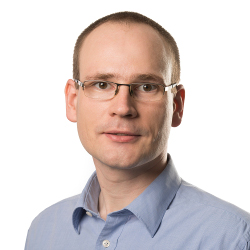
Christian Ikenmeyer is Professor in Computer Science and Mathematics at the University of Warwick. His research focuses on algebraic complexity theory, geometric complexity theory (GCT), and representation theory, with emphasis on tensor rank, Kronecker coefficients, and polynomial identity testing. Research Focus: Dr. Ikenmeyer develops mathematical frameworks to solve fundamental problems in computational complexity, including P vs NP. His work connects representation theory with algebraic geometry to establish complexity lower bounds and classify computational hardness. Leadership: He organizes workshops on algebraic complexity and GCT, including the 2023 Algebraic Complexity Theory Workshop at ICALP. His research is funded by EPSRC and DFG grants, supporting investigations into homogeneous complexity and branching programs. Teaching: Courses include 'Groups and Representations' and programming contest coaching. He has previously taught at MIT, Texas A&M, and Saarland University, developing lecture notes on GCT.
Nikhil Bansal holds the prestigious Patrick C. Fischer Professorship of Theoretical Computer Science in the Department of Computer Science & Engineering at the University of Michigan's College of Engineering. His research program has established him as a leading figure in theoretical computer science, with significant contributions to algorithm design and analysis, particularly in discrete optimization problems. Bansal's research focuses on theoretical computer science with emphasis on design and analysis of algorithms for discrete optimization problems. His work spans multiple areas including discrepancy theory, approximation algorithms, randomized algorithms, combinatorial optimization, complexity theory, machine learning theory, and probability. He has made significant contributions to understanding the limits of approximation algorithms and developing novel techniques for combinatorial optimization problems. Analysis of Bansal's recent publications reveals a strong focus on discrepancy theory, online algorithms, and combinatorial optimization. His work often bridges theoretical computer science with discrete mathematics and probability theory. A recurring theme across his publications is the development of novel algorithmic techniques for solving NP-hard problems with provable guarantees. His research has evolved from foundational work in approximation algorithms to more recent contributions in quantum computing complexity and stochastic optimization. Patrick C. Fischer Professor of Theoretical Computer Science Bansal has advised numerous PhD students including Marek Elias, Shashwat Garg, and Greg Koumoutsous, as well as mentoring several postdoctoral researchers. He has served on editorial boards for top journals including Journal of the ACM, Theory of Computing, and Stochastic Models, and has been active on program committees for major conferences such as STOC, FOCS, SODA, and ICALP, including serving as chair for ICALP 2021. Bansal has organized multiple academic workshops including the STOC 2020 Workshop on Recent Advances in Discrepancy and Applications, several SDP Days at CWI Amsterdam, and the Semester on Bridging Continuous and Discrete Optimization at UC Berkeley in Fall 2017.
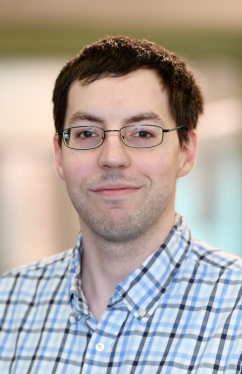
Dr. Johan van Rooij is an Assistant Professor in the Algorithms and Complexity group at Utrecht University , Faculty of Science. His work focuses on algorithm design, computational complexity, and data science applications. Specializes in exact algorithms for NP-hard graph problems Active in parameterized complexity and treewidth-based techniques Contributes to applied data science through transportation optimization and railway inspection projects Research trends show consistent contributions to: Exponential time algorithms for graph problems Treewidth and branch decomposition optimization Data science applications in public mobility Scientific Recognition: 2018: Hendrik Lorentz Prize (Dutch Data Science Prizes) 2022: Finalist for Prize for OR for the Common Good
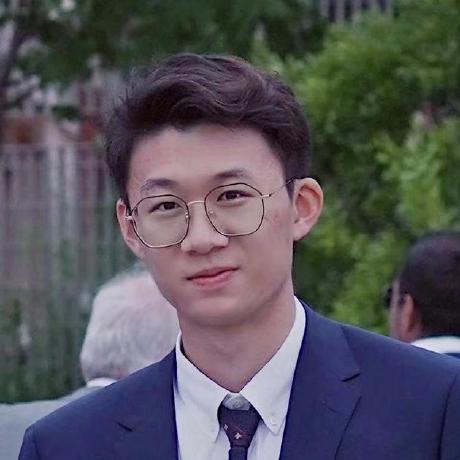
Haoyu Wang is a Researcher in the Computer and Information Science department at the University of Pennsylvania . He previously held research positions at Shanghai Jiao Tong University and interned at Google DeepMind , Amazon AWS , ByteDance , AI2 , Tencent AI Lab , and Goldman Sachs . Education : PhD in Computer and Information Science (2021–Present), MS in Computer and Information Science (2019–2021), BS in Computer Science (2015–2019). His research focuses on Event-Centric NLP/NLU , LLM Reasoning and Planning , Knowledge Graph , and Pose Estimation in Computer Vision . His work includes event causality identification, semantic classification in context, and synthetic control for temporal reasoning. He has contributed to multimodal hallucination analysis and safety in reasoning models through projects like RESIN-11 and Devil's Advocate . His publications span venues like EMNLP , EACL , and ACL . His recent articles analyze LLM limitations in NP-hard problems , clinical trial prediction , event causality , and hallucination in vision-language models . He has served as PC Member for conferences including ACL , NAACL , NeurIPS , and EMNLP since 2019.
Chris Whidden is an Assistant Professor in the Faculty of Computer Science at Dalhousie University, where he leads research in algorithms and bioinformatics. His work bridges theoretical computer science with practical applications in computational biology and ocean data analytics. Whidden's research interests include approximation and fixed-parameter algorithms, computational biology, evolutionary trees and networks, graph theory, hybridization and lateral gene transfer, NP-hardness, and ocean data analytics. He develops efficient algorithms and software to solve NP-hard problems, particularly in the context of phylogenetics and large-scale biological data. His work applies both theoretical algorithm design and practical software engineering to create novel solutions for understanding biodiversity, bacterial and viral evolution, and oceanographic systems. His recent publications reflect a strong trend toward interdisciplinary research, combining deep learning and machine learning with oceanographic data analysis, fish detection and classification, echosounder data processing, and environmental monitoring. Many of his algorithmic contributions focus on phylogenetic tree comparison, including SPR distances, maximum agreement forests, and supertree construction. He has developed several widely used software tools such as rspr, SPR Supertrees, uspr, and phylogenetic topographer. NSERC Killam Trusts Tula Foundation NSF Simons Foundation (via Life Sciences Research Foundation) DeepSense (industry-academic collaboration) He is actively involved in mentoring and has funding available for PhD and MCS students in computer science, particularly in algorithms, bioinformatics, and data analytics. He teaches courses such as Algorithm Engineering (CSCI 4118/6105), Software Development (CSCI 2134), and Design and Analysis of Algorithms (CSCI 3110). Whidden has collaborated extensively with industry through DeepSense, working on projects that apply data analytics and machine learning to the ocean sector, including predictive modeling for ocean buoys, automated fish detection, and tidal energy monitoring.
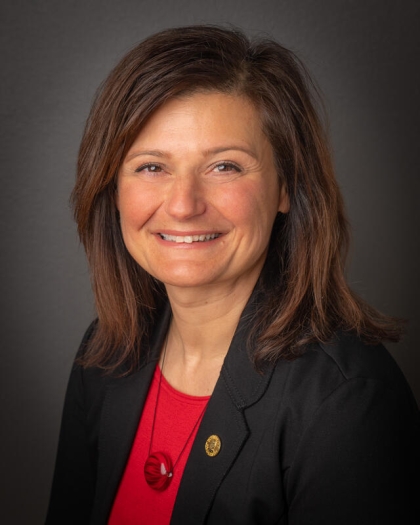
Pinar Heggernes is a Professor at the Department of Informatics at the University of Bergen , specializing in algorithms and graph theory . Her research focuses on solving NP-hard graph problems through polynomial-time and fixed parameter tractable algorithms , particularly on chordal , split , and outerplanar graphs . She served as the elected deputy rector of the University of Bergen (2021–2025) with responsibility for education and digital knowledge, and previously as head of the Department of Informatics until 2021. Her career spans leadership in externally funded projects, editorial roles in international journals, and active participation in national research policy, including co-founding the Norwegian Artificial Intelligence Research Consortium (NORA). Education: PhD in Informatics from the University of Bergen. Research Interests: Algorithms for graph classes, computational complexity, parameterized algorithms, and combinatorial optimization. Collaborations: Extensive partnerships with academia, businesses, and public administration, including advisory roles in the Bergen Chamber of Commerce and the Norwegian Cognitive Center . Grants: Project leader for four Research Council of Norway FRIPRO grants (CLASSIS, SCOPE, MIST, and earlier projects) and participant in EU, Trond Mohn Foundation, and National Security Authority grants. Students: Supervised Paloma T. Lima (PhD, 2019) and co-supervised numerous advisees through collaborative projects. Labs/Teams: Coordinated interdisciplinary ICT research and education initiatives at UiB, with international collaborations in the USA, France, and Turkey.
Siegfried Nijssen is an Assistant Professor of Data Mining and Artificial Intelligence at the Catholic University of Louvain (UCLouvain) in Belgium, working within the ICTEAM research institute's Artificial Intelligence and Algorithms group. He has been at UCLouvain since 2016, previously serving as an Assistant Professor at University Leiden (2012-2016) and completing postdoctoral work at KU Leuven (2006-2015). He earned his PhD in Computer Science from University Leiden in 2006. His research focuses on making data analysis simpler through intersections between pattern mining, exploratory data analysis, and programming paradigms in Artificial Intelligence, particularly constraint programming and probabilistic programming. He has developed techniques for analyzing diverse data types including graphs, networks, and multi-relational data. His work bridges theoretical foundations with practical applications in decision tree learning, probabilistic networks, and source code analysis. Nijssen's recent publications demonstrate a strong focus on optimal decision trees, constraint-based pattern mining, and applications in bioinformatics and education. His research shows consistent evolution from foundational graph mining work (including the Gaston algorithm developed in 2004) to current work integrating machine learning with constraint programming for interpretable AI solutions. As an educator, he teaches courses including Mining Patterns in Data, Databases, and Artificial Intelligence and Machine Learning seminars at UCLouvain. He has advised numerous PhD students and postdocs, primarily in collaboration with Pierre Schaus, with former students like Tias Guns now holding professorships.
Prof. Dr. Hanno Friedrich is an Associate Professor of Freight Transportation - Modelling and Policy at Kühne Logistics University (KLU) in Hamburg, Germany. He holds a Diplom-Wirtschaftsingenieur from the Karlsruhe Institute of Technology (KIT) and a Ph.D. in Economics from KIT (2010), focusing on logistics simulation in food retailing. Prior to academia, he worked at McKinsey & Company (2004-2010) and served as a Junior Professor at TU Darmstadt (2011). Affiliations: Kühne Logistics University, World Conference on Transport Research Society (SIG B5), European Transport Conference (Freight & Logistics Committee) Education: PhD in Economics (KIT, 2010), Diplom-Wirtschaftsingenieur (KIT, 2003), ERASMUS exchange at EM Lyon (2001-2003) Research Interests: His work focuses on freight transport demand modelling, food logistics resilience, risk management in supply chains, and intermodal transport networks. Notable projects include FoodDecide (digital food safety tools), HeGeL (German logistics hypernetworks), and SEAK (food supply chain disruptions). Recent Trends: Articles emphasize spatial analysis of organic food demand, machine learning for ETA predictions in intermodal transport, and computational methods for tracing foodborne outbreaks. Recent work explores regional food self-sufficiency and electric mobility in commercial transport. Grants/Projects: Over 15 projects funded by BMBF, BMVI, and EU, including NutriSafe (blockchain in food logistics) and SMECS (ETA forecasting for seaports). Labs/Teams: Leads research groups in food supply chain resilience, freight transport policy, and intermodal logistics innovation at KLU.
Andrea Vinci is an accomplished researcher with 66 publications and 1,261 citations, specializing in the intersection of quantum computing, edge-cloud architectures, and Internet of Things (IoT) systems. His work demonstrates significant contributions to solving complex computational problems through innovative approaches that bridge theoretical quantum algorithms with practical distributed computing applications. His research interests span quantum computing applications for resource management, multi-density clustering techniques for urban analytics, and platform-independent IoT application development. Vinci has pioneered work in variational quantum algorithms for cloud/edge resource allocation, quantum kernels for IoT data classification, and distributed AI for cognitive building systems. His research demonstrates a consistent focus on addressing NP-hard problems through quantum-classical hybrid approaches. Analysis of Vinci's publication trends reveals a strategic research trajectory moving from foundational work in smart city analytics and crime prediction toward cutting-edge quantum computing applications for IoT and edge-cloud systems. His recent publications (2023-2025) show increasing focus on quantum machine learning techniques specifically tailored for IoT data processing, with significant attention to practical implementation challenges. Vinci maintains an extensive collaborative network, frequently publishing with researchers including Fabrizio Marozzo, C. Mastroianni, J. Settino, and Antonio Guerrieri across multiple high-impact venues including IEEE Transactions, ACM conferences, and specialized journals in quantum computing and distributed systems. His technical contributions include the development of the COGITO platform for cognitive buildings, novel approaches to multi-density crime prediction, and significant advancements in quantum kernel methods for IoT data analysis. Vinci's tutorial publications indicate his role in educating the broader research community about emerging quantum computing applications for distributed systems.
Mr. Jean-Charles Billaut is a Professor at the Polytechnic School of Tours (EPU) within the University of Tours, affiliated with the Computer Science Department and the Fundamental and Applied Computer Science Laboratory of Tours (LIFAT). His primary research focuses on Operational Research, particularly in scheduling theory, production planning, and logistics optimization, with notable contributions to healthcare and food supply chain systems. He has held leadership roles, including Director of the Computer Science Laboratory since 2007 and Editor-in-Chief of the European Journal of Operational Research since 2007. His work bridges theoretical advancements and real-world applications, addressing challenges in multi-agent scheduling, robust production systems, and emergency logistics. Key collaborations include optimizing chemotherapy production and medical sample dispatching, reflecting his commitment to impactful operational research. His research often employs metaheuristics and exact methods to solve complex scheduling and routing problems, emphasizing sustainability and resilience in supply chains.
V. Arvind is a Professor in the Theoretical Computer Science faculty at the Institute of Mathematical Sciences (IMSc) , Chennai. His research is centered on computational complexity theory, with a focus on structural complexity, randomized and algebraic computation, and quantum information and computation. He explores the deep connections between theoretical computer science and mathematics. Institution: Institute of Mathematical Sciences (IMSc), Chennai School: Theoretical Computer Science Academic Rank: Professor Arvind's research interests include computational complexity, structural complexity theory, algebraic computation, derandomization, and quantum computing. He is particularly interested in the interplay between mathematical structures and computation. His work often bridges theoretical computer science with algebra, combinatorics, and logic. His recent publications, primarily expository articles in the EATCS Bulletin’s Computational Complexity Column, cover a wide range of topics such as robust oracle machines, the Alon-Roichman theorem, noncommutative arithmetic circuits, graph isomorphism, and quantum computation. These works reflect trends in foundational complexity theory, algebraic methods in computation, and the exploration of quantum models. The articles emphasize structural insights, lower bounds, and connections to mathematical disciplines. Professional Service and Editorial Roles: Associate Editor, ACM Transactions on Computation Theory Editor, EATCS Computational Complexity Column (since June 2011) Editorial Board Member, International Journal of Computer Mathematics (2009–2013) Co-organizer, ICM Satellite Conference on Algebraic and Probabilistic Aspects of Combinatorics and Computing Program Committee Member for WALCOM 2014, STACS 2012, COCOON 2009, FSTTCS (multiple years, including chair roles), CCC 2006, INDOCRYPT (2002, 2005), and others Teaching: Arvind has taught advanced courses including Computational Complexity, Algorithms, Algebra and Computation, and Discrete Mathematics, often based on foundational texts and notes from leading experts. Lecture notes from his courses have been compiled by students and collaborators. Collaborations: He has an extensive list of co-authors, including prominent researchers such as Manindra Agrawal, Eric Allender, Johannes Köbler, Meena Mahajan, Jacobo Torán, and Ramprasad Saptharishi, indicating strong collaborative research networks in complexity theory and algorithms.
Cristina G. Fernandes is an Associate Professor in the Department of Computer Science at the Institute of Mathematics and Statistics, University of São Paulo (IME-USP), where she conducts research in theoretical computer science, combinatorial optimization, and graph theory. She teaches advanced courses such as Advanced Data Structures and Topics in Algorithm Analysis. Her research interests include algorithms, combinatorial optimization, graph theory, approximation algorithms, data structures (persistent, retroactive, kinetic, succinct), and computational geometry. She applies theoretical methods to solve complex problems in network design, clustering, and discrete structures. The recent publications reflect a strong focus on structural and extremal graph theory, approximation algorithms, and combinatorial optimization. Key themes include tree and path packing, dominating sets, Steiner-type problems, and combinatorial properties of graphs. Her work often involves deep structural analysis and algorithmic design for NP-hard problems. Cristina G. Fernandes has not been mentioned with any specific scientific awards in the provided texts. She has supervised numerous postdoctoral researchers, PhD, MSc, and undergraduate students, many funded by FAPESP, CAPES, and CNPq. She leads significant research projects, including CAPES/MATH/STIC/CLIMAT-AMSU on energy efficiency in distributed computing and CNPq Universal projects on partitioning and connectivity. She is actively involved in academic advising and grant-funded research. She leads or participates in the Research Group in Theoretical Computer Science, Combinatorics and Combinatorial Optimization at IME-USP, fostering collaborative research in algorithms and discrete mathematics.
Michael Haythorpe is a Senior Lecturer at Flinders University's College of Science and Engineering, specialising in computational mathematics, graph theory, numerical optimisation, and algorithm development. He has been with the university since 2011, after completing his PhD in Mathematics at the University of South Australia in 2010. His research focuses on: Designing efficient algorithms for NP-complete problems Theoretical advances in graph theory and complexity theory Heuristic development for computational optimisation Recent research trends include domination problems in graphs, crossing number calculations for small graphs, and mixed-integer programming for fixture scheduling. His work bridges theoretical mathematics and practical algorithmic solutions. Scientific awards and grants : AustMS Lift-off Fellowship (2010) Executive Dean's Award for Teaching Excellence (2017) Defence Grant: AI4DM (2020-2022) Multiple student-nominated teaching awards (2021-2022) Early career recognitions for conference presentations (2008-2010) Teaching roles include coordination of Master of Science (Mathematics) and lecturing in Engineering Mathematics and Mathematics 1A/B courses. He prioritises conceptual understanding over procedural learning.
Malte Helmert is a Professor at the University of Basel in the Department of Mathematics and Computer Science. He previously worked at the University of Freiburg's Research Group on the Foundations of Artificial Intelligence from 2001 to 2011. His research focuses on intelligent problem-solving , particularly in automated planning , combinatorial search , constraint satisfaction , and NP-hard graph problems . Helmert has made significant contributions to classical planning, including the development of the Fast Downward planning system and its derivatives. Education : Diploma in Computer Science (M.Sc.) from the University of Freiburg (2001) Ph.D. in Computer Science from the University of Freiburg (2006) Research interests encompass the theoretical and practical aspects of automated planning, including heuristic search , optimal planning , abstraction techniques , and domain-independent planning . His work explores merge-and-shrink abstractions , landmark progression , and cost partitioning algorithms for classical planning systems. Recent publications analyze advancements in pseudo-Boolean proof logging , higher-dimensional potential heuristics , and correlation complexity in planning domains. These works often integrate mathematical modeling, algorithm design, and empirical benchmarking. Scientific awards include the AAAI Fellow (2021), EurAI Fellow (2020), multiple Best Paper Awards at ICAPS and SoCS conferences, and the Computers and Thought Award (2011). He also received the VDI-Förderpreis for his Master’s thesis. Software contributions include the Fast Downward planning system, MIPS (now maintained by Stefan Edelkamp), and COVER (a vertex cover solver). Helmert has organized tutorials at ICAPS and AAAI conferences on topics like landmark progression , abstraction heuristics , and LP-based heuristics .
Nikhil Shukla is an Associate Professor at the University of Virginia with a joint appointment in Electrical and Computer Engineering and Materials Science and Engineering. His work bridges emerging hardware technologies with computational paradigms for energy-efficient systems. Education: Ph.D. in Electrical Engineering (University of Notre Dame, 2017), BS in Electronics and Telecommunications (University of Mumbai, 2010) His research focuses on emerging solid-state devices for non-Boolean computing, energy-efficient data storage , and integration of novel materials to redefine computing architectures. Key efforts include co-designing devices, circuits, and system-level solutions for Ising machines and dynamical systems solving combinatorial optimization problems. The 15 most recent articles highlight trends in oscillator-based Ising machines for optimization, ferroelectric and phase-transition materials, and hardware acceleration for NP-hard problems like Max-Cut and MaxSAT. Topics span from device physics (e.g., hafnium oxide endurance) to circuit-level implementations (FPGA accelerators, CMOS-compatible designs). Scientific Awards: IEEE TMSCS Best Paper Award (2017), STARnet LEAST Center Best Publication Awards (2015–2017), J.N. TATA and J.R.D TATA Scholarships (2011) Shukla's work at the Computing Hardware Research Lab emphasizes cross-disciplinary approaches, leveraging synchronized oscillators and correlated materials to push beyond CMOS-era limitations.