Bret BatteyView profile
Professor
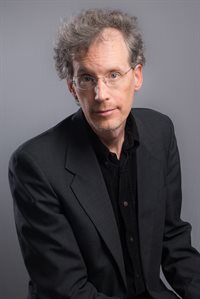
Professor Bret Battey is a Professor of Audiovisual Composition at De Montfort University, affiliated with the Faculty of Computing, Engineering and Media and the Leicester Media School. He is a core member of the Music Technology and Innovation Research Centre (MTIRC) and the Research Institute of Arts, Design and Performance (ADP). With a background spanning music composition, computer science, and digital arts, he integrates technical and artistic expertise in his work. His research interests include algorithmic music, digital signal processing, audiovisual synthesis, complex systems, feedback mechanisms, chaos theory, and the modeling of Indian classical music. He explores the expressive potential of custom-programmed algorithms to create immersive sound and image compositions. Battey's creative works, such as the Estuaries series and Mercurius , have received international acclaim, earning awards from Prix Ars Electronica, Bourges, Punto y Raya, ICMC, and others. His recent publications and installations focus on generative systems, audiovisual counterpoint, and the interplay between time, space, and perception in multimedia art. Award of Distinction: Video Music, Prix CIME 2023 Best Regional Music (Europe), ICMC 2022 MacDowell Colony Norton Stevens Fellow, 2003 U.S. Fulbright Research Fellowship to India, 2001-2002 Fellow of the Higher Education Academy He has supervised numerous postgraduate research students in areas including audiovisual composition, Indian classical music, and complex systems. He has led internally funded projects such as Haptic Control of Multistate Generative Music Systems and received research leave support. His consultancy includes mentoring for pedagogical software in Indian classical music with NESTA. He is actively involved in the academic community as a reviewer for Computer Music Journal and Organised Sound , and as a selection panel member for international competitions. Bret Battey leads and contributes to research groups including MTIRC and ADP, where he fosters interdisciplinary collaboration between music, technology, and visual arts. His work often involves custom software development, live performance systems, and installations that explore the boundaries of sensory experience and computational creativity.