Prof. Dr. Mario Ohlberger is a faculty member in the Department of Mathematics and Computer Science at the University of Münster, Germany. As a leading researcher in numerical analysis and scientific computing, he contributes to the Cluster of Excellence 2044 'Mathematics Münster: Dynamics – Geometry – Structure' and the Mathematical Research Data Initiative (MaRDI). His work integrates machine learning with classical numerical methods. University: University of Münster Research Focus: Numerical analysis for PDEs, model reduction, machine learning, multiscale methods Key Projects: EXC 2044 (subprojects C2 and C4), MaRDI His recent publications emphasize adaptive reduced basis methods, multi-fidelity learning, and surrogate modeling for parameterized PDEs, with applications in oil recovery and reactive transport. He has supervised numerous theses and taught courses on numerical analysis, scientific computing, and model reduction. Scientific awards include the Eliteförderprogramm für Postdoktoranden (2002), Ferdinand-von-Lindemann-Preis (2001), and a 1994 teaching award. Current teaching includes lectures on differential equations and seminars on advanced numerical methods.
Dr. Carlos Moyses Graca Araujo is a researcher at Uppsala University's Department of Physics and Astronomy , specializing in Materials Theory . With expertise in condensed matter physics , his work focuses on renewable energy science , particularly battery materials and photo-electro-catalysis . Education : PhD in Condensed Matter Physics (Uppsala University), Postdoc (KTH Royal Institute of Technology, Yale University) His research employs density functional theory , molecular dynamics , and Monte Carlo simulations to investigate energy conversion and storage mechanisms. He has received prestigious awards including the Benzelius Prize , Ångström Premium , and Bjurzon’s Premium for his contributions to materials science. Dr. Araujo's recent publications highlight advancements in aqueous zinc-ion batteries , Li-metal anodes , and polymer solar cells , with a focus on computational materials design and electrocatalyst optimization . His work spans collaborations with institutions like Stanford and Lawrence Berkeley National Laboratory .
Dr. Urs Aeberhard is a Lecturer at the Department of Information Technology and Electrical Engineering at ETH Zurich and a Senior R&D Scientist at Fluxim AG . He earned his Master and PhD in Theoretical Physics from ETH Zurich in 2004 and 2008 respectively, with thesis work on quantum-kinetic theory of quantum well solar cells conducted at the Condensed Matter Theory Group at Paul Scherrer Institut and ETH Zurich . He previously held a postdoctoral researcher position at the Institute of Photovoltaics , Forschungszentrum Jülich from 2009-2012 and was a visiting research scholar at the National Renewable Energy Lab in 2013 . From 2013-2018 , he worked as a tenured staff scientist at IEK-5 Photovoltaik , Forschungszentrum Jülich , where he founded and led the Multiscale Simulation research group. His research focuses on quantum transport formalisms (particularly NEGF ) for photovoltaic device simulation , including charge carrier generation , recombination in nanostructures , and advanced solar cell concepts such as hot-carrier cells , multi-junction architectures , and photon recycling . He has contributed extensively to multiscale modeling of quantum well , wire , and dot solar cells , and his work spans quantum kinetic theory , optoelectronic device simulation , and computational investigation of defect-mediated recombination and non-equilibrium processes in semiconductor nanostructures . His recent publications emphasize hot-carrier filtering in InAs-InP nanowires , terawatt-scale photovoltaic optics , reverse-bias breakdown in all-perovskite tandem modules , and photon recycling effects in ultra-thin and perovskite-based solar cells. He has presented extensively at international conferences on topics including quantum transport with light-matter interaction , multi-scale simulation of non-idealities in tandem photovoltaics , and computational characterization of passivated contacts in silicon solar cells . Dr. Aeberhard is the developer of PVnegf , a tool for non-equilibrium Green's function simulation of quantum photovoltaic devices , which provides first-principles analysis of electronic structure , photocarrier transport , and optical processes in nanoscale solar cells . The framework enables microscopic simulation of quantum wells , wires , and dots for advanced photovoltaic applications .
Dr. Sebastian Brandstäter serves as Lecturer at the Institute for Mathematics and Computer-Based Simulation, Bundeswehr University Munich since 2022. His academic trajectory includes research associate positions at Hamburg University of Technology (2021) and Technical University of Munich (2016-2021). His research focuses on: Scientific Machine Learning for biomechanical systems Uncertainty Quantification and Bayesian Inference Global Sensitivity Analysis of complex models Multi-Physics & Multi-Scale Modeling of biological tissues Open-source scientific software development Dr. Brandstäter's work centers on gastrointestinal biomechanics, particularly computational modeling of gastric electromechanics and motility. He has pioneered applications of Gaussian-process metamodelling for sensitivity analysis in vascular and gastric systems, and develops open-source frameworks (QUEENS, 4C) that enable efficient multi-query analysis of large-scale models. He actively supervises student theses on patient-specific modeling and computational biomechanics, teaches advanced numerical methods courses, and contributes to the scientific community through conference organization, peer review, and international collaborations. His recent work demonstrates increasing emphasis on data-driven surrogate modeling and solver-independent computational frameworks for biomedical applications.
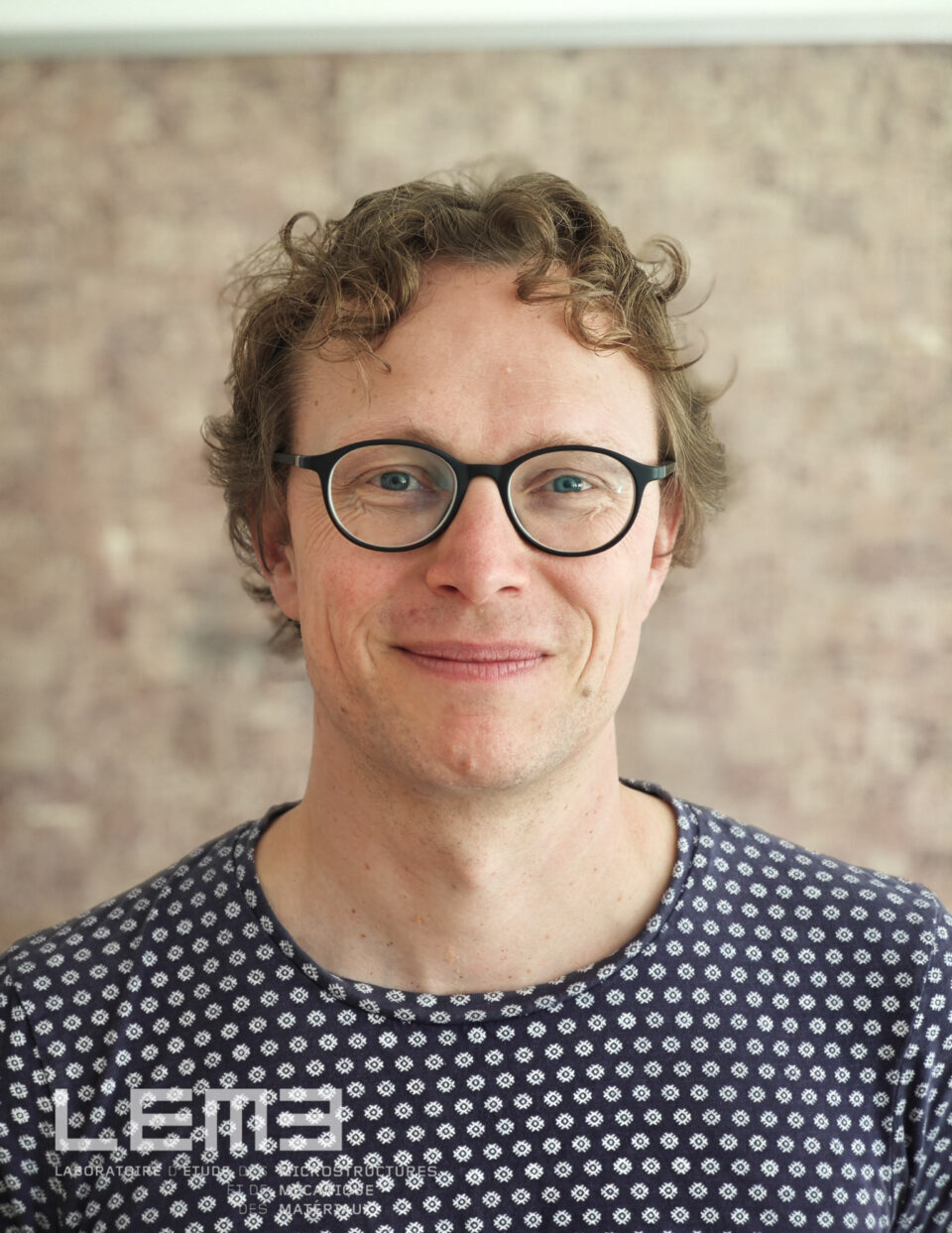
Julien Guenole is a CNRS Research Scientist (Chargé de recherche) at the LEM3 Laboratory (UMR CNRS 7239) in Metz, France, which is a joint research unit of the University of Lorraine, the National Centre for Scientific Research (CNRS), and Arts et Métiers ParisTech. He joined CNRS on January 1, 2020, after previously working at RWTH Aachen's Institute for Physical Metallurgy and Materials Physics (IMM). Guenole serves as Associate editor of Philosophical Magazine and was a Member of CoNRS (section 9) for 2024-2025. He is also Co-leader of Experimental and simulation challenges for the European COST MecaNano network. His research focuses on the plasticity of crystalline materials, complex crystals and their interfaces, multi-scale approaches, numerical nanomechanics, ion irradiation and induced defects . Guenole employs advanced computational methods including molecular dynamics, molecular statics, NEB calculations, and FFT-based approaches to bridge atomic-scale phenomena with continuum mechanics. Recent work includes developing generative machine learning approaches for microstructure design and predicting grain boundary segregation in magnesium alloys. His publication record shows consistent output in high-impact journals including Mechanics Research Communications, Communications Materials, Journal of Magnesium and Alloys, and Acta Materialia. His work frequently combines computational approaches with experimental validation, as seen in studies on metallic nanosponges and magnesium alloy plasticity. Associate editor of Philosophical Magazine Co-leader of Experimental and simulation challenges for European COST MecaNano network Member of CoNRS (section 9, 2024-2025) Supported by cluster IA ENACT (ANR - France 2030 funded project) As a supervisor, Guenole currently advises PhD student Badr LACHKAR on 'Generative Machine Learning for Microstructure Design: An Atomic-Scale-Informed Approach to Interfacial Engineering'. His lab provides opportunities for students to work at the cutting edge of computational materials science, with access to high-performance computing resources and connections to international research networks.
Bill Tumas serves as Associate Lab Director for Materials/Chem Science & Technology at the National Renewable Energy Laboratory (NREL), where he provides overall leadership, management, technical direction, and workforce development for materials, chemical, and computational science capabilities. With over 30 years of experience in national laboratories and industry, Dr. Tumas joined NREL in December 2009 as director of the Chemical and Materials Science Center after spending 17 years at Los Alamos National Laboratory. Dr. Tumas earned his Bachelor's degree in Chemistry from Ithaca College and his PhD in Chemistry from Stanford University. His educational background in chemistry forms the foundation for his extensive work in renewable energy research and development. His research interests span a broad spectrum of renewable energy technologies, with particular focus on photovoltaics and solar energy conversion, electrochemistry, hydrogen production, materials discovery, and energy storage. Dr. Tumas oversees NREL's solar, hydrogen and fuel cells, basic energy sciences, advanced computing, and ARPA-E programs, driving innovation across multiple energy technology domains. Analysis of his 24 research publications from 2001-2024 reveals a consistent focus on advancing materials science for renewable energy applications, with recent work emphasizing photovoltaics scaling, carbon cycle management, renewable hydrogen, and high-throughput materials discovery. His publications appear in high-impact journals including Nature Reviews Chemistry, Science, and Nature Materials, demonstrating the significance of his contributions to the field. Fellow of the American Association for the Advancement of Science Leader of two Energy Frontier Research Centers: Center for Next Generation of Materials Design and Center for Inverse Design Significant research impact with multiple highly cited publications As NREL's laboratory point of contact for the Office of Science's Basic Energy Sciences program, Dr. Tumas manages critical sponsor relationships and program execution. His leadership extends to creating numerous multi-institution and international collaborations that advance renewable energy research globally. Dr. Tumas's work bridges fundamental science with practical applications, addressing some of the most pressing energy challenges of our time. He leads the Materials, Chemical, and Computational Science division at NREL, which serves as a hub for innovative research in renewable energy materials and technologies. Under his direction, the division pursues cutting-edge research that spans from basic science to applied technology development, creating pathways for commercial implementation of advanced energy solutions.
Dr. Paco Lopez Dekker is an Associate Professor at Delft University of Technology's Department of Geoscience and Remote Sensing and Group Leader at the German Aerospace Center (DLR) Microwaves and Radar Institute. His research focuses on advanced radar remote sensing , particularly Synthetic Aperture Radar (SAR) systems for Earth observation. Key areas include: Bistatic/multistatic SAR configurations Ocean surface current and wave dynamics Land ice deformation monitoring Satellite mission design (e.g., ESA's Harmony mission) Radar signal processing innovations He leads the Satellite Radar Lab at TU Delft, developing cutting-edge techniques like super-resolution PSI and multi-satellite interferometry. His recent publications (2023-2025) emphasize: CubeSat-based radar altimetry systems Physics-guided ML for agricultural remote sensing Cryosphere applications of bistatic SAR Harmony mission performance analysis Ocean topography retrieval methods With 275+ publications and ongoing leadership in ESA missions, Dr. Dekker significantly advances satellite remote sensing capabilities for geoscience applications.