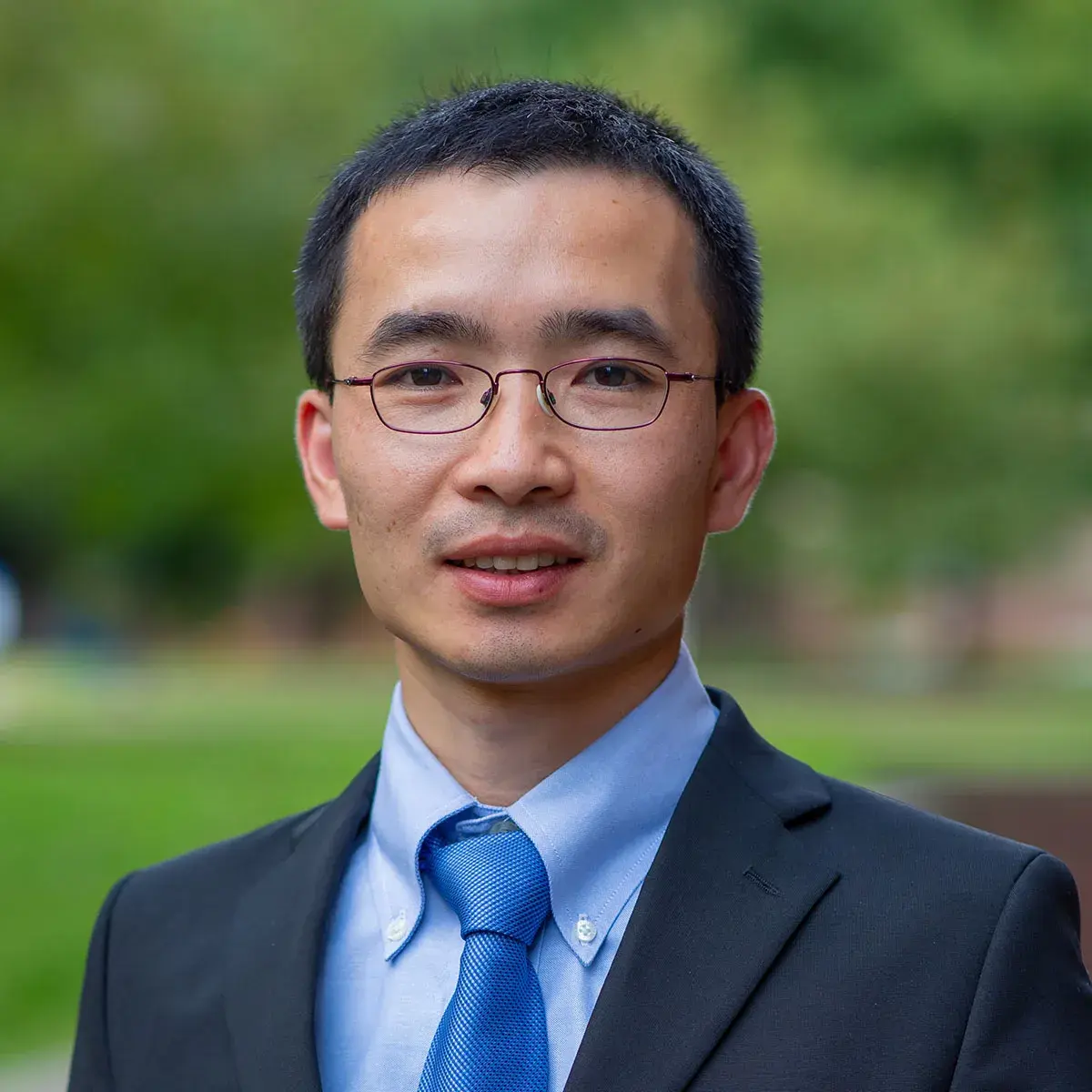
Dr. Xinyu Huang researches mechanics and durability of functional composites in energy systems at University of South Carolina. Work focuses on PEM/SOFC materials, structural composites, and coatings using experimental and modeling approaches.
Prof Nikolaos Nikiforakis is a Professor at the University of Cambridge, leading the Laboratory for Scientific Computing at the Cavendish Laboratory. He holds roles including Director for Academic Programmes of the Centre for Scientific Computing, Course Director of the MPhil in Scientific Computing, and Deputy Director of the EPSRC Centre for Doctoral Training in Computational Methods for Materials Science. He is also a Fellow and Director of Studies in Mathematics at Selwyn College, Cambridge. He directs The Gianna Angelopoulos Programme for Science Technology and Innovation. He holds a BSc in Aeronautical Engineering from the University of Manchester, followed by an MSc in Aerospace Propulsion and a PhD in 'Evolution of Detonation Waves' from Cranfield Institute of Technology. His postdoctoral research at the University of Cambridge’s Department of Chemistry focused on computational models for stratospheric ozone depletion. He later founded the Laboratory of Computational Dynamics at the Department of Applied Mathematics and Theoretical Physics before joining the Cavendish Laboratory in 2008. His research focuses on numerical algorithms and High Performance Computing for multi-physics simulations involving complex systems of nonlinear PDEs. Applications span detonation dynamics, plasma physics, and materials science, with industry collaborations for software development. His work addresses multi-scale, multi-physics problems previously deemed intractable, with practical applications in aerospace, energy, and environmental fields. He leads academic programmes in scientific computing and supervises doctoral research through the EPSRC CDT. His contributions bridge fundamental science and industrial innovation, emphasizing computational methods for materials and fluid dynamics.
Federico Silvestro is a Full Professor at the University of Genoa , affiliated with the Naval, Electrical, Electronic and Telecommunications Engineering Department . His academic roles include being a Course Coordinator, Department Council Member, and Deputy Director of DITEN. His research focuses on Power systems stability and control Cybersecurity in energy networks Electric propulsion for marine applications Optimal energy storage and microgrid design Integration of renewable energy in maritime contexts Recent publications highlight trends in data-driven power system analysis , DC microgrid modeling , cybersecurity for virtual power plants , and advanced energy management strategies for maritime and port systems. Email: federico.silvestro@unige.it He leads the ENET-RT Lab , focusing on real-time power systems simulation and co-simulation platforms for marine and grid applications.
Prof. C. Armando Duarte is the Nathan M. Newmark Distinguished Professor in Civil and Environmental Engineering at the University of Illinois at Urbana-Champaign (UIUC). He holds affiliations with the Computational Science and Engineering Program and the National Center for Supercomputing Applications (NCSA). His research focuses on computational mechanics, particularly the Generalized Finite Element Method (GFEM/XFEM), multiscale modeling, fracture mechanics, and hydraulic fracturing. He has authored/co-authored over 100 publications and co-edited books on computational methods. Education: Ph.D. (1996) and M.Sc. (1991) in Engineering Mechanics from the University of Texas at Austin and Federal University of Santa Catarina, respectively, and a B.Sc. in Mechanical Engineering from the Federal University of Pernambuco. Professional Roles: Professor at UIUC since 2015, previously at the University of Alberta and visiting roles at institutions in Brazil, Portugal, and the Netherlands. He serves on editorial boards of computational mechanics journals and chairs committees for professional societies like USACM and ASCE. Research Interests: Multiscale problems, computational fracture mechanics, meshfree methods, and multiphysics simulations. His work emphasizes 3D fracture analysis, hydraulic fracturing, and thermal gradient modeling. Awards: Recognitions include the Nathan Newmark Professorship, USACM Fellowship, and multiple best paper awards. His work has been cited over 9,000 times, with papers featured in top journals like Computer Methods in Applied Mechanics and Engineering . Teaching: Renowned for excellence in courses like Finite Element Methods, Structural Analysis, and Computational Plates and Shells. His teaching accolades span over two decades at UIUC.
Jens von Wolfersdorf is a Professor at the University of Stuttgart's Faculty of Engineering, Department of Mechanical Engineering. His research focuses on advanced thermal management systems for high-speed aerospace applications, particularly in the areas of heat transfer, fluid dynamics, and combustion. He specializes in experimental and numerical methods for analyzing complex flows in rotating and stationary cooling channels, transpiration cooling for rocket engines, and turbulence modeling. His work integrates cutting-edge techniques such as thermochromic liquid crystal (TLC) measurements, particle image velocimetry (PIV), and computational fluid dynamics (CFD) to validate novel cooling configurations. Key projects include the COOREFLEX-Turbo initiative and contributions to the European ATLLAS-II program for high-speed vehicle materials. Recent studies emphasize rotational heat transfer effects in two-pass cooling channels, additive manufacturing of ribbed cooling structures, and validation of coupled FEM-CFD frameworks. His research addresses challenges in aerospace thermal protection, turbine blade cooling, and scramjet combustor efficiency. Publications span over 15 years, with a focus on transient heat transfer, flow visualization, and material characterization for transpiration-cooled systems. Collaborations involve experimental facilities for high-speed flows and advanced thermal measurement systems.
Kevin Clarno is a tenured Associate Professor in the Department of Nuclear and Radiation Engineering at the University of Texas at Austin, holding the Charlotte Maer Patton Centennial Fellowship in Engineering. His research focuses on computational nuclear energy, multiphysics reactor simulation, and high-performance computing (HPC). Previously, he spent 15 years at Oak Ridge National Laboratory (ORNL), where he led major initiatives such as the Consortium for Advanced Simulation of Light Water Reactors (CASL) and contributed to the development of software tools like SCALE, CTF, and VERA. Education and Career: Assistant Professor at University of Tennessee-Knoxville (2010–2016) Senior Research Scientist at ORNL (2006–2021) Research Interests: Multiphysics coupling methods for reactor simulation Multiscale neutronics and thermal-hydraulics modeling Advanced reactor design (e.g., molten salt reactors) HPC-driven software integration for nuclear analysis Uncertainty quantification in coupled simulations Grants and Projects: Lead of CASL’s Physics Integration Focus Area Development of the Advanced Multi-Physics (AMP) fuel code ORNL-led strategic research projects in reactor simulation Labs and Tools: VERA: Virtual Environment for Reactor Applications CTF: Thermal-hydraulic solver for PWR analysis MPACT: Neutronics simulation tool within SCALE
Hailong Chen is an Associate Professor in the Department of Mechanical and Aerospace Engineering within the Stanley and Karen Pigman College of Engineering at the University of Kentucky. His academic journey includes a Ph.D. in Mechanical Engineering from Arizona State University (2015) and an M.S. in Mechanical Engineering from the University of Florida (2012). Dr. Chen's research focuses on Computational Mechanics & Materials, with expertise spanning meshfree methods, multi-scale multi-physics modeling, mechanics of stochastic heterogeneous microstructures, and pervasive fracture and impact modeling. His work bridges theoretical developments with practical engineering applications through the CM 3 (Computational Mechanics and Methods) research group, which develops advanced computational techniques for real-world mechanics problems. The CM 3 group specializes in multi-scale multi-physics modeling of solid materials, damage and failure analysis under extreme conditions, mechanics of stochastic heterogeneous microstructures (composites, polycrystals), and computational materials engineering. Recent publications demonstrate strong activity in peridynamics, lattice particle methods, and computational homogenization techniques for fibrous and porous materials. Dr. Chen's research has resulted in numerous publications in top journals including Computer Methods in Applied Mechanics and Engineering and Mechanics Research Communications, with recent work focusing on generalized peridynamic formulations, micro-CT-based property computation, and fluid-structure interaction frameworks for hypersonic applications. His academic progression shows steady advancement from Postdoctoral Computational Scientist at Idaho National Laboratory (2015-2018) to Assistant Professor (2018-2024) and currently Associate Professor (2024-present) at the University of Kentucky.
Robrecht Abts is a researcher at KU Leuven’s Manufacturing Processes and Systems (MaPS) group, affiliated with the De Nayer Campus. His work bridges electromechanics, materials science, and advanced manufacturing techniques. His research focuses on structure, behavior, and sustainability of materials , with particular emphasis on thermal analysis in additive manufacturing processes like fused filament fabrication (FFF). This includes leveraging deep learning for real-time thermal data interpretation and optimizing electrical discharge machining (EDM) through adaptive pulse classification. Recent publications highlight his expertise in Threshold-free machine learning pipelines Thermal modeling in 3D printing COMSOL simulations for manufacturing processes
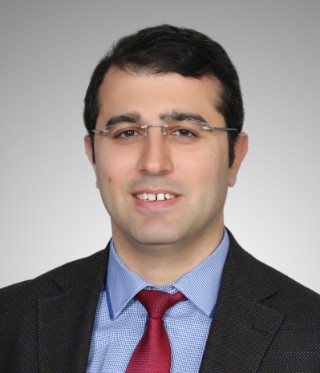
Hüsnü Dal is a Professor at Middle East Technical University (METU) in Ankara, Turkey, specializing in computational mechanics of materials. His research bridges engineering and biomedical applications through advanced computational modeling techniques. Education: Bachelor's Degree, Middle East Technical University, 2001 Master's Degree, University of Stuttgart, 2005 PhD, Dresden University of Technology, 2011 Research Focus: Prof. Dal's work centers on computational micromechanics, multiscale and multifield problems, and materials theory. He investigates fracture in multiphysics media with applications in lithium-ion batteries and tissue mechanics, developing novel constitutive models for complex material behaviors under extreme conditions. His research integrates thermomechanical coupling, viscoplasticity, and data-driven approaches to solve engineering challenges in both synthetic polymers and biological systems. Publication Trends: Recent publications (2023-2025) reveal a dominant focus on data-driven constitutive modeling and phase-field fracture methods. His work spans rubber mechanics, polymeric foams, biological tissues, and battery materials, characterized by strong interdisciplinary connections between materials science, biomechanics, and computational engineering. Key themes include anisotropic hyperelasticity, thermo-viscoplastic fracture, and spatial property variations in additively manufactured materials.
Gregory J. Wagner is an Associate Professor of Mechanical Engineering and Director of Graduate Studies at Northwestern University's McCormick School of Engineering. His research focuses on developing computational methods for multi-scale and multi-physics problems in additive manufacturing, fluid dynamics, and heat transfer. He leads the Wagner Research Group, which specializes in high-performance computing tools for complex engineering simulations. Education includes a Ph.D., M.S., and B.S. in Mechanical Engineering from Northwestern University and Boston University. His work integrates machine learning with traditional computational methods to model material behavior, microstructure evolution, and process-structure-property relationships in advanced manufacturing. Notable contributions include the GO-MELT framework for thermal simulations and the C-HiDeNN neural network approach for large-scale systems. Research interests span additive manufacturing process modeling, multiphysics coupling, and data-driven approaches for material design. Awards include the Bette and Neison Harris Chair in Teaching Excellence. Publications emphasize thermal modeling, phase change phenomena, and computational fluid dynamics innovations. His lab's work bridges mesoscopic and multiscale modeling, with applications in energy systems, biomedical devices, and environmental engineering. Collaborations focus on experimental validation and industrial-scale simulation challenges.
John Dolbow is a Professor in the Thomas Lord Department of Mechanical Engineering and Materials Science at Duke University, with secondary appointments in Civil and Environmental Engineering and Mathematics. He is a Bass Fellow and holds leadership roles as Associate Vice President for Research & Innovation since 2024. Education: B.S.M.E. (University of New Hampshire, 1995), M.S. (Northwestern, 1998), Ph.D. (Northwestern, 1999) Research Focus: Computational fracture mechanics, phase-field modeling, hydrogels, and multiphysics problems in geomechanics and biomedical engineering His recent work advances phase-field methods for fracture nucleation, hydraulic fracturing in geothermal systems, and laser lithotripsy simulations. Dolbow leads Duke's Computational Mechanics Laboratory, integrating civil, mechanical, and materials science approaches. Key contributions include: Erratum corrections for computational mechanics frameworks Nitsche-stabilized methods for interface constraints Phase-field models for surfactant-driven particle raft fracture Multi-resolution approaches for hydraulic fracture simulation Embedded FEM techniques for moving boundary problems Scientific Recognition: R. H. Gallagher Young Investigator Award (2005) Robert J. Melosh Medal for Finite Element Analysis (1999) DOE Computational Science Graduate Fellowship (1997) DOE CSGF Steering Committee Chair
Jonathan Freund is Professor of Mechanical Science and Engineering and Aerospace Engineering at the University of Illinois at Urbana-Champaign, holding the Donald Biggar Willett Professorship since 2016. He serves as Head of Aerospace Engineering (2020-present) and is Co-Director of the Center for Exascale-enabled Scramjet Design (CEESD). His academic journey began with all three degrees in Mechanical Engineering from Stanford University (B.S. 1991, M.S. 1992, Ph.D. 1998), followed by faculty positions at UCLA (1997-2001) before joining UIUC. Freund's research spans fluid mechanics with applications in biomedical systems, aeroacoustics, and materials science. His work focuses on computational modeling of cellular blood flow, jet noise control, plasma-coupled combustion, uncertainty quantification, and nanoscale material processing. He develops advanced simulation tools to investigate phenomena ranging from atomically thin liquid films to spacecraft propulsion systems. His laboratory leverages high-performance computing to solve complex multiphysics problems requiring exascale capabilities. Analysis of his recent publications reveals a strong emphasis on computational fluid dynamics applied to biological systems (35%), aeroacoustics and jet noise (25%), materials processing at nanoscale (20%), and uncertainty quantification methods (20%). His work consistently bridges fundamental fluid mechanics with practical engineering applications, particularly in medical technologies and advanced propulsion systems. Donald Biggar Willett Professor (2016-present) Kritzer Faculty Scholar (2011-2016) Fellow of the American Physical Society (2011) Campus Excellence in Faculty Mentoring Award (2017) APS DFD Gallery of Fluid Motion Winner (2000) Associate Fellow of AIAA (2012) Freund has advised numerous graduate students and received multiple teaching honors including the Engineering Council Award for Excellence in Advising (2008, 2012) and repeated recognition on the List of Excellent Teachers. His research has been supported by agencies including the Department of Energy's National Nuclear Security Administration. He leads the CEESD center which develops physics-faithful predictive simulations for scramjet design using advanced high-temperature composite materials.
Annick Hubin is a Professor in the Department of Sustainable Materials Engineering at the Faculty of Engineering, Vrije Universiteit Brussel. She serves in additional leadership roles including R&D Central management and as Head of a Research Group. Her work focuses on electrochemical processes with applications in materials engineering, corrosion science, and sustainable technologies. Her research interests span electrochemical kinetics, thermodynamics of aqueous solutions, electrode processes, electroreduction of metals and alloys (plating, extraction, refining, recycling), and environmental electrochemistry. She specializes in investigating basic electrochemical reactions using techniques such as potentiometric titrations, voltammetry, chronoamperometry, chronopotentiometry, and impedance measurements. Her work also examines mass transport in electrochemical processes and the action of organic inhibitors for metal deposition or dissolution reactions. Her recent publications reveal a strong focus on corrosion science, battery technologies, and electrochemical materials. There is a clear trend toward applying advanced characterization techniques and machine learning to solve complex problems in electrochemistry and materials science. Her research increasingly addresses sustainability challenges, particularly in battery technology and low-carbon solutions. Professor Hubin actively supervises doctoral students and participates in numerous research projects, demonstrating her commitment to mentoring the next generation of scientists and engineers. She has secured substantial research funding for projects spanning fundamental and applied research in materials engineering. She leads or participates in several significant research initiatives including DESTINY (Low-carbon solutions network), fundamental research on sulfide-based all-solid-state batteries, and projects focused on atmospheric corrosion prediction using machine learning. Her laboratory appears to specialize in electrochemical characterization and materials development for energy applications.
Steven LE CORRE is a University Professor at the Department of Thermal Energy Mechanics within the Nantes Thermal and Energy Laboratory (UMR_C 6607) at the University of Nantes . His work focuses on mechanical modeling and simulation, with applications spanning composites, complex fluids, and biomedical engineering. Current PhD Students: Sana Koubaa (Thermoplastic pultrusion), Violette Brulliard (Intervertebral disc modeling) Defended Theses: Arthur Levy (Ultrasonic welding of composites), Céline Dubois (X-FEM in automobile crashes), Jelmer Jongsma (Polymer adhesive structures), Guillaume Rückert (A-TIG welding fluxes), Yosra Guétari (Cutting simulation via X-FEM) Research interests include fibrous media modeling , multiphysical simulation , and applications to composite manufacturing processes , short-fiber-reinforced fluids , and hydrogel/tissue engineering . His work integrates computational mechanics with industrial and biomedical challenges. Professor LE CORRE is based at POLYTECH NANTES campus ( La Chantrerie, rue Christian Pauc ), with office R126 in the Isitem Building. His research is conducted in collaboration with the Nantes Thermal and Energy Laboratory, a CNRS-affiliated research unit.
Travis W. Knight is Professor and Chair of Mechanical Engineering at the University of South Carolina's Molinaroli College of Engineering and Computing, where he also serves as Program Director for the Nuclear Engineering Graduate Program. His research focuses on advanced nuclear technologies including fuel development, reactor design, and spent fuel management. Education: Ph.D. Nuclear Engineering Science, University of Florida (2000) M.S. Nuclear Engineering Science, University of Florida (1995) B.S. Nuclear Engineering, University of Florida (1994) Dr. Knight's research interests span nuclear fuel development, reactor design innovations, and nuclear waste solutions. His work integrates computational modeling with experimental validation to advance nuclear energy applications in power generation, space propulsion, and defense systems. His publications demonstrate a consistent focus on nuclear fuel behavior, reactor safety, and waste management, with recent emphasis on experimental methods for fuel characterization and microreactor technologies. Major Awards: Fellow of the American Nuclear Society (2024) Breakthrough Leadership in Research Award (2020) Research Achievement Award (2018) Dr. Knight has supervised numerous doctoral and master's students in nuclear engineering, maintaining active research groups focused on fuel development and reactor safety. His lab facilities include capabilities for nuclear material synthesis, characterization, and computational modeling.