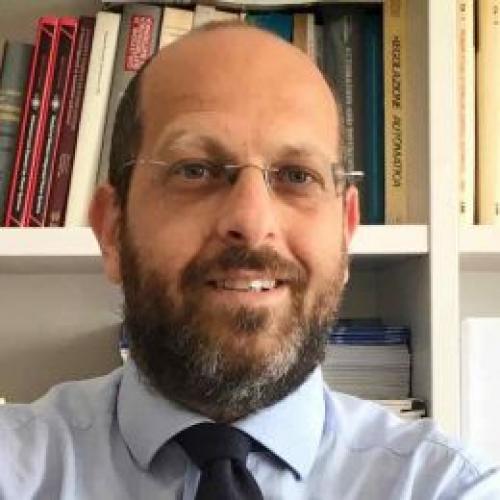
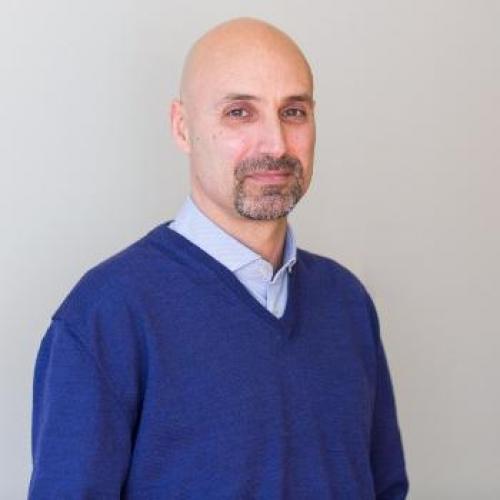
Federico Silvestro is a Full Professor at the University of Genoa , affiliated with the Naval, Electrical, Electronic and Telecommunications Engineering Department . His academic roles include being a Course Coordinator, Department Council Member, and Deputy Director of DITEN. His research focuses on Power systems stability and control Cybersecurity in energy networks Electric propulsion for marine applications Optimal energy storage and microgrid design Integration of renewable energy in maritime contexts Recent publications highlight trends in data-driven power system analysis , DC microgrid modeling , cybersecurity for virtual power plants , and advanced energy management strategies for maritime and port systems. Email: federico.silvestro@unige.it He leads the ENET-RT Lab , focusing on real-time power systems simulation and co-simulation platforms for marine and grid applications.
Dario De Marinis is an Assistant Professor at the Department of Mechanics, Mathematics & Management, Politecnico di Bari, Italy. His research focuses on fluid dynamics with applications in biomedical engineering, aerospace, and computational physics. Research Interests Fluid-structure interaction modeling Microfluidics and particle transport Biomedical applications (blood flow, valve mechanics) Aerospace engineering (hypersonic flows, turbulence) Numerical methods (Lattice Boltzmann, immersed boundary) Publications Trend Dario's recent work (2015–2025) spans computational fluid dynamics, with emphasis on multiphase flows, viscoelastic material behavior, and biomedical microfluidic devices. He has contributed to aerospace applications and turbulent thermal flows.
Luca Pavarino is a Professor at the Department of Mathematics, University of Pavia. His research focuses on scientific computing and numerical methods, particularly in the context of cardiac electrophysiology and multiphysics systems. He leads the Scientific Computing group, specializing in domain decomposition methods (BDDC/FETI-DP), isogeometric analysis, and parallel algorithms. His work integrates advanced numerical techniques with biomedical applications, including cardiac electromechanical coupling, drug testing on cardiac tissues, and modeling genetic cardiac disorders like LQT8 syndrome. Key contributions include scalable solvers for nonlinear systems, preconditioners for heterogeneous media, and operator learning for ionic dynamics. Research interests span computational cardiology, numerical analysis, and parallel computing, with applications to biophysics and drug discovery. His projects often involve interdisciplinary collaborations between mathematics, engineering, and medicine. Notable contributions include: Development of BDDC/FETI-DP preconditioners for cardiac models Integration of machine learning with cardiac electrophysiology High-performance computing for multiphysics systems (Biot’s consolidation, protein stability) Labs/Teams: Scientific Computing Group at the University of Pavia’s Department of Mathematics.
Renzo Arina is a Tenured Associate Professor at the Department of Mechanical and Aerospace Engineering (DIMEAS) at the Polytechnic University of Turin . His academic career spans decades of contributions to Aeroacoustics and Computational Fluid Dynamics (CFD) . Research Interests : Numerical simulation of flow-induced noise Drag reduction techniques for vehicle optimization Computational methods for aeroacoustic modeling Boundary layer dynamics and separation control Research Projects : Erasmus Mundus Master in Aeroacoustics (2024–2025): Member of research group Aerodynamic Optimization of Vehicles (2016): Scientific Director for industrial efficiency Detailed Numerical Modeling of Airborne Sound Field (2013–2016): EU-funded research Discontinuous Galerkin Method for Aeroacoustics (2010–2012): National PRIN project Advising : Supervises PhD candidates Daniele Fabbri (Mechanical Engineering, 2023–ongoing) and Francesco Bellelli (Aerospace Engineering, 2022–ongoing) Labs & Teams : Member of the Boundary Layer Flow, Separation and Control research group at DIMEAS
Stefano Scialo' is an Associate Professor in the Department of Mathematical Sciences "G.L. Lagrange" (DISMA) at the Polytechnic University of Turin. He is also a member of the Interdepartmental Center Ec-L - Energy Center Lab and serves as the contact person for the Bachelor's Degree Program in Mathematics for Engineering (L3). His academic journey began with a Master’s in Aerospace Engineering (2007), followed by a PhD in Mathematics for Engineering (2014), both from the same institution. After his PhD, he held postdoctoral and Assistant Professor positions at DISMA before being promoted to Associate Professor. Education: PhD in Mathematics for Engineering, Politecnico di Torino, 2014 Master in Aerospace Engineering, Politecnico di Torino, 2007 His research focuses on advanced numerical methods for partial differential equations, particularly in the context of complex multiscale and multiphysics systems. Key areas include the Virtual Element Method (VEM), domain decomposition techniques based on PDE-constrained optimization, and the simulation of flows in fractured porous media. He has made significant contributions to 3D-1D coupled problems, with applications in geosciences and biomedical modeling such as tumor-induced angiogenesis. His methodological work emphasizes robustness, scalability, and applicability to non-conforming and polygonal meshes, enabling high-performance computing solutions. The trend in his recent publications reveals a strong emphasis on developing and analyzing mixed virtual element methods, optimization-based coupling strategies, and their applications to engineering and biological systems. His work bridges theoretical numerical analysis with practical implementations in fluid dynamics and subsurface flow. Scientific Contributions: Principal Investigator of the FREYA project (2023–2026) on hybrid numerical approaches for fault reactivation. Coordinator of the INdAM-GNCS research project (2018–2019). Member of the research group "Numerical Analysis and Scientific Computing" at DISMA. Stefano Scialo' actively supervises doctoral students, including Matteo Trombini in the PhD program in Mathematical Sciences. He teaches a range of courses such as Advanced Scientific Programming in MATLAB, Numerical Methods and Scientific Computing, and specialized topics on Virtual Element Methods. He also contributes to curriculum development and academic governance through roles in doctoral colleges and degree program committees, including those for Mathematical, Mechanical, Aerospace, and Automotive Engineering. Laboratories and Research Groups: Member, Interdepartmental Center Ec-L - Energy Center Lab Research Group: Numerical Analysis and Scientific Computing (DISMA)
Leonardo Orazi is a Full Professor at the University of Modena and Reggio Emilia's Department of Engineering Sciences and Methods. He specializes in advanced manufacturing technologies, particularly laser processing, polymer engineering, and biomedical surface functionalization. His teaching roles include courses on Smart Manufacturing, Injection Molding, and Additive Manufacturing in Digital Automation and Mechatronic Engineering programs. Research focuses on laser-induced periodic surface structures (LIPSS), material characterization, and micro/nanostructuring for biomedical and industrial applications. Develops innovative manufacturing processes for antibacterial surfaces, microfluidic devices, and enhanced material properties. Research Interests: Laser texturing, polymer processing, surface engineering, additive manufacturing, and simulation-driven design. Labs/Teams: Active in laser-matter interaction research and collaborative projects on biomaterial functionalization. His work bridges computational modeling (e.g., Moldflow simulations) with experimental validation. Publications: Over 40 peer-reviewed articles since 2010, emphasizing laser-based manufacturing advancements, polymer molding optimization, and biomedical material surface treatments. Recent work includes antibiofouling polymer functionalization via ultrafast lasers and fiber orientation modeling in composites.
Massimo Zucchetti is a Full Professor at Politecnico di Torino, Department of Energy (DENERG), where he has been teaching Radiation Protection and Nuclear Power Plants. He maintains a significant international presence as a Research Affiliate at the Plasma Science and Fusion Center at MIT, a position he has held since 2005. His academic journey began at Politecnico di Torino, where he graduated in Nuclear Engineering in 1986 and completed his PhD in Energetica between 1986-1990. He progressed through the academic ranks at Politecnico di Torino from Associate Professor (1998-2002) to Full Professor (2002-present), with prior research experience at the European Commission Joint Research Centre. Zucchetti's research spans nuclear fusion engineering, radioactive waste management, and energy policy. His work focuses particularly on controlled thermonuclear fusion, nuclear safety, and radioactive waste management, with emphasis on tritium transport in fusion reactors, safety analysis of fusion power plants, and environmental impact assessment. He has led multiple significant research projects including TITANS (Tritium Impact and Transfer in Advanced Nuclear reactorS, 2022-2025), components for ITER (2008-2010), and innovative materials for fusion reactors (2004-2006). As coordinator of the IEA Program on Environmental, Safety and Economic Aspects of Fusion Power, he plays a key role in international fusion research collaboration. His recent publications show a clear trend toward practical applications of fusion technology, particularly in the ARC (Affordable Robust Compact) reactor design. These works emphasize neutronics, thermal-hydraulics, tritium management, and safety analysis for compact fusion systems. His research demonstrates increasing focus on making fusion energy more commercially viable through innovative engineering solutions while maintaining rigorous safety standards. The interdisciplinary nature of his work connects nuclear engineering with environmental science and energy policy. Fellow of Plasma Science and Fusion Center, MIT (2015-present) Research Affiliate Fellow at Laboratory for Nuclear Science, MIT (2005-2015) Nomination for 2015 Nobel Prize in Physics for research on advanced fuel nuclear fusion Editor-in-Chief of multiple journals including International Journal of Ecosystems and Ecology Science and Journal of International Environmental Application & Science Zucchetti actively mentors PhD students in the Energetica program at Politecnico di Torino, with current advisees working on topics ranging from multiphysics modeling in ARC-class reactors to innovative materials for next-generation nuclear reactors. He coordinates significant research grants from competitive funding programs including EURATOM and PRIN. His laboratory work focuses on fusion reactor components, particularly breeding blankets and tritium management systems. The TESIN research group within DENERG serves as his primary research team, working on thermal-hydraulic analysis, neutronics, and safety assessments for advanced nuclear systems.
Filippo Masseni is a Fixed-term Tenure-Track Assistant Professor at the Department of Mechanical and Aerospace Engineering (DIMEAS) , Politecnico di Torino. His academic and research activities focus on aerospace propulsion systems, particularly hybrid rocket engines and solid propellant development. Scientific disciplinary sector: IIND-01/G - Aerospace Propulsion ERC sector: PE8_1 - Aerospace Engineering Research Interests include combustion instability modeling, coupled propulsion/trajectory optimization, multidisciplinary design optimization, and robust optimization techniques. His work bridges theoretical modeling with practical applications in hybrid rocket engines and advanced propulsion systems. In teaching , he serves as Course Lecturer for Combustion in Aerospace Engines and supervises courses like Aeronautical Propulsion and Aircraft Engines, spanning academic years 2019-2025. Supervised PhD Students : Vincenzo Madonia, Daniele Tozzi, Leonardo Stumpo, Alessandra Zumbo, Lorenzo Folcarelli, Giovanni Polizzi Research group: Aerospace Propulsion (DIMEAS)
Simone Ferrari is a Fixed-term Assistant Professor in the Department of Energy (DENERG) at Politecnico di Torino. He is a member of the Interdepartmental Center PEIC (Power Electronics Innovation Center) and affiliated with the College of Electrical and Energy Engineering and College of Mechanical, Aerospace and Automotive Engineering as an invited member. His research focuses on electric machines, finite element analysis, and open-source software development for electromagnetic systems. He has supervised multiple PhD students in electrical engineering and has contributed to commercial consulting projects such as the design of electric motors for lifting applications and supervision of high-power motor development. Teaching responsibilities include courses on Propulsion of Hybrid and Electric Vehicles, Applied Electromagnetism, and Electrical Machines across multiple academic years. His work emphasizes multiphysics simulation, data-driven modeling, and the development of efficient traction motors for electric vehicles. Key research outputs include advancements in flux-map-based modeling, fault-tolerant motor designs, and thermal/structural scaling techniques for synchronous machines. Dr. Ferrari holds a patent for a method to identify spatial harmonic flux and torque maps without torque transducers. His recent publications (2024-2025) address challenges in electric motor efficiency, fault performance, and NVH mitigation, reflecting his commitment to advancing sustainable power electronics and clean energy technologies aligned with SDGs 7 and 9.
Prof. Alberto Salvadori is an Associate Professor at the University of Brescia (Italy) and Research Assistant Professor at the University of Notre Dame (USA). He founded and leads the Multiscale Mechanics and Multiphysics of Materials Lab, focusing on computational modeling of complex physical phenomena across multiple scales. He holds a Ph.D. in Structural Engineering from Politecnico di Milano (2000). His research spans: Fracture mechanics and crack propagation in embrittled materials Multiphysics modeling of Li-ion batteries and energy storage systems Mechanobiology of cell motility and protein relocation Machine learning applications in materials science Granular material behavior and powder compaction His publications show strong focus on: Advanced battery technologies and solid-state electrolytes Multiscale computational methods for materials design Biomechanics of cellular processes Innovative fracture propagation algorithms Awards include: Marie Curie Fellowship (2013) from European Union Research funding from: EU Marie-Curie Sklodowska actions University of Notre Dame Italian Ministry of Education Private industry partners He leads the Multiscale Mechanics and Multiphysics of Materials Lab at University of Brescia, collaborating with Cornell Fracture Group and Patient-based Medicine Lab.
Sandra Dulla is a Full Professor at the Department of Energy (DENERG) of the Polytechnic of Turin . She has been actively involved in teaching at both PhD and Master's levels since at least 2019, with courses on Numerical Methods for Neutron Transport , Nuclear Fission Reactor Physics , Monte Carlo Methods , and Biomedical Applications of Radiation . Her research focuses on advanced nuclear reactor technologies, particularly Generation IV nuclear fission reactors Monte Carlo modeling and variance reduction techniques Neutron transport theory Thermonuclear fusion systems Multiphysics analysis of liquid metal-cooled reactors Recent publications highlight her work in Lead-Cooled Fast Reactors , Energy Grid Optimization , and Thermal-Hydraulic Module Development for reactor codes like FRENETIC. She has received the Best Paper/Presentation Award from the American Nuclear Society Mathematics & Computation Division (2012). Her projects include GREEN-ENERGY (2025-2027) ENDURANCE (2024-2028) GREaT-PIONEeR (2020-2023) Studi di core physics (2023-2026) for commercial research Professor Dulla supervises PhD students such as George Afful , Massimo Quarta , Christian Vita , and Alex Aimetta , with thesis topics spanning Multiphysics Modeling of Fusion Machines and Monte Carlo Decommissioning Applications . She leads the NEMO Research Group within DENERG.
Chiara Gastaldi is an Associate Professor at the Department of Mechanical and Aerospace Engineering (DIMEAS) at the Polytechnic University of Turin, specializing in mechanical design and machine construction. Her academic career spans multiple teaching roles across bachelor's, master's, and doctoral programs, with particular focus on sustainable design, mechanical engineering, and computational methods. She serves on the College of Mechanical, Aerospace, and Automotive Engineering and the College of Biomedical Engineering, contributing to curriculum development and academic governance. Dr. Gastaldi's research centers on bearings, friction, multiphysics modeling, and numerical modeling, with emphasis on sustainable and circular design approaches. Her work bridges traditional mechanical engineering with modern computational techniques, focusing on practical applications in aerospace engineering, computational engineering, fluid mechanics, and sustainable design. She leads the ISED (Industrial Systems Engineering and Design) research group, driving innovation in model-based systems engineering applied to sustainable product development. Her recent publications reveal a strong trend toward integrating sustainability principles into mechanical design, particularly through life cycle assessment methodologies applied to human-powered vehicles and circular design strategies. The research demonstrates growing interest in lattice metamaterials, friction modeling, and computational approaches to mechanical design optimization, with applications ranging from turbine blades to hydrogen storage systems. ASME Yetep Award (2016) ASME Yetep Award (2019) Dr. Gastaldi actively supervises multiple PhD students working on sustainable mechanical design, lattice metamaterials, and circular economy approaches. Her research portfolio includes significant projects funded by competitive calls and commercial contracts, such as PRIME for predictive maintenance, mechanical design of metal scrap crushing machines, CO2 footprint assessment of vehicle aftermarkets, and dynamic design of turbine blades with friction contacts for renewable energy applications. She also serves as an Associate Editor for the PROCEEDINGS OF THE INSTITUTION OF MECHANICAL ENGINEERS. PART C, JOURNAL OF MECHANICAL ENGINEERING SCIENCE and participates in scientific committees including the ASME Technical Committee on Sound and Vibration and the International Committee on Joint Mechanics. Through the ISED research group, Dr. Gastaldi leads collaborative efforts in industrial systems engineering and design, with particular emphasis on sustainable and circular approaches to mechanical product development. Her team works closely with industry partners on practical applications of advanced mechanical design principles, while also mentoring the next generation of engineers through student teams like Policumbent, which focuses on human-powered vehicle design.
Mirco Raffetto is a Full Professor in the Department of Naval, Electrical, Electronic, and Telecommunications Engineering (DITEN) at the University of Genoa under the Polytechnic School. He actively participates in academic governance as a member of the Department Board, Scientific Council of the Interuniversity Center for Electromagnetic Fields and Biosystems (ICEMB), and School Council. Research Focus: His work spans Electromagnetic field analysis for moving media Computational electromagnetics with finite element methods Metamaterial modeling and inverse scattering Photobiomodulation effects on mitochondrial function Microwave imaging for biomedical applications Waveguide and cavity analysis for industrial systems His research combines theoretical rigor with numerical simulations to solve complex problems in electromagnetics and interdisciplinary biosystems. Teaching: He teaches graduate courses on Electromagnetic Fields in multiple degree programs including Computer Engineering, Electronics Engineering, and Biomedical Engineering. His teaching emphasizes both fundamental theory and practical applications.
John Anthony Salvatore is an Associate Professor in the Department of Molecular Sciences and Nanosystems at Ca' Foscari University of Venice. He holds a PhD in Electrical Engineering from École Polytechnique Fédérale de Lausanne (2011) and a Master's in Micro and Nanotechnology from Polytechnic of Turin (2006). His research focuses on flexible and biodegradable electronics, multiphysics simulations for power modules, and energy-efficient semiconductor systems. He has contributed to over 60 publications and actively participates in editorial roles for journals like Frontiers in Electronics and Micro and Nanosystems . His current grants include projects on biodegradable packaging and energy-efficient wide-bandgap semiconductors. Research interests include biodegradable electronics, stretchable sensor systems, and power electronics packaging. His work bridges material science, semiconductor engineering, and biomedical applications. Notable contributions include the development of flexible perovskite LEDs and sweat-based clinical biomarkers. He leads the RDRL laboratory, emphasizing interdisciplinary collaboration between molecular sciences and nanosystems. Professional experience includes roles as Senior Scientist at ABB Corporate Research (2017-2021), Postdoctoral Fellow at the University of Illinois (2013-2015), and Team Leader at ETH Zurich (2011-2017). He is fluent in Italian, English, and basic French.
Antonio Froio is an Associate Professor at the Department of Energy (DENERG) at Politecnico di Torino. His academic career focuses on Industrial and Information Engineering (Area 0009), particularly in Nuclear Power Plants (IIND-07/D). He is an active member of the American Nuclear Society (2021-), Nuclear and Reason Committee (2021-), and Italian Nuclear Association (2020-). Research Interests: Antonio's work centers on breeding blankets , controlled thermonuclear fusion , and thermal-hydraulic analysis . He applies computational engineering (ERC PE8_4) to advance affordable and clean energy (SDG 7). His research includes Design of tritium extraction systems CFD co-simulation for nuclear plants Multiphysics modeling of fusion reactors Uncertainty quantification in nuclear data Recent Publications: His academic output spans thermal-hydraulic assessments, limiter system designs, and computational tools for fusion reactors. Notable contributions include work on EU DEMO systems, PbLi loops, and transient accident simulations. Scientific Awards: Effective member - American Nuclear Society (2021-) Effective member - Nuclear and Reason Committee (2021-) Effective member - Italian Nuclear Association (2020-) Teaching and Supervision: Antonio teaches Computational heat and mass transfer , Monte Carlo methods , and Nuclear fusion reactor engineering courses. He supervises PhD students in the NEMO Research Group including Mauro Spro', Antonio Zurzolo, Marco Caravello, Fabrizio Lisanti, and Alex Aimetta.