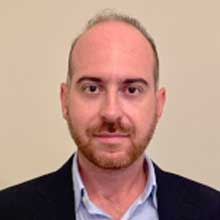
Sinead O'Keeffe is a Research Fellow at the University of Limerick in the Faculty of Science and Engineering , specifically within the Department of Electronic and Computer Engineering . Her research bridges the technical domain of optical fiber sensor development with critical applications in radiation therapy and sports medicine. Primary Research Themes Medical radiation dosimetry using optical fiber sensors Brachytherapy dose monitoring systems Sports injury prevention in Gaelic football and running Mental health literacy in rural farming communities Key Technical Contributions Development of scintillation-based dosimeters Characterization of perfluorinated polymer fibers 3D printed sensor systems for clinical and rehabilitation applications Interdisciplinary Applications Prostate cancer radiotherapy dose measurement Mental health intervention programs for athletes Work-family conflict analysis in Irish farming Email: sinead.okeeffe@ul.ie
Marinko Sarunic is an Adjunct Professor at the School of Engineering Science , Simon Fraser University . He holds a PhD in Biomedical Engineering from Duke University and has been recognized as a Michael Smith Foundation for Health Research Scholar . His research focuses on biomedical imaging , particularly optical coherence tomography (OCT) , microscopy , and low-coherence interferometry , with applications in diabetic retinopathy , Alzheimer’s disease , and age-related macular degeneration . Dr. Sarunic's work spans adaptive optics , deep learning , and sensorless OCT systems , emphasizing clinical translation and open-source software development (e.g., OCTAVA ). His Google Scholar publications highlight multimodal imaging , vascular heterogeneity analysis , and AI-driven diagnostics for retinal diseases. His contributions include the Michael Smith Foundation for Health Research Scholar award. Though not currently teaching courses, his collaborations and leadership in retinal imaging and medical device innovation are pivotal for advancing non-invasive diagnostics in neurodegenerative and diabetic conditions .
Riccardo Piccoli is a Researcher at the Department of Molecular Sciences and Nanosystems, Ca' Foscari University of Venice. He serves as a Laboratory Supervisor at the Research Institute for Complexity Safety and teaches courses such as Fundamentals of Electronics in the Physical Engineering degree program. PhD in Electronic, Computer, and Electrical Engineering (University of Pavia, 2014) Master's in Electronic Engineering (University of Pavia, 2011) Bachelor's in Electronic and Telecommunications Engineering (University of Pavia, 2009) His research focuses on ultrafast lasers and terahertz technology, particularly in quantum matter-light interactions and hollow-core fiber applications . Recent work includes terahertz imaging techniques and high-power laser pulse compression. He collaborates with institutions across Europe, North America, and the Middle East. Dr. Piccoli's publications highlight advancements in terahertz coherent detection , nonlinear photonics , and microfluidic waveguides . He leads research projects involving quantum optics, nanocavity interactions, and biomedical imaging applications. He is affiliated with the Research Institute for Complexity Safety and has held research roles at Polytechnic University of Milan, Weizmann Institute of Science, Max-Planck-Institut für Kernphysik, and INRS-EMT. His expertise spans terahertz spectroscopy, ultrafast phenomena, and photonic material design.
Luca Pollonini, Ph.D. , is an Associate Professor at the University of Houston within the Cullen College of Engineering , Department of Engineering Technology. He leads the Optical Bioimaging Lab , focusing on biomedical optics, cortical hemodynamics, and tissue oxygenation monitoring. His research spans wearable sensors, traumatic brain injury (TBI) studies, and early detection of pressure ulcers via diffuse optical imaging. Education: Ph.D. in Information Engineering, University of Brescia, Italy (2004) M.S. in Electrical Engineering, University of Brescia, Italy (2000) Dr. Pollonini's research integrates near-infrared spectroscopy (fNIRS) for real-time brain imaging and biomedical signal processing to detect physiological changes. His work on portable optical sensors includes applications for heart failure monitoring, astronaut fingertip injuries, and pressure ulcer prevention. Recent publications highlight his contributions to biomedical device design , TBI cortical connectivity , and cardiac rehabilitation technologies . Awards include the 2001 Best Science Thesis (Lombardy Institute), 2004 ARVO Best Poster , and 2014 Wolff Center Innovation Patent for skin-flap blood-flow monitoring. He serves as an Assistant Affiliate Member at the Houston Methodist Research Institute (since 2014) and mentors postdoctoral and graduate fellows in NSF-funded projects involving diffuse optical imaging and wearable sensor development.
Dr. Amarendra Kumar Sarma is a full Professor in the Department of Physics at the Indian Institute of Technology Guwahati (IIT Guwahati), where he has been faculty since 2007 and Professor since 2018. He leads the Theoretical Quantum Optics and Quantum Technology Group, focusing on frontier areas of quantum science including quantum optomechanics, entanglement, and nonlinear photonics. His research explores quantum technology through multiple interconnected domains: Quantum Hybrid Systems: Integrating superconducting qubits with optomechanical elements for quantum transduction and sensing Nonlinear Dynamics: Soliton physics, PT-symmetric optics, and ultrafast switching in waveguides Quantum Control: Entanglement generation, mechanical squeezing, and quantum synchronization techniques Quantum Metrology: Overcoming standard quantum limits for force sensing using electro-optomechanical approaches Analysis of his 15 most recent publications (2018-2025) reveals strong emphasis on hybrid quantum systems (60% of works), with particular focus on quantum-classical interfaces for sensing applications. PT-symmetry and nonlinear dynamics constitute 30% of output, while quantum information fundamentals comprise 10%. Machine learning integration emerges as a new frontier in quantum control methodologies. He actively mentors researchers including 7 current PhD students and 12 former advisees. Notable grants include: STARS-2 project: 'Exploring Hybrid Circuit QED Systems for Quantum Technology' (2024-2027) SERB MATRICS: 'Soliton Dynamics in PT-Symmetric Models' (2020-2023) DST Fast-track: 'Parity-time Symmetry in Nonlinear Optics' (2014-2017) The Quantum Optics and Quantum Technology Group develops theoretical frameworks for experimental quantum implementations, maintaining collaborations with international institutions in quantum materials and device physics.
Alice Martignon is a Research Fellow and Subject Expert at the Department of Philosophy and Cultural Heritage, Ca' Foscari University of Venice, where she coordinates the ARMID@Venezia research project. She holds a PhD in Art History from the University of Udine and previously served as a postdoctoral fellow at the Giorgio Franchetti Gallery. Her museum experience includes collaborations with the Fondazione Musei Civici Venezia and the Regional Directorate of Museums of Veneto. Martignon's research focuses on the art market, historical collecting practices, decorative arts, and cultural heritage conservation, with specialized expertise in non-invasive diagnostics and digital humanities. Her work frequently examines 19th-20th century Venetian art markets and the legal frameworks surrounding cultural goods. Her publications demonstrate strong interdisciplinary approaches, combining art historical analysis with scientific techniques like multispectral imaging and spectroscopy. Recent works emphasize digital restoration methods, material characterization of historical artifacts, and responses to cultural heritage emergencies like the 2019 Venice floods. Scientific Recognition: Finalist in the 2023 National Art Competition sponsored by the Italian Ministry of Culture for the ARMID@Venezia project She coordinates the ARMID@Venezia initiative, funded through the National Art Bonus program, focusing on digitization and virtual restoration of damaged music manuscripts. As a Senior Teaching Assistant, she supervises graduate theses and has developed courses on provenance research and digital humanities methodologies. Martignon leads the Materials Characterization Laboratory research group and serves on scientific committees including ICOM Italia's Provenance Working Group and the Venice Centre for Digital and Public Humanities. She maintains international collaborations through memberships in The International Art Market Studies Association and The Society for the History of Collecting.
Val Zwiller is a Professor at the Royal Institute of Technology (KTH) in the Department of Quantum and Nanophysics, affiliated with the School of Engineering Sciences (SCI). His research focuses on quantum photonics, superconducting single-photon detectors, nanowire quantum dots, and integrated photonic systems. He teaches and coordinates courses such as Quantum Photonics (SK2900) and Quantum Technology (SK2903), and advises on degree projects in engineering and applied physics. Research Interests: Zwiller's work spans quantum entanglement generation, single-photon detection technologies, and applications in quantum communication and sensing. His recent studies include fractal superconducting nanowire detectors, telecom-band quantum dots, and quantum state tomography. His research bridges fundamental quantum physics with practical photonic device development. Course Responsibilities: Quantum Photonics (SK2900) - Examiner, Course Coordinator, Teacher Quantum Technology (SK2903) - Teacher, Assistant Optical Physics (SK2303) - Examiner Supervision of Degree Projects in Engineering Physics and Applied Physics Publications Trends: Zwiller's recent articles emphasize scalable quantum detection systems, nanowire-based quantum emitters, and advanced LIDAR technologies with single-photon sensitivity. His work frequently intersects quantum optics with material science and engineering. Awards/Grants: No specific awards or grants were explicitly mentioned in the provided texts. Lab/Teams: While not detailed in the input, his affiliation with the Department of Quantum and Nanophysics suggests involvement in KTH's quantum photonics and nanotechnology research groups.
Professor Sunil Khijwania is a faculty member in the Department of Physics at the Indian Institute of Technology Guwahati, where he has served since 2004, rising from Assistant Professor to his current position as Professor since August 2014. His academic journey includes a PhD from IIT Delhi in 1999, followed by postdoctoral positions at the University of Tokyo (2000-2002) and Mississippi State University (2002-2004). He has also held visiting positions at The Hong Kong Polytechnic University during 2006-2008. Professor Khijwania's primary research focus is on Fiber Optics and its applications, particularly in developing Smart Optical Fiber Sensors for real-field applications. His laboratory, established single-handedly at IIT Guwahati, has been recognized as one of the prominent Fiber Optics Labs of India by 'Optics & Photonics News' (2011). His work spans multiple disciplines including Structural Health Monitoring for civil infrastructure, environmental monitoring for air/water contamination detection, and biomedical engineering applications. His research integrates emerging technologies such as graphene, nano-photonics, plasmonics, specialty fibers, and guided-wave all-optical devices. Current projects focus on developing Smart Optical Fiber Sensors using combinations of Graphene, Localized-surface-plasmon-resonance (LSPR), Specialty fiber (Photonic Crystal Fiber and Bragg Fiber), Fiber Bragg gratings/Long Period gratings, and Nano-photonics. Professor Khijwania has published over 110 papers in journals and conference proceedings with total citations exceeding 1500. His research output demonstrates a consistent focus on optical fiber sensors with particular emphasis on humidity sensing, structural monitoring, and biomedical applications, showing progression from fundamental fiber optics research to increasingly applied work addressing real-world engineering challenges. Elevated as Senior Member of Optical Society of America (OSA) Elevated as Senior Member of IEEE Fellow and Life Member of Optical Society of India (OSI) Elected Executive Member of Optical Society of India (OSI) Laboratory acknowledged as one of the prominent Fiber Optics Labs of India by 'Optics & Photonics News' (2011) Professor Khijwania has served in various leadership roles including Head of the Center for Educational Technology (2015-2019), President of the Faculty Forum (2015-2016), and Warden of Manas Hostel (2008-2011). He has played instrumental roles in national initiatives including TEQIP III and GIAN. His research has been supported by grants from DST, BRNS, and international collaborations including with NASA and EPM Canada. He has organized major conferences including PHOTONICS 2010, an international conference on fiber optics and photonics. His Fiber Optics Laboratory at IIT Guwahati serves as a hub for multidisciplinary research, bringing together students and collaborators from civil engineering, mechanical engineering, environmental science, and biomedical fields to develop innovative optical sensing solutions. The lab has established international collaborations, including a Research MoU between IITG and EPM Canada in Fiber Optics.
Prof. Fikri Serdar Gokhan is a faculty member at Rafet Kayış Faculty of Engineering, Department of Electrical and Electronic Engineering. His academic journey spans institutions such as Alanya Aladdin Keykubat University, Harran University, and Hasan Kalyoncu University, where he held progressive roles from Lecturer to Associate Professor before attaining his current rank as Professor. Education: Doctorate and Masters in Electronics Engineering from Uludag University (2010, 2003), Licence in Electrical and Electronics Engineering from Uludag University (1998). Prof. Gokhan's research focuses on Optics and Photonics , particularly Brillouin and Raman fiber amplifiers, quantum tunneling in plasmon sources, and thermal sensing in CMOS-MEMS technology. His work includes analytical modeling, numerical simulations, and applications in optical communication and sensing. His publications highlight expertise in Brillouin amplification, fiber optics, quantum photonics, and terahertz imaging. Notable contributions include innovative guess functions for Raman amplifiers, SBS management in Yb fibers, and electrical-driven plasmon sources on silicon. Administrative roles include Head of Department and Deputy Director of the Institute at Hasan Kalyoncu University. Students mentored include Güneş Yılmaz (PhD) and Arzu Babaev (Masters thesis).
Nigel Emptage is a Professor of Neuropharmacology and Head of the Department of Pharmacology at the University of Oxford. He holds academic roles in the Medical Sciences Division and has served as Senior Dean of Lincoln College. His research focuses on synaptic signaling, optical neuroimaging techniques, and molecular mechanisms underlying neuronal communication. Education: PhD in Zoology from the University of Cambridge (1987-1991), BSc (Hons) in Biophysics from the University of East Anglia (1984-1987). Postdoctoral training included work with Tim Bliss at the National Institute for Medical Research and Tom Carew at Yale University. Research interests include optical recording of neuronal activity, synaptic plasticity, and the development of advanced microscopy tools. Notable achievements include pioneering optical quantal analysis and innovations in volumetric imaging technologies. Awards include the Pharmaron Prize (2018) and the University of Oxford Teaching Excellence Award (2017). He has secured grants from BBSRC, MRC, EPSRC, and the Wellcome Trust. Academic service roles include Director of Graduate Studies (2006-2014) and leadership in neuroscience oversight committees. Outreach initiatives include teaching the European Microelectrode Cell Physiology course and community programs with Lincoln College. The Emptage Group specializes in synaptic pharmacology and neuroimaging.
Dr. Daniel Pizarro Pérez is a Professor in the Department of Electronics at the University of Alcalá, Spain. He is a member of the GEINTRA research group, which focuses on Electronic Engineering applied to Intelligent Spaces and Transport. He holds a doctoral degree from the University of Alcalá, completing his thesis on 'Localización de robots móviles en espacios inteligentes utilizando cámaras externas y marcas naturales' (2008), supervised by Dr. Manuel Ramón Mazo Quintas and Dr. Enrique Santiso Gómez. His research interests span computer vision, medical imaging, smart grid technologies, acoustic signal processing, and control systems. Notable projects include augmented reality applications in laparoscopic surgery, non-intrusive load monitoring using smart meters, and advanced control methodologies for power electronics. His work bridges theoretical advancements with practical applications in healthcare, energy systems, and robotics. Recent publications highlight contributions to neural radiance fields for minimally-invasive surgery, distributed acoustic sensing in submarine environments, and deep learning-based activity recognition via energy consumption. His research frequently integrates interdisciplinary approaches, such as combining computer vision with medical robotics and leveraging machine learning for real-time control systems. Dr. Pizarro’s work has been supported by grants and collaborations within the GEINTRA group, with applications in intelligent spaces, robotic navigation, and sensor fusion. He has also contributed to educational initiatives like the GEMS Erasmus+ project, emphasizing sensory module development for robotics education.
Dr. Jiawen Li is an Associate Professor in the School of Electrical and Mechanical Engineering at the University of Adelaide, specializing in Biomedical Engineering. She leads the intravascular imaging program at the Institute of Photonics and Advanced Sensing (IPAS), focusing on developing ultrathin, flexible fiber-optic imaging probes for vascular and biomedical applications. Her work bridges photonics, engineering, and medicine to advance diagnostics for cardiovascular diseases and other conditions. Research Interests: Dr. Li’s research centers on multimodal imaging technologies, including optical coherence tomography (OCT), fluorescence imaging, and ultrasound integration. She pioneers innovations in 3D-printed micro-optics, fiber-optic sensors, and nanoparticle-based contrast agents to enhance deep-tissue imaging capabilities. Her lab addresses fundamental questions about plaque evolution, heart attack mechanisms, and treatment responses at the cellular level. Awards & Recognition: She has received prestigious accolades such as MIT’s Innovators Under 35 , Sony Women in Technology Award, and multiple grants totaling over $13 million. Her team’s inventions include the world’s smallest 3D-printed endoscope and a single-fiber probe for simultaneous imaging and sensing. Grants & Funding: As a chief investigator, Dr. Li secures major funding from NHMRC, MRFF, and ARC, advancing projects like quantum biosensing, meta-optics for medical imaging, and real-time ocular imaging. Her collaborative work spans universities, industries, and international partnerships (e.g., University of Nottingham, Stuttgart, Germany). Labs & Teams: Her lab at IPAS fosters interdisciplinary innovation, with active projects in cardiovascular imaging, cancer detection, and biomedical device development. She mentors students in cutting-edge topics such as quantum biosensing and meta-optics through ARC-funded training programs.
Professor Heike Ebendorff-Heidepriem is a Professor in the School of Physics, Chemistry and Earth Sciences at the University of Adelaide. She serves as Deputy Director of the Institute for Photonics and Advanced Sensing (IPAS) and Director of the Optofab Adelaide Hub within the Australian National Fabrication Facility (ANFF). Her research focuses on advanced optical fiber fabrication, materials science, and photonics applications, including high-precision glass extrusion, exposed-core fibers, and quantum sensing. She leads a multidisciplinary team of over 20 researchers and has secured >$20M in funding, collaborating with global industry and academic partners. Her work spans fiber lasers, mid-infrared photonics, and sensor technologies, with significant contributions to nanomaterial integration and plasmonic processes. She has supervised 12 PhD and 5 HDR students over 15 years, emphasizing mentorship in photonics and materials innovation. Research Interests: Professor Ebendorff-Heidepriem specializes in developing novel optical fibers and glasses for applications such as high-power laser delivery, nonlinear optics, and evanescent field sensing. Her team pioneers fabrication techniques like billet extrusion and ultrasonic milling, enabling structures like suspended nanowire-core fibers and diamond-doped sensors. Key areas include mid-infrared materials (tellurite, fluoride glasses), plasmonic nanoparticle embedded glasses, and portable sensing solutions for mining and biomedical fields. Labs/Teams: IPAS and Optofab Adelaide Hub provide advanced facilities for fiber fabrication, laser development, and materials characterization. Her collaborations include 82 university groups and 30 industry/defense partners, driving commercialization of technologies like gold nanoparticle-based colored glass and diamond-doped fiber sensors.
Michael W. Jenkins is a Professor of Biomedical Engineering at the Case Western Reserve University School of Medicine and a member of the Cancer Imaging Program at the Case Comprehensive Cancer Center. His research focuses on developing biomedical optics tools for studying congenital heart disease and peripheral nervous system disorders. Key techniques include optical coherence tomography (OCT), light-sheet microscopy, and infrared neuromodulation. The Jenkins Lab specializes in advancing 3D imaging modalities for real-time tissue analysis, aiming to reduce surgical delays and improve diagnostic accuracy. Research interests include rapid 3D tissue visualization to replace traditional frozen-section pathology, optical pacing of cardiac tissues, and corneal nerve imaging. His work bridges engineering and medicine, with applications in ophthalmology, cardiology, and neurology. Recent innovations include label-free microscopy techniques (e.g., MUSE imaging) and AI-driven segmentation tools for neural anatomy analysis. Publications highlight advancements in corneal crosslinking assessment, vagus nerve microanatomy characterization, and cardiac tissue imaging. The lab collaborates with industry to translate optical tools into clinical settings, emphasizing precision and real-time diagnostics. Teaching and mentorship are integral to his role, fostering interdisciplinary training in biomedical optics. Ongoing projects address unmet clinical needs in neural modulation therapies and regenerative medicine through optical platforms.
Iwan Schie serves as Working Group Leader at the Leibniz Institute of Photonic Technology (Leibniz-IPHT) in Jena, Germany, where he leads the Spectroscopy / Imaging Multimodal Instrumentation research group. His work bridges analytical chemistry, biomedical engineering, and clinical applications with a focus on developing Raman spectroscopy-based diagnostic tools. Dr. Schie maintains an active research program with numerous publications in high-impact journals across multiple disciplines. Dr. Schie's research centers on Raman spectroscopy applications in medical diagnostics and environmental monitoring. His work demonstrates particular expertise in developing multimodal imaging systems that combine Raman spectroscopy with complementary techniques like optical coherence tomography and fluorescence imaging. His research spans both fundamental methodological development and clinical translation, with several studies focusing on cancer diagnostics across multiple organ systems including head and neck, bladder, and colon cancers. The environmental applications of his work include microplastic detection and pollen analysis. Analysis of Dr. Schie's publication record reveals a clear trajectory toward clinical implementation of Raman spectroscopy technologies. His recent work increasingly focuses on regulatory-compliant medical device development, with multiple studies conducted in accordance with European Medical Device Regulation standards. The publications demonstrate progression from ex vivo validation studies to in vivo clinical applications, with particular emphasis on workflow integration within surgical settings. His collaborative approach is evident through extensive co-authorship networks spanning physics, engineering, and clinical medicine. Dr. Schie has made significant contributions to advancing Raman spectroscopy methodology, with publications addressing critical challenges in device stability, spectral analysis, and multimodal integration. His work on establishing clinical workflows represents important steps toward routine clinical adoption of these technologies. The practical impact of his research is demonstrated through development of systems like the invaScope Raman endoscopy platform for bladder tumor diagnosis. As Working Group Leader at Leibniz-IPHT, Dr. Schie oversees research activities in spectroscopy and multimodal imaging instrumentation. His team develops advanced optical systems for biomedical applications with particular focus on real-time tissue characterization during surgical procedures. The research environment supports both fundamental methodological development and applied clinical translation, with strong emphasis on regulatory compliance for medical device development.