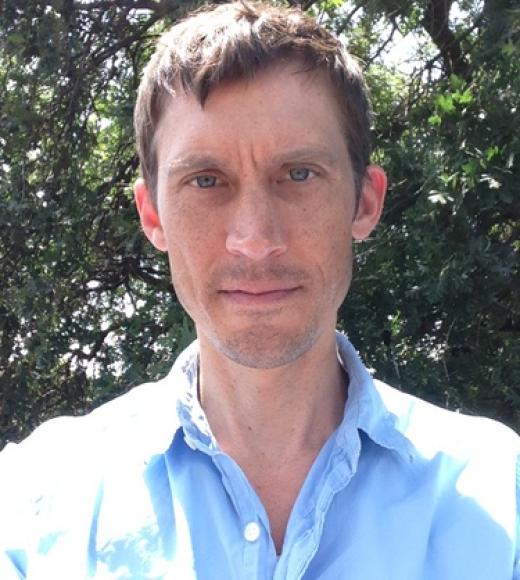
Lee M. Miller is a Professor and Vice Chair of Academic Affairs in the Department of Neurobiology, Physiology and Behavior at the University of California, Davis, affiliated with the Center for Mind and Brain. His research focuses on neuroengineering, computational neuroscience, and neural mechanisms underlying attention, speech processing, and multisensory integration. Research interests include the development of neural prosthetics, decoding of neuromuscular signals for prosthetic control, and understanding how auditory and visual systems interact during speech perception and attentional processes. His work bridges clinical applications (e.g., cochlear implants) with fundamental neuroscience, leveraging tools like electrophysiological recordings, EEG/MEG, and advanced signal processing techniques. Recent publications highlight innovations in electromyographic speech neuroprosthetics, the topology of neuromuscular signals, and the neural basis of speech-in-noise processing. Miller’s studies emphasize translational potential, such as improving speech synthesis from brain signals and designing haptic feedback systems for motor coordination. His contributions have advanced understanding of neural mechanisms in sensory integration, auditory attention, and the impact of cognitive factors on perception. Miller maintains a lab dedicated to these interdisciplinary efforts, with a focus on both basic science and clinical applications.
Min Peng is a Professor at Wuhan University's School of Computer Science. His research focuses on artificial intelligence, machine learning, natural language processing, and knowledge graphs. He has collaborated extensively with institutions like Hefei University of Technology and the University of Chinese Academy of Sciences. His work bridges theoretical advancements in AI with practical applications in finance, social media analysis, and network optimization. Recent contributions include neural-symbolic reasoning frameworks, contrastive learning for knowledge graphs, and financial benchmarking with large language models. Research interests emphasize scalable machine learning models for complex reasoning tasks, explainable AI, and domain-specific applications in finance and social networks. Over 100 publications span venues like WWW, ACL, and NeurIPS, highlighting interdisciplinary impact. Notable projects include SymAgent (neural-symbolic agent frameworks), PIXIU (financial LLM benchmark), and DTC (commonsense machine comprehension). Key technical trends include integrating large language models with structured data, temporal knowledge graph reasoning, and transfer learning across domains. His work often addresses real-world challenges in data efficiency, interpretability, and cross-domain scalability. Current efforts explore financial LLMs, agent-based reasoning systems, and multimodal applications. While no specific grants or awards are listed in the provided data, his prolific publication record indicates sustained research excellence. Collaboration networks include teams in computer science, electrical engineering, and finance disciplines.
Shunichi Ishihara is a Professor at the School of Culture, History & Language, The Australian National University, where he leads research in forensic linguistics and computational linguistics. His work focuses on forensic text and voice comparison, authorship attribution, and Japanese linguistic studies. He holds qualifications including a PhD (ANU), MSc (Macquarie), MA (ANU), and BEd (Shizuoka). Research Interests: Forensic Voice/Text Comparison Computational Linguistics Intonational Modelling Japanese Language Processing Stylometric Analysis Research Trends: Recent work emphasizes likelihood ratio-based systems for authorship verification, fusion of acoustic and text features for forensic analysis, and applications of deep learning in text evidence evaluation. His studies often explore cross-lingual comparisons (e.g., Japanese, English, Vietnamese) and system validation methodologies. Grants & Projects: "Likelihood project on author recognition" (2024-2026) "Big Australian Speech Corpus" (2010-2015) Multiple forensic voice/text comparison initiatives Labs & Teams: Director of the Speech and Language Lab, collaborating on speech corpus development and forensic linguistic systems.
Lokukaluge Prasad Perera is a Professor in Maritime Technology at UiT The Arctic University of Norway and a Senior Research Scientist in Smart Data at SINTEF Digital . He holds a BSc in Mechanical Engineering from Oklahoma State University (1999), MSc in Systems & Controls from the same institution (2001), and a PhD in Naval Architecture and Marine Engineering from Technical University of Lisbon (2012). His research focuses on Maritime and Offshore Systems , Advanced Data Analytics , Autonomous Navigation , Energy Efficiency , and Digital Twin Applications . He has published over 100 peer-reviewed papers and was recognized in the World's Top 2% Scientists (2021-2022) by Stanford University. Key professional experiences include roles at SINTEF Ocean (2014–2017), Center for Marine Technology and Engineering in Portugal (2008–2012), and Wärtsilä Finland (2012–2014). He has also held academic positions at Naval & Maritime Academy and Ocean University of Sri Lanka . His work addresses challenges in emission reduction , renewable energy integration , and safety-critical systems for maritime operations. Current projects emphasize trustworthiness of autonomous ships and data-driven decision frameworks for energy efficiency.
Dr. Dave Murray-Rust is an Associate Professor in Human-Algorithm Interaction Design at TU Delft's Faculty of Industrial Design Engineering. He explores the intersection of humans, data, and AI through design research, focusing on ethical AI systems and sociotechnical interactions. His work bridges computer science, design theory, and digital sociology, addressing challenges like algorithmic fairness and human-AI collaboration. He leads initiatives such as the AI Futures Lab and Data-Centric Design Lab, advancing methods for leveraging behavioral data in design processes. His research emphasizes experiential AI frameworks, metaphors for designers, and the legibility of AI systems. He has been honored with awards including Best alt.HRI 2024 and a CHI 2023 Best Paper Award for contributions to fairness perceptions in algorithmic decision-making. Murray-Rust teaches courses like the Speculative Design Studio and collaborates on projects like DCODE (Designing the Future of AI) and the BrightSky Project. His work extends to public engagement through installations like GeoPact and explorations of blockchain's societal impact. He holds an Honorary Fellowship at the University of Edinburgh.
Ajita Rattani is an Assistant Professor in the Department of Computer Science and Engineering at the University of North Texas, affiliated with Discovery Park. Her research focuses on biometrics, AI fairness, deepfake detection, and machine learning applications in health and security. She holds a Ph.D. in Computer Science and Engineering, with expertise in facial recognition, ocular biometrics, and multimodal authentication systems. Research Interests: Her work addresses algorithmic fairness in facial attribute classification, robustness of biometric systems against adversarial attacks, and developing lightweight models for on-device authentication. She also explores applications of machine learning in health informatics, such as BMI prediction from facial images and analyzing social determinants of health. Publications Trends: Recent work emphasizes bias mitigation in AI systems (e.g., gender/racial fairness), deepfake detection through fusion of audio-visual cues, and advancing ocular biometric recognition under challenging conditions. Notable contributions include frameworks like CodeIT for data-efficient deepfake detection and PatchBMI-Net for lightweight BMI prediction. Advising & Grants: Leads research projects funded by NSF SaTC grants (e.g., probing fairness in ocular biometrics). Active in organizing competitions like VISOB 2.0 for mobile ocular biometrics evaluation. Her lab develops practical solutions for real-world challenges in biometrics and AI ethics. Labs/Teams: Involved in interdisciplinary teams addressing transdisciplinary collaboration challenges and applying AI to disaster detection (wildfires, droughts) using satellite and sensor data fusion.
Andrea Santilli is a Research Scientist at Nous Research and holds a PhD in Computer Science from GLADIA at Sapienza University of Rome. His research focuses on large language models (LLMs), robustness, reliability, and multimodal learning. He previously worked at Apple MLR, Hugging Face’s BigScience, and Pi School. He earned his MSc and BSc in Computer Science from Tor Vergata University and Sapienza. Education: PhD in Computer Science, Sapienza University of Rome (2024) MSc in Computer Science, University of Roma Tor Vergata (2020) BSc in Computer Science, University of Roma Tor Vergata (2018) Research Interests: Santilli’s work spans LLM robustness , mechanistic interpretability , multimodal neural databases , and instruction-tuning . He introduced Parallel Jacobi Decoding and contributed to projects like BLOOM, Camoscio, and Fauno. His research bridges syntax-aware NLP, privacy-preserving LLMs, and cross-modal alignment. Publications: His work includes advancements in 3D-text latent space alignment (CVPR 2025), evolutionary merging (ICML 2025), and efficient decoding (ACL 2023). Over 15+ peer-reviewed papers span venues like ACL, CVPR, and ICLR. Awards: Received the Emanuele Pianta Award for his MSc thesis on continual language learning with syntax-based episodic memory. Grants & Projects: Winner of ‘Machine Learning Algorithms for Translation’ grant (2022), developing Parallel Decoding Co-PI for ‘Multimodal AI for 3D Analysis’ (2021) with Ecole Polytechnique Labs & Teams: Active in GLADIA (Sapienza), Apple MLR, and Hugging Face’s BigScience initiative. Core contributor to open-source projects like PromptSource and BLOOM.
Lin Dong is an Assistant Professor in the Department of Mechanical and Industrial Engineering at New Jersey Institute of Technology (NJIT). His research focuses on advanced energy harvesting technologies, particularly in piezoelectric materials, flexible electronics, and their biomedical applications. He leads a federally funded project (NSF grant) titled Membranous Energy Harvester with Tuning Capability for Flexible Electronics , which explores energy harvesting systems for wearable and implantable devices. His research interests include the design of self-powered sensors, piezoelectric hydrogels, and nature-inspired nanofibers for health monitoring. Notable contributions include amphibious energy generators, helical piezoelectric hydrogels for human-machine interfaces, and flexible sensors for cardiac monitoring. His work bridges materials science, biomedical engineering, and mechanical systems, with applications in smart health and wearable technology. Dr. Dong’s publications (29+ articles) emphasize energy harvesting innovations, with 16+ citations. His articles highlight trends in flexible, bio-integrated energy systems and multimodal sensing. He collaborates on projects involving body sensor networks and tunable energy harvesters for flexible electronics. He has secured a 2021 NSF grant (PI) and generated media attention for advancements in flexible energy harvesting and nanofiber research. His lab develops cutting-edge materials and devices for sustainable energy solutions and healthcare applications.
Yintong Huo is a tenure-track Assistant Professor in the Department of Computer Science at Singapore Management University (SMU), School of Computing and Information Systems. He joined SMU in early 2024 after completing his PhD at The Chinese University of Hong Kong (CUHK) under Prof. Michael R. Lyu. His academic journey includes a Bachelor's degree from the University of Electronic Science and Technology of China. Education: PhD in Computer Science and Engineering, The Chinese University of Hong Kong (2024) Bachelor's degree, University of Electronic Science and Technology of China Huo's research focuses on intelligent software engineering , particularly empowering AI models (especially LLMs) for software development, testing, and operations. His work spans AI4SE, LLM4SE, AIOps, code intelligence, and multimodal software engineering . Two flagship projects define his current research: LogPAI - an open-source AI platform for automated log analysis adopted by leading tech companies, and WebPAI - a multimodal intelligence project for automatic webpage development. His research addresses critical challenges in software reliability, log analysis, and UI code generation through innovative applications of AI. His recent publications reveal a strong trend toward multimodal approaches in software engineering , combining vision and language models for UI code generation, and increasingly sophisticated applications of LLMs for log analysis and software reliability. Huo's work demonstrates exceptional impact, with multiple papers accepted at top-tier venues including ASE, ICSE, and FSE with high acceptance rates (e.g., 9.5% for ASE'25). Scientific Awards: ICSE Distinguished Reviewer Award (2025) ISSRE Distinguished Reviewer Award (2024) IEEE Open Software Services Award (2022, for LogPAI with 3k+ GitHub stars and 70k+ downloads) ACM SIGSOFT CAPS Travel Grants (ASE'23, ICSE'24, FSE'24) Nomination for Best Teaching Assistant Award (2022) National Scholarship (2019) Huo actively mentors students at multiple levels, currently supervising PhD students Shi Ying Chang and Dan Huang (co-supervised with Prof. David Lo), research engineer Minxing Wang, and visiting students including Shiwen Shan. His undergraduate mentee Truong Hai Dang will intern at Apple Inc. He maintains strong industry connections, with his LogPAI project adopted by world-leading tech companies. Huo serves on program committees for major conferences including ASE'25, ICSE'26, and FSE'26, and is recruiting fully-funded PhD students and research assistants for projects in AI4SE and multimodal software engineering. Huo leads the LogPAI and WebPAI research initiatives, which have evolved into substantial open-source projects with significant industry adoption. His team focuses on practical applications of AI in software engineering, with particular emphasis on reliability and usability in real-world systems. The research environment benefits from SMU's strong position in software engineering research, where the university ranks No. 2 globally in Software Engineering according to CSRankings (2020-2025).
Dr. Wan Renjie is an Assistant Professor in the Department of Computer Science at the Faculty of Science, Hong Kong Baptist University (HKBU). He holds a BEng in Network Engineering from the University of Electronic Science and Technology of China and a PhD from Nanyang Technological University (NTU), Singapore. Prior to joining HKBU, he was a Wallenberg-NTU Presidential Postdoctoral Fellow (2020–2022) and a guest researcher at Peking University (2019–2020). His research focuses on computational photography, 3D vision, AI security, digital watermarking, and neural representations . He explores robustness and security in vision models, especially concerning NeRFs and 3D Gaussian Splatting, and develops methods for low-light enhancement, reflection removal, and domain adaptation. Dr. Wan has published in top-tier venues including TPAMI, IJCV, CVPR, ICCV, NeurIPS, AAAI, and ECCV . His recent work emphasizes copyright protection for neural 3D models , adversarial attacks in multimodal and event-based systems, and medical image reconstruction. He is actively mentoring PhD students and research assistants. VCIP 2020 Best Paper Award Outstanding Reviewer, ICCV 2019 He teaches courses such as Introduction to AI and ML (COMP3057) , AI Application Development (COMP3065) , and Python for Data Analysis and Machine Intelligence (COMP7035) . Dr. Wan leads a dynamic research group with ongoing projects on watermarking, 3D reconstruction, and AI security, and he is currently recruiting new PhD students and research assistants.
ZHANG Zhiyuan is a Full-time Assistant Professor of Computer Science (Practice) at the School of Computing and Information Systems (SCIS) at Singapore Management University. His research focuses on Artificial Intelligence, Machine Learning, and Data Science, with specialties in 3D object detection, neural networks, and computer vision. He holds a PhD from the National University of Singapore (2015). Key research areas include developing efficient neural architectures (e.g., binarized vision transformers, hybrid diffusion models), multimodal human pose estimation, and medical imaging applications like dental biometrics. His work spans theoretical advancements and practical applications in autonomous systems, LiDAR fusion, and low-light image enhancement. Teaching expertise includes Data Structures & Algorithms, Programming Fundamentals II, and Object-Oriented Programming. No grants or awards are explicitly listed in the provided materials.
Yan Chen is an Assistant Professor at the Virginia Tech College of Engineering , where he leads the PRIME Lab (Programming with Intelligent Machines & Environments) . His work focuses on creating interactive Human-AI systems to enhance real-time data analysis and programming education, particularly addressing barriers in collaborative learning environments. University of Toronto (Postdoctoral Fellow) University of Michigan (Ph.D., Information Science) University of Colorado, Boulder (BS/MS in Applied Math & Electrical & Computer Engineering) His research bridges Human-Computer Interaction (HCI) and Computer Science Education , with a focus on real-time data analysis , AI-driven programming assistance , and scalable learning tools . He employs LLMs and human-centered design to simplify complex computational processes, enabling data workers to detect critical patterns efficiently. Recent publications highlight trends in generative AI for education , proactive AI programming support , and collaborative analytics . Key themes include real-time classroom insights , intergenerational smartphone learning , and automated feedback systems . Scientific recognition includes: 🏆 Best Paper at L@S 2024 🏅 Best Paper Honorable Mention at CHI 2023 🏅 Best Paper Honorable Mention at UIST 2022 🏆 Best Short Paper at VL/HCC 2020 He mentors a team of PhD and MS students in projects spanning AI-assisted education, web automation, and collaborative coding tools, with active recruitment for future research directions.
Professor Marilyn A. Walker is a leading academic in Natural Language Processing and Dialogue Systems at the University of California Santa Cruz , with significant contributions to conversational agents, personality modeling, and narrative analysis. She has held visiting roles at Google Research and leadership positions at University of Sheffield and AT&T Labs. Education : Ph.D. in Computer and Information Science (University of Pennsylvania, 1993), M.A. in Linguistics (University of Pennsylvania, 1993), M.S. in Computer Science (Stanford, 1988), B.A. in Computer and Information Science (UC Santa Cruz, 1984). Research Interests include Natural Language Processing , Conversational Agents , Dialogue Systems , and Personality Modeling . Her work bridges machine learning with linguistic theory to enhance dialogue adaptivity and expressive language generation. Scientific Awards include ACL Fellow (2016) Best Paper Awards at SIGDIAL 2016 and 2014 Royal Society Wolfson Research Merit Award (2003-2009) Grants exceed $2.5M, including NSF awards for projects like Interactive Dialog Agents for Social Language Development (2017) and Processing Opinion Sharing Dialog in Social Media (2011). She has also received corporate funding from Amazon , Fujitsu , and Hitachi .
Christian Wolff is a University Professor and Chair of Media Informatics at the Institute for Information and Media, Language and Culture at the University of Regensburg. Since April 2022, he has served as the founding Dean of the Faculty of Computer Science and Data Science, while maintaining secondary membership in the Faculty of Languages, Literature and Cultural Studies (SLK). His academic career spans over three decades with significant contributions to multiple disciplines at the intersection of computer science and humanities. Wolff's research interests center around multimedia and multimodal information systems, electronic publishing, and text technology, particularly text mining. His work bridges computer science with digital humanities, legal informatics, and social media analysis. Recent publications demonstrate a strong focus on large language models, sentiment analysis applications across various domains, legal technology innovations, and virtual reality research for cognitive studies. His interdisciplinary approach has produced significant contributions in both technical and humanities domains. His recent publication trends reveal a strategic shift toward applied AI research, particularly in legal technology (LegalTech), social media analysis, and sentiment analysis using large language models. The publications show increasing collaboration across disciplines, connecting computer science with law, political science, literature, and psychology. His work on the digital basis document for legal proceedings represents a major practical application of his research in the German justice system. East Bavarian Cultural Prize Doctoral Award of the University of Regensburg Wolff has led numerous interdisciplinary research projects connecting computer science with humanities and legal studies. His leadership extends to institutional roles including Dean of Research, Vice Dean, and Dean of Faculty positions. He has been instrumental in establishing the new Faculty of Computer Science and Data Science at the University of Regensburg, demonstrating significant impact on institutional development and research infrastructure. Wolff directs research initiatives focused on text technology, digital humanities, and legal informatics. His work with the INDIGO - Internet and Digitization Eastern Bavaria initiative and the TRIO project demonstrates commitment to regional technology transfer and innovation. The interdisciplinary nature of his research groups connects computer scientists with legal scholars, linguists, and social scientists to address complex digital transformation challenges.
Jason Nelson is a Professor of Digital Culture in the Department of Linguistic, Literary and Aesthetic Studies at the University of Bergen, Norway. He is a creator of digital poems and fictions, builder of surrealist and politically focused art games and digital creatures. His work is exhibited widely in galleries and journals around the globe at FILE, ACM, LEA, ISEA, SIGGRAPH, ELO and numerous other venues. Nelson serves on organizational boards including the Australia Council Literature Board and the Electronic Literature Organization. Nelson's research focuses on the intersection of digital technology, creative writing, and artistic expression. He explores how AI and machine learning can be harnessed for creative purposes, developing new forms of digital literature and interactive art. His work often involves building expansive visual worlds through collaborative AI processes, creating interactive digital poetry, and developing novel approaches to digital narrative. Nelson's research spans digital humanities, electronic literature, AI-generated art, and interactive media, with particular emphasis on how these technologies transform creative processes and experiences. Over the past decade, Nelson's work has increasingly focused on the creative potential of AI technologies, especially in the areas of text-to-image generation and multimodal authorship. His projects often blend game engines with poetic expression, creating immersive experiences that challenge traditional boundaries between human and machine creativity. Recent works explore themes of multispecies futures, time perception, and the transformation of physical spaces through augmented reality. Nelson has received numerous scientific awards and fellowships including: Fulbright Fellowship at the University of Bergen Moore Fellowship at the National University of Ireland Winner of the Digital Writing Prize, Queensland Literary Awards (15,000 AUD) Winner of the Woollahra Library Digital Poetry Prize (5,000 AUD) Runner-Up Prize at the Videomedeja digital art exhibition Finalist for the Turn-on Literature Prize Finalist for the Queensland Literary Awards, Digital Writing Category Multiple finalist nominations for the New Media Writing Prize Nelson actively participates in academic advising and has secured significant research funding, including a 125,000 AUD grant from the Australia Council of the Arts, Literature Board for his project "Cube Cryptext and Nomencluster," which was recognized as the world's largest interactive art-game. His work "Nine Billion Branches" received multiple awards including the Digital Writing Prize from the Queensland Literary Awards. He has also received a 75,000 NOK grant for the "Flood Mosaic Artwork" project featured in the Floodlines Exhibition at the State Library of Queensland. Nelson is affiliated with the Center for Digital Narrative at the University of Bergen, where he collaborates with researchers like Scott Robert Rettberg and Alinta Krauth. Together they form EphemerLab, exploring new creative processes that move beyond simple "ask and generate" AI methods. Their work involves stitching together hundreds of individual image fragments and components into cohesive visual and narrative concepts, pushing the boundaries of what's possible with current AI technologies.