José Ignacio Olmeda Martos is a Professor at the Computer Science Department of the University of Alcalá, Spain. His research focuses on artificial intelligence, neural networks, financial modeling, and applications in tourism and e-learning. He leads the CSRG-UAH Cognitive Science Research Group and the AUDITAI Group for AI Software Development. He earned his Ph.D. in 1996 with a thesis on nonlinear financial models under Dr. Sergio Barba-Romero. His work bridges computational methods with real-world challenges in finance, tourism, and education. Research interests include predictive analytics, algorithmic optimization (genetic algorithms, SOMs), and accessibility in digital systems. His contributions span hybrid models in credit scoring, volatility forecasting using neural networks, and e-commerce adoption analysis. Over 25 years, he has published extensively on topics like tourism demand prediction (PLAZA project), web accessibility metrics, and financial market predictability. Key projects include developing internet-based tourism reservation systems for Castilla-La Mancha and applying wavelet filtering in financial time series. His research emphasizes interdisciplinary applications, integrating AI with tourism management and financial engineering. Education: Ph.D., Universidad de Alcalá, 1996 Publications reflect his expertise in computational finance, tourism technology, and machine learning. Despite no listed awards, his work demonstrates sustained impact in both academic and applied domains. Advising and grant activities are not detailed in the provided texts.
David Newman serves as a Senior Enterprise Fellow within the Electronics and Computer Science department at the University of Southampton's Faculty of Engineering and Physical Sciences. His research focuses on the intersection of web science, scientific workflow systems, and semantic technologies, with particular emphasis on developing infrastructure for collaborative research environments. His primary research interests center around Web Science , Scientific Workflow Systems , and Research Objects , where he investigates how digital platforms can enhance scientific collaboration. Newman's work explores the social dimensions of scientific computing through projects like myExperiment, examining how researchers share and reuse computational workflows. His research bridges technical infrastructure development with social computing aspects of scholarly practice, contributing to the evolution of virtual research environments that support modern scientific collaboration across disciplines. Analysis of Newman's publication history reveals consistent contributions to the development of semantic platforms for scientific collaboration, particularly through the myExperiment project. His work spans from foundational research on scientific social objects (2011) to practical implementations like Erica the Rhino (2016) that demonstrate real-world applications of workflow systems. The publications show progression from theoretical frameworks for research objects toward applied implementations in digital art and news enrichment, reflecting both technical depth and interdisciplinary reach. While no specific scientific awards are documented in the available materials, Newman's contributions to the myExperiment platform represent significant impact in the research infrastructure community. His work has helped shape how scientists share and discover computational workflows, contributing to more efficient and collaborative research practices across multiple disciplines. As a Senior Enterprise Fellow, Newman contributes to the university's research ecosystem through development of digital research infrastructure rather than traditional student supervision. His work focuses on creating platforms that support researcher collaboration at scale, with implications for how scientific communities organize and share knowledge in the digital age. The myExperiment platform, in particular, has served as an important testbed for concepts now mainstream in research computing. Newman's research is closely associated with the Web & Internet Science group at Southampton, where he has contributed to the development of semantic technologies for research communities. His work represents an important strand of the university's leadership in web science and digital research infrastructure, connecting technical innovation with practical applications for scholarly communication and collaboration.
Soon Myoung Chung is a computer science researcher with significant contributions in the areas of cloud computing security, parallel data clustering, and GPU-accelerated algorithms. The publications indicate long-standing research activity spanning from 2002 to at least 2022, suggesting sustained academic engagement. While no formal institutional affiliation is provided in the scraped content, the depth and consistency of work imply a faculty or research-oriented academic role. The research interests center around cloud security , especially hypervisor vulnerabilities and isolation breaches, parallel and distributed clustering algorithms for large-scale data, and 3D shape analysis using orthogonal moments. These fields reflect a strong focus on algorithmic efficiency, security in virtualized environments, and pattern recognition. The most recent articles show a trend toward leveraging GPU acceleration for real-time data processing in crisis management and enhancing anomaly detection in time series data. Earlier works emphasize foundational methods in association rule mining, text clustering, and combinatorial fusion for feature selection. Collectively, the publications demonstrate expertise in both theoretical algorithm design and practical implementation in high-performance computing contexts. Although no scientific awards are mentioned in the provided texts, the body of work has accumulated over 1,800 citations, indicating influence in the field. There is no information available about students advised, grants received, or leadership roles. No labs or collaborative teams are referenced in the scraped material.
Frédéric Dufaux is a CNRS Research Director at Université Paris-Saclay, affiliated with CentraleSupélec and the Laboratoire des Signaux et Systèmes (L2S), where he heads the Telecom and Networking hub. He holds an M.Sc. in Physics (1990) and a Ph.D. in Electrical Engineering (1994) from the Swiss Federal Institute of Technology (EPFL). With over 20 years of research experience, he previously worked at EPFL, MIT, and industry leaders including Compaq and Digital Equipment. His research spans: Fundamental video coding techniques and 3D video systems High dynamic range imaging and perceptual quality assessment Privacy-preserving video surveillance and multimedia content analysis Wireless video transmission and next-generation compression standards Recent publications focus on HDR compression optimization, semantic video coding using seam carving, distributed video coding with machine learning, and 3D video standardization, demonstrating consistent innovation in video processing architectures and perceptual quality enhancement. Awards & Honors: IEEE Fellow Two ISO Awards for contributions to JPEG 2000 wireless (JPWL) and JPSearch standards He leads multiple standardization initiatives in MPEG/JPEG committees and has held editorial leadership roles including Editor-in-Chief of Signal Processing: Image Communication (2010-2019). He chairs the EURASIP Technical Area Committee on Visual Information Processing and has organized major conferences including ICIP and MMSP.
Carlos Morales serves as Associate Professor at Purdue University's Polytechnic Institute, specializing in digital video, animation, and interactive technology for visual training solutions. His research focuses on game-based learning applications in chemistry education and innovative distance learning systems, with significant contributions to educational technology through interdisciplinary collaboration. His primary research domains include: Game-based Learning for STEM education Interactive Educational Technology development Digital Video Production for distance learning Animation Technology pipelines Mobile Learning Applications design Chemistry Education Technology integration Dr. Morales' publication record (2002-2007) demonstrates consistent innovation in chemistry video games and mobile learning solutions, featuring multiple collaborative projects with chemistry educators. His work bridges engineering design and educational theory to create validated tools that enhance student engagement through visual realism and sustained interactivity. As Principal Investigator and Co-PI, he has secured substantial research funding including: National Science Foundation: $539,999 for "Effective Distance Learning Through Sustained Interactivity and Visual Realism" (2003-2006) National Science Foundation: $200,000 for "Game-based Learning in Chemistry" (2003-2006) ITaP MIDC: $15,000 for "Development of Mobile Games for Chemistry" (2006-2007) Discovery Learning Center: $20,000 for Chemistry Video Game Development (2006-2007)
Dr. Josiah Wang is a Visiting Professor in the School of Computer Science at the University of Sheffield. His research focuses on multimodal machine learning, particularly the intersection of computer vision and natural language processing. He has contributed to advancements in image captioning, object detection, and multimodal machine translation. His work emphasizes techniques like semi-supervised learning, distributional similarity, and visual-linguistic integration. Wang's research has been showcased in venues such as the ImageCLEF challenges, where he contributed to scalable concept annotation tasks and multimodal translation systems. His projects often address critical issues in content selection for image descriptions and the exploitation of visual semantics for improved language generation. While no specific awards or grants are listed, his involvement in organizing and participating in ImageCLEF tasks demonstrates his leadership in collaborative research initiatives. His work bridges theoretical machine learning with practical applications in visual language systems, reflecting a commitment to advancing both technical and interdisciplinary research.
Dr. Koteswar Rao Jerripothula is an Assistant Professor in the Department of Electrical Engineering at the Indian Institute of Technology Kanpur (IIT Kanpur), specializing in the SPCOM stream. Previously, he served as an Assistant Professor at Indraprastha Institute of Information Technology Delhi (IIIT-Delhi). He holds a PhD from Nanyang Technological University (Singapore) and a BTech from IIT Roorkee. His research focuses on Computer Vision, Artificial Intelligence, and Multimedia Signal Processing, with applications in healthcare informatics and federated learning. Education: PhD (2017), Nanyang Technological University BTech (2012), Indian Institute of Technology Roorkee Research Interests: Computer Vision and Image Processing Multimedia Computing and Systems Artificial Intelligence and Machine Learning Computational Health and Biomedical AI His Visual Intelligence and Multimedia Signals (VIMS) Lab explores topics like co-saliency detection, federated learning, and light-weight biometrics. The lab seeks students with strong coding and communication skills. Contact: vims.iitk@gmail.com.
Jürgen Brehm is an Adjunct Professor at the Faculty of Electrical Engineering and Computer Science of Leibniz University Hannover . He holds a venia legendi in Computer Engineering after completing his habilitation in 2000. Education: Diploma in Computer Science (1986), Doctorate in Engineering (1991), Habilitation (2000) Research interests span computer architecture , parallel processing , performance analysis , and e-learning . His work explores ubiquitous computing , communication architectures , and optimization algorithms . Recent publications highlight trends in parallel computing , optimization , and interactive systems , including works on swarm intelligence , particle swarm optimization , and open content integration. Scientific award : Feodor Lynen Fellowship (1994) Teaching includes core courses like Basics of Computer Architecture , Operating Systems , and Parallel Processing . He also designed two multimedia-equipped computer science lecture halls and managed large-scale DFG projects for e-learning and HPC computing.
Dr. Jagruti Sahoo is an Associate Professor in Computer Science and Academic Program Coordinator for the Cybersecurity Program at South Carolina State University (SCSU), USA. Her research focuses on Internet of Things (IoT) , cybersecurity , machine learning , vehicular networks , and network functions virtualization . Ph.D. in Computer Science and Information Engineering from National Central University, Taiwan (2013) Postdoctoral research at University of Sherbrooke and Concordia University, Canada (2013-2016) Her research lab explores optimization, security, and privacy in IoT and cyber-physical systems, particularly in smart transportation and smart farming domains. She has published extensively in IEEE journals and conferences, with expertise in fog node placement, vehicular network protocols, and VNF management. Dr. Sahoo serves on technical program committees for major conferences (IEEE ICC, Globecom, CCNC, LCN) and as Associate Editor for IEEE Access . She is certified by CompTIA Security+ and contributes to professional organizations like ACM, N² Women, and Women in Cybersecurity (WiCyS).
Antonio Garrido del Solo is a Professor in the Department of Computer Systems at the School of Computer Engineering, University of Castilla-La Mancha (UCLM). He has been affiliated with UCLM since 1986, becoming a Catedrático (Full Professor) in the area of Computer Architecture and Technology (ATC) in 2003. He served as Director of the School of Engineering at UCLM (2000-2008), Director of the Information Technology section at the Regional Development Institute (IDR) of UCLM (1996-2000), and Deputy Director of the Informatics Department at UCLM (1993). Professor Garrido earned his Licentiate in Physical Sciences from the University of Granada in 1986 and his Doctorate from the University of Valencia in 1991. Since 1993, he has been the co-founder of the High-Performance Networks and Architectures (RAAP) research group at UCLM, which currently includes 23 doctors. His academic leadership includes heading the Computer Architecture and Technology area from 2008 to 2021. His research interests span wireless networks, multimedia communications, video transcoding, software-defined networking, edge computing, and energy efficiency in networks. Professor Garrido has focused on digital image processing, broadband video transmission, video transcoding, and multimedia data transmission over wireless networks. His recent work demonstrates a strong emphasis on software-defined networking applications for wireless LANs, particularly in multicast transmission, load balancing, and energy efficiency. His publication record shows a clear evolution from video transcoding and wireless communications to software-defined networking and edge computing. The past decade reveals a significant shift toward SDN-based solutions for wireless networks, with particular attention to quality of service, resource allocation, and energy efficiency in enterprise WLAN environments. His work often combines theoretical networking principles with practical implementations for real-world applications. Professor Garrido has been deeply involved in university quality evaluation since 2000, serving as an external evaluator for Spain's National University Quality Evaluation Plan (PNECU), ANECA's Evaluation Plan (PEI), and multiple ANECA programs including VERIFICA, MONITOR, and ACREDITA. Since 2018, he has been a member of the EURO-INF seal commission, which he has chaired since 2022. He has also collaborated with regional quality agencies (ACCUEE, AQUIB, DEVA) in evaluating university programs and faculty. His research has been supported by numerous competitive research projects, including MECODIVI (2018-2021), excellence networks in computer architecture and advanced communications (2017-2019), and multiple projects focused on multimedia content delivery, wireless sensor networks, and energy management systems. He has led the RAAP research group for nearly three decades, securing funding from both regional and national sources. Professor Garrido co-founded the RAAP (High-Performance Networks and Architectures) research group at UCLM in 1993, which has grown to include 23 doctors. The group has maintained a consistent research focus on network architectures, wireless communications, and multimedia systems, while adapting to emerging technologies like software-defined networking and edge computing. Their collaborative approach has resulted in numerous publications in top-tier networking journals and conferences.
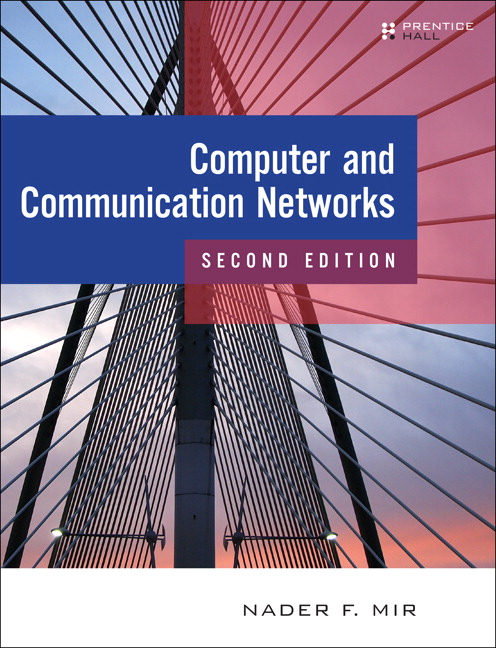
Dr. Nader F. Mir is a Professor of Electrical Engineering at San Jose State University, where he serves in the Charles W. Davidson College of Engineering within the Electrical Engineering Department. His office is located in Engineering Building E251 at One Washington Square, San Jose, California 95192. With extensive experience in academia and research, Dr. Mir has served as Department Associate Chair and continues to contribute significantly to the field of electrical engineering and computer networking. Ph.D. in Electrical Engineering, Washington University (1995) Author of the widely adopted textbook 'Computer and Communication Networks' (3rd Edition expected 2023-24) Holds US Patent 7,012,895 B1 for 'Packet-Switching Network with Symmetrical Topology' Series Technical Editor for IEEE Communications Standards Magazine (2015-present) Dr. Mir's research spans computer networks, protocols, TCP/IP, virtualization, AI, cloud data centers, network security, and multimedia networking. His work focuses on the intersection of theoretical networking principles and practical implementation challenges, particularly in emerging technologies like software-defined networking and network function virtualization. He has made significant contributions to understanding high-speed switching systems, multimedia streaming optimization, and cloud network architecture. His recent publications demonstrate a clear trajectory toward AI-driven network management, edge computing, and optimizing multi-tenant cloud environments. These works reveal his ability to adapt to evolving technological landscapes while maintaining focus on fundamental networking principles. The publications collectively showcase expertise across computer networking, cloud infrastructure, multimedia systems, and wireless communications. Nancy Wheeler Nelson Faculty Excellence Award (2017) Faculty Service Recognition Award (2017) Faculty Award for Excellence in Scholarship (2015) Faculty Author Award (2014) Most Effective Professor Award from IEEE-SJSU Society (2004) Dr. Mir has supervised numerous theses and graduate projects while serving on various Master's and PhD thesis defense committees. Beyond teaching and research, he has secured research grants including a CENIC Network Research Foundation grant for forest fire protection through surveillance sensor networks. His editorial work with IEEE publications has shaped discourse in communications standards and networking technologies. Dr. Mir's leadership extends to organizing major conferences including the IEEE International Conference on Computer Communication Networks and serving as chair for multiple international conferences.
Thomas Erich Zinner is Professor at the Department of Information Security and Communication Technology, Norwegian University of Science and Technology (NTNU), a position held since August 2019. Previously, he served as visiting professor and head of the FG INET research group at TU Berlin, and led the 'Next Generation Networks' research group at the University of Würzburg's Communication Networks chair. His educational background includes a diploma (2006) and Ph.D. (2012), both from the University of Würzburg. His research spans network architecture performance evaluation with emphasis on SDN/NFV and QoE-centric management approaches for emerging networks. Zinner's recent publications reveal strong trends toward intelligent 6G architectures integrating AI in the user plane, QoE-aware 5G resource allocation, and autonomic management of softwarized networks. His work combines theoretical modeling, simulation frameworks like OMNeT++, and practical implementations focused on real-world applicability in beyond-5G systems. He leads the Networking Research Group at NTNU working on the TeraFlow project, developing secure cloud-native SDN controllers for autonomic traffic management at massive scale. This initiative addresses critical challenges in next-generation network infrastructure through innovative controller architectures and flow management techniques.
Hiroyuki Kasai is a Full Professor at the School of Fundamental Science and Engineering, Waseda University, where he leads research in signal processing, machine learning, and optimization. He holds a B.Eng. (1996), M.Eng. (1998), and Dr.Eng. (2000) in Electronics, Information, and Communication Engineering from Waseda University. His career includes positions as Associate Professor and Professor at the University of Electro-Communications (2007-2019), Senior Policy Researcher at Japan's Cabinet Office (2011-2013), and visiting roles at Technical University of Munich and British Telecom. His research spans: Fundamental methodologies : Riemannian optimization, stochastic gradient algorithms, tensor decomposition Applied domains : Network analysis, multimedia systems, environmental sound processing, video coding Emerging areas : Low-rank modeling, manifold learning, and large-scale anomaly detection His publications focus on efficient algorithms for high-dimensional data, with recent work emphasizing Riemannian manifold optimization and real-time tensor analysis. This includes development of open-source tools like SGDLibrary (MATLAB) and McTorch (PyTorch) for optimization tasks. Awards include: IEEE ICCE Best Paper Award (2011) Yamashita Memorial Award (2003) Ericsson Young Scientist Award (2001) 電気通信普及財団賞 (2015) IEICE Service Recognition Award (2010) He maintains memberships in IEEE, IEICE, IPSJ, and JSIAM, and has contributed to over 100 peer-reviewed publications with significant citation impact (h-index 27 via Google Scholar).
Dr. Xiao Su is Associate Dean for Graduate Studies and Research at the Charles W. Davidson College of Engineering, San José State University, and a faculty member in the Computer Engineering Department. She joined SJSU in Fall 2002 after working at Inktomi Corporation. Dr. Su holds a Ph.D. from the University of Illinois, Urbana-Champaign (2001) and teaches courses in networking and security. Her research spans computer networking, multimedia communications, network security, and cloud computing. She has secured over $2.5M in research funding from NSF, NASA, Intel, and HP. Major grants include a $400K NSF CAREER Award (2006-2012) for multimedia streaming research and a $1.5M NASA grant for airport traffic optimization. Publications show strong focus on cloud-based media distribution, peer-to-peer networks, and security systems. Recent work emphasizes cloud storage optimization, mobile computing applications, and secure video transmission. Her 50+ publications demonstrate consistent innovation in distributed systems design and multimedia networking. Applied Materials Faculty Award for Excellence in Teaching (2012) College of Engineering Faculty Award for Excellence in Scholarship (2010) National Science Foundation CAREER Award (2006) As principal investigator, she has led 8+ major grants establishing research infrastructure and curriculum enhancements. She serves on NetApp's Academic Alliance advisory board and maintains active industry collaborations in Silicon Valley. A senior member of IEEE and ACM, Dr. Su has chaired technical committees for IEEE ICME and other international conferences.
Dr. Xiangmin Zhou is a Senior Lecturer at the School of Computing Technologies, RMIT University, located at City Campus Australia. His research focuses on artificial intelligence, data management, distributed computing, and multimedia systems. He actively supervises Masters and PhD students in areas such as fairness-aware task recommendation in spatial crowdsourcing and adaptive multi-participant analytics. His teaching interests include social media analysis, multimedia databases, query optimization, and cloud data management. Dr. Zhou’s research interests span information systems, AI-driven recommendation frameworks, privacy-preserving techniques, and distributed computing solutions. His work emphasizes context-aware systems, ethical AI, and scalable data processing. Recent publications highlight innovations in federated learning, privacy preservation, and social media-based disaster detection. He is open to supervising students interested in his core research areas and collaborative projects. Dr. Zhou’s academic contributions include developing novel algorithms for recommendation systems, social media analysis, and real-time event detection. His projects often bridge theory and practice, addressing challenges in spatial crowdsourcing, video novelty detection, and multi-platform coordination. His work aligns with RMIT’s focus on technology-driven solutions for societal challenges.