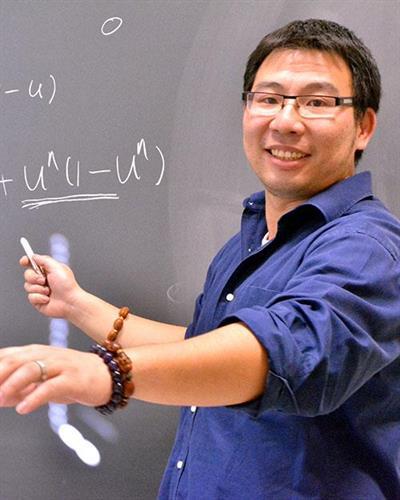
Joe Alexandersen is an Associate Professor in the Department of Mechanical Engineering at the University of Southern Denmark (SDU), affiliated with the Institute of Mechanical and Electrical Engineering. His research spans structural optimization, heat transfer, fluid dynamics, and high-performance computing, with applications in heat sink design, microfluidic devices, and additive manufacturing. Research Interests Topology and shape optimization Conjugate heat transfer Navier-Stokes flow modeling Finite element methods High-performance computing Scientific Awards 2022 Fluids 2020 Best Paper Award 2017 DTU Young Researcher Award 2015 ISSMO/Springer Prize for Young Scientist Key Projects HiHeaT: Topology optimization for high heat flux components (2024–2027) Structural Analysis of Large Modular Vessels (2025–2027)
Maurice S. Fabien is an Assistant Professor in the Department of Mathematics at the University of Wisconsin-Madison and a SIAM-MGB Early Career Fellow. In 2025, he will join MIT's Schwarzman College of Computing as an MLK Assistant Professor while on leave from UW-Madison. His research focuses on computational mathematics with specialization in partial differential equations, high-performance computing, and numerical methods including discontinuous Galerkin formulations and multigrid solvers. Research interests span: Development of structure-preserving discretizations for hyperbolic systems GPU-accelerated computational algorithms Hybridizable discontinuous Galerkin (HDG) frameworks Multiscale modeling in porous media and biomechanics Numerical analysis of nonlinear PDEs Publications demonstrate strong focus on: High-order methods for conservation laws Efficient solvers for elliptic/parabolic systems Applications in fluid dynamics and materials science GPU-based performance optimization Error analysis of energy-stable schemes Awards & Honors: SIAM-MGB Early Career Fellowship (2025) Research Team: Austin Anyanwu (Undergraduate) - Finite precision arithmetic Alexis Liu (Alumni) - GPU-accelerated elliptic solvers Patrick Li (Undergraduate) - GPU-based mesh refinement Neer Mehta (Alumni) - Adaptive mesh refinement algorithms Significant involvement since 2007 in STEM diversity initiatives focused on recruitment/retention of underrepresented groups in academia.
Prof. Daniel Kressner is a Professor at the École Polytechnique Fédérale de Lausanne (EPFL), holding positions in the School of Basic Sciences (SB), Mathematics Institute (MATH), and the Numerical Algorithms and High-Performance Computing (ANCHP) group. He also leads the SMA-ENS unit within the SB-SMA division. His research focuses on numerical linear algebra, high-performance computing, and tensor approximation methods, with applications in scientific computing and data science. Education details are not explicitly listed, but his career at EPFL includes leadership in key research groups and doctoral programs. He supervises multiple doctoral students, including Alice Cortinovis, Peter Effenberger, and others. Research interests emphasize low-rank methods, matrix equations, and efficient algorithms for large-scale problems. Recent work includes advancements in randomized algorithms, tensor networks, and preconditioning techniques for eigenvalue problems. His publications span high-impact journals like Siam Journal on Matrix Analysis and Applications and Numerical Linear Algebra with Applications, addressing topics such as compressed sensing, multigrid methods, and distributed signal processing. Prof. Kressner advises doctoral candidates and contributes to the Program doctoral Mathématiques (EDMA-GE) committee. His lab, ANCHP, develops software tools for hierarchical matrices and tensor computations, such as the hm-toolbox for HODLR and HSS matrices.
Luke Olson is a Professor in the Department of Computer Science at the University of Illinois at Urbana-Champaign (UIUC), part of the College of Engineering. He holds an affiliate appointment in the Department of Mechanical Science and Engineering. His research focuses on numerical methods, high-performance computing, and parallel algorithms, particularly algebraic multigrid (AMG) solvers and sparse matrix computations. He leads the development of open-source libraries like PyAMG and RAPtor, advancing computational tools for scientific and engineering applications. Education: Ph.D. in Applied Mathematics from the University of Colorado Boulder (2003), M.S. in Mathematics from the University of Iowa (1999), and B.A. in Mathematics and Physics from Luther College (1997). Research Interests: Algebraic multigrid methods and preconditioners High-performance computing and parallel algorithms Numerical solutions to partial differential equations Scientific computing and software development Machine learning integration in numerical simulations Recent Articles Trends: Recent work merges machine learning with traditional numerical methods, such as neural network closures for turbulent combustion and reduced basis approximations using neural networks. Ongoing contributions include optimizing multigrid methods for exascale architectures and enhancing communication efficiency in distributed systems. Awards: Recognized with the NSF CAREER Award (2007), UIUC Campus Award for Excellence in Teaching (2024), and the Donald Biggar Willett Faculty Scholar distinction (2016). Active in conference organization, including the Copper Mountain Conference on Multigrid Methods. Teaching & Grants: Teaches courses like Numerical Methods for PDEs and Scientific Machine Learning. Leads projects funded by NSF and industry collaborations, emphasizing education innovation through the AE3 fellowship (2014–2016). Labs/Teams: Directs the Scientific Computing Group at UIUC and contributes to interdisciplinary initiatives like the Center for Exascale-enabled Scramjet Design (CEESD).
Amanda Bienz serves as an Assistant Professor in the Department of Computer Science at the University of New Mexico (UNM), where she leads the Scalable Solvers Lab and acts as faculty advisor for Women in Computing. Her academic roles include teaching operating systems and parallel computing courses while spearheading efforts to restructure New Mexico's CS4ALL curriculum for statewide computer science education expansion. Her research centers on overcoming communication bottlenecks in high-performance computing systems, specifically targeting the performance gap between emerging exascale hardware and real-world applications. Key focus areas include developing portable communication optimizations, enhancing MPI collective operations, creating topology-aware message passing extensions, and benchmarking heterogeneous architectures. Her work directly addresses critical challenges in scaling parallel applications through innovations in sparse solvers, neighborhood collectives, and node-aware communication strategies for GPU-accelerated systems. Analysis of her 2022-2024 publications reveals consistent emphasis on communication optimization across diverse HPC domains. Her research demonstrates particular expertise in irregular communication patterns, locality-aware algorithms, and performance modeling for heterogeneous architectures. Significant contributions include novel approaches to sparse dynamic data exchange, compressed linear algebra algorithms, and persistent communication techniques that reduce synchronization overhead in large-scale simulations. Scientific Awards: NSF CAREER Award for "Towards Exascale Performance of Parallel Applications" Dr. Bienz actively mentors students through the Scalable Solvers Lab, welcoming new researchers interested in high-performance computing. Her NSF CAREER grant provides substantial research funding supporting both technical innovation and educational initiatives. The CS4ALL curriculum restructuring project demonstrates her commitment to broadening computer science access throughout New Mexico's K-12 education system. The Scalable Solvers Lab develops open-source tools including the Raptor algebraic multigrid solver and MPI-Advance communication library. Current projects focus on benchmarking heterogeneous architectures (Summit/Lassen supercomputers), optimizing FFT implementations, and creating node-aware communication strategies for conjugate gradient methods. The lab maintains active GitHub repositories with substantial community engagement, including contributions to CUDA-aware MPI implementations and halo exchange libraries for multi-GPU systems.
Jieyang Chen is an Assistant Professor in the Department of Computer Science at the University of Oregon's School of Computer and Data Sciences, where he leads research in high-performance computing and data-intensive scientific applications. His work bridges theoretical computer science with practical solutions for large-scale computational problems. Research Focus: Developing energy-efficient algorithms for CPU-GPU heterogeneous systems Creating fault-tolerant frameworks for scientific computing Designing advanced data compression techniques with error control Optimizing distributed machine learning workflows Dr. Chen's research portfolio demonstrates a consistent focus on performance, reliability, and energy efficiency in scientific computing. His recent publications show increasing sophistication in handling scientific data through techniques like multigrid frameworks, progressive retrieval methods, and adaptive compression algorithms that preserve critical features in climate and other scientific datasets. Education: PhD in Computer Science, University of California, Riverside (2019) MS in Computer Science, University of California, Riverside (2014) BE in Computer Science, Beijing University of Technology Dr. Chen previously worked as a Computer Scientist at Oak Ridge National Laboratory before joining the University of Oregon faculty. His collaborations span national laboratories and industry partners, contributing to real-world applications in scientific computing infrastructure.
Lars Grasedyck is a Professor of Numerical Analysis at RWTH Aachen University. His research focuses on hierarchical matrices, tensor approximation, and numerical methods for partial differential equations and matrix equations. He has contributed to applications in biomedical engineering, particularly EEG/MEG inverse problems, and is involved in software development (HLIB, HLIB-pro). Education: Diploma and Ph.D. in Mathematics at Christian-Albrechts-Universität zu Kiel (1998, 2001), Postdoctoral work at Max Planck Institute, Leipzig (2002-2010). Research: Specializes in high-dimensional numerical methods, low-rank matrices, and tensors with applications in PDEs, uncertainty quantification, and biomedical modeling. Projects: Leads DFG-funded initiatives on adaptive tensor networks for parametric PDEs and tumor progression modeling. Advising: Supervises doctoral students including Thong Le, Maren Klever, and Dieter Moser. Software: Developed HLib and HLib-pro for hierarchical matrix computations. Conferences: Active in GAMM Fachausschuss Numerische Analysis, organizing workshops and symposia globally.
Oliver G. Ernst is a Professor of Numerical Analysis at Technische Universität Chemnitz . His research focuses on Numerical Analysis , Uncertainty Quantification , and Inverse Problems , with applications in Thermo-Hydro-Mechanical (THM) processes , Electromagnetics , and Stochastic Partial Differential Equations . He is associated with the Numerical Analysis group at TU Chemnitz. Key Research Areas : Efficient numerical methods for PDEs Krylov subspace techniques Stochastic finite element methods Multi-physics modeling Geoscientific applications Recent Publications (2025-2010): THM simulations under uncertainty Neural network PDE solvers Bayesian inversion frameworks Rational Krylov algorithms Deflated restarting strategies Collaborations : TU Bergakademie Freiberg University of Manchester Technical University of Munich University of Maryland University of Geneva Software Development : Contributor to OpenGeoSys platform Developer of FEMALY MATLAB library Academic Recognition : h-index 32, i10-index 66, with over 4423 citations since 2020.
Dr. Lipeng Wan is a tenure-track Assistant Professor of Computer Science at Georgia State University (GSU), located at 25 Park Place, room 733. He holds a B.Eng. in Communication Engineering from Nanjing University of Science and Technology (2008), an M.Eng. in Information and Communication Engineering from Southeast University (2011), and a Ph.D. in Computer Science from the University of Tennessee, Knoxville (2016). Prior to joining GSU, he served as a Computer Scientist at Oak Ridge National Laboratory (ORNL), first as a postdoctoral researcher (2016–2018) and later as a full-time research staff member (2018–202?). His research focuses on big data management and analytics , high-performance and data-intensive computing , and resilience and performance optimization for distributed systems . Key interests include scientific data workflows, I/O innovations for exascale systems, and error-controlled data compression frameworks like MGARD and HPDR. Dr. Wan’s recent work emphasizes adaptive data transmission (e.g., JANUS), load balancing in cloud environments (SciLance), and optimizing file access patterns on HPC systems. His publications address challenges in exascale computing, including I/O performance, geographically distributed data management, and feature-preserving compression for climate simulations. He leads research at GSU in collaboration with national labs like ORNL, focusing on advancing scalable data management techniques for high-performance computing applications.
Olaf Schenk is a Professor at the Institute of Computing within the Faculty of Informatics at Università della Svizzera italiana (USI), Switzerland. He serves as Director of the Institute of Computing and Co-Director of the Master in Computational Science. He is also an adjunct member of the Computer Systems Institute at USI. PhD in Information Technology and Electrical Engineering, ETH Zurich (2001) Venia Legendi in Mathematics and Computer Science, University of Basel (2009) Applied Mathematics, Karlsruhe Institute of Technology (KIT), Germany His research focuses on high-performance computing , computational science and engineering , and applied algorithms for extreme-scale simulations. He bridges computer science with scientific computing needs, particularly in parallel algorithms , sparse solvers , graph analytics , and manycore architectures . His work emphasizes scalable software tools and programming models for emerging HPC systems. The 15 most recent publications reflect a consistent focus on sparse matrix computations , parallel and task-based algorithms , graph partitioning , and performance optimization for heterogeneous and manycore systems. Keywords span high-performance computing, numerical linear algebra, and large-scale data analysis, showing strong integration of theoretical algorithm design with practical implementation. Olaf Schenk has received several prestigious honors: Elected Fellow, Society for Industrial and Applied Mathematics (SIAM) Senior Member, IEEE and ACM SIAM Supercomputing Prize 2023 IBM Faculty Award Two Leadership Computing Awards from the U.S. Department of Energy He has held leadership roles as Chair, Vice Chair, and Program Director of the SIAM Activity Group on Supercomputing. He serves as Associate Editor for ACM Transactions on Mathematical Software and on the editorial board of SIAM Journal on Scientific Computing . He has participated in over 60 international program committees, including top-tier conferences such as SC, IPDPS, and IEEE CSE. He advises PhD and Master’s students in computational science and leads research projects funded by national and international agencies. He is also the Founder & Director of Panua Technologies Sagl, focusing on high-end software for simulation and optimization. His research group at USI works on next-generation computing tools for extreme-scale scientific simulations, with ongoing work in adaptive algorithms, resilience, and hybrid CPU-GPU computing. He leads collaborative projects with institutions in Europe and the U.S., aiming to develop scalable, robust, and efficient software for future exascale systems.
Allan Peter Engsig-Karup is Associate Professor in the Department of Applied Mathematics and Computer Science at the Technical University of Denmark. His research develops high-order numerical methods for wave modeling, coastal engineering, and computational fluid dynamics. He specializes in spectral element methods, GPU computing, and uncertainty quantification techniques. Recent work advances numerical solvers for incompressible Navier-Stokes equations with free surfaces, hybrid-spectral models for nonlinear waves, and unfitted mesh techniques. His group develops efficient algorithms for large-scale simulations of water wave interactions with offshore structures.
Fayssal Benkhaldoun is a Professor at Université Paris 13, affiliated with the LAGA laboratory (UMR7539). He has held leadership roles including former Head of the MCS team (Modeling and Scientific Computing) at LAGA and former President of the Scientific Council at IUT Villetaneuse. He is also the Project Leader of the International Office at IUT Villetaneuse. His research focuses on numerical methods for partial differential equations, particularly finite volume schemes for hyperbolic and elliptic problems. Key areas include shallow water equations, flow in porous media, mesh adaptation, and combustion front propagation. He has organized major conferences such as the International Symposium on Finite Volumes for Complex Applications (FVCA), initiating its first edition in 1996. Recent work emphasizes advanced numerical techniques like stabilized meshless methods, GPU acceleration, and parallel computing for CFD applications. His contributions span environmental modeling (flood simulation, sediment transport) and industrial applications (phosphate slurry rheology). Students advised include Jan Karel (2014, streamer propagation) and Saida Sari (2013, multilayer shallow water equations). He co-organized conferences since 1996 and has been an invited speaker at numerous institutions globally.
Harald Köstler is an Associate Professor and Head of Research at the Erlangen National High Performance Computing Center (NHR@FAU) within the Department of Computer Science at Friedrich-Alexander-Universität Erlangen-Nürnberg (FAU). He leads the research group on HPC Software Design at the Chair of Computer Science 10 (System Simulation), focusing on software engineering for high-performance computing and data analytics. His research interests include: Software Engineering for HPC Code Generation for Numerical Solvers Performance Engineering on Hybrid Architectures Discontinuous Galerkin and Lattice Boltzmann Methods Multigrid Solvers and Parallel Algorithms Performance Portability across CPUs, GPUs, and FPGAs The recent publications highlight a strong trend in developing efficient, scalable, and portable simulation frameworks for complex physical systems. His work emphasizes code generation, performance optimization, and the integration of classical model-driven and data-driven approaches. Key application areas include computational fluid dynamics, geotechnical engineering, and climate modeling, often leveraging the waLBerla and ExaStencils frameworks. Harald Köstler has no listed scientific awards in the provided text. He advises students in the areas of high-performance computing, numerical methods, and software engineering for scientific applications. His research is supported by collaborations within the FAU HPC ecosystem and likely involves grants related to national high-performance computing initiatives. He is a key contributor to the waLBerla framework, a block-structured, high-performance software for multiphysics simulations, and is involved with the ExaStencils project, which focuses on advanced multigrid solver generation. These frameworks form the core of his research team's efforts in scalable scientific computing.
André Brodtkorb is a Professor and Head of the Department of Information Technology at Oslo Metropolitan University. His research spans applied mathematics, numerical analysis, and computational science, focusing on physics simulations and GPU computing. He advocates for open and reproducible research and is actively involved in education and societal engagement through the Academy of Young Researchers (2024-2028). Research Interests: His work integrates applied mathematics and computer science to develop high-performance simulations for environmental phenomena, including ocean currents, volcanic ash dispersion, and coastal flooding. He specializes in GPU-accelerated parallel computing, finite-volume methods, and Python-based scientific programming. Publication Trends: Recent articles highlight advancements in GPU computing efficiency, ocean modeling, and inverse ash transport modeling for volcanic plume forecasting. His research bridges computational methods with real-world environmental challenges. Scientific Awards: Member of the Academy of Young Researchers (2024-2028) Contact Information: Office: Pilestredet 35, 0166 Oslo Phone: +47 456 19 070 (Mobile), +47 672 35 924 (Office) Email: andre.brodtkorb@oslomet.no
Xiaozhe Hu is a full-time Professor in the Department of Mathematics at Tufts University since July 2024. Previously held positions include Associate Professor (2019-2024) and Assistant Professor (2014-2019) at Tufts, and Adjunct Associate Professor (2020-2022) at the University of Bergen, Norway. Education : PhD in Computational Mathematics (Zhejiang University, 2009); BS in Information and Computer Science (Zhejiang University, 2004) His research focuses on scientific computing and numerical analysis , particularly: Development of adaptive and parallel numerical methods for PDEs and graph problems Multigrid/multilevel solvers for large-scale coupled systems Quantum algorithms and spectral graph theory Applications in poromechanics , reservoir simulation , and bioinformatics Recent publications demonstrate expertise in preconditioning techniques for Biot’s model, meshless methods for fluid-structure interaction, and data-driven discretization approaches . Awards include the Reimann-Louville Award (2016) and outstanding PhD graduate recognition (Zhejiang Province, 2009). PhD Students : Junyuan Lin (Loyola Marymount), Peter Ohm (RIKEN), Casey Cavanaugh (LSU), Kaiyi Wu, Eoghan O'Keefe Master Students : Charles Colley (Purdue PhD), Yue Shen (Florida State PhD), Samuel Rabinowitz, Phong Huang, Samuel Hocking Co-organizer of the Computational and Applied Mathematics Seminar and contributor to open-source HAZmath finite element library.