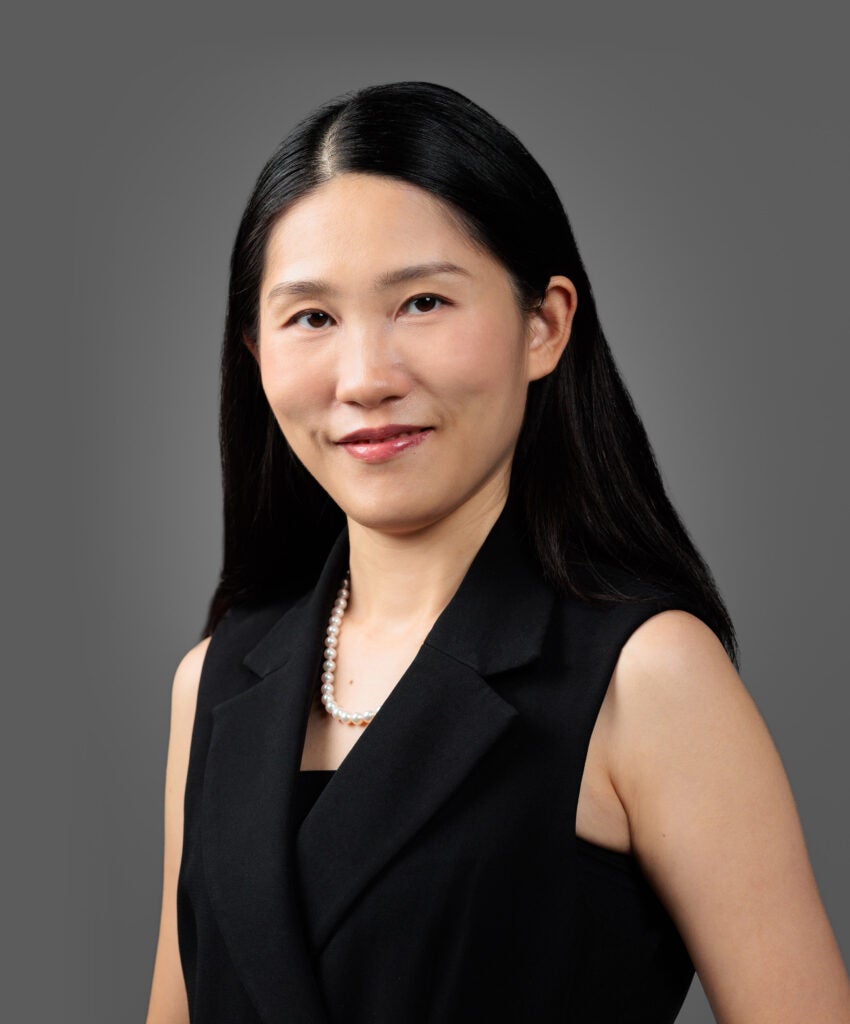
Miaofang Chi is a Professor in the Thomas Lord Department of Mechanical Engineering and Materials Science at Duke University. She holds a Ph.D. from the University of California, Davis (2008). Her research focuses on designing advanced materials using novel electron microscopy techniques to study atomic-scale behavior in energy-related applications, including solid-state batteries, catalysis, and sustainable materials. Key areas of interest include nanomaterials synthesis, electrochemical energy storage, and materials characterization. Education: Ph.D. in Materials Science, University of California, Davis, 2008 Courses Taught: ME 758S (Curricular Practical Training), ME 555 (Advanced Topics in Mechanical Engineering) Dr. Chi's work bridges materials science and energy technology, emphasizing the development of high-performance materials for batteries, catalytic systems, and microelectronics. Her research employs cutting-edge electron microscopy to study material behavior at the atomic level, contributing to advancements in energy sustainability and nanotechnology. Publications span over 200 peer-reviewed articles, with recent focus on solid-state battery characterization, nanocatalyst design, and interfacial stability in energy materials. Her lab (Chi Lab) is recognized for innovative contributions to materials discovery and analysis.
David Cahill is the Grainger Distinguished Chair in Engineering and Professor of Materials Science and Engineering at the University of Illinois Urbana-Champaign. He leads the David Cahill Research Group , focusing on nanoscale thermal transport, magnetic materials, and energy-related materials. His roles include co-Director of the IBM-Illinois Discovery Accelerator Institute and former Head of the Department of Materials Science and Engineering (2010-2018). Cahill holds a Ph.D. in Physics from Cornell University (1989) and a B.S. in Engineering Physics from Ohio State (1984). His research explores thermal management in advanced materials, nanoscale heat transfer, and experimental techniques like ultrafast laser metrology. Key interests include thermal conductivity of soft matter, magnetic materials' thermal properties, and battery material transport phenomena. Awarded the 2023 Paul Klemens Award and elected to the American Academy of Arts and Sciences (2023), Cahill has been recognized globally for innovations in materials characterization. His work bridges fundamental science and engineering applications, including thermoelectrics, battery technology, and semiconductor materials. Courses taught include MSE 201 (Phases and Phase Relations), MSE 401 (Thermodynamics of Materials), and specialized quantum materials seminars. His research group actively collaborates with industry and academia on projects such as thermal conductivity switching in polymers and high-performance solid-state electrolytes.
S. Lance Cooper is a Professor in the Department of Physics at the University of Illinois at Urbana-Champaign, where he also serves as Associate Head for Graduate Programs. He earned his B.S. from the University of Virginia (1982) and Ph.D. from the University of Illinois (1988), followed by a postdoctoral appointment at AT&T Bell Labs. His research focuses on optical spectroscopy of novel quantum materials under extreme conditions (low temperature, high pressure, and magnetic fields), with a particular emphasis on understanding emergent phenomena in strongly correlated systems. His group has pioneered studies of pressure-tuned quantum phase transitions in layered ruthenates, spinels, and topological insulators, revealing insights into orbital ordering, superconductivity, and magnetodielectric effects. Cooper has been active in academic service, including roles as Secretary-Treasurer for the Division of Condensed Matter Physics (APS, 2015-2019) and Associate Editor for Physical Review Letters (2006-2011). He has also been a leader in STEM education innovation, co-developing graduate-level courses on scientific communication and mentoring programs to integrate evidence-based writing pedagogies into STEM curricula. His educational initiatives have received recognition through awards such as the 2018 Campus Award for Excellence in Graduate Student Mentoring. Key research themes include: (1) field- and pressure-tuned spectroscopy of frustrated magnetism, (2) quantum phase transitions in layered chalcogenides, and (3) growth of high-quality single crystals for extreme condition studies. His work has produced over 60 peer-reviewed publications, with recent breakthroughs in understanding vibronic excitations in Ce₂O₃ and magnetodielectric behavior in spinel oxides. Collaborations span experimental physics, materials science, and education research.
Apala Majumdar is a Professor in the Department of Mathematics and Statistics at the University of Strathclyde, United Kingdom. She is a leading applied mathematician whose research lies at the interface of mathematical modeling, applied analysis, and theoretical physics, with a focus on nematic liquid crystals and soft materials. She holds visiting positions at the University of Bath and the University of Oxford, and is actively engaged in international collaborations across Europe, Asia, and the Americas. Her educational and professional journey includes appointments at the University of Bristol, University of Oxford, and the University of Bath, where she served as Director of the Centre for Nonlinear Mechanics (2018–2019) and led a Bath-Chile-Mexico research network. She is currently Principal Investigator on multiple international projects, including initiatives funded by the Isaac Newton Institute and the International Centre for Mathematical Sciences (ICMS), and plays a strategic role as a member of the Global Challenges Research Funding Strategic Advisory Group in the UK. Her research centers on four main themes: (i) analysis of continuum theories for liquid crystals; (ii) multiscale modeling linking microscopic and macroscopic descriptions; (iii) non-equilibrium phenomena such as switching dynamics; and (iv) industrial applications involving geometry- and energy-driven pattern formation. Her work is inherently interdisciplinary, involving collaborations with physicists, chemists, and industry partners like Merck Chemicals. Her recent publications reflect a strong focus on advanced modeling of liquid crystalline phases, including Landau-de Gennes theories, smectic phase transitions, topological defects, and confinement effects in spherical and 2D geometries. These works span high-impact journals such as SIAM Journal on Mathematical Analysis , Soft Matter , and Physical Review E , showcasing her contributions to both theoretical depth and practical applications. She has received numerous honors, including: Fellowship of the Royal Society of Edinburgh (2024) Friedrich Wilhelm Bessel Research Award (2022) Suffrage Science Award in Mathematics (2020) British Liquid Crystal Society Cyril Hilsum Medal Kirk Distinguished Fellowship at Isaac Newton Institute IOP Publishing Top Cited Paper Award for China (2024) She is deeply committed to mentoring and community building, supervising PhD students and postdoctoral researchers, and organizing initiatives such as the Retreat for Women in Applied Mathematics. She serves on the Programme Committee of the ICMS and is actively involved in shaping research strategy for global challenges. Her research group maintains a dedicated website at https://themajumdargroup.wordpress.com/ .
Axel Enders is an Adjunct Professor at the Department of Physics and Astronomy , University of Nebraska-Lincoln . His research focuses on self-assembly of nanostructures , nanomagnetism , and advanced scanning tunneling microscopy and X-ray circular dichroism techniques. Research Themes Self-assembly of dipolar molecules on metal surfaces Magnetic properties of nanoscale clusters and films Surface state engineering for molecular interactions Multiferroic nanoscale templates Key Collaborations Regular partnerships with Jan Honolka , Ralph Skomski , and Peter A. Dowben across multiple institutions Interdisciplinary work with Alexander Sinitskii (materials synthesis) and Klaus Kern (nanoscience) Technical Expertise Specializes in scanning tunneling microscopy for surface analysis Utilizes X-ray circular dichroism for magnetic characterization Develops buffer-layer assisted growth methods for nanoclusters
Christian Binek is an Associate Professor in the Department of Physics and Astronomy at the University of Nebraska-Lincoln , affiliated with the Nebraska Center for Materials and Nanoscience . His research focuses on voltage-controlled magnetism, spintronics, and thermodynamics of magnetic systems. PhD (1995) and Habilitation (2001) from the University of Duisburg, Germany Research at neutron facilities in Grenoble, France, and calorimetric studies at RIKEN, Japan His work pioneered perpendicular exchange bias and electrically controlled magnetism using chromia (Cr2O3). Recent publications analyze electromagnons, space-charge conduction, and voltage-tunable anisotropy in antiferromagnetic thin films. Scientific honors include the 1996 Duisburger Universitätsgesellschaft Outstanding PhD Thesis Award and the 2007 Sigma Xi Outstanding Young Scientist Award . Former advisees include postdoctoral researchers and PhD candidates who have transitioned to industry and academia.
Chetan Dhital is an Assistant Professor in the Department of Physics at Kennesaw State University (KSU), where he has been a faculty member since 2018. He leads an experimental condensed matter physics research group focused on non-centrosymmetric materials, topological magnets, and quantum phenomena. His laboratory specializes in single-crystal synthesis, neutron/X-ray scattering, and electromagnetic property measurements. Education: PhD in Physics, Boston College (2014) MS in Physics, Tribhuvan University, Nepal (2005) BS in Physical Science, Tribhuvan University, Nepal (1999) Research Focus: Dr. Dhital investigates materials exhibiting multiferroicity, superconductivity, magnetic skyrmions, and Weyl fermions. His recent work emphasizes chiral magnetic oxides, 2D MXenes, and kagome lattice systems, utilizing techniques like quantum oscillation measurements and surface-enhanced Raman spectroscopy to probe electronic and magnetic behavior. Teaching: He teaches undergraduate courses including Introduction to Physics (PHY2211/2212), Thermal Physics (PHY4230), and laboratory sessions, with office hours held weekly. Laboratory: Dr. Dhital directs a materials synthesis lab (Building E, Room 220, Marietta Campus) equipped with high-temperature furnaces, fume hoods, and electrical measurement tools. He actively recruits undergraduate researchers for projects involving national laboratory collaborations (e.g., Oak Ridge National Lab).
Prof. Manh-Huong Phan is a full Professor in the Department of Physics at the University of South Florida , where he directs the Laboratory for Advanced Materials and Sensors . He holds a Ph.D. in Engineering Physics from Bristol University, UK, and has established himself as a leading researcher in nanomagnetism and functional magnetic materials. Ph.D. : Engineering Physics, Bristol University, United Kingdom (2006) M.S. : Applied Physics, Chungbuk National University, South Korea (2003) B.S. : Solid State Physics, Vietnam National University, Vietnam (2000) His research focuses on nanomagnetism, nanospintronics, smart sensing technologies, energy-efficient multicaloric materials, magnetic nanoparticles, 2D van der Waals magnets, and quantum materials . His work bridges fundamental physics with applications in energy, healthcare, and advanced electronics. He has pioneered discoveries in room-temperature 2D ferromagnetism and light-tunable magnetism in transition metal dichalcogenides, contributing to the emerging field of opto-spin-caloritronics . The recent publications highlight a strong trend in two-dimensional magnetic materials , particularly vanadium-doped transition metal dichalcogenides (TMDs), with a focus on achieving and controlling room-temperature ferromagnetism using light and thermal stimuli. His group also advances magnetic sensor technologies , including novel magneto-LC resonance systems for respiratory monitoring, and explores fundamental phenomena like the spin Seebeck effect, exchange bias, and skyrmions in complex oxides and heterostructures. His scientific contributions have been recognized with numerous honors: Faculty Outstanding Research Achievement Award, USF (2017, 2019, 2021) Honorary Doctoral Degree, Vietnam National University - Hanoi (2021) Outstanding Dissertation Award, APS-GMAG (2022) National Research Council (NRC) Fellowship for his student Inclusion in the World's Top 2% Scientists list Prof. Phan is a dedicated mentor, advising numerous graduate and undergraduate students who have won awards for their presentations and research. His group has secured significant funding from agencies like NSF, DOE, NASA, and ARO . He is also active in the academic community as an editor for journals such as Journal of Science: Advanced Materials and Devices (Elsevier) and Scientific Reports (Nature), and as an organizer and chair for major international conferences on magnetism and materials. He leads a dynamic research team focused on cutting-edge projects in 2D magnetism, smart sensors, and energy materials , with recent innovations including AI-integrated respiratory monitoring for COVID-19 detection and the development of novel magnetocaloric microwires for efficient refrigeration.
Oleg G. Shpyrko is an Associate Professor in the Department of Physics at the University of California, San Diego. His research group focuses on experimental condensed matter physics, utilizing advanced X-ray techniques to study nanoscale structural and magnetic dynamics in both hard and soft matter systems. His research interests include: Coherent X-ray scattering and diffraction imaging Dynamics in strongly correlated electron systems Magnetic nanostructures and antiferromagnetic domain walls Phase transitions in soft and hard condensed matter Materials for energy storage and conversion Nanoscale confinement effects The recent publications highlight a strong trend in using coherent X-ray techniques such as Bragg Coherent Diffraction Imaging (BCDI) and X-ray Photon Correlation Spectroscopy (XPCS) to probe nanoscale dynamics in materials ranging from battery cathodes to magnetic systems and biological nanostructures. His work bridges fundamental physics with applied materials science, particularly in energy and quantum materials. His research has been supported by prestigious awards and grants: NSF CAREER Award Department of Energy (Basic Energy Sciences) Air Force Office of Scientific Research (AFOSR) Argonne LDRD Hellman Foundation Prof. Shpyrko has advised several successful graduate students, including Andrej Singer (now Assistant Professor at Cornell), Roopali Kukreja (Assistant Professor at UC Davis), Andrew Ulvestad, Devin Cela, and Leandra Boucheron, many of whom have received awards and recognition. His lab maintains in-house capabilities in dynamic light scattering, atomic force microscopy, microfocus X-ray systems, and cryostats, while heavily utilizing national facilities such as the Advanced Photon Source, LCLS, NSLS-II, and PETRA III. His group actively explores future research directions enabled by fourth-generation synchrotron sources and X-ray free-electron lasers, aiming to uncover non-equilibrium dynamics and hidden order in complex materials.
Rebecca Ricciardo is an Assistant Professor of Teaching in the Department of Chemistry & Biochemistry at The Ohio State University. She specializes in general chemistry instruction, focusing on equitable teaching practices and addressing systemic barriers in STEM education. Her work includes redesigning general chemistry curricula to support students with varying math and chemistry backgrounds through innovative course pathways. Dr. Ricciardo holds a B.S. in Chemistry (Summa Cum Laude, Kent State University, 2004) and a Ph.D. in Solid State Inorganic Chemistry from The Ohio State University (2009). She completed an NSF-funded postdoctoral fellowship at OSU’s Center for Emergent Materials (2009–2011), during which she began her teaching career. Her research bridges chemistry and education, emphasizing culturally responsive pedagogy and math-chemistry curriculum design. Key Projects: Redesigned CHEM1206/1208 courses to integrate math prerequisites, enabling broader STEM access. Teaching: Instructs general chemistry courses (CHEM1210, 1220) and leads active-learning initiatives in large classrooms. Her scientific awards include an NSF Materials Post-Doctoral Research Fellowship. She has published extensively in inorganic chemistry and chemical education, focusing on material properties, charge transfer mechanisms, and undergraduate research integration. Rebecca’s work addresses systemic inequities in STEM by reimagining curricula to foster belonging and access for underrepresented students, aligning with national efforts to diversify the scientific workforce.
Jihang Yu is a Lecturer at the Department of Material Science and Engineering, National University of Singapore (NUS). Prior to this role, she worked as a Principal Process Integration Engineer at GlobalFoundries Singapore, focusing on back-end-of-line (BEOL) process integration for STTMRAM development and production. She holds a Bachelor’s degree (First Class Honors, 2015) and a Ph.D. (2019) in Material Science and Engineering from NUS. Her research centers on high-perpendicular magnetocrystalline anisotropic (PMA) materials for spintronic devices, particularly achieving SOT switching in single-layer metallic PMA materials. Her work bridges fundamental materials science with applied magnetoelectronics, emphasizing thin-film properties and device applications. Key publications include groundbreaking studies on magnetization switching mechanisms, topological effects in magnetic materials, and spin-orbit torque dynamics in advanced alloys like FePt and CoFeC. These contributions highlight her expertise in magnetic materials, spintronic devices, and nanoscale phenomena. Her engineering background at GlobalFoundries informs her research in scalable magnetic technologies, while her academic work demonstrates innovation in low-power, high-efficiency magnetic systems.
Riccardo Comin is an Associate Professor in the Department of Physics at the Massachusetts Institute of Technology (MIT). His research focuses on quantum materials, particularly exploring electronic and magnetic phenomena in low-dimensional and strongly correlated systems. Key areas include van der Waals magnets, superconductivity, topological materials, and energy-related materials. He investigates novel functionalities through advanced spectroscopic and nanofabrication techniques. His work combines experimental approaches such as resonant X-ray scattering, angle-resolved photoemission, and ultrafast spectroscopy to study electronic structure, spin dynamics, and emergent phases. Current research emphasizes strain-engineered multiferroics, charge/spin ordering in cuprates, and nanoscale magnetism in 2D systems. Comin’s group develops novel materials synthesis routes and advanced characterization tools to uncover quantum phenomena with potential for next-generation electronics and energy applications. Recent studies include electrical control of p-wave magnetic phases, electronic commensuration in layered semimetals, and stacking-dependent ferroelectricity in van der Waals heterostructures. His research has led to discoveries in topological flat bands, strain-tunable superconductivity, and nanoscale spin wave dynamics. Comin’s work bridges fundamental physics with technological applications in optoelectronics and quantum devices.
Dr. Arkadeb Pal is a Researcher at the University of Groningen within the Faculty of Science and Engineering and the Solid State Materials for Electronics department. His expertise lies in experimental condensed matter physics , focusing on the magnetism of matter and its interplay with electronic and structural properties. Recent research includes studies on magnetoelectric coupling , spin-phonon interactions , and multiferroic behavior in materials like MnSb2O4, α-FePO4, and MnGeTeO6. These works explore field-driven phase transitions, hidden electric polarization, and magnetoelastic effects using techniques such as neutron diffraction and specific heat measurements. His publications in Physical Review B highlight collaborations with researchers from institutions in the Netherlands, Taiwan, and India. Key keywords include Condensed Matter Physics , Magnetism , Spin-Phonon Coupling , and Multiferroic Materials . No formal advising roles or awards are documented in the provided materials.
Martin Sarott is a Postdoctoral Researcher in Complex Oxides at the University of Groningen, affiliated with the Zernike Institute for Advanced Materials and the Faculty of Science and Engineering. His research focuses on epitaxial ferroic thin films, domain configurations, optical control of ferroic order, and complex oxides for unconventional computing. He specializes in experimental techniques including pulsed laser deposition, nonlinear optics, X-ray diffraction, and advanced microscopy methods. His work addresses challenges in material synthesis, domain engineering, and device fabrication, with applications in next-generation electronics and energy-efficient systems. Notably, he explores strain effects on polar phases in WO3 thin films and optical manipulation of ferroelectric polarization states. Recent publications highlight contributions to understanding structure-property relationships in epitaxial systems, polar skyrmions, and novel diffraction strategies for hidden order detection. Sarott collaborates on projects involving 2D materials, plasmonic membranes, and quantum sensing for domain imaging. His experimental toolkit includes advanced lithography (photolithography, electron beam lithography) and in-situ characterization methods.
Makoto Iwata serves as Professor in the Department of Physical Engineering within the Faculty of Engineering at Nagoya Institute of Technology, where his research centers on ferroelectric phenomena, dielectric properties, and structural phase transitions in condensed matter systems. His experimental work focuses on electric field-induced critical behavior in crystals and liquid crystals, utilizing advanced characterization techniques including scanning force microscopy and X-ray fluorescence holography. He earned both his Master of Engineering (1991) and Doctor of Engineering (1994) degrees from Nagoya University, where he subsequently served as Research Assistant from 1994 to 2001 before joining Nagoya Institute of Technology. Professor Iwata's research program investigates field-driven phase transitions in complex oxides and liquid crystals, with particular emphasis on relaxor ferroelectrics, crystal growth of perovskite materials, and the development of tunable dielectric devices. His experimental approach integrates dielectric spectroscopy, structural analysis, and phase diagram mapping under electric fields to understand critical phenomena near morphotropic phase boundaries. Analysis of his publication record reveals consistent high-impact output spanning ferroelectric critical endpoints, aging effects in relaxor systems, and electric field manipulation of liquid crystal phases. The work demonstrates strong methodological coherence across condensed matter physics and materials science, with recent efforts focusing on KTN solid solutions and nematic liquid crystals exhibiting positive dielectric anisotropy. His honors include the JPEX/JJAP Editorial Contribution Award (2009) and consecutive Excellent Teacher Awards from Nagoya Institute of Technology (2016, 2018). JPEX/JJAP Editorial Contribution Award (2009) Excellent Teacher Award (2016) Excellent Teacher Award (2018) Professor Iwata currently leads a JSPS Grant-in-Aid for Scientific Research (C) project (2024-2028) on temperature-electric field-concentration phase diagrams in KTN crystals for tunable capacitor applications, while collaborating as Co-investigator on a Grant-in-Aid for Scientific Research (B) (2022-2026) developing 3D structural analysis of piezoelectric materials via X-ray holography. His academic leadership includes service as Associate Editor of the Journal of the Physical Society of Japan (2018-2025), committee roles in the Dielectric Society of Japan (including chairing the Best Young Researcher Award committee), and membership in the Japanese Physical Society and Applied Physics Society of Japan. He actively engages with the broader community through high school outreach programs including model lectures and hands-on physical engineering demonstrations at Nagoya Institute of Technology.