David Lindlbauer is an Assistant Professor at Carnegie Mellon University's Human-Computer Interaction Institute (HCII), where he leads the Augmented Perception Lab and co-directs the CMU Extended Reality Technology Center. His research focuses on advancing Mixed Reality (MR) and Extended Reality (XR) interfaces through computational interaction methods that optimize spatial, temporal, and multimodal feedback.
David Lindlbauer is an Assistant Professor at the Human-Computer Interaction Institute (HCII) within Carnegie Mellon University's School of Computer Science. He leads the Augmented Perception Lab and co-directs the CMU Extended Reality Technology Center (XRTC) . His research bridges Human-Computer Interaction, Computer Graphics, and Computer Vision to create adaptive interfaces that enhance human-digital interaction. Education : PhD (summa cum laude) from Technische Universität Berlin , MSc and BSc from University of Applied Sciences Upper Austria Previous Affiliation : Postdoctoral Researcher at ETH Zurich (2018-2020) David's research focuses on understanding human perception of digital information and developing computational approaches to optimize AR/VR interface usability. Key areas include: Context-aware adaptive interfaces Visual saliency and attention modeling Spatial audio-haptic systems Optimal placement algorithms Object manipulation in Remixed Reality Diminished/ambient MR interfaces His 15 most recent publications (2024-2025) span topics in adaptive XR interfaces, multimodal notifications, haptic systems, and spatial cognition. These works appear at venues like ACM CHI, ACM UIST, IEEE VR, and Frontiers in VR. Common themes include: Machine learning for interface adaptation Human factors in XR design Real-time environment analysis Privacy-aware display systems Collaborative MR interfaces Accessibility enhancements Scientific Recognition : Best Paper Honorable Mention Award (ACM CHI 2024) Best Paper Award (ACM ISS 2023) ETH Zurich Postdoctoral Fellowship Multiple best paper recognitions at CHI, UIST, and IEEE VR Teaching & Leadership : Course developer for CMU's "Interactive Extended Reality" Mentor for NASA SUITS Challenge team Co-chair roles at CHI and UIST Overseeing PhD students and research interns
Markus Vincze is an Associate Professor at the Institute of Automation and Control Engineering (ACIN) at Vienna University of Technology (TU Wien). He founded the Vision for Robotics (V4R) group in 1996 to advance robotic perception, particularly in real-world environments and homes. His work focuses on cognitive computer vision techniques for robotics. Education: Diplom in Mechanical Engineering (1988) and PhD (1993) from TU Wien; M.Sc. (1990) from Rensselaer Polytechnic Institute. V4R coordinates EU projects like ActIPret, robots@home, HOBBIT, and national initiatives like vision@home. Markus has edited a book on Robust Vision with Gregory Hager and authored 62 peer-reviewed journal articles and over 400 reviewed publications. His recent research explores zero-shot 6D pose estimation, sim-to-real transfer, and transparent object detection. Markus has served as program chair for ICRA 2013 and organized HRI 2017 in Vienna. He has advised numerous students and secured grants from the Austrian Academy of Sciences for work at HelpMate Robotics and Yale's Vision Laboratory. The V4R group leads innovations in robotic vision, including frameworks for synthetic data generation (Unrealgensyn), depth completion (CAGT), and educational robotics applications for sustainability. Their work spans household robotics (RH3), agricultural robotics (EdgeSoil), and human-robot collaboration.
Jian Zhao is an Associate Professor at the University of Waterloo's School of Computer Science, specializing in Information Visualization (InfoVis), Human-Computer Interaction (HCI), and Data Science. With a Ph.D. from the University of Toronto (2016), his research emphasizes interactive visualization techniques, AI integration in design processes, and socio-technical systems. He explores how human-AI collaboration can enhance data analysis, presentation, and user experience in complex systems. Key research areas include: 1) AI-Driven Design (e.g., code generation via sketching, infographic creation), 2) Health Informatics (therapeutic AI tools for autism support), 3) Immersive Technologies (VR/AR interfaces for presentations and education), and 4) Social Computing (remote family communication, multi-modal emoticons). His work bridges technical innovation with human-centered design principles. His publications (2021–2025) reflect a focus on interactive visualization frameworks (e.g., iTrace for cross-view data analysis), AI-human collaboration (CoLadder for hierarchical code editing), and specialized applications like TherAIssist for art therapy and EMooly for autism support. Zhao frequently explores novel interaction modalities , including gesture-based VR interfaces and sketch-based programming tools. He leads projects in computational notebooks (EDAssistant, Slide4N), visual analytics (MissBin for bipartite networks), and neurofeedback training games (Eggly). His work often emphasizes systematic design considerations for missing data, cross-view analysis, and contextual visualization in spatial AR environments.
Mark D. Gross is a Professor of Computer Science and Director of the ATLAS Institute at the University of Colorado Boulder. His research focuses on modular robotics, tangible interaction design, digital fabrication, and computational design. He co-founded Modular Robotics and Blank Slate Systems, leveraging his expertise in educational technology and maker culture. Education: PhD in Design Theory & Methods from MIT. Academic history includes roles at Carnegie Mellon University and University of Washington Seattle. His work spans architecture, robotics, and human-computer interaction. Research Interests: Modular robotics and computationally enhanced construction kits Tangible interaction and e-textiles Shape-changing interfaces and swarm robotics Sketch-based interaction and digital fabrication Publications highlight advancements in collaborative AR systems, shape-changing interfaces (e.g., LiftTiles, ShapeBots), and accessible technologies like FluxMarker. His work bridges computational tools and creative design processes. Advising: Guided students such as Ryo Suzuki (PhD '20). Entrepreneurial ventures include companies spun off from research. Labs/Teams: Leads projects at the ATLAS Institute, emphasizing interdisciplinary collaboration in robotics, design, and human-centered computing.
Arie E. Kaufman is a Distinguished Professor in the Department of Computer Science at Stony Brook University, serving as Chief Scientist of the Center of Excellence in Wireless and Information Technology (CEWIT) and Director of the Center of Visual Computing (CVC). He additionally holds a Distinguished Professorship in Radiology, with a 40+ year career at Stony Brook since joining in 1985 and chairing the CS department from 1999-2009. His seminal research spans computer graphics, visualization, and virtual reality with biomedical applications, pioneering breakthroughs including 3D Virtual Colonoscopy (FDA-approved colon cancer screening), Cube hardware architectures (commercialized as VolumePro), the Reality Deck (1.5 billion-pixel immersive display), and foundational work in volume visualization. His interests focus on real-time rendering, medical imaging, and immersive analytics, with recent work integrating machine learning for healthcare and environmental risk visualization. Recent publications demonstrate continued leadership in high-resolution immersive displays (Silo), XR analytics with LLMs, storm surge visualization, and neural reconstruction techniques. His work bridges theoretical innovation with practical applications, particularly in pancreatic cancer prognosis and disaster preparedness. Major honors include: IEEE Visualization Career Award (2005) Fellow of the National Academy of Inventors (2017) ACM Fellow (2009) IEEE Fellow (1998) Long Island Technology Hall of Fame (2013) European Academy of Sciences membership (2002) As PI on 100+ research grants, Kaufman's work has generated 300+ refereed papers, 40+ patents, and extensive media coverage (New York Times, Science, Wall Street Journal). He leads the Center of Visual Computing with focus on translational research, including VolVis software (5,000+ installations) and Reality Deck deployments for big data analytics. His lab develops cutting-edge visualization infrastructure for medical diagnostics and environmental modeling, with current projects advancing immersive storm surge analytics, neural structure extraction, and VR-based risk communication systems. Future work emphasizes AI-enhanced visualization for precision medicine and climate resilience planning.
Pere-Pau Vázquez is an Assistant Professor in AI for Visual Computing at the Computer Vision Lab, TU Wien, Austria . Previously, he held academic positions at the ViRVIG Group and Facultat d'Informàtica de Barcelona (UPC) , where he taught courses in Programming, Computer Graphics, and Visualization for over 20 years. His research focuses on Information Visualization, Scientific Visualization, Medical Data Visualization, Molecular Visualization, and AI applications to Visual Computing . Current Teaching : Data Visualization, Fast Realistic Rendering, Information Visualization, Medical Images, Scientific Visualization, Virtual Reality, and 3D Medical Visualization. Former PhD Students : Elena Molina, Alexandra Cortez, Jesús Díaz, Pedro Hermosilla, Eva Monclús. His scientific awards include the Best PhD Thesis Award (UPC, 2003), Best Student Paper Award (SPIE, 2012), and Best Paper Award (International Conference on Computer Graphics Theory and Applications, 2013). Recent publications explore AI integration in biomedical visualization, molecular data analysis, and interactive techniques for volume rendering. He serves on the EuroGraphics Executive Board as Secretary and is active in steering committees for EuroVis and Visual Computing for Biology and Medicine . His work bridges Computer Graphics, Artificial Intelligence, and Human-Computer Interaction , with applications in medical and molecular data analysis.
Toshiharu Sugawara is a Professor in the Department of Computer Science and Engineering at Waseda University's Faculty of Science and Engineering, School of Fundamental Science and Engineering, a position he has held since April 2007. With a Ph.D. in Engineering from Waseda University, his research spans multiple domains in artificial intelligence and multi-agent systems, maintaining active collaborations across international institutions and contributing significantly to the field through numerous publications and awards. Dr. Sugawara received his BS and MS degrees in Mathematics from Waseda University in 1980 and 1982, respectively, followed by his Ph.D. in 1992. Before joining Waseda University as faculty, he worked as a Research Scientist at NTT Laboratories from 1982 to 2007, with a visiting researcher position at the University of Massachusetts at Amherst in 1992-1993. He also held part-time lecturer positions at University of Electro-Communications (2003-2007), Waseda University (2004-2006), and Tokyo University of Agriculture and Technology (1990-1991). His research interests focus on artificial intelligence with particular expertise in multi-agent systems, machine learning, cooperation and coordination mechanisms, soft computing, computational social science, and social informatics. His work bridges theoretical foundations with practical applications in network management and information systems. Recent publications demonstrate a strong trajectory toward interpretable multi-agent reinforcement learning, efficient path planning algorithms, and modeling social behaviors in complex networks. His research group has made significant contributions to multi-agent path finding, cooperative task execution, and understanding virtual economies in social media platforms. Dr. Sugawara has received numerous prestigious awards including multiple Best Paper Awards at JAWS conferences (2014, 2015, 2018), ACM SAC 2015, and various research paper awards from Japanese academic societies. His work on multi-agent systems has been consistently recognized for its theoretical rigor and practical impact. As an advisor, Dr. Sugawara has mentored numerous students who have become prominent researchers in their own right, with many co-authoring papers that have received awards. His laboratory maintains strong collaborations with industry partners, particularly in the areas of network management and intelligent systems. Current research directions include developing interpretable multi-agent reinforcement learning frameworks, optimizing multi-agent coordination in constrained environments, and analyzing social dynamics in virtual economies.
Taskin Padir is a Professor in the Department of Electrical and Computer Engineering at Northeastern University and concurrently serves as an Amazon Scholar. He holds a PhD and MS from Purdue University and a BS from Middle East Technical University. His research focuses on experiential robotics, human-robot teaming, and embodied AI, with leadership roles in the Robotics and Intelligent Vehicles Research Laboratory (RIVeR Lab) and the Institute for Experiential Robotics. Padir has led projects for DARPA, NASA, and industry partners, advancing autonomous systems for extreme environments and human-robot collaboration. Education: PhD, Electrical and Computer Engineering, Purdue University (2004) MS, Electrical and Computer Engineering, Purdue University (1997) BS, Electrical and Electronic Engineering, Middle East Technical University (1993) Research Interests: Shared autonomy and human-in-the-loop robotics Embodied artificial intelligence Human-robot teaming in extreme environments (e.g., space, disaster zones) Collaborative robotics for industrial applications His work bridges robotics, AI, and real-world challenges, with recent projects addressing seafood processing automation, robotic navigation in unstructured terrains, and spectroscopy-based environmental monitoring. Awards: Recipient of the 2024 Faculty Research Team Award, 2023 Impact Award, and 2022 Amazon Scholar distinction. His research has been funded by NSF, DARPA, NASA, and industry collaborators like Amazon Robotics and Intel. Labs: Director of the RIVeR Lab and Institute for Experiential Robotics, fostering interdisciplinary research in autonomous systems and intelligent vehicles. Current projects include CRISP (Co-worker Robots for Seafood Processing) and PROSPECT (robotic spectroscopy tools).
Steve Tanimoto is a Professor at the Paul G. Allen School of Computer Science & Engineering at the University of Washington, with an adjunct appointment in the Department of Electrical & Computer Engineering. His work focuses on human-centered computing, particularly in educational technology and collaborative problem-solving environments. He has made significant contributions to the understanding of liveness in programming environments and their application to education, including a keynote at the International Conference on Live Coding (2015) that traced historical influences leading to widespread use of liveness in modern software environments. Dr. Tanimoto's research spans several interconnected domains: Novice programming environments and educational technology Collaborative problem-solving environments and tools Technology for educational assessment, particularly using pattern-recognition methods for teaching written language on tablets Liveness in programming environments and its applications Image processing from interdisciplinary perspectives (as detailed in his MIT Press book "An Interdisciplinary Introduction to Image Processing: Pixels, Numbers, and Programs") His recent publications demonstrate a consistent focus on the intersection of computing education, human-computer interaction, and collaborative problem-solving. A notable trend is the exploration of "liveness" in programming environments and how this concept can enhance educational experiences. His work increasingly integrates AI technologies with educational applications, particularly in the areas of writing instruction and collaborative problem-solving, with significant NIH funding support (P50 HD071764 and U54 HD083091). His notable recognition includes: VL/HCC Best Showpiece Award in 2015 for "Solving Problems by Drawing Solution Paths" Dr. Tanimoto has advised several graduate students through to completion, including Robert Thompson (2019), Sandra Fan (2013), and Tyler Robison (2012). He currently advises Emilia Gan (co-advised with B. Mako Hill) and Edward Misback. His research has been supported by NIH grants for work on computerized writing and reading instruction for students with learning disabilities. His CoSolve research group has developed experimental facilities for collaborative problem-solving, exploring tools that support problem formulation, visualization of problem spaces, and team collaboration dynamics, with applications in education, design, and various problem-solving domains.
Sina Sareh is a robotics researcher at the Royal College of Art (RCA), where he leads the RCA Robotics Laboratory within the School of Design. He has established himself as an expert in soft robotics and multimodal sensing, developing innovative solutions for human safety and access problems in industrial operations. Dr. Sareh's educational background includes: PhD in Robotics from the University of Bristol, where he worked on monolithic design of flexible actuators for operation in confined liquid environments MSc in Control Systems from the University of Sheffield BSc in Electrical Engineering from Amirkabir University of Technology, Tehran Dr. Sareh's research focuses on soft robotics, multi-modal mobility, manipulation and attachment, and multimodal sensing. His work bridges the gap between robotics engineering and practical applications, particularly in medical and industrial settings. He has developed novel approaches to robotic attachment inspired by octopus biology, created haptic interfaces that mimic the feeling of touching human internal organs, and designed soft robotic technologies to help articulate pain symptoms. His research consistently demonstrates innovation in creating adaptable robotic systems that can operate effectively in complex, unstructured environments where traditional rigid robots face limitations. His publication record demonstrates a strong trajectory in robotics research, with emphasis on soft robotics, medical applications, and novel sensing techniques. The research shows progression from fundamental soft actuator design to practical applications in surgery, industrial operations, and human-robot interaction, with a consistent focus on solving real-world problems through biologically inspired approaches. Dr. Sareh has successfully secured multiple research grants, including EPSRC funding for 'Getting a Grip' and 'Multi-vendor Interoperability in Robotics,' as well as InnoHK funding for 'Intelligent Medicine Warehousing.' He has also served as an impact assessor for the Research Excellence Framework (REF) 2021 in Engineering and is a member of the editorial board at IET Cyber-physical Systems and Robotics Journal. Currently, Dr. Sareh advises research students including Filippo Sanzeni, and maintains active collaborations with industry and academic partners through the RCA Robotics Laboratory, which serves as a hub for interdisciplinary robotics research at the intersection of design, engineering, and human-centered applications. His work on projects like 'Topographies of Pain' and 'Reminisys' demonstrates a commitment to applying robotics technology to improve healthcare outcomes and quality of life.
Herman Bruyninckx is a Part-Time Full Professor at Eindhoven University of Technology (TU/e) in the Mechanical Engineering department, specifically within the Control Systems Technology group and EAISI High Tech Systems initiative. He also serves as a professor (Hoogleraar) at KU Leuven in Belgium. Academic focus on robotics, control systems, and multi-agent coordination Active research in model predictive control , semantic mapping , and dynamic constraint algorithms Recent publications address industrial automation , agro-food robotics , and haptic technology Research Highlights : Developed hybrid decision-making frameworks for multi-agent navigation Innovated swing-free control methods for robotic pick-and-place operations Formulated constrained dynamics algorithms with LQR-Gauss principle integration Created ExoTen-Glove for haptic feedback in virtual environments Collaborative Projects : Coordinated with researchers like René van de Molengraft , Elena Torta , and Koen de Vos Contributed to NWO/TTW FlexCRAFT project for cognitive robotics in agro-food technology
George Kesidis is a Professor in Computer Science and Engineering and Electrical Engineering at Penn State University. His research spans deep learning security, virtual reality optimization, and cloud computing. College of Engineering (Penn State University) Research Focus: Backdoor Attacks, DNN Robustness, Edge Caching Active in NSF and U.S. Navy-funded projects (2022-2026) His work addresses backdoor data poisoning , test-time evasion attacks , and DNN overfitting mitigation . He develops techniques like activation clipping, perturbation analysis, and statistical defense models. Recent projects include edge caching systems for VR and security-driven AI frameworks. Key article trends reveal expertise in adversarial deep learning, immersive media delivery, and cloud resource optimization. Current grants focus on multi-user VR, GPU scheduling, and serverless-cloud hybrid architectures. He collaborates extensively with researchers like David J. Miller and Xinyu Li, particularly on cloud-based adversarial defense mechanisms and VR streaming benchmarks.
Karan Ahuja is the Lisa Wissner-Slivka & Benjamin Slivka Assistant Professor of Computer Science at Northwestern University, directing the Sensing, Perception, Interactive Computing & Experiences (SPICE) Lab. He earned his Ph.D. in Human-Computer Interaction from Carnegie Mellon University (2023) and a B.Tech. in Computer Science (2017). His research focuses on creating technologies that sense and understand human behavior, with applications in mobile health, extended reality, and natural user interfaces. Key projects include LemurDx for ADHD diagnosis, EITPose for wearable hand pose tracking, and MobilePoser for full-body pose estimation via consumer IMUs. Awards include Forbes 30 Under 30 (2024), MIT 35 Innovators Under 35 Asia Pacific, and ACM SIGCHI's Outstanding Dissertation Award. He has worked at Google, Apple, Microsoft Research, Meta Reality Labs, and IBM Research. His lab emphasizes real-world deployments, with technologies licensed and integrated into products used by millions. Prospective students are invited to join his lab at Northwestern via a dedicated application form. Research spans embedded systems, computer vision, and on-device ML, with a focus on impactful applications in healthcare and XR.
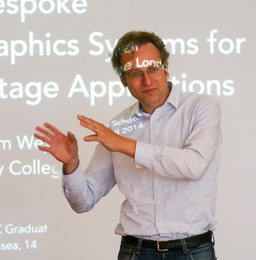
Tim Weyrich is Professor of Visual Computing (part-time) at University College London and Professor of Digital Reality at Friedrich-Alexander University Erlangen-Nürnberg. He leads the Digital Reality Lab and has affiliations with the Virtual Environments and Computer Graphics group at UCL, Eurographics, and the EPSRC Doctoral Training Centre (SEAHA). Previously, he held a Postdoctoral Teaching Fellowship at Princeton University. Research Interests: Content creation and computational photography Appearance modeling and fabrication Point-based graphics and cultural heritage analysis Digital humanities and 3D printing Article Trends: Recent work focuses on neural radiance fields (FruitNeRF++), 3D Gaussian splatting, mmWave radar inverse rendering, and texture anomaly detection. Applications span autonomous systems, cultural heritage, and medical imaging. Scientific Awards: Best Paper Honourable Mention (BMVC 2022) Best Student Paper Award (EG Workshop on GCH 2014) Honorable Mention (Eurographics 2011) Best Student Paper Honourable Mention (BMVC 2018) ACM SIGCHI Best Paper Honourable Mention (CHI 2013)