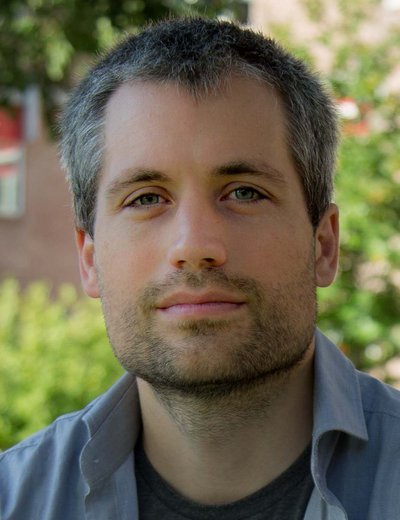
Shravan VeerapaneniView profile
Professor
Shravan Veerapaneni is a Professor in the Department of Mathematics at the University of Michigan, within the College of Literature, Science, and the Arts. His research focuses on developing large-scale computational tools for solving differential and integral equations on complex moving geometries that arise in engineering and biophysics. His work spans multiple interdisciplinary areas connecting mathematics, computational science, and applied physics. Education: B.S. from Indian Institute of Technology (2003), Ph.D. from University of Pennsylvania (2008) Previous Position: Research Scientist at Courant Institute of Mathematical Sciences (NYU), 2008-2011 Teaching: Courses include Math 671, Math 371 (Numerical Methods for Engineers), and Math 156 (Applied Honors Calculus II) Professor Veerapaneni's research interests encompass scientific computing, fast algorithms, potential theory, complex fluids, microfluidics, soft-matter, and biomechanics. His core application areas include biomembrane mechanics, blood flow modeling, cilia-driven flows, and microfluidic-chip design. More recently, he has expanded his research to include scalable solvers and machine learning techniques for autonomous vehicle mobility in off-road settings. His work demonstrates a strong emphasis on developing high-order accurate numerical methods with practical applications in biomedical engineering and fluid dynamics. His publications reveal a consistent focus on boundary integral methods, Stokes flow simulations, and optimization problems in complex geometries. The research shows progression from fundamental mathematical methods to increasingly complex applications in biophysics and engineering. His work on vesicle dynamics, microswimmers, and particulate suspensions demonstrates expertise in computational fluid dynamics at microscales. NSF CAREER Award (2015) for project 'Fast Algorithms for Particulate Flows' Professor Veerapaneni has developed computational frameworks for simulating complex fluid-structure interactions, with applications ranging from biological systems (vesicles, cilia) to engineering problems (microfluidic chips, autonomous vehicles). His group has produced significant software contributions including visualization tools for fluid dynamics simulations, as evidenced by the animations of vesicle flows on his website. His collaborative work spans mathematics, engineering, and computer science departments, reflecting the interdisciplinary nature of his research.