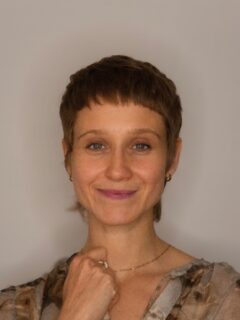
Isabelle Cleynen is a Senior Lecturer at the Faculty of Medicine, KU Leuven, and leads the Laboratory for Complex Genetics within the Department of Human Genetics. She is also a member of the LBI - KU Leuven Brain Institute and participates in institutional councils. Senior Lecturer, Faculty of Medicine, KU Leuven Head, Laboratory for Complex Genetics Member, KU Leuven Brain Institute Her research focuses on polygenic risk scores (PRS) for disease prediction, genetic architecture of complex diseases, and multi-omics integration. Key projects include PRS implementation for breast cancer and Alzheimer's, AI-driven detection of bone necrosis risk in IBD, and genetic analysis of intestinal transplantation outcomes. Recent publications highlight her work at the intersection of genomics, artificial intelligence, and translational medicine, particularly for inflammatory bowel disease and neuroinflammatory disorders. Collaborative studies span European multicenter cohorts and cross-omics methodologies. She contributes to teaching courses on Molecular Genetics, Development and Reproduction, Genomic Medicine, and Biomedical Research Skills at KU Leuven.
Prof. Vera van Noort is a faculty member at the Faculty of Bioscience Engineering and leads the Computational Systems Biology group at KU Leuven . Her research focuses on integrating multi-omics data , bioinformatics , and computational modeling to unravel molecular mechanisms in microbial systems and protein interactions . She chairs the Leuven Centre for Biosciences, Bioengineering and Biotechnology and contributes to KU Leuven One Health initiatives. PhD in Molecular Biology (2007) - Radboud University Nijmegen Professor at KU Leuven since 2013 Her research explores: Phage-host interactions : Analyzing lysine acetylation and post-translational modifications during phage infections in Pseudomonas aeruginosa Machine learning applications : Developing tools like SCARAP for comparative genomics and FLAMS for PTM analysis Therapeutic phage cocktail design : Through projects like PHAGEFORCE and EnzyMares Her recent articles demonstrate expertise in: Multi-omics integration for gene prioritization (2025) Structural bioinformatics of phage proteins (2025) Microbial acetylome analysis (2024) Computational enzyme discovery (2023) Teaching responsibilities include courses in: Bioinformatics Programming for Bioscience Engineers Omics Techniques
Associate Professor Jori LIESENBORGS is affiliated with Hasselt University's Faculty of Sciences, Department of Computer Sciences, and the Expertise Centre for Digital Media. They lead the Applied Computer Science Lab while contributing to the Digital Future Lab initiative. Research spans high-performance computing , scientific modeling , and data-intensive applications with discipline codes including High Performance Computing (01020702), Mathematical Software (01020703), and Numerical Computation (01020705). Key specialties involve visual analytics for high-dimensional data, AI-driven video streaming optimization, and epidemiological simulations for infectious disease control. Current supervised PhD projects include: Daniël Bot: Visual Analytics for High-Dimensional Data Hannes Keunen: AI & Video Streaming (2024-2028) Elise Kuylen: Individual-based Disease Transmission Models (2023) Jan Yperman: Machine Learning in MS Research (2021) Balazs Nemeth: Pharmacometrics Applications (2020) Active research grants focus on AI-driven video streaming infrastructure and HIV/Hepatitis C outbreak modeling using phylogenetic data. Teaching responsibilities include Algorithms, Operating Systems, Parallel Systems, and Computational Optimization across the 2024-2026 academic cycles. The Applied Computer Science Lab provides specialized computational resources at Campus Diepenbeek (EDM-2.10), supporting both theoretical algorithm development and real-world implementations in medical and media technology domains.
Sonja Reinhold serves as a Research Fellow at Friedrich-Alexander University Erlangen-Nuremberg (FAU), working with the Research on Migration, Displacement and Integration group since May 2021. Her expertise centers on migration policy, refugee integration systems, and municipal-level reception frameworks for people seeking protection, with current focus on the Stiftung Mercator-funded project "More than four walls" for sustainable refugee accommodation. Her academic foundation includes: Doctoral studies in Political Science at FAU (since April 2024) LL.M. in European Law from Utrecht University (2020), specializing in EU asylum policy B.A. in Political Science and Public Law from FAU and Tel Aviv University Reinhold's research critically examines algorithmic governance in migration systems and crisis-responsive integration policy , particularly how municipalities can leverage data-driven tools for equitable refugee distribution while maintaining human rights standards. Her work bridges theoretical migration studies with practical implementation challenges, emphasizing community-based solutions and policy transferability across European contexts. Recent publications reveal an evolving research trajectory from pandemic impact analysis (2022) toward computational approaches for refugee integration (2023-2024), demonstrating interdisciplinary convergence of Migration Studies , Computer Science , and Public Administration . This progression highlights her commitment to translating academic insights into actionable municipal frameworks. Her research is supported by competitive grants from Stiftung Mercator (current "More than four walls" project; previous "Match'In" algorithmic matching system) and the Robert Bosch Stiftung ("Brennglas Corona" pandemic study). As an emerging scholar, she actively disseminates findings through policy forums but has not yet supervised graduate students. Active Funding: "More than four walls" (Stiftung Mercator, 2024-present) Completed Projects: "Match'In" algorithmic matching (Stiftung Mercator, 2021-2024); "Brennglas Corona" pandemic analysis (Robert Bosch Stiftung, 2021-2023) Reinhold collaborates with municipal networks including "Wohnen statt Unterbringung" and the Federal Initiative for Refugee Protection, positioning her research at the critical intersection of academic inquiry and frontline integration practice across German communities.