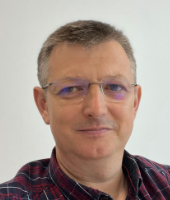
Oana AMĂRICĂI-BONCALO is a Professor at the Computer and Information Technology Department of University Politehnica Timisoara. She holds a Dr. Habil. Eng. degree and has served as Assistant Professor, Lecturer, and Associate Professor since 2009. Her research focuses on reconfigurable systems, system reliability, embedded systems, and forward error correction with FPGA applications. Education: Engineering Degree (2006) and PhD in Computer Engineering (2009), both from University Politehnica Timisoara. She was an invited researcher at University College Cork (2012) and University of Cergy-Pontoise (2016). Since 2017, she has been an Editor for Microprocessor and Microsystems (Elsevier). Research projects include GEMSCLAIM (green energy management in mobile systems). She supervises PhD student Andrei-Bogdan MIHĂILESCU. Recent publications emphasize LDPC decoding architectures, FPGA-based solutions, and reliability assessment in quantum circuits. Notable contributions include innovations in layered decoding algorithms, memory optimization for LDPC decoders, and one-hot data representation techniques. Her work intersects VLSI design, digital signal processing, and embedded systems reliability. Event organization includes a 2024 workshop on audio-video technical solutions and participation in IEEE symposiums. She contributes to academic events like the Mobile Applications Student Contest (SCMUPT).
Laurentiu Dimitriu is a Professor at the Gheorghe Asachi Technical University of Iasi , affiliated with the Faculty of Electrical Engineering. His research focuses on Automotive Electronics , Real-Time Systems , and Control System Diagnostics , with significant contributions to microprocessor-based control systems and sensor technology. Teaching: Power Supplies and Circuits, Electronic Measuring and Control Devices, Automotive Electronics Contact: dimitriu@etc.tuiasi.ro Research Interests span automotive control systems, thermal engine management, and fuzzy logic applications in engine optimization. His work addresses hardware/software co-design for microprocessor control units, fuel efficiency, and cooling systems. Engineering Trends in his publications highlight real-time communication protocols, sensor diagnostics, and airflow control mechanisms. Over 84 works (including books and patents) demonstrate his expertise in integrating embedded systems with automotive engineering. Scientific Contributions include 14 invention patents for electroacupuncture devices, engine control systems, and sensor technologies. His 1995 book Sisteme electronice de control pentru automobile remains a seminal reference in automotive electronics. Collaborations extend to INMT Bucharest, Transloc R.A. Botosani, and academic-industrial partnerships for real-time engine testing systems.
Олена Сергіївна Назарова є доцентом в Національному університеті "Запорізька політехніка", де працює з 2005 року. Вона має науковий ступінь кандидата технічних наук та академічне звання доцента. Її професійна діяльність охоплює наукові дослідження в галузі електромеханічних систем та викладання спеціалізованих дисциплін, пов'язаних з метрологією, мікропроцесорною технікою та математичним моделюванням. Освіта: Запорізький національний технічний університет, 2007 рік, спеціальність 8.092203 "Електромеханічні системи автоматизації та електропривод", кваліфікація "Магістр з електромеханічних систем автоматизації та електроприводу"; Запорізький національний технічний університет, 2007 рік, спеціальність 7.050104 "Фінанси", кваліфікація "фінансист". У 2012 році захистила кандидатську дисертацію за спеціальністю 05.09.03 - "Електричні комплекси та системи" на тему "Синтез і дослідження систем керування електроприводами холодильних станів з використанням комплексу взаємопов'язаних моделей". Наукові інтереси Олени Сергіївни охоплюють моделювання багатомасових взаємопов'язаних електромеханічних систем, розробку інструментів автоматизації для технологічних комплексів та мехатронних систем, електромеханічні системи з мікропроцесорним керуванням, а також методи вимірювання, контролю та діагностики промислового обладнання. Вона є керівником науково-дослідної роботи № 03611 (0121U112938) "Розробка та дослідження автоматизованих електроприводів та мехатронних систем". Аналіз публікацій Олени Сергіївни демонструє її глибоку експертизу в моделюванні електромеханічних систем, зокрема систем холодної прокатки, та розробці систем керування для електроприводів. Її роботи охоплюють широкий спектр від математичного моделювання до практичної реалізації систем керування, що свідчить про її здатність поєднувати теоретичні знання з практичними застосуваннями в промисловості, включаючи останні дослідження в галузі SMART-технологій для клімат-контролю в теплицях. 2006 – Лауреат премії «Програми підтримки вчених та обдарованої молоді» розробленої АКБ «Індустріалбанк» при підтримці виконавчого комітету Запорізької міської ради «За виняткові досягнення у науковій роботі» 2011 – Грамота Міністерства освіти і науки України 2013 – Почесна грамота Районної адміністрації 2015 – Почесна грамота Міської ради до 115-річчя ЗНТУ 2017 – Подяка Міністерства освіти і науки України 2018 – Подяка Запорізької обласної ради 2019 – Подяка Управління молоді, фізичної культури та спорту Запорізької обласної державної адміністрації Олена Сергіївна активно бере участь у міжнародних науково-технічних конференціях, включаючи «Електротехнічні і комп'ютерні системи: теорія і практика (ЭЛТЕКС-2019)», «Проблеми автоматизованого електропривода» та «Modern Electrical and Energy Systems». Вона публікується в міжнародних наукових журналах та має профілі в наукометричних базах даних (ORCID, Scopus, Web of Science, Google Scholar), що свідчить про її інтеграцію в глобальний науковий простір. Наукова діяльність Олени Сергіївни тісно пов'язана з лабораторіями кафедри електроприводу та автоматизації промислових установок, де вона проводить експериментальні дослідження та тестує нові методи керування електроприводами. Її робота сприяє розвитку сучасних технологій в галузі промислової автоматизації та підготовки висококваліфікованих фахівців для української промисловості.
Crișan Strugaru was a Professor at the Politehnica University of Timisoara, serving as Head of the Department of Computers from 1983 to 1992. He held academic positions from 1961 until his retirement in 2003, contributing significantly to the development of Romania's first School of Computers. His roles included researcher, educator, and administrator, with international grants and leadership in academic organizations such as the Romanian Academy. Education: B.S. in Electromechanics, Faculty of Electrical Engineering, Politehnica University of Timisoara (1960) Ph.D. in Computer Science, defended in 1973 with a thesis on microprogrammed control units Research Interests: Professor Strugaru specialized in computing architectures, embedded systems, hardware-software co-design, robotics, and network protocols. His work included pioneering contributions to microprocessor-based systems, industrial robot control, and digital communication systems. Awards and Recognition: Recipient of the Traian Vuia Prize (1983) for robotics innovations Honorary Member of the Academy of Technical Sciences of Romania (2005) President of the Romanian Academy’s 'General Systems and Cybernetics' sub-commission (1992) Advising and Grants: Supervised numerous B.S. and Ph.D. students, coordinated 20 research contracts, and authored 11 patents. His research teams developed the experimental TIM-S microcomputer and advanced industrial testers. Labs and Teams: Research conducted in the Department’s laboratories led to innovations in microprocessor applications and digital communication systems, with practical industrial implementations.
Corneliu Zaharia is a Lecturer at the Department of Electronics and Computers , within the Faculty of Electrical Engineering and Computer Science at Transilvania University of Brașov, Romania . His research spans hardware-software co-design, embedded systems, and computer vision. Research Areas Very Large Scale Integrated Circuits Microprocessor Architectures Artificial Intelligence Mobile Platforms Patents : Zaharia has contributed to multiple invention patents, including technologies for real-time video processing, peripheral processing, and vehicle camera systems. His publications focus on optimizing hardware-software integration for edge computing and object detection.
Dr. Irina Zeleneva is an Associate Professor at the Department of Computer Systems and Networks, Faculty of Computer Science and Technologies, Zaporizhzhia Polytechnic National University. With a Ph.D. in Computers, Systems, and Networks, she has 15+ years of academic experience since joining the university in 2003. Specializes in FPGA-based digital system design Focuses on hardware acceleration and reliability optimization Teaches advanced topics in microprocessor architecture Her research includes: Development of energy-efficient FPGA systems Hardware-software co-design Neural network text classification accelerators Reliable embedded control architectures Recent publications analyze FPGA implementation of floating-point multipliers, finite state machines with elementary state chains, and AI-enhanced educational frameworks . Her work frequently appears in international conferences like IDAACS and PIC S&T, with multiple Scopus/WoS indexed articles. Dr. Zeleneva's contributions: Co-author of two monographs on FPGA acceleration PI in multiple university research projects Active participant in annual "Week of Science" conferences
Sergey Oleksandrovych Sgadov is a Senior Lecturer in the Department of Computer Systems and Networks at Zaporizhzhia Polytechnic National University. With academic activity at the university since 1998, he has established himself as a dedicated educator and researcher in computer science and microprocessor technologies. His institutional affiliation places him within the Faculty of Computer Sciences and Technologies, where he contributes to both teaching and research initiatives. Education: Graduated from Zaporizhia National University in 1993 with honors, specializing in "Solid-state electronics and microelectronics" and receiving the qualification of "specialist". Dr. Sgadov's research spans multiple domains of computer science and engineering. His primary interests include microprocessor programming, application development using Delphi and C++, web programming with .NET technologies, and computer modeling of physical processes. He has made significant contributions to graph theory, particularly in topological graph drawing algorithms and their applications in printed circuit board design. His work bridges theoretical computer science with practical engineering applications, focusing on creating efficient algorithms for complex computational problems. Analysis of his publication record reveals a strong focus on graph theory applications in electronic design automation, microprocessor systems development, and educational tools for computer engineering. His research has evolved from fundamental theoretical work on graph algorithms to practical implementations in microcontroller programming and educational technology. The consistent thread throughout his work is the application of computational methods to solve complex engineering problems, particularly in circuit design and microprocessor systems. Dr. Sgadov teaches courses in microcontroller programming and programming of microcontroller systems, bringing his research expertise directly into the classroom. His teaching methodology likely incorporates practical, hands-on experience with modern microprocessor technologies, reflecting his research interests in ARM Cortex processors and microcontroller applications.