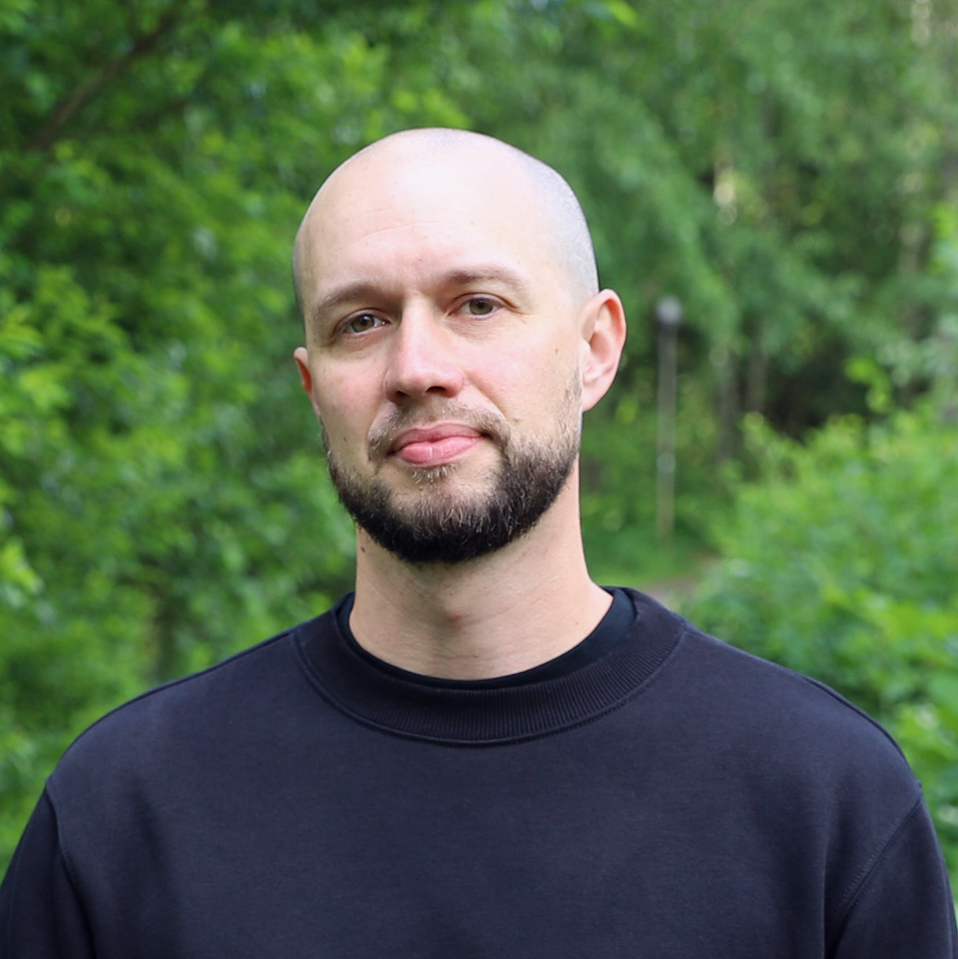
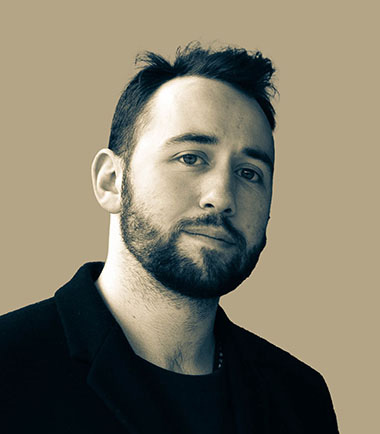
Myungin Lee is a Lecturer at the Department of Immersive Media Design, University of Maryland, College Park. His research focuses on designing multimodal instruments and interactive systems that integrate principles from HCI, machine learning, signal processing, and neuroscience. Key projects include NeuResonance (inter-brain synchronization feedback) and FractalBrain (EEG-based VR mindfulness tools). He has contributed to venues like ACM CHI, IEEE VIS, and NIME, and holds patents on reverberation time estimation using neural networks. Research interests span crossmodal correspondence in XR, neuro-interactive systems, and real-time audio-visual simulations. Notable collaborations include the NASA Ocean Project and AlloSphere Research Group . His work has been showcased at Ars Electronica and Getty PST 2024. Education: PhD in Media Arts & Technology (implied by dissertation, 2023) Patents: Multichannel microphone-based reverberation time estimation methods (WO2018111038A1, US10854218B2, etc.).
Dr. Olaf Jahn is a Research Associate at the Museum of Natural History Leibniz Institute for Evolution and Biodiversity Research in Berlin, Germany. His work focuses on bioacoustic methods for biodiversity monitoring through the AMMOD project (Automated Multisensor Stations for Monitoring of Biodiversity) as part of Module 5: Automated Bioacoustic Monitoring. Research Focus: Bioacoustics, rapid detection of bird communities, ecological monitoring, and conservation biology Key Tools: Automated sound recognition systems, spectrogram analysis, temporal contextual integration algorithms His research spans tropical avian ecology in regions like Ecuador's Chocó forest while developing cutting-edge signal processing approaches for acoustic monitoring. Jahn's work bridges classical field biology with modern computational methods, creating robust tools for real-world biodiversity assessment. Through publications in journals like PLOS One, Applied Acoustics, and Expert Systems with Applications, he has advanced automated bird identification techniques using: Morphological filtering of spectrograms Temporal contextual information integration Direction of arrival estimation with microphone arrays Robust frame selection for audio parameterization Acoustic detection of endangered species
Thomas Jean-Hugh is a Professor and Teacher-Researcher at Le Mans Université , affiliated with the Laboratoire d’Acoustique de l’Université du Mans (LAUM) , a leading research institute in acoustics in France. His role involves both teaching and active research in acoustic imaging, signal processing, and structural acoustics. Education PhD in Acoustics and Signal Processing (exact institution and year not specified in text) Research Interests Thomas Jean-Hugh’s research focuses on acoustic source localization and imaging , particularly through the use of microphone arrays , beamforming , and inverse problem solving . His work spans: Acoustic holography for non-stationary and confined sources UAV acoustic detection and tracking using sparse sensor arrays Vibro-acoustic diagnostics for automotive and naval structures Speech processing in meeting environments using distant microphone arrays Non-destructive testing using acoustic emission and imaging techniques Research Trends His recent publications (2022–2025) reveal a strong focus on machine learning-enhanced acoustic imaging , real-time UAV detection , and robust speech processing . He integrates genetic algorithms , Bayesian regularization , and circular harmonics into acoustic array processing, with applications in autonomous systems , marine biology , and automotive acoustics . Scientific Contributions Over 70 peer-reviewed publications in journals and conferences Active supervision of PhD students and postdocs in acoustics and signal processing Participation in international conferences such as Interspeech , ICSV , GRETSI , and ICA Collaborations & Labs He collaborates extensively within LAUM and with external partners including CNRS , ISCA , and international research groups. His lab work involves experimental acoustics , sensor array design , and real-time signal processing .
Professor Christian Ritz serves as Director of SMART and Professor in the School of Electrical, Computer and Telecommunications Engineering within the Faculty of Engineering and Information Sciences at the University of Wollongong. He has held his professorship since 2017 and served as Associate Dean (Research) in 2022 and Associate Dean (International) from 2016-2021. Professor Ritz's research focuses on signal processing for speech, audio, acoustics and visual information. His current projects include microphone array signal processing for enhancing sound recorded in classrooms, sound scene classification for dementia care environments, spatial audio for Virtual and Augmented Reality, and undersea surveillance. His work spans multiple technical domains including signal processing, audio engineering, computer vision, and communications engineering. His recent publication trends show a strong focus on neural network applications for audio processing, particularly for classroom monitoring and spatial audio reproduction. His work integrates deep learning with traditional signal processing techniques to address challenges in spatial audio synthesis, room impulse response generation, and directional audio reproduction. He has also contributed to applications in mining automation, public safety surveillance, and positioning systems. Professor Ritz is a member of the Centre for Signal and Information Processing (CSIP), part of the Signals, Information and Communications Research Institute (SICOM) at the University of Wollongong. His research is funded by the ARC, overseas research institutes, and defense organizations. His grant portfolio is extensive, including projects such as AI/IoT-powered Airborne System for Monitoring Water Level and Tidal Floods, Multi-Modal Satellite-based Vessel Surveillance, Net Zero Industry and Innovation Program, Smart Eye: Airborne and AI-Driven Assessment Solution of Sugarcane, and numerous projects related to spatial audio and underwater surveillance. He has secured funding from diverse sources including the Australian Research Council, defense organizations, and international collaborations. Professor Ritz maintains an active research laboratory environment focused on signal and information processing. His work spans multiple application domains from classroom monitoring to underwater mine detection, with strong connections to both academic and industry partners. His research group appears to focus on practical applications of signal processing techniques to solve real-world problems across various domains.
Dr Jiahong Zhao is a Lecturer in Acoustics at the University of Southampton. His research focuses on signal processing and audio technologies. Research interests include microphone array signal processing, spatial audio, machine learning, and computer vision. Current supervisor for PhD student Yaoxiang Yu in Engineering and Environment. Contact: Jiahong.Zhao@soton.ac.uk
Johannes M. Arend serves as an Assistant Professor in the Department of Information and Communications Engineering at Aalto University, Finland. His research centers on virtual acoustics, spatial audio processing, and psychoacoustics, with significant contributions to audio engineering and hearing science applications. His primary research domains include Virtual Acoustics, Spatial Audio, Psychoacoustics, Hearing Science, Acoustics, and Audio Engineering. Leading the Technical Psychoacoustics research group, he investigates sound perception in virtual environments and develops advanced spatial audio techniques. Key methodologies involve spherical microphone array processing, head-related transfer function (HRTF) interpolation, and voice directivity analysis, with applications spanning virtual reality, hearing diagnostics, and audio reproduction systems. Analysis of his 15 most recent publications (2021-2025) reveals consistent focus on spatial audio processing and perceptual validation. Dominant themes include spatial upsampling techniques for microphone arrays (33% of articles), voice directivity modeling with phoneme-level analysis (27%), and HRTF processing for binaural rendering (20%). His work demonstrates strong interdisciplinary integration between audio signal processing, speech science, and virtual reality applications, particularly in developing perceptually validated tools for hearing assessment and spatial audio reproduction. Dr. Arend actively leads the Technical Psychoacoustics research group, directing projects on virtual acoustic environments, spatial hearing assessment, and audio reproduction technologies. His team develops innovative methods for binaural rendering and conducts perceptual studies to validate technical solutions, with recent work focusing on VR-based hearing diagnostics and spatial audio evaluation frameworks.
Dr. Rob Worley is a Research Fellow at the University of Sheffield’s School of Electrical and Electronic Engineering since 2022, following his PhD studies initiated in 2018. His research focuses on robot navigation and localization within buried pipe networks, with a particular emphasis on acoustic and visual sensing technologies. He leads the Pipebot Patrol project, advancing autonomous inspection systems for water and sewer infrastructure. His work integrates state estimation, artificial intelligence, and robotics to address challenges in feature-sparse underground environments. Worley’s research interests span robot localization algorithms, SLAM (Simultaneous Localization and Mapping), and sensor fusion, with applications to cylindrical pipe networks. His projects leverage cylindrical regularity and hybrid metric-topological models to enhance navigation accuracy. Notable contributions include acoustic echo localization using microphone arrays and visual SLAM techniques for sewer networks. He has published extensively on topics like error detection in particle filters and condition monitoring in underground pipes. Advising and grants: While no specific advisees are listed, his projects likely involve collaborative research teams. He has contributed to the Pipebots initiative since its inception, focusing on localization and sensing advancements. Labs/Teams: Active member of the University of Sheffield’s robotics research group, contributing to the development of autonomous inspection technologies for infrastructure maintenance.
Sangyun Shin is a Researcher in the Department of Computer Science at the University of Oxford, supervised by Professors Niki Trigoni and Andrew Markham. His work focuses on advancing object localization systems for robotics through 3D vision technologies. He specializes in integrating multimodal sensing (e.g., RGB-D cameras, acoustic arrays) to enhance robotic perception in challenging environments. His research interests include 3D motion capture for wildlife, domain-adaptive 3D detection, and self-supervised learning for nighttime vision. He has explored applications ranging from long-range wildlife tracking to autonomous drone navigation using reinforcement learning. Recent efforts emphasize sensor fusion and neural network architectures tailored for dynamic environments. Key technical contributions include the SoundLoc3D system for 3D sound localization and the WildPose framework for wildlife motion capture. His publications span topics like acoustic neural warping fields (SPEAR), spherical point cloud segmentation, and LiDAR-based object detection for urban driving. Shin's work bridges theoretical advancements in machine learning with practical robotics applications, addressing challenges such as cross-domain adaptation and low-resource sensor setups. His research has implications for autonomous systems, environmental monitoring, and human-drone interaction interfaces.
Dale Johnson is a Research Fellow in the Department of Computer Science at the School of Computing and Engineering , University of Huddersfield. He is affiliated with the Centre for Audio and Psychoacoustic Engineering , focusing on psychoacoustics and 3D audio technology development. Research Fellow, Department of Computer Science (2025) Member, Centre for Audio and Psychoacoustic Engineering Active in open-access audio research and software tool creation His research spans Binaural Audio , Microphone Array Optimization , and Acoustic Modeling . Publications highlight expertise in Convolutional Neural Networks for spatial audio discrimination and Impulse Response Analysis for immersive environments. He contributes to datasets like 3D Microphone Array Comparison and collaborates on international acoustic projects. Recent work (2020-2022) demonstrates a focus on improving 3D Audio Perception through Virtual Room Acoustics simulations and calibration methods. Keywords include Transfer Functions , Crosstalk Reduction , and Digital Signal Processing .
Associate Professor Benjamin Halkon is a leading experimental dynamicist at the School of Mechanical and Mechatronic Engineering , University of Technology Sydney , specializing in non-contact vibration measurement techniques. He directs the UTS Tech Lab Vibration Laboratory , which houses advanced systems like the Polytec PSV-500 Xtra Scanning Laser Vibrometer. His career spans academic leadership, including Deputy Head of School (Teaching & Learning) and co-chairing the Asia-Pacific Vibration Conference (2019) and Inter-Noise 2026 (Technical Chair). Education: PhD and BEng (Hons.) in Mechanical Engineering from Loughborough University Memberships: Fellow of Institution of Mechanical Engineers, Fellow of Institution of Engineers Australia Dr. Halkon's research focuses on laser Doppler vibrometry in challenging environments, with applications to defence, government, and industry . His work addresses instrument vibration correction, acoustic manipulation, and structural analysis for autonomous vehicles. He has secured over $1.6M in research grants and published >100 works with a high Field-Weighted Citation Impact (FWCI 3.20). His teaching portfolio includes coordinating key subjects like Dynamics and Control and Mechanical Vibration and Measurement , alongside leading curriculum reforms for undergraduate and postgraduate programs. Current funded projects include collaborations with SkyKraft Pty Ltd , Space Research Network , and SiteHive Pty Ltd on vibration sensors and acoustic classifiers.
Oliver Ackermann Lylloff is a Researcher at DTU Wind and Energy Systems, Technical University of Denmark, specializing in experimental wind turbine aeroacoustics and wind tunnel testing. His work directly contributes to UN Sustainable Development Goals for affordable clean energy and climate action through advanced rotor design research. Education: PhD in Wind Energy Systems, Technical University of Denmark (2017-2021) Dr. Lylloff's research centers on experimental aeroacoustic characterization of wind turbine components using the Poul la Cour Wind Tunnel (PLCT). His expertise spans leading edge erosion analysis, vortex generator noise detection via beamforming, and Kevlar membrane acoustic properties under aerodynamic loading. He develops innovative methodologies for noise source localization and blade surface durability testing, directly addressing industry challenges in turbine noise reduction and efficiency optimization. His recent publications (2024-2025) demonstrate a cohesive research trajectory focused on experimental wind tunnel validation of aerodynamic and aeroacoustic phenomena. Key trends include the development of open-source tools like AeroAcoustics.jl, systematic studies of leading edge protection systems, and advanced beamforming techniques for noise source identification—bridging theoretical fluid dynamics with practical wind turbine design constraints. As Principal Investigator for the Sustainable and Cost Efficient Small Wind Turbine project (2025-2027), Dr. Lylloff leads a €2.1M research initiative funded by the Danish Energy Agency. His grant portfolio includes multiple collaborative projects with industry partners like Siemens Gamesa and Vestas, focusing on distributed energy solutions and blade erosion mitigation. Dr. Lylloff operates within DTU's Rotors Wind Turbine Design Division and the Poul la Cour Wind Tunnel Laboratory (PLCT), where he manages experimental campaigns using state-of-the-art microphone arrays and beamforming systems. He actively disseminates research through public datasets like the PLCT-data collections and engages in knowledge transfer via media appearances and conference organization.
Amy Bastine is a Researcher at the School of Engineering within the ANU College of Systems & Society at the Australian National University. Her work focuses on advanced audio signal processing, acoustics, and machine learning applications in spatial audio environments. She is affiliated with the Information & Signal Processing cluster, emphasizing interdisciplinary research. Her research interests include room acoustic modeling, spatial audio capture using spherical microphone arrays, and developing neural network-based solutions for sound field analysis. She explores topics like active noise control, source localization in reverberant environments, and immersive audio technologies. Recent projects involve creating datasets for acoustic analysis and optimizing algorithms for real-world applications. Her publications from 2022-2025 highlight trends in physics-informed neural networks for sound field estimation, sparse representation techniques, and multi-channel ANC systems. These contributions aim to bridge theoretical acoustics with practical implementations in wearable devices and recording studios. No scientific awards or grants are explicitly listed in the provided texts. Her research has been applied to datasets like room impulse responses and spherical microphone array measurements. She collaborates on projects involving acoustic imaging, HRTF interpolation, and environmental noise mitigation strategies.
Ben Travaglione is an Adjunct Professor at the University of Western Australia's School of Physics, Mathematics and Computing, and serves as Quantum Computing Discipline Leader at the Defence Science and Technology Group (DSTG). His roles include Chair of the Western Australian Branch of the Australian Institute of Physics and Chair of the UWA Physics Industry Advisory Panel. Education: PhD in Physics (Small-scale Quantum Algorithms) from University of Queensland (2002), BSc (First Class Honours) in Applied Computational Physics from Murdoch University (1998). Research focuses on quantum computing/quantum information science and defence applications, including sensor systems and MEMS technology. Key contributions include quantum algorithm development, MEMS-based sensing frameworks, and condition monitoring solutions for remote assets. Recipient of DSTG Maritime Division Award (2018) recognizing collaborative scientific contributions. Current research projects include real-time optimization algorithms funded by the Department of Defence (2024–2027 grant). Labs/teams: Member of QUISA (Quantum Information Science and Applications) research group. Collaborates with academic and defence industry partners to advance quantum technologies for ADF applications.
Hugh O'Dwyer is a Teaching Professor at Trinity College Dublin (TCD) within the Department of Electronic Engineering, where he lectures on the M.Phil in Music and Media Technology (MMT) program. He holds a Ph.D. from TCD (2021) under Prof. Frank Boland, focusing on Machine Learning applications for audio, particularly Sound Source Localization and Virtual Testing of Binaural Audio. His doctoral work included objective/subjective headphone and ambisonic microphone evaluation, alongside machine learning-based localization methods. Education: He graduated from TCD's School of Engineering with a Biomedical Engineering degree (2015), researching EEG-based musical instrument perception in the brain through his thesis. During studies, he actively participated in Trinity Orchestra and Jazz Society roles, earning a lifetime honorary membership for his contributions. Research interests span spatial audio engineering, machine learning in acoustics, and music technology education. He has published extensively with the Audio Engineering Society (AES), presenting at conferences in Helsinki, Milan, and Dublin. His work includes VR audio recording techniques, sound projector calibration, and ambisonic microphone comparisons. Outside academia, he mentors young musicians through the Suburban Sounds program and developed a CPD course in music technology for over 100 teachers during the pandemic. As a musician/producer, he has collaborated with prominent Irish artists like Hozier and Saint Sister, and his band Spies' album 'Constancy' (2018) received critical acclaim.
Guillaume Dutilleux is a Professor in the Department of Electronic Systems at the Norwegian University of Science and Technology (NTNU). His research focuses on bioacoustics, environmental acoustics, sound propagation, and noise mitigation in contexts such as wind turbines, railways, and road traffic. He has contributed to interdisciplinary projects, including acoustic tracking of wildlife and automated biodiversity monitoring. Dutilleux teaches courses like TTT4181 (Acoustic Discovery), TTT4290 (Bioacoustics for Biodiversity), and TFE4595 (Electronic Systems Design). He has published extensively in journals such as Applied Acoustics , Journal of the Acoustical Society of America , and Bioacoustics , with recent work addressing time-varying acoustical systems and noise annoyance prediction. His research emphasizes practical applications of acoustics in environmental and technological domains. Leading acoustic experiments on long-range sound propagation and noise impact assessment Developing educational programs in acoustical measurement techniques Collaborating on automated acoustic monitoring for endangered species conservation His work bridges theoretical acoustics with real-world challenges, contributing to both academic discourse and policy-informing studies.