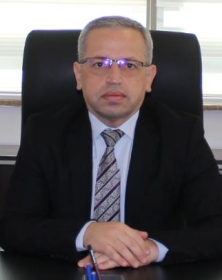
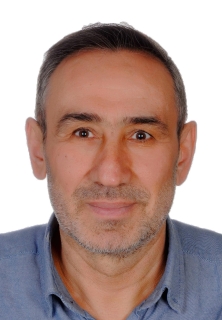
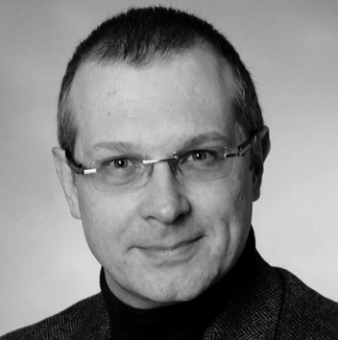
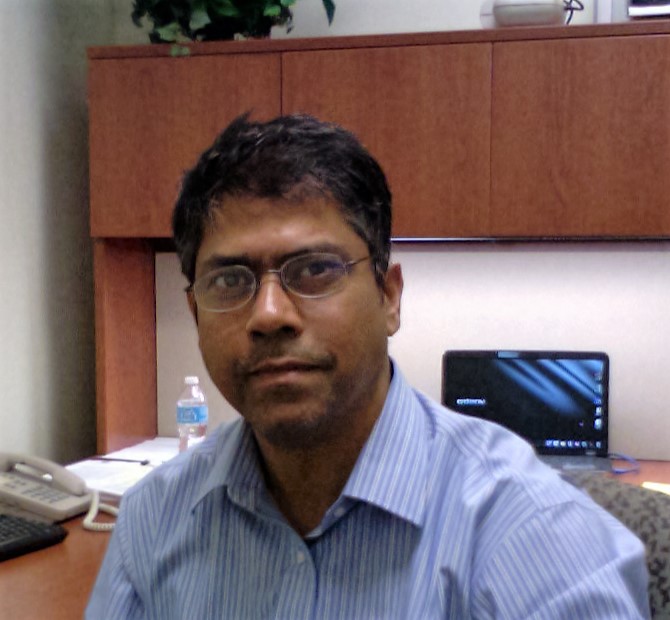
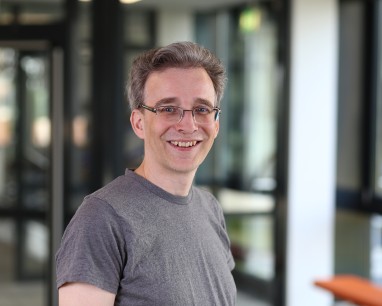
Christoph Kalkuhl is an academic staff member at the University of Tübingen , affiliated with the Faculty of Mathematics and Natural Sciences and the Department of Physics . His work focuses on electronics design, microcontroller systems, and nanoanalytics in biomedicine. Office address: At Morgenstelle 14, Tübingen, 72076 Phone: 29-76290 Research Interests Electronics design and development Microcontroller-based systems Nanoanalytics applications in biomedical contexts Applied physics instrumentation Semiconductor device engineering
Dr. Elans Grabs is an Associate Professor at Riga Technical University's Institute of Information Technology, specializing in machine learning, network traffic analysis, and telecommunications. His work bridges digital signal processing and unmanned aerial vehicle navigation. Current research focuses on AI-driven network optimization Expertise in sensor fusion for autonomous systems Active in open RAN and wireless communication protocols His publications span topics from IoT performance modeling to laser communication algorithms for moving platforms. Recent works emphasize real-time signal processing, video traffic classification, and drone cooperation systems. While no formal awards are listed, his contributions to network traffic simulation and embedded systems design demonstrate technical depth. Articles show specialization in convolutional neural networks for streaming video analysis and wireless sensor network optimization.
Professor Michael Karagounis is a current faculty member at Dortmund University of Applied Sciences and Arts, teaching electronics since 2016. Previously, he served as Professor of Electrical Engineering at Hamm-Lippstadt University of Applied Sciences (2013-2016). His career uniquely bridges academic research and semiconductor industry experience at Infineon and Intel. His educational foundation includes: Communications Engineering degree from Cologne University of Applied Sciences Supplementary Electrical Engineering studies at Open University of Hagen Research focuses on Microelectronics with specialization in Analog and Mixed-Signal Circuit Design, RF Circuits, and Integrated Circuit Design for Automotive and Consumer Electronics. His work targets critical applications including automotive microcontroller power systems and smartphone navigation circuitry, emphasizing practical implementation of theoretical design principles in industrial settings. He actively supervises student theses, leveraging his semiconductor industry background to provide real-world context for academic concepts. His research projects in microchip design demonstrate applied engineering approaches, though specific grant details are not provided in available sources. The absence of lab-specific information suggests integrated departmental research facilities rather than a named independent laboratory.
Prof. Dr. Claus Fühner is a Professor of Computer Engineering at the Faculty of Computer Science of Ostfalia University of Applied Sciences. His research interests include: Systems and Software Engineering for embedded systems Implementation of embedded systems from microcontrollers to cloud Functional safety Wireless communication (Bluetooth Low Energy, LoRaWAN) AI, neural networks, and LLMs in technical systems Railway automation Recent research projects (2016-2023) show a focus on practical applications in IoT and embedded systems, with an increasing emphasis on AI and LLMs. Key projects include SmartFreightWagon for railway freight digitalization (2023) and autonomous vehicle research using deep learning (2020). Prof. Fühner regularly supervises student theses and is open to industry collaboration. He can be contacted via email at c.fuehner@ostfalia.de.
Abdulaziz Ceylan is a Lecturer in the Department of Electronics and Automation at Adıyaman University's Besni Ali Erdemoğlu Vocational School, where he has served since February 18, 2014. He also holds the position of Deputy Director at the vocational school. Born in Malatya in 1979, he completed his primary education in Malatya and secondary education in Adıyaman before attending Gaziantep M. Rüştü Uzel Industrial Vocational High School for telecommunications. His research interests focus on Electronic Circuits , Information Technologies , and Mechatronic Systems , with particular emphasis on Control Systems and Automation technologies. His teaching portfolio spans numerous technical courses including Analog Electronics, Circuit Analysis, Microcontroller Applications, and Computer-Aided Electronic Circuit Design. Dr. Ceylan's academic work includes research on quadrotor aircraft modeling, demonstrating his application of computational methods to advanced electronics problems. His publication record, while modest, shows engagement with practical engineering challenges in the field of unmanned aerial systems. 11th INTERNATIONAL MEB ROBOT COMPETITION award recipient As an educator, Dr. Ceylan has developed significant experience teaching a diverse range of electronics and automation subjects. His career progression from high school teacher to university lecturer while pursuing advanced degrees demonstrates his commitment to both education and professional development in the field of electrical and electronics engineering. He currently leads the Department of Electronics and Automation at Besni Ali Erdemoğlu Vocational School, overseeing curriculum development and educational delivery in this specialized technical field.
Akın DOĞRU is a Lecturer at Adiyaman University's Besni Ali Erdemoğlu Vocational School, Department of Computer Technologies. With over 20 years of academic experience since 2001, he teaches a comprehensive range of computer technology courses at both associate degree and bachelor's levels. His educational background includes: Bachelor's degree in Mechanical Engineering from Gaziantep University (1997) Master's degree in Computer Engineering from Ahmet Yesevi University (2011) Dr. DOĞRU specializes in practical computer technologies with emphasis on web development, mobile applications, and system administration. His teaching portfolio spans foundational courses like Basic Information Technologies to advanced topics including Mobile Application Development, Server Operating Systems, and E-Commerce Programming. He has consistently taught across multiple academic years from 2006 through the current 2024-2025 term. His administrative experience includes significant leadership roles: Department Head (2002-2007, 2010-2011, 2020) Deputy Director of Vocational School (2006-2007) Deputy Head of Department (2025) Dr. DOĞRU maintains active technical expertise through his membership in the Linux Users Association and specialized certificates in Microcontroller Programming and Arduino development. His pre-academic career as a mechanical engineer (1997-2001) provides valuable industry perspective that enriches his teaching methodology and course content.
Irenäus Schoppa is a Professor in the Faculty of Computer Science at Konstanz University of Applied Sciences for Technology, Business and Design, serving as Chairman of the Examination Board for Applied Computer Science. His academic focus centers on Hardware-Software Co-Design, with teaching responsibilities in the Bachelor's program Applied Computer Science (AIN). Key courses include: Digital Technology [AIN1] Microcontroller Systems [AIN3] Digital Systems [AIN5-7] Contact details: Room F 124, Alfred-Wachtel-Straße 8, D-78462 Konstanz Phone: +49 7531 206-644 Email: irenaeus.schoppa@htwg-konstanz.de Office hours for examination matters via Moodle course PAV-IN (Room O 309); other appointments in Room F 124.
Mohammad Habibi serves as an Assistant Professor in the Department of Mechanical and Manufacturing Engineering at Tennessee State University's College of Engineering. His office is located in IND 103, with contact available via phone (615-963-5248) or email (mhabibi@tnstate.edu). Dr. Habibi's academic credentials include: Ph.D. in CISE (Robotics & Computer Integrated Manufacturing), Tennessee State University, 2014 M.S. in CISE (Systems Engineering), Tennessee State University, 2003 B.S. in Electrical Engineering, Z. H. College of Engineering and Technology, Aligarh Muslim University, India, 1989 His research program centers on three interconnected domains: Cyber-Physical Systems implementation in infrastructure, intelligent manufacturing processes integrating mechatronics, and advanced materials engineering to combat thermal degradation. This work manifests in practical applications spanning surveillance analytics, robotics, and sustainable manufacturing systems, with publications demonstrating consistent interdisciplinary contributions across engineering and computer science. Publication trends reveal an evolution from foundational visual analytics research (2011-2014) focused on surveillance data exploitation to recent theoretical advances in stochastic control (2019) and educational innovation (2018). His 11 documented publications span power systems engineering, robotics, and data science, reflecting a career-long commitment to solving complex engineering problems through computational methods. No scientific awards are documented in the provided materials. Dr. Habibi actively mentors students through capstone projects involving AI-driven manufacturing monitoring, digital twin development, and UAV applications. His teaching portfolio covers core mechanical engineering subjects including mechatronics, manufacturing processes, and materials engineering, with courses designed to bridge theoretical concepts and industrial applications using platforms like LEGO-EV3 and Proteus simulation. Though no formal lab structure is documented, his research manifests through student-led projects in cyber-physical systems and intelligent manufacturing, utilizing robotics platforms, microcontroller systems, and simulation environments to address real-world challenges in infrastructure monitoring and industrial automation.
Mustafa AKSU is a Lecturer at Ahi Evran University, Faculty of Engineering and Architecture, Department of Computer Engineering. He holds a Doctorate (2016) from İnönü University in Computer Hardware, a Master's (2004) in Electrical and Electronics Engineering from Kahramanmaraş Sütçü İmam University, and a BSc (1998) in Computer Science Engineering from Kocaeli University. Current Position: Doctor Öğretim Üyesi (Lecturer) since 2022 Previous Role: Full-time Teaching Staff at Kahramanmaraş Sütçü İmam University (2001-2022) His research focuses on Data Structures and Algorithms , with significant contributions to skip ring/skip list innovations and their applications in robotics, artificial intelligence, and image processing. Key interests include: Algorithm optimization Machine learning applications Image segmentation techniques Mobile system development Renewable energy simulations Publications showcase expertise in data structures, robotics, and energy systems, with a recent 2024 paper on COVID-19 prediction algorithms and a 2023 book chapter on robotic simulation importance . Collaborations span institutions including İnönü University, University of Turku, and Gaziantep University. As a thesis advisor, he has guided three Master's students in 2024. Professional experience includes department chairmanship (2011-2014) and extensive teaching roles since 2001.
Oscar Cid Solé is a researcher in the Department of Geophysics at Universitat Ramon Llull , affiliated with the IU Ebro Observatory and Geophysics Research Group . His work focuses on space weather, geomagnetically induced currents (GIC), and infrastructure resilience. Institution: Universitat Ramon Llull (Spain) Department: Geophysics Key Collaborations: Spanish power grid studies, Antarctic geomagnetic observatories Research interests include space weather effects on energy infrastructure, magnetometer data acquisition for GIC modeling, and radio link systems for remote observatory operations. His work bridges Earth and planetary sciences with engineering applications . Recent publications highlight trends in transfer function analysis for GIC validation, Spain-specific power grid studies , and Antarctic geomagnetic monitoring . Collaborative projects emphasize infrastructure resilience and interdisciplinary data sharing. Active projects (2024–2027) include POWER-GAS-SW (space weather impacts on gas pipelines) and IBERGIC-CAST (Spanish power grid vulnerability analysis). He contributes to research groups like GRGEO and IBERGIC .
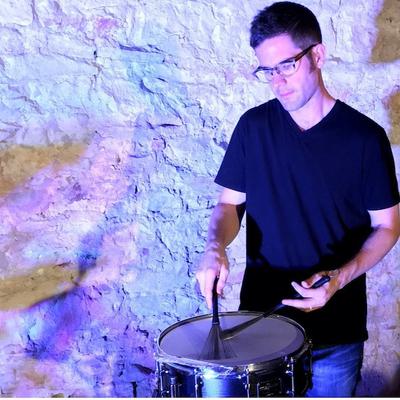
Adam Bedell serves as an Instructor of Percussion in the School of Music at Texas Lutheran University, specializing in contemporary performance practices, electronic instrument building, and new music advocacy. His educational qualifications include: Bachelor of Music in Percussion Performance from Central Michigan University Master of Music in Percussion Performance from the University of Texas at Austin Bedell is a founding member of the Austin-based ensemble line upon line percussion , having premiered over 100 new works for percussion and performed across 30 U.S. states, Europe, and Australia. His artistic practice integrates traditional percussion with electronic instrument design and microcontroller technology, reflecting deep engagement with experimental music creation. Professional recognition includes: Grammy Nomination for the album A Company of Voices, Conspirare in Concert (Harmonia Mundi) As an educator, Bedell contributes to percussion pedagogy through performance demonstrations and instrument-building workshops, emphasizing interdisciplinary approaches to music technology. His chamber music collaborations span orchestral, solo, and experimental contexts with ensembles like Conspirare.
Mariusz Węgrzyn is a Lecturer in the Department of Automation and Computer Science at the Faculty of Electrical and Computer Engineering, Cracow University of Technology. His research focuses on algorithm design, embedded systems, and FPGA applications, with recent publications on square root computation, IoT-based fire detection, and test vector optimization for soft processors. University: Cracow University of Technology School: Faculty of Electrical and Computer Engineering Department: Department of Automation and Computer Science Academic Rank: Lecturer Research Trends: Mariusz Węgrzyn’s work spans hardware acceleration, numerical algorithms, and IoT systems. His 2025 publications emphasize FPGA efficiency and floating-point approximation, while 2021 studies explore energy optimization in safety systems and test vector reduction. Contact: Email: mariusz.wegrzyn@pk.edu.pl
Prof. Dr.-Ing. habil. Jan Richling serves as a Professor in the Department of Electrical Engineering and Information Technology at South Westphalia University of Applied Sciences in Hagen, Germany. Based in Room H.318 at Haldener Straße 182 (58095 Hagen), he maintains active academic engagement with consultation hours by appointment and can be contacted via phone (+49 2331 9330-6219) or email (richling.jan@fh-swf.de). His research expertise spans critical domains in computer engineering, with particular focus on: Microprocessor architecture and design Embedded system optimization Real-time operating environments Network protocol implementation Energy-efficient computing solutions Fail-safe system reliability These interconnected fields address modern challenges in efficient, robust computing infrastructure. Prof. Richling's teaching portfolio includes foundational and advanced courses such as Microcontroller Systems, Computer Organization, Operating Systems, IP Networks Programming, and Fail-safe Systems (a compulsory elective), directly reflecting his research specializations. No information regarding scientific awards, graduate student supervision, research grants, or laboratory facilities was provided in the source material.
Nikolay Hristov Nenov is a Part-time Lecturer at the Technical University - Gabrovo, Bulgaria, within the Faculty of Economics, Department of Management. Holding a Doctorate in Technical Sciences, he bridges industrial management with technical disciplines through extensive teaching and research in electronics and electrical engineering. His work emphasizes practical applications for industrial systems and student training. Nenov's research spans Industrial Management , Electronics , and Electrical Engineering , with core focus on industrial electronics , control circuits , induction heating systems , and emerging Industry 4.0 challenges. His methodology integrates theoretical frameworks with hands-on laboratory exercises, as demonstrated in his textbooks covering electrical measurements, electric drives, and industrial electronics. Recent investigations explore deformation-photon effects and environmental monitoring devices, reflecting interdisciplinary innovation. Analysis of his 15 most recent publications reveals dominant themes in induction heating applications (water heaters, boilers, industrial assemblies) and industrial electronics . Work evolved from foundational textbooks (2009-2011) to contemporary topics like Industry 4.0 (2021) and photon emission physics. Frequent collaborations with P. Tomchev and R. Ivanova yield engineering solutions for manufacturing, thermal systems, and radiation effects, highlighting consistent industry-academia partnerships.
Andreas Gollwitzer is Professor of Electrical Engineering and Technical Computer Science at HFU Furtwangen University since October 2009, specializing in digital systems and measurement technology. His work bridges theoretical research with practical instrumentation development across multiple engineering domains. His academic credentials include: Diplom-Ingenieur (FH) from FH Amberg-Weiden (1999) Diplom-Ingenieur from Fernuniversität Hagen (2003) Doktor-Ingenieur from Universität Bayreuth (2009) Professor Gollwitzer's research spans digital signal processing , microcontroller programming , and precision measurement systems , with strong emphasis on sensor technology and analog-digital hybrid systems . His experimental approach integrates optical, microwave, and electrochemical methodologies for advanced instrumentation, particularly in interferometry and high-frequency measurement applications. His 2008-2010 publications reveal a consistent focus on calibration-free measurement techniques and real-time sensor systems , demonstrating interdisciplinary work connecting electrical engineering with materials science and physical chemistry. Key themes include interferometric precision, microwave-based process monitoring, and impedance modeling for chemical sensors. As an active IEEE member, he regularly presents at international conferences including IEEE Frequency Control Symposium and OPTO, with expertise covering both theoretical modeling and hardware implementation of measurement systems.