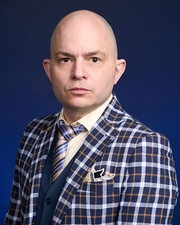
Dr. Philipp Grete is a postdoctoral research associate at the Hamburg Observatory (University of Hamburg), previously holding a Marie Skłodowska-Curie Fellowship at the same institution and a postdoctoral position at the Department of Physics & Astronomy, Michigan State University . His interdisciplinary research bridges astrophysics and computational methods , focusing on: Magnetohydrodynamic turbulence in astrophysical systems Performance-portable exascale simulation frameworks (Parthenon, AthenaPK) Cosmic ray transport mechanisms Anisotropic transport processes in weakly collisional plasmas Supercomputer-driven AGN feedback analysis He leads the XMAGNET project using DOE INCITE allocations on exascale systems and recently secured DFG funding for three years. His work has been recognized with the Postdoctoral Excellence in Research Award (MSU), SC23 Best Paper nomination, and CUG23 Best Paper Runner-up award.
Sofia Eriksson is an Associate Professor in the Department of Mathematics within the Faculty of Technology at Linnaeus University. She specializes in numerical analysis and scientific computing, with a primary focus on developing finite difference methods for solving time-dependent partial differential equations. Her research has significant applications in fluid dynamics and aerodynamics. Dr. Eriksson's research interests span numerical analysis, scientific computing, finite difference methods, partial differential equations, and computational mathematics. She leads or participates in two major research groups: Computational Mathematics for Predictive Digital Twins (PreDiTwin) and Scientific Computing and Partial Differential Equations. Her work emphasizes developing stable numerical methods with proper boundary and interface treatments. Her publication record shows consistent output since 2007, with 15 recent publications spanning journals like Journal of Computational Physics, SIAM Journal on Numerical Analysis, and Foundations of Computational Mathematics. Her research shows a clear progression from foundational work on finite difference methods to more specialized applications in fluid dynamics and aerodynamics. The publications demonstrate expertise in developing stable numerical schemes, particularly for time-dependent problems with complex boundary conditions. Dr. Eriksson teaches courses in Numerical Methods, Linear Algebra, and Calculus, contributing to both undergraduate and graduate education in mathematics and computational science. Her teaching reflects her research expertise, providing students with practical knowledge of numerical methods applicable to real-world scientific and engineering problems.
Dr. Philipp Bringmann is a postdoctoral researcher at the Institute of Analysis and Scientific Computing , Technische Universität Wien (TU Wien), where he has worked since February 2023. His research focuses on adaptive finite element methods, particularly for fourth-order partial differential equations and Stokes problems, with emphasis on optimal convergence rates and parameter-free implementations. His work includes the development of C0 interior penalty methods for the biharmonic equation, discontinuous Petrov-Galerkin schemes for nonlinear problems, and rigorous convergence analysis for adaptive least-squares finite element methods. He has contributed to a posteriori error estimation , discretization stability , and nonconforming mesh techniques. His publications span journals such as Numerische Mathematik , arXiv.org , and Computers and Mathematics with Applications , with recurring themes in numerical analysis and computational mathematics. Collaborators include Prof. Carsten Carstensen and Prof. Dirk Praetorius.
Christoph Erath is a Professor of Mathematics at the University College of Teacher Education Vorarlberg (PH Vorarlberg) in Austria, serving as Director of Secondary Education and Subject Didactics. He holds a Habilitation (Privatdozent) in Applied Mathematics from TU Wien and maintains active research and teaching responsibilities. His educational background includes: PhD in Mathematics (Dr. rer. nat., summa cum laude) from Ulm University, Germany (2010) Master's degree in Technical Mathematics (Dipl.-Ing., with honor) from TU Wien, Austria (2005) Professor Erath's research focuses on advanced numerical methods for partial differential equations , with expertise spanning Finite Element Methods, Boundary Element Methods, and Discontinuous Galerkin Methods. His theoretical work emphasizes a priori and a posteriori error analysis, robustness, and adaptive mesh refinement strategies. He has developed numerical schemes for climate modeling and created innovative teaching formats through collaboration with local companies, bridging theoretical mathematics with practical classroom applications. His publication record demonstrates consistent advancement in coupling different numerical methods with rigorous error analysis. Recent work has expanded into educational applications, examining how fundamental mathematical competencies interact with emerging technologies like artificial intelligence in school settings, reflecting his dual commitment to theoretical mathematics and pedagogical innovation. Scientific recognition includes: Award from Ulmer Universitätsgesellschaft for PhD Thesis (2012) PhD scholarship from Baden-Württemberg, Germany (2007-2010) Award from Austrian Mathematical Society for Diploma Thesis (2006) Professor Erath actively supervises graduate theses in mathematical fields and has led research teams including postdocs and PhD students. His teaching portfolio includes core courses in Applied Mathematics, Analysis, and Mathematical Methods for teacher education students. He maintains strong research connections with institutions including TU Wien, TU Darmstadt, and the University of Colorado, contributing significantly to both computational mathematics and mathematics education methodology.
Jannis Teunissen is a researcher in the Multiscale Dynamics group at Centrum Wiskunde & Informatica (CWI), the Dutch national center for mathematics and computer science. He also serves as a visiting lecturer at the Centre for mathematical Plasma Astrophysics at KU Leuven. Education: BSc in Physics & Astronomy and Master in Computational Science from University of Amsterdam PhD in computational plasma physics at CWI (obtained "cum laude") Postdoctoral research at KU Leuven's Centre for mathematical Plasma Astrophysics Dr. Teunissen's research focuses on computational plasma physics, particularly on simulating electric discharges. His work bridges theoretical modeling, computational methods, and experimental validation. He develops advanced computational techniques for studying streamer discharges, which are fast-moving ionized channels that form the first stage of sparks. These phenomena have important applications in environmental technology, high-voltage engineering, and atmospheric science. His research employs a range of computational methods including adaptive mesh refinement (AMR), plasma fluid modeling, particle-in-cell simulations, geometric multigrid solvers, and high-performance computing techniques. More recently, he has been applying machine learning methods to space weather research. Analysis of his publication history shows a strong focus on streamer discharge phenomena across different gas mixtures, with emphasis on macroscopic parameterization, electric field measurements, and radio emission calculations. Hershkowitz Early Career Award and Review (2024) from Plasma Sources Science and Technology Early Career Scientist Prize on Plasma Physics (2023) from IUPAP Student Award of Excellence of the Gaseous Electronics Conference (2015) PhD obtained "cum laude" (2015) Dr. Teunissen has been actively involved in several research projects including "Reliable nExt GENERation Actuation sysTEms (REGENERATE)" and "Plasma for Plants: Towards controlled and efficient plasma-activated water generation for a cleaner environment." His work has resulted in numerous publications focusing on streamer discharges in various gas mixtures, their radio emissions, electric field measurements, and computational modeling approaches. His research has significant implications for understanding natural phenomena like lightning and developing more environmentally friendly alternatives to traditional insulating gases used in high-voltage technology.
Dr. Mihhail Berezovski is a tenured Associate Professor of Mathematical Sciences and Program Coordinator for the B.S. in Data Science at Embry-Riddle Aeronautical University's College of Arts & Sciences. With over ten years of experience, he has pioneered data science applications and cross-disciplinary engagement strategies that connect academic research with real-world industry problems. His innovative approach provides students with authentic data-enabled research experiences through partnerships with businesses, government agencies, and non-profit organizations. Dr. Berezovski earned his Ph.D. in Applied Mechanics from Tallin Technological University. His academic journey includes positions as a Postdoctoral Scholar at Worcester Polytechnic Institute (2011-2015) and Researcher at the Institute of Cybernetics at TUT, Estonia (2011-2015). Dr. Berezovski's research spans Data Science, Industrial Mathematics, Numerical Methods, and Material Science . He specializes in developing data-enabled solutions for complex problems across diverse domains including aviation, child welfare systems, and material science. His work bridges theoretical mathematics with practical applications, focusing on adaptive algorithms for wave propagation in heterogeneous materials and predictive analytics for real-world systems. He has established a sustainable model where students engage directly with industry-provided problems, creating meaningful research experiences that prepare them for data science careers. His publication record demonstrates a clear evolution from theoretical work in elastic wave propagation toward applied data science projects addressing real-world challenges. Recent publications show increasing focus on interdisciplinary applications in aviation, social services, and media literacy, reflecting his commitment to solving practical problems through mathematical and computational approaches. Dr. Berezovski's contributions to mentoring have been recognized with numerous prestigious awards: 2024 Faculty Mentor Award from the Mathematical, Computing, and Statistical Sciences Division of CUR 2023 ERAU College of Arts & Sciences Award for Undergraduate Student Mentorship 2022 ERAU College of Arts & Sciences Dean's Award for Leadership and Innovation 2022 ERAU Faculty Mentor of the Year Award With over 200 students from 26 universities participating in 70+ research projects, Dr. Berezovski has established a highly successful undergraduate research program. His funding portfolio includes support from the National Science Foundation and the Mathematical Association of America, and he has served as co-PI on projects with METIS Solutions and DHS. His innovative model connects students directly with industry partners, providing authentic research experiences that result in publications, conference presentations, and valuable career preparation. Dr. Berezovski leads initiatives that foster cross-disciplinary collaboration across Embry-Riddle, working with departments including Security Studies, Human Factors, Aviation Maintenance Science, and Civil Engineering. His research group focuses on applied data science projects that address real-world challenges while providing students with hands-on experience. The program has established long-term partnerships with over ten organizations, businesses, and government labs, creating a sustainable ecosystem for data science research and education.
Alexander Fuller Viguerie is a Researcher (Ricercatore Legge 240/10 a tempo determinato) at the Department of Pure and Applied Sciences (DiSPeA) at the University of Urbino Carlo Bo. His position involves both teaching responsibilities in mathematical courses and conducting advanced research primarily focused on numerical methods and mathematical modeling. He teaches courses including Logic, Algebra and Geometry; Numerical Methods for Linear Algebra and Functional Analysis; and Statistical Processing of Experimental Data across various programs including Informatics, Digital Innovation, and Biotechnology. Viguerie's research spans multiple interdisciplinary domains with an emphasis on numerical analysis and computational methods. His primary research interests include mathematical epidemiology (particularly modeling of infectious diseases like COVID-19), computational fluid dynamics, partial differential equations, and dynamic mode decomposition techniques. His work demonstrates a strong focus on developing and applying advanced numerical methods to solve complex problems in epidemiology, fluid mechanics, and biomedical applications. He has developed compartmental models with diffusion components for spatially resolved epidemic simulations, created novel approaches using delay differential equations for disease modeling, and applied dynamic mode decomposition to accelerate simulations of cancer growth models. His publication record shows a significant shift toward mathematical epidemiology during the pandemic years, with numerous high-impact papers analyzing the spatiotemporal spread of COVID-19 across different countries. Viguerie has developed modified SEIRD models with dynamic parameterization capabilities, enabling more accurate forecasting of pandemic trajectories. His work extends beyond epidemiology to include applications in computational fluid dynamics, additive manufacturing, and biomedical modeling, demonstrating versatility across multiple application domains while maintaining a strong methodological foundation in numerical analysis. Viguerie maintains an extensive international research network, with collaborations spanning Europe, Asia, North America, and South America. His research shows particularly strong connections with institutions in Italy, the United States, Brazil, Germany, and Singapore. This global collaboration network enables him to conduct cross-country comparative studies, as evidenced by his work analyzing the spread of COVID-19 in Italy, the USA, and Brazil. His research methodology frequently combines theoretical mathematical analysis with practical numerical implementation, resulting in tools that have potential applications in public health decision-making and engineering design processes.
Dr. Manuel Behrendt is a Research Fellow at the Ludwig-Maximilians-Universität München, where he serves as a staff scientist at the University Observatory in the CAST-group led by Prof. Andreas Burkert. He also holds a position with the Physics of Galactic Nuclei (PGN) group at the Max-Planck-Institute for Extraterrestrial Physics in Garching, Bavaria. His primary research focuses on the structure-formation and evolution of galactic discs in the early universe, utilizing high-resolution hydrodynamic simulations within the framework of gravitational disc instability. Dr. Behrendt's work addresses fundamental questions about: The formation and evolution mechanisms of giant clumps and small-scale structures in high-redshift galaxies The hierarchical organization of clumps, including whether observed kpc-scale clumps are composed of sub-clump clusters The role of stellar feedback in shaping galactic structure formation and kinematics The energetic sources driving high random motions observed in young galaxies A significant contribution to the field is his development of MERA.jl, a high-performance Julia package designed for analyzing large-scale astrophysical simulation data. This tool provides: Efficient numerical performance through Julia's JIT compilation Unified API for handling multi-resolution AMR grids and particle datasets Interactive development capabilities that scale from notebooks to production scripts Memory-conscious design for processing large datasets Multi-threaded I/O operations for improved performance Dr. Behrendt's publication record demonstrates a consistent research trajectory focused on galaxy formation processes, particularly examining clump structures in high-redshift galaxies. His work bridges theoretical astrophysics with practical computational methods, making important contributions both to our understanding of galaxy evolution and to the development of advanced analysis tools for the broader astrophysics community. As an educator, Dr. Behrendt actively supervises students, teaches tutorials and astrophysical laboratory courses, and serves as a substitute lecturer for Prof. Burkert's courses. His dual commitment to research excellence and educational mentorship highlights his comprehensive contribution to the academic community.