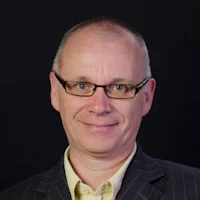
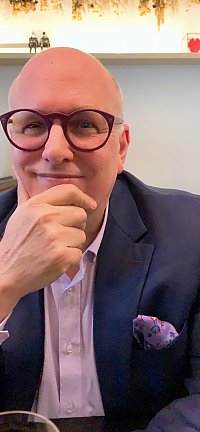
Professor Max Deeg is a leading scholar in Buddhist Studies at Cardiff University , holding a personal chair since 2009. With a career spanning institutions in Germany, Austria, and the UK, his research focuses on transcultural Buddhist history from India to East Asia, Chinese Buddhist travelogues , and interreligious encounters in medieval China. He has held visiting positions at universities in Japan, Nepal, the US, and Germany, and currently directs the Centre for the History of Religion in Asia (CHRA) . PhD from University of Würzburg (1990) Dr. phil. habil. in Religious Studies (1998) Full Professor at University of Vienna (2002-2006) His research explores Buddhist narratives as tools for constructing religious identity, foundation myths in trans-Himalayan contexts, and terminology evolution in Chinese Buddhist translations. Recent publications analyze Indian Buddhist monasticism through Chinese sources and religious concepts like xin (trust) across Buddhist, Manichaean, and Christian traditions. Awarded the KHK Visiting Research Fellowship (2016) and a DAAD Scholarship (1986-87) , Prof Deeg contributes to editorial boards of major journals. He supervises PhD students and teaches Buddhist Studies , Life of the Buddha , and Chinese Buddhist Texts .
Albrecht Fuess is a Professor of Islamic Studies at Philipps University of Marburg since 2010, specializing in Middle Eastern History (13th–17th centuries), Mamluk socio-cultural dynamics, and contemporary European Islamic discourses. His research spans historical continuity in Ottoman-Mamluk-Safavid interactions, Islamic youth cultures, and Mediterranean geopolitics. Research Focus: Medieval Islamic history, Transottomanica mobility studies, Islam in Europe, and cultural integration of Muslim migrants. Awards: Le Studium Fellowship (2007–2009) at Université de Tours. His publications emphasize military-economy interplay, legitimacy through religious narratives, and resource management in empires, with a focus on Mamluk and Ottoman transformations. He has advised on doctoral projects covering topics like Islamic welfare, Arabic ʾAmālī literature, and Cypriot-Ottoman relations. Leadership: Co-coordinator of Transottomanica (DFG-SPP 1981), member of ANR and DAAD committees, and liaison professor for the German National Academic Foundation. Editorial Roles: Co-editor of 'Transottomanica' and 'Muslim Worlds' series, and advisory board member for journals in Cairo, Paris, and Leuven.
Prof. Dr. Sebastian Conrad holds the Chair of Modern History at Freie Universität Berlin , specializing in Global History , (Post-)colonial History , and Intellectual History . He joined the faculty in 2010 after teaching at European University Institute in Florence and serving as visiting scholar at institutions including NYU Abu Dhabi and The New School, New York. Director of MA "Global History" (FU Berlin/Humboldt University joint program) Director of Graduate School "Global Intellectual History" Principal Investigator, Cluster of Excellence "Temporal Communities" (2024) Research Interests focus on transnational historical frameworks , globalization of historical narratives , and postcolonial historiography . His latest book Die Königin: Nofretetes globale Karriere (2024) analyzes cultural globalization through Nefertiti's iconography, while his current project explores global history of bodily aesthetics and identity formation since the 19th century. Recent Publications include: 2022: "Empire and Nationalism" (American Historical Review) 2021: "Globalizing the Beautiful Body" (Journal of World History) 2020: "Greek in Their Own Way" (American Historical Review) Scientific Honors : Elected member, Berlin-Brandenburg Academy of Sciences and Humanities (2024) Elected member, Academia Europaea (2024) Finalist, German/NDR non-fiction book awards (2024) for Nefertiti study Academic Leadership includes editorial roles at Geschichte und Gesellschaft , Past & Present , and Globalgeschichte book series (Campus Verlag). His work bridges historical analysis with contemporary debates on memory, identity, and global cultural dynamics.
Sebastian Thies is Professor and Chair for Ibero-American Literary and Cultural Studies at the University of Tübingen, where he has been employed since October 2012. He serves as Vice Director of the Interdisciplinary Centre for Global South Studies (ICGSS) and coordinates the BMBF/DAAD thematic network 'Futures under construction in the Global South'. His academic journey began with a PhD in Hispanic Studies from the University of Osnabrück in 2000, followed by positions at the University of Bielefeld where he progressed from Junior Professor for Hispanic Literary and Media Studies to Full Professor for Inter-American Studies. Thies' research focuses on Global South Studies, with particular emphasis on Latin American literature, film, and media. His work explores subjectivity formations, entangled temporalities, and political communication across borders. He has directed significant research initiatives including the doctoral studies program 'Entangled Temporalities in the Global South' and has co-edited major reference works such as The Routledge Handbook for Global South Studies on Subjectivities (2024). His extensive publication record demonstrates a consistent engagement with transnational cultural phenomena, particularly examining how Latin American cultural production intersects with global political and social dynamics. Thies frequently collaborates with international scholars, reflecting his commitment to transdisciplinary and transregional approaches to cultural analysis. Project Leader: Research Training Network 'Entangled Temporalities in the Global South' Vice Project Leader: Thematic network 'Literary Cultures of the Global South' Associated Investigator: BMBF-Area Studies Project 'The Americas as a Space of Entanglement' Project Leader: Research Group 'E Pluribus Unum? Ethnic Identies in Processes of Transnational Integration' Thies actively supervises doctoral students through the Interdisciplinary Centre for Global South Studies and has established collaborative networks across Latin America, particularly with institutions in Mexico and Colombia. His current research agenda focuses on 'Futures under construction in the Global South' and continues to explore the intersections of cultural production, political communication, and subjectivity formation in transnational contexts.
Prof. Stefan Rohdewald is a Professor of East and South-Eastern European History at the University of Leipzig since 2020. Previously, he held positions at Justus Liebig University Giessen (2013-2020), University of Passau (2003-2012), and University of Zurich (1998-2001). His research focuses on transregional histories, religious memory, and intercultural communication in Eastern Europe and the Ottoman sphere. Key roles include coordinating DFG’s Transottomanica program and leading the GiZo partnership with University of Zagreb. Education: PhD (2004, University of Zurich), Habilitation (2012, University of Passau). Research interests span memorial discourses, Ottoman-Europe relations, and sport history. Major projects include studies on Serbo-Bulgarian religious figures and transottoman mobility dynamics. He chairs conferences on minority politics and Ottoman Europe, contributing to over 70 peer-reviewed publications. Award-winning publications include Götter der Nationen (2014) and Vlad der Pfähler (2017). His work bridges Eastern European, Ottoman, and transnational histories through innovative methodological frameworks.
Prof. Dr. Daniel Leese is a full professor of History and Politics of Modern China at the University of Freiburg's Institute of Sinology. He specializes in 20th-century Chinese history, focusing on the Communist Party's legacy and transitional justice. Current research includes a dual biography of Chiang Kai-shek and Mao Zedong, and analysis of PRC information systems. Education: PhD in International History (2006, International University Bremen). Academic roles include ERC grant leadership (2014-2019) and FRIAS Senior Fellowship (2018-2019). Awards include Carl Friedrich von Siemens Fellowship (2022/2023). Key publications: Maos langer Schatten (2021) Justice After Mao (2023) Chinesisches Denken der Gegenwart (2023) Research emphasizes Mao's political impact, historical justice mechanisms, and institutional memory. Maintains a digital archive of Mao-era documents (maoistlegacy.de).
Zaur Gasimov is a Lecturer at Johannes Gutenberg University Mainz and currently serves as DAAD Departmental Coordinator and Co-Head at the Faculty of Economics and Administrative Sciences, Turkish-German University. He holds a habilitation in Modern History and Eastern European History, with a focus on Eastern European History, political science, and sociology. Education : B.A. in International Relations from Baku State University; M.A. from Catholic University of Eichstätt-Ingolstadt; Doctorate in Eastern European history Research : Concentrates on Russian-Turkish relations, nationalism in Eastern Europe, cultural transfer processes, and historical narratives. His habilitation thesis analyzed Polish-Turkish anti-Soviet alliances. Publications : Authored monographs on Prometheism, Azerbaijani historiography, and Russification policies. Collaborated on comparative studies of cultural transfer and Ottoman-Russian entanglements.
Prof. Dr. Ulrike Freitag is a distinguished scholar in Islamic Studies and social history of the Arab world, holding a Professorship at Freie Universität Berlin and serving as Director of the Leibniz-Zentrum Moderner Orient (ZMO) . Her work bridges urban history, transregional Islamic networks, and Arabian Peninsula studies within Indian Ocean and Red Sea contexts. Education : PhD in Islamic Studies (Freiburg, 1991), Habilitation (Bonn, 2002) Research : Focus on Ottoman urban violence, Saudi state formation, Hadhrami diaspora, and historical urbanism in Jeddah Her supervision of PhD projects spans topics from Moroccan Sufi sanctußen to Yemeni Jewish communities. Recent scientific awards include fellowships at Leiden University and Käthe-Hamburger Kolleg. She contributes to public discourse through Tagesspiegel op-eds and international conferences.
Cora Schmidt-Ott is a Postdoctoral Researcher at the Chair of Modern and Contemporary History (Prof. Dr. Jan Eckel) at the University of Freiburg . Her work focuses on the intellectual biography of Samuel P. Huntington and the broader intellectual history of the 20th century, particularly in relation to political stability, globalization, and the American Century. She collaborates with institutions like the German Historical Institute, Washington DC , and has led DFG-funded projects. Education: MA in Comparative Modern History (University of Freiburg & University of Bologna); BA in History and American Studies (University of Freiburg & Connecticut College) Her research explores the intersections of political theory, Cold War liberalism, and transnational historical processes, with a particular emphasis on Huntington's influence on postcolonial state-building and global order. She has contributed to debates on migration, museum narratives, and post-war societal transformations. Recent publications and lectures highlight her expertise in political history, American studies, and Cold War-era intellectual networks. She has received scholarships from the Bavaria Graduation Scholarship , Max Weber Fellowship , and Erasmus Program , among others. Scientific Awards: Bavaria Graduation Scholarship (2016) Max Weber Fellowship (2015) Erasmus Scholarship (2013) Baden-Württemberg Scholarship (2011) Cora Schmidt-Ott contributes to academic discourse through her leadership in workshops, teaching roles in seminars on decolonization and 20th-century history, and her ongoing project funded by the German Research Foundation on Samuel Huntington's intellectual legacy.
Prof. Ann Heylen is a Professor at the Department of Taiwan Culture, Languages and Literature (TCLL) at National Taiwan Normal University (NTNU), Taipei, Taiwan since 2008. She also serves as Executive Director of the International Taiwan Studies Center at NTNU. Holding a Ph.D. in Chinese Studies (Sinology) from Catholic University Leuven (KULeuven), her research focuses on Taiwan’s historical narration, colonial periods (Dutch and Japanese), sociolinguistics, and digital humanities. Education: Ph.D. in Chinese Studies (Sinology), Catholic University Leuven (KULeuven), Belgium Research Interests: Prof. Heylen explores Taiwan’s historical discourse through digital newspaper corpora and language planning. Her work applies Einar Haugen’s sociolinguistic matrix model to analyze Taiwanese language standardization. She also investigates 17th-century European presence in East Asia, particularly Dutch-Taiwan relations, and uses ego-documents (diaries, oral histories) to study Taiwanese national identity. Publications: Her work bridges historical analysis and modern methodologies, with recent focus on digital humanities and colonial historiography. Affiliations: Founding board member of the European Association of Taiwan Studies (EATS) Editor-in-Chief of the East Asian Journal of Popular Culture (Intellect Books) Current Projects: Monograph on Formosa media narratives in Benelux newspapers (19th-20th centuries) and 400-year Dutch-Taiwan relations commemoration studies.
Professor Maria Löblich holds a position in the Department of Communication History and Media Cultures at the Institute of Journalism and Communication Studies, Faculty of Political and Social Sciences at Freie Universität Berlin. She specializes in historical and comparative approaches to communication studies with particular expertise in German division and reunification contexts, media policy history, and qualitative research methodologies. Her research focuses on communication history, media biographies, and the relationship between East and West German media landscapes. She has developed innovative approaches to studying media use across life courses and historical periods, with particular attention to how media shapes and reflects collective identities during periods of political transformation. Her methodological expertise lies in qualitative approaches including biographical interviews, discourse analysis, and historical media research. Her recent publications demonstrate a strong focus on historical media analysis, particularly examining the Berliner Zeitung as an anchor of East German identity, media usage patterns in divided Berlin, and the development of journalism studies after the student movement. She has also contributed significantly to theoretical discussions on mediatization and media policy frameworks. Fellow at the Berkman Center for Internet & Society, Harvard University (2012/13) Speaker of the Communication History Group of the German Society for Publizistik- and Communication Science (2012-2016) Professor Löblich has supervised numerous research projects examining media history in divided Germany and currently leads investigations into the media legacy of the GDR. Her methodological contributions to qualitative communication research have been widely recognized, including her co-authored book 'Qualitative Forschung in der Kommunikationswissenschaft.'
Dr. Harry O. Maier is Professor of New Testament and Early Christian Studies at Vancouver School of Theology since 1994, with ongoing fellowships at the Max Weber Center for Advanced Cultural and Social Studies at the University of Erfurt since 2017. His academic career spans over 25 years with significant contributions to understanding early Christianity within the context of the Roman Empire. His educational background includes a D. Phil from Oxford University (1987), Master of Divinity from Lutheran Theological Seminary (1989), and B.A. from Pacific Lutheran University (1981). Maier's research focuses on the intersection of New Testament studies, early Christianity, and spatial theory within the Roman Empire. His work examines how early Christian communities navigated urban spaces, constructed religious identity, and engaged with imperial ideologies. He has pioneered approaches that analyze biblical texts through spatial theory, examining how geography, urban structures, and neighborhood dynamics shaped early Christian thought and practice. His research particularly emphasizes the Book of Revelation, the Shepherd of Hermas, and Pauline literature, with attention to how these texts engaged with Roman imperial culture. His scholarly contributions include significant publications such as New Testament Christianity in the Roman World (Oxford University Press, 2018) and Picturing Paul in Empire (Bloomsbury, 2013), which won recognition for their innovative approaches to understanding early Christian texts within their socio-spatial contexts. Canadian Christian Writers Association Award for Best Book in Philosophy and Christian Leadership (2003) for Apocalypse Recalled: The Book of Revelation after Christendom Canadian Corportation of Religion Award for Best Dissertation in Religion (1990) for The Social Setting of the Ministry as Reflected in the Writings of the Shepherd of Hermas, Clement and Ignatius Maier has organized numerous academic conferences including "The Shepherd of Hermas and Religious Experience" (2018), "Religion of Quarters" (2018), and "Locating Martyrs and Space/Time" (2017). He serves on editorial boards for several prestigious publications including as associate editor for the Bryn Mawr Classical Review since 2016 and co-editor of the Christian Religion and Public Life book series since 2020. His external reviewing work includes major academic presses such as Oxford University Press and Cambridge University Press. As founder and co-organizer of The Greater Vancouver Biblical Colloquium since 2008, Maier has fostered interdisciplinary dialogue among scholars of biblical studies and related fields. His academic leadership extends to professional societies including the Society of Biblical Literature and the North American Patristics Society.
Hartmut Rosa holds the Professorship of General and Theoretical Sociology at Friedrich Schiller University Jena since 2005. He serves as Director of the Max Weber College in Erfurt and leads multiple DFG-funded research groups including the Collaborative Research Center TRR 294 'Structural Change in Property'. A leading theorist in social acceleration and resonance theory , he combines temporal analysis with democratic theory and critical sociology. Born: August 1965 Current: Director of Max Weber College Key Positions: New School for Social Research affiliation His research spans : Social acceleration across technological, cultural, and experiential dimensions Resonance as alternative to alienation Democratic theory under time pressure Modernity diagnostics Critical theory foundations Recent article themes include: Digital self-tracking motivations (2021) - intersection of big data and temporal ethics Corona crisis as temporal disruption (2020) - rethinking economic priorities Acceleration's impact on democracy (2005-2023) - temporal overload analysis World relations theory (2011-2022) - new materialist approaches Major scientific awards : 2023 Gottfried Wilhelm Leibniz Prize (Germany's highest research honor) 2018 Erich Fromm Prize for Social Psychology 2018 Paul Watzlawick Ring of Honor 2016 Tractatus Prize for Philosophical Essays He leads multiple research projects : SFB TRR 294 Subproject C06 'Making Things Available' DFG Priority Programme on Aesthetic Eigenzeiten Research Group 'Land Grabbing, Acceleration, Activation' VW Foundation project on 'Aporias of Perfection' in acceleration
Irene Albers is a full Professor at Free University of Berlin's Department of Philosophy and Humanities, holding dual appointments at the Peter Szondi Institute for General and Comparative Literature and Institute for Romance Philology since 2004. She chairs both the Examination Board and Doctoral Committee for General and Comparative Literature, serves as Trustee of Studienstiftung des deutschen Volkes since 2004/05, and has been Principal Investigator for the Friedrich-Schlegel Graduate School for Literary Studies and Cluster Languages of Emotion since 2007. Her research bridges comparative literature, anthropology, and visual culture with institutional leadership spanning editorial projects and international conferences. Her educational background includes: Born in Bremen (1967) Romance Studies, Philosophy, and German Studies at Universities of Tübingen, Tours, and Konstanz M.A. from University of Konstanz (1993) Ph.D. from University of Konstanz (1999) on literature and photography in Émile Zola, Proust, and Claude Simon Albers' core research examines literary anthropology through colonial/postcolonial lenses, focusing on French literary engagement with Africa, surrealism, and literature-photography intersections. She pioneered studies on Michel Leiris' ethnological poetics and Claude Simon's photographic techniques, extending to historical emotion research (anatomy of affects, body language) and romance novella traditions. Her work consistently challenges Eurocentric literary canons through primitivism critique and heteronomy aesthetics, emphasizing textual restitution and cultural reclamation. Recent publications (2018-2025) reveal a sharp turn toward colonial restitution ethics, particularly in oral literature provenance. Articles increasingly analyze literature as colonial loot, connecting French modernism with African/Caribbean contexts through collaborative projects with anthropologists like Eléonore Devevey. This trajectory builds from earlier surrealist studies to concrete frameworks for decolonizing literary scholarship, spotlighting institutional complicity in cultural appropriation while advancing symmetrized modernity revisions. Scientific awards include: Senior Fellow and Prize Winner of the Zukunftskolleg, University of Konstanz (2009) Albers supervises master's and doctoral students through dedicated AVL colloquia while securing major research funding as Principal Investigator for Friedrich-Schlegel Graduate School (2007-present) and Cluster Languages of Emotion (2007-2012). Her current DFG-funded project 'Literature as Colonial Loot?' with Andreas Schmid pioneers philological provenance research. Earlier, she contributed to Collaborative Research Center 511 'Literature and Anthropology' (Konstanz, 1999-2002) and DFG-funded conferences on Claude Simon. She leads the DramaNet research project and co-edits the 'machina' series at transcript Verlag since 2010. As board member (2007-2009) and deputy (2008-2012) of Cluster Languages of Emotion, she coordinates Area D 'Cultural Codings of Emotions'. Her Zukunftskolleg fellowship (2012-2013) and Marcel Proust Society collaborations underscore sustained engagement with literary anthropology networks.
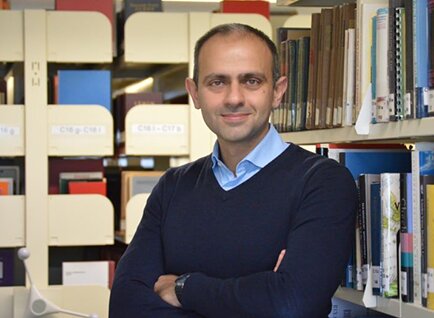
Dr. Razak Khan is a Research Fellow in the History Research Group at CeMIS (Center for Modern Indian Studies). His academic journey includes a DPhil from Freie Universität Berlin (2014) and postdoctoral fellowships at the Max Planck Institute for Human Development and Friedrich–Alexander University Erlangen–Nürnberg. Research Focus: Early modern/colonial India, South Asian Islam, Urdu public cultures, history of emotions, Indo-German comparative histories, and global intellectual history. Key Projects: His Habilitation project explores 'Minor Cosmopolitanism' through Syed Abid Husain's writings, while his book Minority Pasts (OUP, 2022) examines locality and belonging in Rampur. Publications: 15 recent works span transnational Indo-German intellectual histories, emotional geographies, Urdu archives, and Indo-Islamic cultural studies. Collaborations: Co-edited The Incomparable Festival (Penguin, 2021) and contributed to interdisciplinary volumes on emotions and migration.