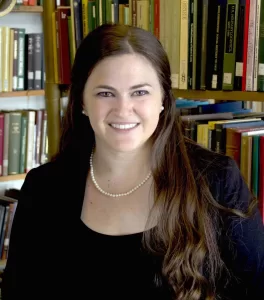
Jessica Barker is a Senior Lecturer in Medieval Art History at The Courtauld Institute of Art, specializing in sculpture and funerary art. She holds degrees from the University of Oxford and The Courtauld Institute of Art, where she was a Henry Moore Postdoctoral Fellow. Her research focuses on northern Europe and the Iberian Peninsula, exploring themes like the macabre, gender, materiality, and the body in medieval art. Her major works include *Stone Fidelity: Marriage and Emotion in Medieval Tomb Sculpture* (2020), winner of prestigious awards, and co-edited *Revisiting the Monument* (2016). She has published widely in journals like *Art Bulletin*, *Art History*, and *The Sculpture Journal*. Current projects include co-curating *The Rule: Shaping Lives* (2026) and researching Portuguese *padrões* columns. She advises PhD students on topics like medieval manuscripts, measurement relics, and golden representations of the dead. Awards include the 2021 International Centre of Medieval Art Prize and 2022 Historians of British Art Award. She contributes to initiatives like the Sculptural Processes Group and serves on editorial boards. Her work bridges artistic innovation, material culture, and interdisciplinary approaches to medieval monuments.
Christina Maria Kreinecker is a Professor at the Faculty of Theology and Religious Studies, KU Leuven, where she heads the Research Centre for Multilingual Manuscripts (LEMMA) and serves on the Faculty Council. She is an active member of LECTIO – KU Leuven Institute for the Study of Text Transmission and LILI – KU Leuven Interdisciplinary Language Institute. Her research integrates New Testament Textual Criticism with papyrological analysis of documentary evidence to reconstruct ancient everyday life and Greco-Roman cultural contexts. She specializes in multilingual manuscript traditions, examining how linguistic diversity shaped biblical transmission across antiquity. Her methodology bridges textual scholarship with socio-historical analysis of early Christian communities. Recent publications reveal consistent focus on 1 Corinthians' textual history across multilingual contexts, particularly in patristic writings. Her work demonstrates how Vulgate, Coptic, and Old Latin witnesses preserve evidence of interlingual interactions, with significant contributions to understanding language contact in early Christian textual practices. Kreinecker leads eight major research projects including the 1Cor-Tekst initiative (2022-2027) tracing 1 Corinthians' transmission across the first millennium and the NTTMMC center (2019-2029) dedicated to multilingual New Testament contexts. Her grants examine textual phenomena in Origen, Cappadocian Fathers, and Augustine while exploring papyrological metaphors in Romans 6-8. As director of LEMMA, she coordinates investigations into bilingual manuscripts to detect interlingual interactions within New Testament traditions. Her leadership in LECTIO and LILI fosters interdisciplinary collaboration between textual scholars, linguists, and papyrologists studying transmission mechanisms across historical periods.
Thomas Klein is a Professor of Medieval and Modern Latin Philology at the Martin Luther University Halle-Wittenberg since 2002. His research spans Medieval Latin Literature , Textual Criticism , and Classical Reception , with a focus on Weltchronistik , Pragmatische Schriftlichkeit , and Hagiographie . He has held prestigious fellowships, including the DFG Scholarship and Lynen Fellowship , and serves as Lead Editor of the 'Medieval Latin Yearbook'. Academic Appointments : Acting Professor at Wuppertal (1997-1998) and Munich (2001-2002), Habilitation at Bonn (1997), and ongoing supervision of 15+ graduate students . Research Projects : Bibliographic revision of 'Initia carminum Latinorum', critical editions of medieval texts (e.g., 'Ernestus' by Odo von Magdeburg), and collaborative work with Dieter Scheler on 'Hierapigra ad purgandos prelatos'. His publications include critical editions of Latin poems (e.g., 'Carmina misogynica'), studies on medieval satirical literature , and contributions to understanding pragmatic literacy and exemplum traditions . He has authored reviews in Gnomon and Mittellateinisches Jahrbuch , advancing medieval Latin bibliography .
Rafael González Fernández is a Professor at the University of Murcia, affiliated with the Department of Prehistory, Archaeology, Ancient History, Medieval History, and Historiographic Sciences and Techniques within the Faculty of Arts and Humanities. His primary research focuses on Roman history, epigraphy, and archaeology, with a particular emphasis on Latin inscriptions, Roman villas, and ancient Mediterranean cultures. He holds a Doctorate from the University of Murcia, awarded in 1991 for his thesis on Justinian's ideological structures in the Codex Justinianus. Key research interests include the study of Roman material culture, funerary archaeology, and the socio-political dynamics of the late Roman Empire. He has conducted extensive fieldwork at sites like the Roman villa of Los Villaricos, where he explored olive oil production facilities and their role in Hispania Tarraconensis. His work often bridges classical antiquity with early medieval history, examining topics such as Herodotean influences in medieval chronicles and the persistence of pagan practices under Christian dominance. His publications span over three decades, covering topics from Republican-era votive inscriptions to the analysis of Severan dynasty political strategies. Collaborations with institutions like the Spanish Archaeological Archive and international scholars highlight his global academic engagement. Though no awards are explicitly mentioned, his contributions to Roman epigraphy and archaeology are widely recognized in academic circles. His research also extends to interdisciplinary projects, such as the analysis of heraldic repertoires and the application of digital methods in archaeological documentation. The article ECHOES OF HERODOTUS IN THE CAPTURE OF MULA exemplifies his interdisciplinary approach, linking classical historiography to early modern Spanish literary traditions.
Nicholas Melvani is a Research Fellow at the Department of Eastern European History at Johannes Gutenberg University Mainz, working within the Leibniz ScienceCampus "Byzantium between Orient and Occident" since November 2019. His research focuses on Byzantine history, art, and architecture, particularly the history and topography of Constantinople. Dr. Melvani earned his BA in History and Archaeology (majoring in Archaeology and Art History) from the University of Athens (1993-1997), followed by an MA in Byzantine Art and Archaeology (1997-2001), and completed his PhD with a dissertation on "Late Byzantine Sculpture (1204-1453): Iconographic Remarks, Stylistic Issues, and Social Context" in 2008. His primary research interests include Byzantine sculpture, the history and monuments of Constantinople, and Byzantine epigraphy. His current project, "Constantinople and Central Europe in the 16th Century," examines the monumental topography of Byzantine Constantinople as recorded by 16th-century German visitors and scholars during the early Ottoman period, combining textual analysis with visual evidence to reconstruct the city's transformation. Dr. Melvani has published extensively on Byzantine topics, including the monograph "Late Byzantine Sculpture" (2013) and numerous scholarly articles focusing on Byzantine art, architecture, and history. His publications demonstrate expertise in the Palaiologan period and the cultural interactions between Byzantine and post-Byzantine worlds. Previously, he served as a Research Associate at the Institute for Historical Research in Athens, Fellow at Koç University in Istanbul, and Visiting Lecturer at Boğaziçi University. His work bridges Byzantine studies with Eastern European history through the examination of cultural transmission routes between Constantinople and Central Europe.
Prof. Dr. Klaus Geus is a University Professor for Historical Geography of the Ancient Mediterranean at the Friedrich Meinecke Institute, Department of History and Cultural Studies, Free University of Berlin. Appointed to his current position on April 22, 2009, he has established himself as a leading scholar in ancient geography, cartography, and related fields of classical studies. His research spans multiple dimensions of ancient geographical knowledge, with particular focus on ancient sciences (especially geography, astronomy, metrology, and mathematics), Armenia, ancient East and North Africa, utopian concepts, and ancient historiography (particularly Herodotus and Polyainos). He has made significant contributions to understanding the reception history of ancient astronomy and geography across different cultural contexts, including the Latin West of the 15th and 16th centuries and the Oriental Middle Ages (Syrian, Arab, and Armenian traditions). Prof. Geus's scholarly output reveals a clear trajectory of increasingly sophisticated analysis of ancient geographical texts and concepts, with recent work focusing on 'common sense geography,' cognitive mapping in historical texts, and the intersection of spatial understanding with textual representation. His publications demonstrate exceptional command of both primary sources and theoretical frameworks for analyzing ancient geographical knowledge systems. Preis für gute Lehre 2002 (Award for Good Teaching 2002) from the Bavarian Ministry of Science, Research and Arts Senior Fellow at the Excellence Cluster 'Topoi' (Berlin) Research Fellow of the Gerda Henkel Foundation (2005-2009) As a dedicated educator and researcher, Prof. Geus has supervised numerous doctoral students and contributed significantly to the academic community through his extensive publications, conference participation, and collaborative research projects. His work bridges traditional philological approaches with innovative methodological perspectives, making important contributions to our understanding of how ancient peoples conceptualized and represented space and geography.
David Martinez-Chico is a Research Fellow at the University of Valencia's Department of Prehistory, Archaeology and Ancient History within the Faculty of Geography and History. He currently holds an Atracció de Talent Fellowship at the University of Barcelona (2025-2026) and previously received the Margarita Salas Fellowship at the Universities of Valencia and Girona (2022-2024). His research focuses on ancient numismatics, Mediterranean archaeology, and Roman military-economic systems. Dr. Martinez-Chico earned his PhD in Numismatics from the University of Valencia in 2020 with the thesis "Los tesoros imperiales de Hispania," supervised by Dr. Pere Pau Ripollès Alegre. He completed his Master's degree in Archaeology at the University of Valencia in 2017 and his Bachelor's degree in History at the University of Murcia in 2016. His academic journey reflects a deep specialization in Mediterranean historical archaeology with increasing methodological sophistication. Martinez-Chico's research interests span Classical Archaeology, Ancient Numismatics (particularly Greek and Roman), and Historical Materialism. His work examines the intersection of coinage, military organization, and economic systems in the ancient Mediterranean world, with particular focus on how coins, riches, and lands were distributed among soldiers and warriors from Late Pharaonic through Early Medieval times. His publications reveal intricate connections between monetary systems and military logistics across the Mediterranean basin and its peripheries, from Central Europe to the Sahara margins. His recent publications demonstrate methodological innovation, including the development of the AMALIA algorithm for lead isotope analysis, which has enhanced understanding of Roman metallurgical practices. Analysis of coin hoards from Spain, Yemen, Iraq, and Turkey provides evidence for trade networks, military campaigns, and economic practices that challenge traditional narratives about cultural isolation in antiquity. Atracció de Talent Fellow at the University of Barcelona (2025-2026) Margarita Salas Fellow at the Universities of Valencia and Girona (2022-2024) Editor of "Coins, Riches and Lands. Paying for Military Manpower in Antiquity and Early Medieval Times" (2025) Co-author of over 50 scholarly publications in international journals Martinez-Chico actively collaborates with international researchers on numismatic and archaeological projects. His work on clipped siliquae in Southern Spain has transformed understanding of late Roman monetary practices, while his research on Byzantine solidi hoards provides crucial evidence for Mediterranean economic connections during political transitions. His interdisciplinary approach combines traditional archaeological methods with advanced scientific techniques to reconstruct ancient economic systems. As a member of the GRAM Archaeological Research Group on the Mediterranean, Martinez-Chico contributes to regional archaeological projects while maintaining international connections. His current research examines the relationship between military organization and economic systems in Late Antiquity, with particular focus on the transformation of Roman military pay structures during the 4th-5th centuries CE.
Nadia Cannata is a Full Professor of Italian Linguistics and Philology at Sapienza University of Rome, where she is affiliated with the Department of European, American and Intercultural Studies within the Faculty of Humanities. She has held this position since 2008 and maintains regular office hours for students. Her academic career spans multiple prestigious institutions including Oxford University, University of Reading, and Harvard University's Villa I Tatti. Her educational background includes a D.Phil from Oxford University (1991) and a summa cum laude Degree in Literature from the University of Rome "La Sapienza" (1985). Professor Cannata specializes in Renaissance studies with research interests spanning Italian linguistics, philology, book history, vernacular and Neo-Latin literature, and the interrelations between linguistic theory and fine art in the early Renaissance. Her work particularly focuses on orality and written records in Early Modern Europe, with a significant emphasis on medieval epigraphy in the vernacular. She has pioneered the EDV (Italian Medieval Epigraphy in the Vernacular) project, creating a comprehensive database of vernacular inscriptions from 9th-15th century Italy. Her recent work has expanded into language museum studies, where she directs the EUROTALES project - a Museum of the Voices of Europe that explores linguistic heritage across the continent. Professor Cannata's publications show a clear trajectory from traditional philological scholarship toward interdisciplinary approaches that bridge historical linguistics with digital humanities and museum studies. Her recent work increasingly focuses on the relationship between language, cultural identity, and public engagement, with particular attention to how linguistic heritage can be presented to diverse audiences through innovative museum practices. Villa I Tatti Fellowship, Harvard University (1997-98) Leverhulme Trust Fund Scholar (2001-2002) British Academy Post-Doctoral Fellow (1991) Premio Sapienza Ricerca (2011) British Academy Grant (2014) Istituto Lorenzo de' Medici Award (2016) Professor Cannata has secured significant research funding, including €16,000 for the "Letture e riscritture dell'antico" project (2014-15) and €10,000 for the "Museum and Languages" international conference. She was one of the curators for the exhibition "I libri che hanno fatto l'Europa" (The Books That Made Europe) at the Accademia Nazionale dei Lincei in Rome (2016). As director of the EUROTALES project, she leads a collaborative initiative involving multiple international partners to create a museum of European linguistic heritage that combines scholarly research with public engagement. Her work bridges traditional philological scholarship with contemporary digital humanities approaches, making significant contributions to our understanding of linguistic history and cultural identity formation in Europe. Currently, Professor Cannata directs the EUROTALES project, which has established her as a leading expert in language museum studies, culminating in her co-authorship of "Language Museums and the Display of Intangible Cultural Heritage" (Routledge, 2020), the first comprehensive study of language museums worldwide. She serves on the advisory boards of several international peer-reviewed journals including The Italianist, Critica del Testo, and Studj Romanzi, and is a member of the peer review college of MIUR, the Italian Ministry of Education, Universities, and Research.
Zoltán Varady is a Professor in the Department of Medieval Studies at the Faculty of Humanities and Social Sciences of Gáspár Károli Reformed University. He previously served as a college professor at PTE Gyula Illyés Faculty in Szekszárd and as a postdoctoral fellow at ELTE BTK in Budapest. His academic career spans several decades with significant contributions to Hungarian medieval history and epigraphy. Varady earned his MA in History and Linguistics from ELTE BTK in 1982, followed by a university doctor (dr. univ.) qualification in 1994, and completed his doctoral studies at the Hungarian Academy of Sciences in 1996 with a dissertation on epigraphic examination of medieval stone inscriptions in Transdanubia. His research focuses on epigraphic examination of medieval Hungarian inscriptions, Latin-language sources from medieval and early modern Hungary, medieval Hungarian history, and auxiliary historical sciences. He has extensive knowledge of basic archaeology and archival practices. His publications and research output demonstrates a consistent focus on medieval epigraphy, particularly stone inscriptions in the Transdanubian region. His work spans from Romanesque and early Gothic inscriptions through Renaissance capitalis typefaces to inscriptions from the era of King Matthias. His research methodology combines careful epigraphic analysis with historical contextualization, revealing insights about medieval society, royal patronage, and linguistic evolution. His recent publications continue to advance the field of Hungarian medieval epigraphy with sophisticated dating methods and interpretation techniques. Rector's Commendation from University of Pécs (2005) Certificate of Recognition from Board of Trustees of the János Bolyai Research Scholarship of the Hungarian Academy of Sciences (2006) Honorary University Professor title from Pécsi Tudományegyetem Szenátusa (2013) Varady has also served in significant administrative roles including Deputy Director General of General and Educational Affairs at PTE IGYK (1998-2003, 2006-2007), Head of Department at University of PTE IGYK (1997-2002, 2007-2009), and Chairman of the Scientific and R&D Committee of the University of Pécs (2005-2006). He is a member of the Hungarian Academy of Sciences' Public Body and serves as Vice President of the South-Transdanubian Group of the Hungarian Historical Society. His language skills include Latin (superlative), Esperanto (superlative), and English (intermediate). He has organized numerous conferences, particularly the Tolna County Archival Days series, and has participated in important research projects including the Central European Medieval Epigraphy Team since 2008.
Francesca DELL'ACQUA is an Associate Professor of History of Medieval and Byzantine Art at the University of Salerno, Department of Cultural Heritage Sciences (DISPAC). Her academic work bridges the fields of art history, religious studies, and medieval history, with a particular focus on the cultural and theological exchanges between Byzantium and the Latin West during the early medieval period. Based at the Fisciano Campus, she maintains an active research profile with numerous publications and international collaborations. Professor DELL'ACQUA's research interests primarily center on the iconography and theological significance of the Virgin Mary in early medieval art and literature, Byzantine Iconoclasm and its reception in Italy, cultural transmission between East and West, and early medieval monasticism. Her work demonstrates how religious concepts, particularly concerning Marian devotion, traveled across linguistic and political boundaries despite the growing divide between Greek and Latin cultures. She has made significant contributions to understanding how theological ideas were translated into visual forms during periods of religious controversy. Her publications reveal a consistent focus on the eighth and ninth centuries, examining how theological debates about sacred images influenced artistic production across Europe. A recurring theme is the transmission of Byzantine theological concepts into Western European contexts, particularly through monastic networks. Her research shows how early medieval artists and theologians creatively adapted Eastern traditions to local contexts, resulting in distinctive hybrid forms of religious expression that reflected both theological orthodoxy and regional identity. Professor DELL'ACQUA has led significant research projects including 'Iconophilia' (2015-2017), funded by the European Commission, which investigated the echoes of the Byzantine debate on sacred images in Rome and central-southern Italy. She is also principal investigator of 'At the Crossroads of Empires: The Longobard Church of S. Ambrogio, Montecorvino Rovella,' examining an early medieval church discovered in the 1970s that shows clear links to the material culture of secular courts and monasteries in southern Langobardia during the late eighth and ninth centuries. Her collaborative archaeological work at this site, funded by the British Academy, Gerda Henkel Stiftung, and universities of Salerno and Birmingham, has yielded important insights into Lombard-Byzantine cultural interactions. Her research methodology combines close analysis of visual materials with textual scholarship, revealing how theological concepts shaped artistic production and religious practice. She has demonstrated particular expertise in analyzing how early medieval communities used architectural space, liturgical practice, and material objects to express complex theological ideas related to the Incarnation, the nature of Christ, and the role of Mary in salvation history. Her work on pectoral crosses, ivory carvings, mural paintings, and liturgical textiles has illuminated the multisensory nature of early medieval religious experience.
Lena Wahlgren-Smith is a Lecturer at the University of Southampton specializing in Latin literature and its usage from Late Antiquity to the Early Modern period. She contributes to the Ancient History programme, teaching modules on Greek Myth, Late Antique Roman history, and Latin/Greek language instruction. Research Focus: Medieval and Early Modern funerary inscriptions Secondary Area: Medieval letter-writing traditions and manuscript studies Current Project: Latin in the Landscape – database of English funerary inscriptions Her work explores narrative choices in Latin epistolography and epigraphy, emphasizing identity formation through language selection. She is particularly interested in bilingual tomb inscriptions and their socio-cultural implications. Academic Leadership: Member of the Centre for Medieval and Renaissance Culture
Michael L Weiss is a Professor at Cornell University, affiliated with the Department of Linguistics, Department of Classics, and Medieval Studies Program within the College of Arts and Sciences. His work spans multiple disciplines in historical linguistics. Research Focus: Indo-European linguistics, historical phonology/morphology of Greek, Latin, and Sabellic languages, Tocharian and Old Irish historical grammars Key Contributions: Author of foundational textbooks including Kuśiññe Kantwo for Tocharian B and the Outline of the Historical and Comparative Grammar of Latin Recent Publications: 2024 work on Indo-European vocabulary of institutions, 2023 analysis of Latin uncia , 2022 studies on Venetic sound changes and Oscan epigraphy Interdisciplinary Approach: Combines philological, linguistic, and ritual analysis in works like Language and Ritual in Sabellic Italy His scholarship demonstrates consistent engagement with Proto-Indo-European reconstructions, measurement terminology evolution, and agricultural technology lexicon analysis. Publications in venues like Die Sprache and Classical Philology show his commitment to both detailed case studies and broad theoretical questions.
Liana J. Brent is an Assistant Professor of Classical and Medieval Studies at Bates College, specializing in Roman material culture and social history. She holds a Ph.D. in Classics (Classical Archaeology) from Cornell University (2019), and B.A./M.A. degrees from McMaster University (2010, 2012). Her research focuses on Roman burial practices, Latin inscriptions, and archaeological fieldwork in southeast Italy. Brent has held prestigious fellowships including the Rome Prize at the American Academy in Rome and a Mellon Postdoctoral Fellowship at the University of Pennsylvania. Education: Ph.D., Cornell University; M.A. & B.A., McMaster University (Canada) Research: Excavates a Roman cemetery in Italy; monograph in progress on Roman burial rituals Teaching: Courses on Roman history, archaeology, Latin language, and slavery Brent’s work bridges archaeology and museum studies, analyzing how ancient practices connect living communities with ancestors. Her publications explore topics like libation rituals, labor identity, and the materiality of Roman funerary artifacts. She has conducted fieldwork across Italy and incorporates hiking (including the Via Appia Antica) into her research methodology. Awards include the Rome Prize (2017–2019) and Mellon Fellowship (2019–2020). She advises senior theses and leads archaeological teams, contributing to both academic discourse and public understanding of classical antiquity.
Susan Frances Jones is an Assistant Professor in Art History at Northeastern University London, specializing in late medieval and early modern art with particular expertise in technical analysis and object-based methodologies. She holds an MA from the University of Edinburgh and a PhD from the Courtauld Institute of Art, with prior positions including Assistant Curator at the National Gallery London and Fellow at the Art Institute of Chicago. Her research explores four interconnected areas: inscriptions and visual communication; intellectual traditions; international art trade; and materials/workshop practices. Current research examines the transformation of oil painting in the 15th century through the lens of Jan van Eyck's work, analyzing technical innovation, authorial presence, and cultural context. Jones has led major interdisciplinary projects including the VERONA initiative (Van Eyck Research in OpeN Access), which developed standardized imaging protocols for Van Eyck's oeuvre across 29 international museums. This project received the 2019 European Heritage Award. Her research has been supported by prestigious fellowships including: J. Paul Getty Postdoctoral Fellowship Frances A. Yates Fellowship at the Warburg Institute She has supervised numerous MA dissertations on topics ranging from Netherlandish manuscripts to Spanish altarpieces, and regularly lectures at institutions including the Metropolitan Museum of Art, Prado Museum, and Columbia University.
Jan Ragnar Hagland is a Professor at NTNU’s Department of Nordic Studies and Literature, specializing in Old Norse philology, runic studies, and the history of the Norwegian language. His research focuses on medieval legal texts, Icelandic sagas, and the intersection of literacy practices with socio-historical contexts. He has authored or co-authored numerous books and articles, including editions of medieval legal codes, translations of sagas, and studies on runic inscriptions. Affiliations: NTNU, Faculty of Humanities; Norwegian Academy of Science and Letters Key Projects: Trøndersk Språkhistorie (Trøndelag Language History Project), Runestone Analysis, Saga Translation Projects His work bridges textual analysis and historical context, examining how language and literature reflect cultural, legal, and social dynamics in medieval and early modern Scandinavia. Notably, he explores the role of literacy in shaping local identities and the transmission of legal and mythological knowledge.