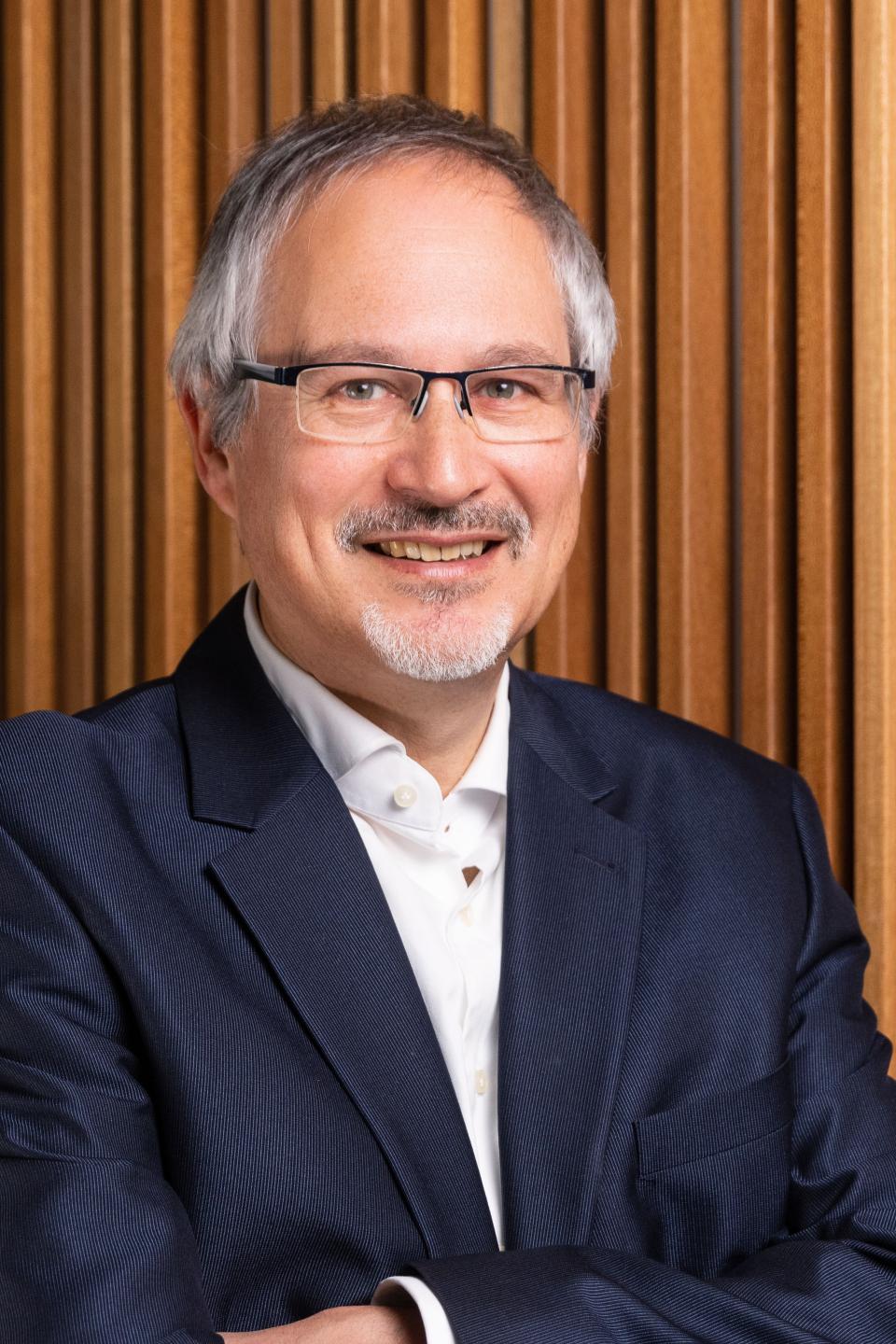
Ralf Peeters is a Full Professor in Mathematics of Knowledge Engineering at Maastricht University's Faculty of Science and Engineering , Department of Advanced Computing Sciences. He serves as Vice-Dean of Research and Director of the STEM Graduate School, while leading the university's team at the inter-university research school DISC and co-chairing the Mathematics Centre Maastricht. Education: PhD in Mathematics (Free University, Amsterdam, 1994) Technical Mathematics (Delft University of Technology, 1988) Research Interests span applied mathematics, systems and control theory, signal/image processing, artificial intelligence, and biomedical engineering applications. His work bridges mathematical techniques with real-world challenges in healthcare and industrial systems. Recent Publications highlight advancements in deep learning for cardiac signal reconstruction, tensor-based signal decomposition, and recurrence plot analysis. These works integrate machine learning with clinical diagnostics, particularly in electrocardiographic imaging and arrhythmia characterization. Key Collaborations: Mathematics Centre Maastricht Dutch Mathematics Platform Dutch Institute of Systems and Control Leadership Roles: Vice-Dean of Research (FSE), Director of STEM Graduate School, Head of DISC-affiliated team, and Co-Chair of Mathematics Centre Maastricht. He has supervised over 25 PhD projects, emphasizing applied research across health and industrial domains.
Dr. Yongkai Wu is an Assistant Professor in the Department of Electrical and Computer Engineering at Clemson University, where he focuses on advancing Responsible AI , Causal Inference , and Machine Learning . His research addresses fairness, trustworthiness, and transparency in AI systems through causal modeling and has been published in top-tier venues like AAAI, NeurIPS, and KDD. Education: Ph.D. in Computer Science (2020) and M.S. in Computer Science (2018) from the University of Arkansas; B.Eng. in Electronic Engineering (2014) from Tsinghua University. Dr. Wu’s research spans Responsible AI and Causal Inference , with applications in healthcare, computer vision, and cybersecurity. He explores Causal Fairness in non-IID settings, Responsible LLMs , and Robust Learning via hyperspectral data. His work integrates ethics into AI/ML systems, ensuring equitable outcomes in dynamic environments. His recent articles highlight trends in Fairness through causal inference, Explainable AI in healthcare, and Efficient LLMs . Collaborations with institutions like the University of Maryland and Prisma Health underscore real-world impact. Scientific Awards: Best Paper Award (SIGKDD'25), travel awards from SBP-BRiMS, IJCAI, KDD, and NeurIPS. Dr. Wu’s grants include NSF , SC EPSCoR , Prisma Health , and United States Army CCDC funding for projects on Responsible AI in Healthcare , Hyperspectral AI , and Robust Learning . He mentors students through summer programs and directed research, emphasizing hands-on experience with Python, PyTorch, and ethical AI frameworks.
Mathias Unberath is the John C. Malone Associate Professor in the Department of Computer Science at Johns Hopkins University, with secondary appointments in Ophthalmology and Otolaryngology—Head and Neck Surgery at the School of Medicine. He is a core faculty member of the Laboratory for Computational Sensing and Robotics (LCSR) and the Malone Center for Engineering in Healthcare, and affiliate faculty at the Institute for Assured Autonomy and Data Science and AI Institute. Education: PhD in Computer Science from Friedrich-Alexander University of Erlangen-Nürnberg (2017), MSc in Optical Technologies (2014), BSc in Physics (2012) His research focuses on computer-assisted medicine, integrating computer vision, machine learning, and medical robotics to develop human-centered solutions through mixed reality and embodied technologies. His work addresses surgical phase recognition, explainable AI, and digital twin representations for clinical workflows. Unberath's 15 most recent publications demonstrate expertise in surgical AI (7/15), medical imaging (12/15), and mixed reality (8/15), with specific subfields including segmentation frameworks (3 papers), cognitive load estimation (4 papers), and surgical robotics (5 papers). NSF CAREER Award NIH NIBIB Trailblazer R21 Google Research Scholar Award Inaugural DSAI Junior Faculty Award IPCAI 2025 Best Paper Award He teaches graduate courses in machine learning, AI system design, and interpretable machine learning. His group, the ARCADE Lab, develops technologies for computer-assisted interventions, emphasizing robustness, explainability, and human-AI collaboration in clinical settings.
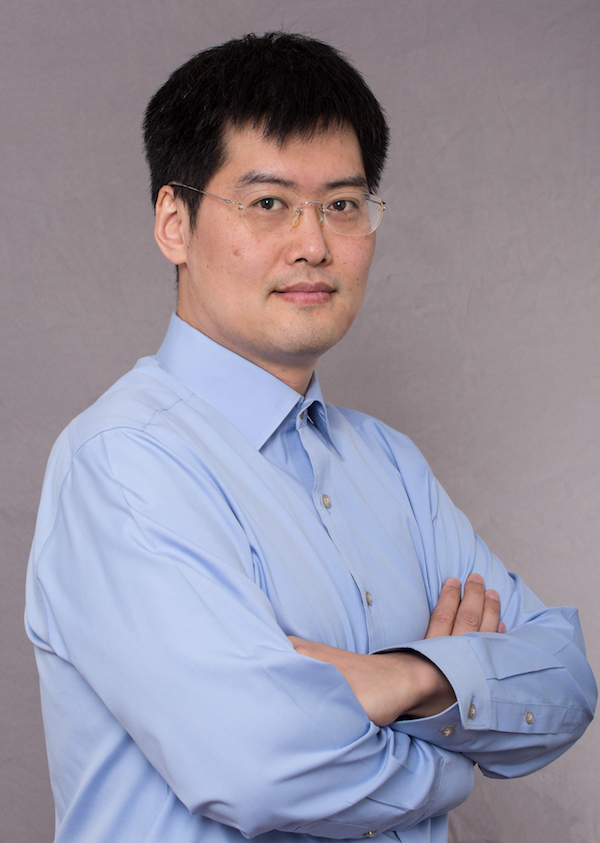
Xuming He is an Associate Professor at the School of Information Science and Technology (SIST), ShanghaiTech University, where he leads the PLUS Lab. His research spans computer vision and machine learning with a focus on developing algorithms that operate effectively under limited supervision and evolving data conditions. His core research interests include weakly-supervised and few-shot learning for scenarios with sparse annotations, continual learning frameworks for knowledge retention during sequential task acquisition, semantic segmentation techniques for scene understanding, and multimodal vision-language representations. He emphasizes interpretable machine learning to build transparent AI systems capable of human-understandable reasoning, addressing critical challenges in model trustworthiness and deployment reliability. Recent publications reveal strong trends toward novel class discovery in long-tailed recognition scenarios, physics-informed generative modeling for scientific applications, and robust segmentation under distribution shifts. His work increasingly integrates large language models for multimodal reasoning while maintaining focus on efficiency in resource-constrained environments like robotic grasping and medical imaging analysis. He actively mentors students, having supervised Qian He to PhD completion and Chuanyang Hu to Master's degree in 2023. He welcomes prospective graduate students through ShanghaiTech's Computer Science & Technology program and offers undergraduate research projects requiring minimum six-month commitments. The PLUS Lab under his direction drives innovation in learning under supervision constraints, with recent work spanning medical tumor analysis, cross-view geolocation, photonic computing, and semiconductor design verification. The lab's research bridges theoretical advances with practical applications across healthcare, robotics, and scientific discovery domains.
Sara Magliacane is an Assistant Professor at the University of Amsterdam and a Research Scientist at the MIT-IBM Watson AI Lab . She leads research at the intersection of causality and machine learning , focusing on improving AI robustness, generalization, and safety through causal reasoning. Her work spans causal representation learning , causal discovery , and causality-inspired ML in domains like reinforcement learning and dynamical systems. PhD in Artificial Intelligence (2017), VU Amsterdam MSc in Computer Engineering (2011), Politecnico di Milano/Torino BSc in Computer Engineering (2008), Università degli Studi di Trieste Her research explores causal variable identification from high-dimensional data (e.g., images, sequences) and causal graph discovery for domain adaptation. Methods include CITRIS , FANS-RL , and SNAP , with applications in embodied AI and biomedical data. The group emphasizes theoretical guarantees and scalable algorithms for real-world systems. Recent work trends include temporal causal modeling , intervention-efficient learning , and nonstationary reinforcement learning . Publications cover topics like causal discovery in partially observed settings , causal graph pruning , and sample-efficient concept learning , often combining neurosymbolic approaches with deep learning. Scientific Awards : ELLIS Scholar Sara supervises PhD students across universities (UvA, University of Pisa) and collaborates with institutions like TU Delft , Harvard , and IBM Research . She co-organizes workshops at premier conferences (NeurIPS, ICML, AISTATS) and teaches causality courses at the University of Amsterdam and Harvard Data Science Initiative. Her lab, Amsterdam Machine Learning Lab (AMLab) , investigates causal structure in embodied agents , safe reinforcement learning , and hybrid dynamical system modeling . The group maintains active partnerships with institutions such as MIT-IBM Watson AI Lab , Qualcomm , and Adyen .
Aaron Young is an Associate Professor in the Woodruff School of Mechanical Engineering at Georgia Institute of Technology and a program faculty member in the Biomedical Engineering School. He serves as Director of the Exoskeleton and Prosthetic Intelligent Controls (EPIC) Lab, focusing on robotic human augmentation through advanced control systems for prosthetics and exoskeletons. Education: Postdoctoral Fellow, University of Michigan (2014-2016) Ph.D., Northwestern University (2014) M.S., Northwestern University (2011) B.S., Purdue University (2009) Dr. Young's research addresses clinically viable control systems for wearable robotic devices, emphasizing intent recognition , EMG signal processing , and machine learning integration. His work targets mobility impairments from stroke, amputation, cerebral palsy, and neurological injuries, aiming to reduce metabolic costs, restore natural biomechanics, and enhance community ambulation. Key innovations include data-driven control frameworks , biomechanical terrain adaptation , and anthropometry-based personalization . His recent publications highlight advancements in deep learning for real-time biomechanics , EMG-informed joint estimation , and adaptive assistance systems . The EPIC Lab's facilities feature a terrain park with force plates , motion capture systems , and HumoTech simulation platforms for device testing. Scientific Awards: New Faces of Engineering (IEEE USA, 2017) Military Health System Team Award (2015) NSF Graduate Fellowship (2010) NDSEG Fellowship (2010) IEEE EMBC 3rd Place (2013) Projects include NSF-funded hip exoskeletons for stroke survivors, DoD-powered prostheses for amputees, and Pediatric knee exoskeletons for cerebral palsy. The lab cultivates interdisciplinary expertise in robotics , biomedical engineering , and human-machine interaction .
Mike Rubenstein is an Assistant Professor with joint appointments in the Department of Computer Science and Department of Mechanical Engineering at Northwestern University. He holds the Lisa Wissner-Slivka and Benjamin Slivka Professorship in Computer Science and is affiliated with the Center for Robotics and Biosystems. His educational background includes a Ph.D. in Computer Science from the University of Southern California, an M.S. in Electrical Engineering from USC, and a B.S. in Electrical Engineering from Purdue University. Prior to joining Northwestern, he completed a postdoctoral fellowship at Harvard University's Self-Organizing Systems Research Group. Rubenstein's research focuses on advancing multi-robot systems to enable capabilities beyond traditional single robots, emphasizing parallelism, adaptability, and fault tolerance at scale (hundreds to millions of robots). His work spans swarm shape control, modular self-reconfigurable robotics, bio-inspired satellite constellations, and novel sensing for air vehicle swarms. Key themes include algorithmic control for large-scale systems and hardware innovations to overcome current limitations in swarm robotics. His advising has produced notable student achievements, including Petras Swissler's Best Student Paper Award at DARS 2021 and Drew Curtis's NDSEG Fellowship. Research trends across his publications reveal a consistent emphasis on scalability, real-world applicability, and bridging hardware constraints with algorithmic innovation in swarm systems. Rubenstein actively mentors graduate students and leads projects involving swarm robotics platforms like FireAnt and PCBot. His lab focuses on developing systems where simplicity in individual robots enables emergent complexity at the swarm level, with applications ranging from space exploration to medical imaging.
Rob Gleasure is a Professor in the Department of Digitalization at Copenhagen Business School (CBS), Denmark. His research focuses on the intersection of information systems, digital technologies, and human behavior, with particular expertise in blockchain technology, crowdfunding, AI applications, and technology adaptation. Based at Solbjerg Square 3 in Frederiksberg, he contributes to CBS's mission of advancing knowledge in business and society through digital transformation. Professor Gleasure's research spans several key areas within information systems and digital innovation: Digital finance and blockchain technologies, including cryptocurrency and financial applications Crowdfunding platforms and digital fundraising mechanisms Artificial intelligence applications in various domains including healthcare and banking Human-computer interaction and the psychological aspects of technology adoption Digital collaboration and the affective dimensions of online work Quantum computing infrastructure and emerging technologies His recent publications reveal an evolving research trajectory that increasingly addresses the societal implications of digital technologies. Gleasure has moved from foundational work on crowdfunding and blockchain to more complex examinations of AI ethics, gender bias in technological systems, and the psychological impacts of digital media. His research demonstrates growing attention to sustainable development goals, particularly those related to responsible consumption and production, reduced inequalities, and climate action. The interdisciplinary nature of his work bridges business, technology, and social sciences, often employing both qualitative and experimental methodologies. Professor Gleasure has served as a supervisor for numerous students (21 supervisor tasks mentioned) and has been active in academic service including co-chairing the ACM Collective Intelligence Conference in 2021. His research has attracted media attention, with contributions to discussions on cryptocurrency, carbon offsetting in aviation, and AI applications.
Dr. Sasan Mahmoodi is an Associate Professor at the School of Electronic and Computer Science , University of Southampton. His research focuses on Medical Image Analysis , Biometrics , and Computer Vision , with applications in healthcare and security systems. Research Groups: Vision, Learning and Control; Institute for Life Sciences; Centre for Machine Intelligence His work spans deep learning , rule-based AI , and pattern recognition in medical imaging, including applications for neonatal brain injury prognosis and radiographic knee osteoarthritis classification. He also contributes to biometric technologies like facial profile recognition and gait analysis. Recent publications highlight his expertise in: Domain adaptation for biometric systems Infrared gait recognition databases Motion artefact correction in HRpQCT imaging Histopathology image segmentation using U-Net variants Dr. Mahmoodi supervises PhD students in computer science and human health development and collaborates on interdisciplinary projects involving machine learning and medical imaging.
Heidi Ottevaere is a Professor at the Faculty of Engineering of the Vrije Universiteit Brussel (VUB) since October 1, 2009. She serves as the head of the Instrumentation and Metrology platform at the Photonics Innovation Center and leads the 'biophotonics' research unit of the Brussels Photonics Team (B-PHOT), which is chaired by Prof. Hugo Thienpont. Her work focuses on the design, fabrication, and characterization of photonic components and systems for diverse applications in medical diagnostics, environmental monitoring, and industrial processes. Dr. Ottevaere earned her Electrotechnical Engineering degree with majors in Photonics from Vrije Universiteit Brussel in 1997 and completed her PhD in Applied Sciences at the same institution in 2003. Her doctoral research focused on 'Refractive microlenses and micro-optical structures for multi-parameter sensing: a touch of micro-photonics.' Professor Ottevaere's research spans multiple cutting-edge areas of photonics with particular emphasis on biophotonics, micro-optics, and optical metrology . Her work bridges fundamental science with practical applications, developing novel photonic components and systems that address real-world challenges. She has pioneered research in miniaturized optical systems for medical diagnostics, environmental monitoring, and industrial applications. Her current research focuses on advancing lab-on-a-chip technologies, microfluidic optical sensors, and novel optical fiber systems for biomedical applications. She has developed microminiaturized, integrated plastic detection units for absorbance and laser-induced fluorescence measurements in microfluidic channels, enabling portable, robust, and disposable diagnostic systems. Her recent publications demonstrate a strong trend toward integrated optical sensing systems with applications in medical diagnostics and environmental monitoring. There's a clear progression from fundamental optical component design to complete system integration, with increasing emphasis on artificial intelligence for data analysis and computational imaging techniques. Her work bridges photonics with biomedical engineering, materials science, and data science, reflecting the interdisciplinary nature of modern photonics research. Dr. Ottevaere has been recognized with several prestigious awards: Best Application award (2008) Educational award - Bronze (2019) MOC09 Contribution Award Winners (2009) As an educator and mentor, Professor Ottevaere has promoted 9 PhD students and supervised numerous master's theses. She has secured substantial research funding from diverse sources including the Fund for Scientific Research Flanders (FWO), the Institute for the Promotion of Innovation by Science and Technology in Flanders (IWT), and multiple European Framework Programs. Her current portfolio includes projects on miniaturized biosensors for drinking water screening, precision manufacturing, and photonics education initiatives in Uzbekistan. She has coordinated multiple strategic research and networking projects with regional, national, and international funding bodies. Professor Ottevaere leads the biophotonics research unit within the Brussels Photonics Team (B-PHOT), one of Europe's leading photonics research groups. Her team includes researchers working on optical metrology, micro-optics fabrication, and biophotonic applications. She collaborates extensively with industry partners including Melexis, Umicore, and Anteryon, as well as academic institutions across Europe through various EU-funded projects. She has been instrumental in developing the interuniversity engineering curriculum 'Master in Photonics' which received the EC Erasmus Mundus quality label in 2006, and continues to be the driving force behind photonics education at VUB.
Qipei Mei is an Assistant Professor in the Department of Civil and Environmental Engineering at the University of Alberta's Faculty of Engineering. With an MSc in Computer Science and a PhD in Structural Engineering, he bridges civil engineering with artificial intelligence to enhance infrastructure productivity and sustainability. His research spans AI-driven design automation, robotics for construction safety, and IoT-based condition assessment. PhD, Structural Engineering - University of Alberta (2020) MSc, Computer Science - Georgia Institute of Technology (2018) MSc, Structural Engineering - University of Alberta (2014) B.E., Civil Engineering - Huazhong University of Science and Technology (2011) Mei's work focuses on three key areas: leveraging data-driven methods for design automation, applying sensing/robotics to construction operations, and using digital twins for infrastructure assessment. His team explores generative AI for housing design, robotic construction in remote communities, and smart monitoring systems. Recent publications highlight advancements in: lateral capacity prediction for monopile foundations, transformer-based architectural layout analysis, large language models for building code compliance, vision-language models for safety hazard detection, and sensor networks for bridge monitoring. These works demonstrate interdisciplinary integration of AI, structural engineering, and IoT. Mei actively collaborates with diverse researchers and welcomes graduate students to his Smart Infrastructure Technologies (SITE) Research Group, part of the Infrastructure and Human Tech Lab (IHT-Lab). He teaches advanced topics in structural and civil engineering while pursuing industry-funded projects through NSERC, CFI, and Alberta Innovates.
Dr. Wei Shao is an Assistant Professor in the College of Medicine at the University of Florida, specializing in artificial intelligence applications in medical imaging. His work focuses on developing machine learning algorithms for medical image registration, segmentation, and diagnosis, with a particular emphasis on integrating these tools into clinical workflows. Dr. Shao holds a Ph.D. in Electrical and Computer Engineering from Stanford University (2022), preceded by M.S. degrees in Mathematics and Electrical and Computer Engineering from the University of Iowa (2019-2018). His postdoctoral training focused on deep learning and medical imaging. His research projects include: Machine learning algorithms for multimodal image registration and segmentation AI-driven disease diagnosis on medical images Integrating image processing into clinical practices Notable contributions include advancements in 3D medical image segmentation, text-guided models for radiology, and AI-enhanced micro-ultrasound for prostate cancer screening. His work bridges computational methods with clinical needs, aiming to improve diagnostic accuracy and patient care. Recent publications highlight innovations in diffusion models, vision-language integration for medical imaging, and robust artifact detection in 4DCT scans. These studies underscore his commitment to advancing AI-driven solutions in healthcare.
Zahraa Abdallah is a Senior Lecturer at the School of Engineering Mathematics and Technology, University of Bristol. She holds a PhD and BSc in relevant fields. Her research focuses on Machine Learning, Data Science, Time Series Analysis, and their applications in Health Informatics, Neuroscience, and Bioinformatics. She leads projects on wearable technology integration for diabetes management and EEG-based disease classification. Her work emphasizes explainable AI and multimodal approaches. Zahraa is affiliated with the Bristol Doctoral College Initiative (BDFI) as an Academic Co-Director and collaborates with experts like Prof. Raul Santos-Rodriguez. Contact: zahraa.abdallah@bristol.ac.uk | Website: zahraa-abdallah.com Research Interests: Time Series Clustering & Forecasting EEG-based Disease Detection (Parkinson’s, Alzheimer’s) Smartwatch-Driven Healthcare Systems Explainable AI in Biomedical Applications Key Projects: Development of the CSTS benchmark for time series clustering Investigating insulin needs using automated delivery data Gene essentiality classification via graph neural networks Collaborations: Professor Raul Santos-Rodriguez (BDFI) Lucia Marucci (Systems & Engineering Biology)
Dr. Rafeef Garbi is a Professor at the Department of Electrical and Computer Engineering, University of British Columbia, and the Founder/Director of the Biomedical Signal and Image Computing Laboratory (BiSICL). Her multidisciplinary research integrates artificial intelligence, computer vision, and medical imaging for clinical applications in pediatric orthopedics, oncology, and neurology. PhD (Chalmers University, Sweden), MSc (with distinction), Technical Licentiate Research Focus: Specializing in Medical Image Computing and Visual Computing , her lab develops AI-driven solutions for: Automated segmentation and analysis of multi-dimensional biomedical data Clinically-translatable biomarkers for disease assessment Computer-aided intervention systems in surgical contexts Scientific Leadership: UBC Killam Faculty Research Fellow Peter Wall Institute for Advanced Studies Early Career Scholar Senior IEEE Member & Founding IEEE EMBS Vancouver Section Member Key Collaborations: Active in the Medical Image Computing and Computer Assisted Intervention (MICCAI) Society and CAIDA: UBC ICICS Centre for Artificial Intelligence Decision-making and Action. Her team bridges engineering, medicine, and computational biology through translational research.
Timothy Cootes is a Research Professor at the University of Manchester's Division of Informatics, Imaging & Data Sciences. He holds an MSc teaching role in Mathematical Methods and has led projects like BoneFinder and ASPIRE™. His research focuses on statistical models for medical image analysis, facial interpretation, and musculoskeletal disease diagnosis. Education: Bachelor's in Maths and Physics from Exeter University PhD in Civil Engineering (storm sewer overflow) from Sheffield City Polytechnic Research Interests: Statistical shape/appearance models for medical imaging Machine learning applications in osteoporosis/osteoarthritis analysis Facial feature tracking and recognition systems Groupwise image registration techniques Awards: 2015 ISBI Grand Challenges Prize 2010 IAPR Fellowship 2023 Highly Commended Oral Presentation Collaborations: Dr. Paul Bromiley (medical imaging) Dr. Claudia Linder (musculoskeletal projects) Dr. Adrian Davison (facial recognition) Key Impacts: Developed Active Appearance Models (AAMs) for facial recognition Co-created BoneFinder automated bone analysis software Contributed to global osteoarthritis risk assessment frameworks