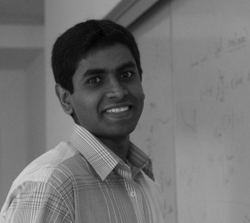
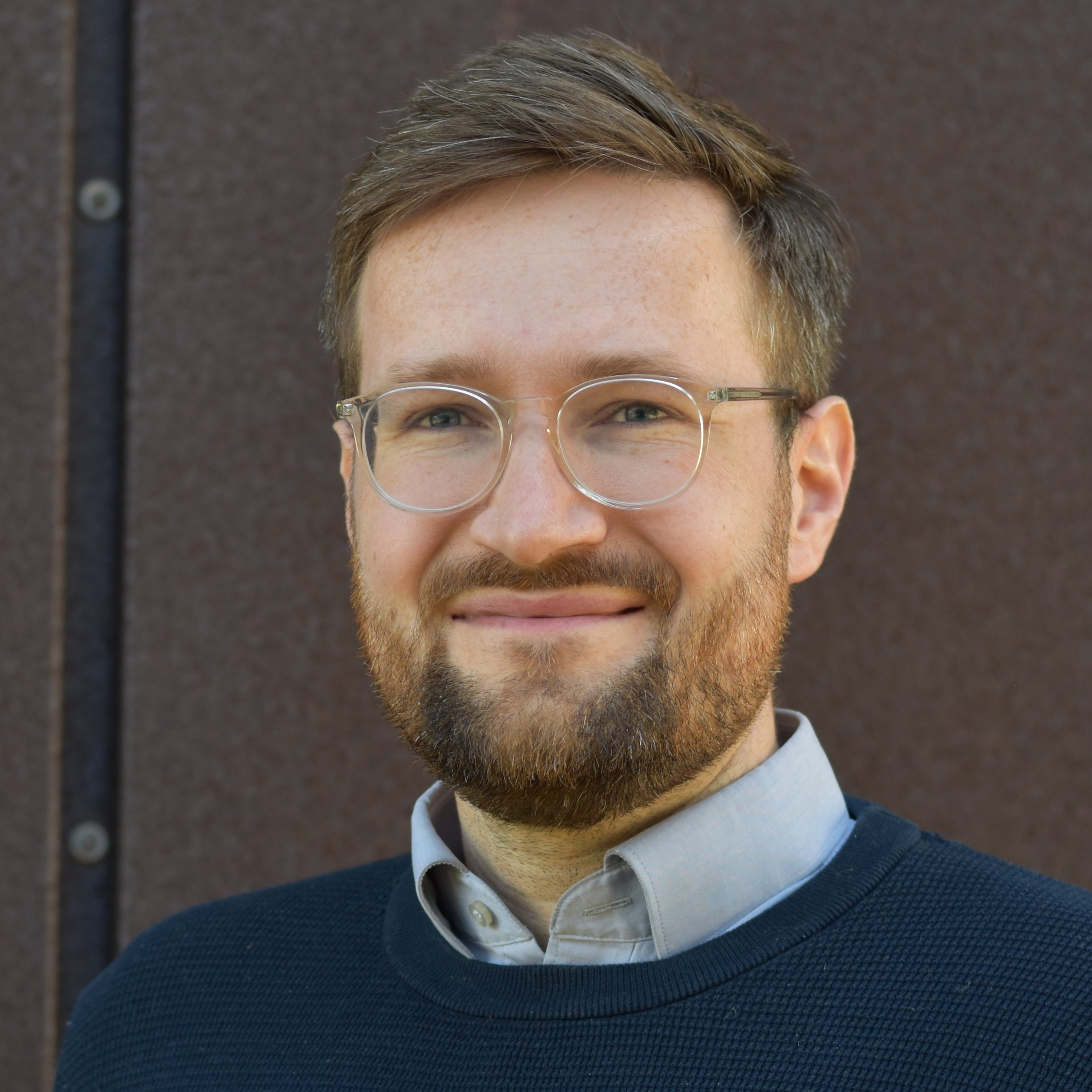
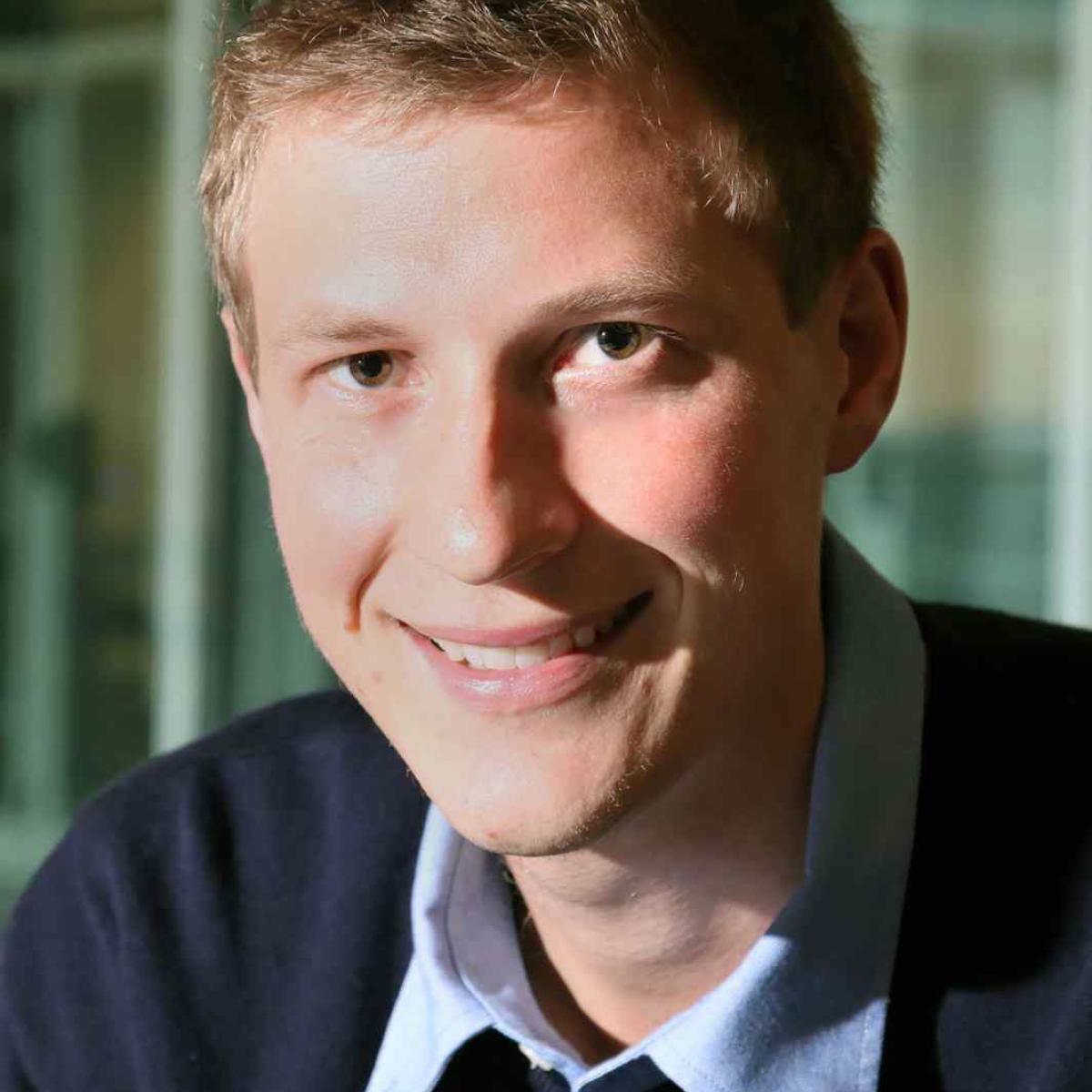
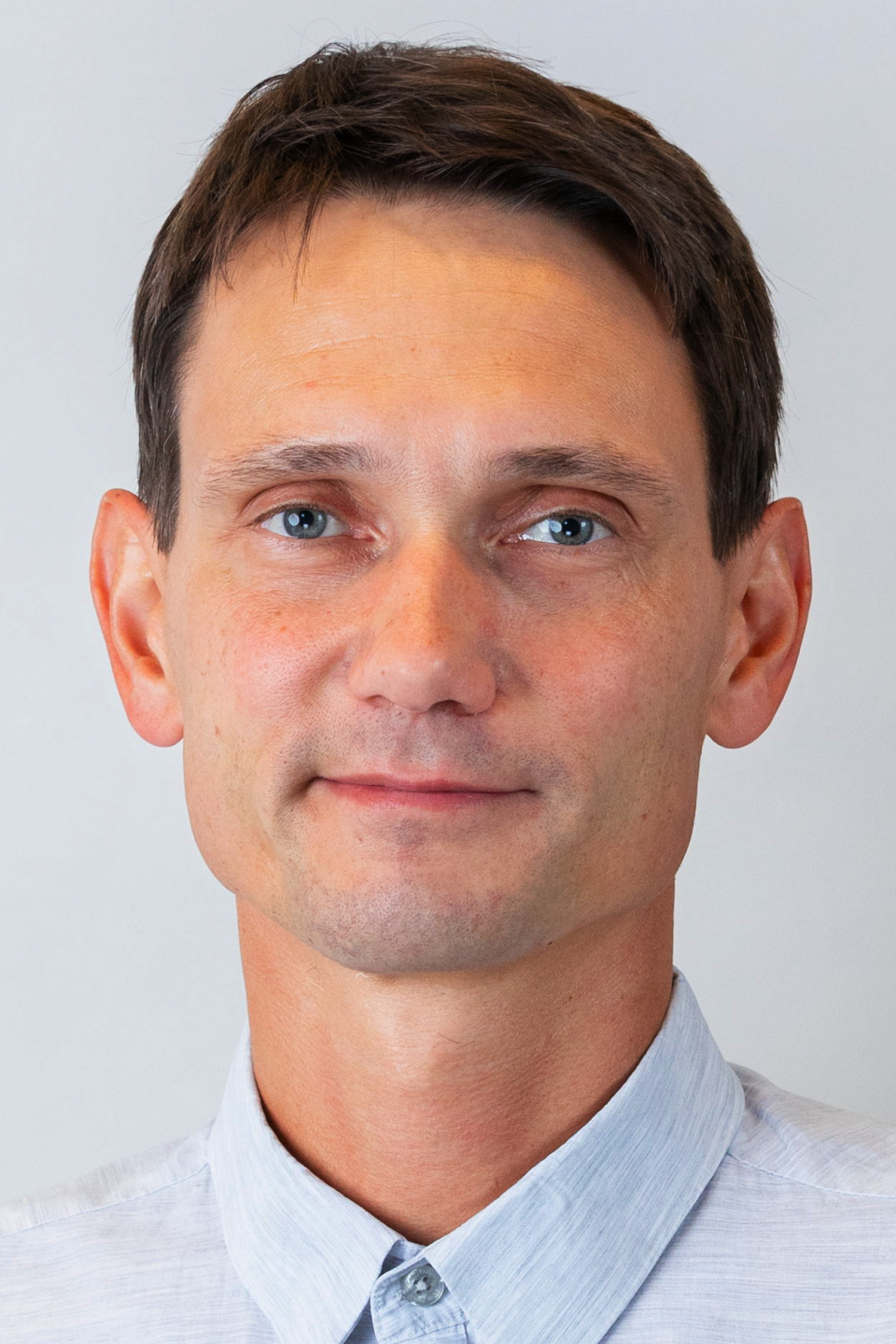
Ştefan Tohăneanu is a Professor in the Department of Mathematics and Statistical Science at the University of Idaho , affiliated with the College of Science. His academic journey includes a Ph.D. in Mathematics from Texas A&M University (2007), and M.S. degrees in Algebra (2001) and Analysis (2001) from the University of Bucharest, where he also earned a B.S. in Mathematics (1997). Research Focus: Commutative Algebra, Hyperplane Arrangements, Matroid Theory, and applications to Coding Theory, including generalized Hamming weights, Orlik-Terao algebras, and homological properties of ideals. Publications: Recent work explores Betti numbers, Jacobian ideals, logarithmic derivations, and connections between algebraic invariants and coding theory problems like minimum distance computation and error correction. Collaborations: Engages with global research networks through affiliations with institutions such as Texas A&M University, University of Bucharest, and University of Idaho.
Illya V. Hicks is a Professor in the Computational and Applied Mathematics Department at Rice University. He holds a PhD from Rice University (2000) and a BS from Texas State University (1995). His research focuses on combinatorial optimization, integer programming, graph theory, and matroid theory, with applications in social networks, cancer treatment, and network design. He has advised numerous doctoral, post-doctoral, and masters students. Education: PhD and MA in Computational and Applied Mathematics, Rice University, 2000 BS in Mathematics, Texas State University, 1995 Research Interests: Utilizing graph decomposition techniques to solve NP-complete problems, including branch decompositions and matroid circuit problems. Applications include sensor network design, healthcare logistics, and algorithmic graph theory. Awards: Recognized with the 2015 Presidential Mentoring Award (Rice University), 2010 Forum Moving Spirit Award (INFORMS), and the 2005 Optimization Prize for Young Researchers. Grants and Projects: Includes NSF-funded research on branch decomposition techniques, submodular optimization, and healthcare service distribution. Active in promoting minority participation in operations research through travel grants and mentoring initiatives. Labs/Teams: Engaged in collaborative research on graph algorithms, combinatorial optimization, and interdisciplinary applications in healthcare and engineering.
University of Illinois Urbana-ChampaignUnited States
Chandra Chekuri is the Paul and Cynthia Saylor Professor in the Department of Computer Science at the University of Illinois Urbana-Champaign, situated within the Grainger College of Engineering. He has been actively contributing to theoretical computer science for over two decades, with significant leadership roles including serving as Editor-in-Chief of the prestigious SIAM Journal on Computing since May 2025. His academic journey began with a B.Tech in Computer Science from the Indian Institute of Technology, Madras in 1993, followed by a Ph.D. in Computer Science from Stanford University in 1998. Prior to joining UIUC, he spent eight years as a Member of Technical Staff at Bell Labs, Lucent Technologies. Chekuri's research focuses on theoretical computer science with particular emphasis on the design and analysis of algorithms, discrete and combinatorial optimization, approximation algorithms, mathematical programming, and graph theory. His work explores fundamental connections between discrete structures and optimization problems, with applications spanning network design, data analysis, and computational complexity. His recent publications demonstrate a continued focus on hypergraph algorithms, submodular function optimization, and graph partitioning problems, showing how theoretical insights can yield practical algorithmic improvements. His approach often combines continuous relaxations with discrete rounding techniques to develop approximation algorithms for NP-hard problems. As Editor-in-Chief of SIAM Journal on Computing, Chekuri leads one of theoretical computer science's most respected publications, which covers analysis and design of algorithms, algorithmic game theory, computational complexity, and other mathematical aspects of computer science. His editorial leadership follows previous service as Associate Editor for several major journals including SIAM Journal on Computing, Mathematics of Operations Research, and Mathematical Programming. ACM Fellow (January 2024) Scott Fisher Teaching Award (for year 2022-23) from CS Department Chekuri has advised numerous PhD students to completion, including Kent Quanrud, Vivek Madan, Shalmoli Gupta, and Chao Xu, with several currently in progress such as Tanvi Bajpai, ElFarouk Harb, Rhea Jain, and Weihao Zhu. His teaching portfolio includes graduate courses on Randomized Algorithms, Approximation Algorithms, Algorithms for Big Data, and Combinatorial Optimization. He has served as Director of the Graduate Program in the Department of Computer Science from May 2014 to August 2017, demonstrating significant administrative leadership within the department.
Chaitanya Swamy is a Professor and University Research Chair in the Department of Combinatorics & Optimization at the University of Waterloo, Canada. His primary affiliation is within the Faculty of Mathematics, and he holds positions in both the Department of Combinatorics & Optimization and the School of Computer Science. He obtained his Ph.D. in Computer Science from Cornell University under the supervision of David Shmoys, followed by postdoctoral research at Caltech's Center for the Mathematics of Information. Swamy’s research focuses on algorithms, particularly in combinatorial optimization, approximation algorithms, algorithmic game theory, stochastic optimization, network design, scheduling, and online algorithms. His work spans theoretical contributions and practical applications, including algorithm design for facility location, network routing, and mechanism design. He has contributed to foundational results in approximation algorithms, such as the development of primal-dual methods and LP-rounding techniques. Swamy has held significant editorial roles, including as an associate editor for Discrete Optimization and SIAM Journal on Computing . He has organized major conferences like CanaDAM 2021 and sessions at ISMP 2018. His teaching record includes courses on combinatorial optimization, scheduling, and algorithmic game theory. He has advised numerous Ph.D. and Master’s students, many of whom have gone on to prestigious academic and industry positions. Swamy’s research has been recognized through awards for his students, including the University of Waterloo Alumni Gold Medal. He actively contributes to the academic community through committee work for conferences like STOC, APPROX, and SODA, and his publications reflect a deep engagement with both theoretical and applied aspects of algorithms and optimization.
Lars Rohwedder is an Associate Professor in the Algorithms Group at the University of Southern Denmark (SDU) in Odense. He previously held positions as an Assistant Professor at Maastricht University (Netherlands) and postdoc researcher at EPFL, Lausanne (Switzerland). He earned his Ph.D. in Computer Science from CAU Kiel (Germany), advised by Klaus Jansen, and is a recipient of the 2019 PhD of the year award from Förderverein der TF of Kiel University. His research focuses on algorithms for combinatorial optimization, including approximation algorithms, online algorithms, parameterized algorithms, and integer programming. He has contributed to solving scheduling problems, resource allocation, and optimization under uncertainty. Rohwedder has served on program committees for conferences like MAPSP, SODA, STACS, and ICALP. He is funded by NWO's Open Competition M1 project on quasi-polynomial time algorithms. His teaching includes courses on advanced algorithms, operations management, and optimization at SDU and Maastricht University. Key achievements include a quasi-polynomial approximation for the restricted assignment problem, FPT algorithms for scheduling, and contributions to the Submodular Santa Claus problem. His work bridges theoretical foundations and practical applications, with a focus on algorithmic efficiency and robustness.
Neil Olver is an Associate Professor in the Department of Mathematics at the London School of Economics and Political Science (LSE), where he has held his current position since 2021. He is also affiliated with CWI in Amsterdam. His research focuses on combinatorial optimization, network design, algorithmic game theory, and probability, with applications to traffic networks and robust optimization. Olver has organized major events such as the Highlights of Algorithms conference and the Hausdorff Trimester Program on Discrete Optimization. He completed his PhD in Applied Mathematics at McGill University (2010), preceded by an MSc (2006) and BSc (2004) from the University of Cape Town and McGill University. His academic career includes roles at Vrije Universiteit Amsterdam (2013–2021) and MIT (2010–2013). Olver has been awarded grants from NWO (VIDI, TOP, VENI) and the NSF, supporting research on network optimization and robust design. His notable contributions include resolving the VPN Conjecture, advancing strongly polynomial algorithms for generalized flows, and analyzing dynamic traffic equilibria. Students advised include Dr. Dario Frascara and Dr. Madelon de Kemp. Current grants include a VIDI-funded project on 'Usable Algorithms for Network Design.'
Laura Anderson is an Associate Professor in the Department of Mathematics at Binghamton University. She holds a Ph.D. from MIT (1994) and has been affiliated with Binghamton since 2001. Her research focuses on Combinatorics and Topology, with a specialization in matroid theory, hyperplane transversals, and topological combinatorics. She teaches advanced courses such as Introduction to Combinatorics (Math 511) and Discrete Mathematics (Math 314). Her academic contributions include groundbreaking work on oriented matroids, combinatorial Grassmannians, and hyperfield applications. Anderson has advised multiple Ph.D. students, including Olakunle Abawonse, Ulysses Alvarez, and Leandro Junes, whose theses explore topics like matroid extensions and tropical phased matroids. She actively participates in academic conferences, co-organizing the Binghamton University Graduate Conference in Algebra and Topology (BUGCAT). Anderson’s research integrates algebraic topology with discrete mathematics, addressing geometric realizations, hyperfield structures, and topological invariants. Her pedagogical innovations include experimenting with flipped classroom methods in calculus education. She maintains an active presence in academic service, contributing to journal reviews and editorial work in combinatorial geometry.
David Perkinson is a Professor of Mathematics at Reed College, where he holds a position in the Department of Mathematics. His research focuses on combinatorics, algebraic geometry, and discrete mathematics, with a particular emphasis on sandpile models, graph theory, and matroid theory. He is the author of the textbook *Divisors and Sandpiles: An Introduction to Chip-Firing*, which explores the combinatorial theory of chip-firing on graphs. Perkinson has also developed software tools like the Sandpile Java App, which visualizes and analyzes the Abelian Sandpile Model. He organizes the Cascade Lectures in Combinatorics (CALICO), a series of conferences funded by the National Science Foundation, aimed at fostering collaboration among researchers in combinatorics. His work bridges discrete mathematics with algebraic geometry, emphasizing connections between graph theory and geometric structures. Perkinson teaches advanced courses in analysis and contributes to the academic community through his research on topics such as divisor theory on graphs, sandpile groups, and combinatorial game theory. His recent publications (2015–2024) address matroid theory, sandpile dynamics, and applications of algebraic methods to discrete systems.
John MacLaren Walsh is a Professor in the Department of Electrical and Computer Engineering at Drexel University, where he leads the Adaptive Signal Processing and Information Theory Research Group. He holds BS, MS, and PhD degrees from Cornell University, all completed under Dr. C. Richard Johnson, Jr. His research spans information theory, network coding, distributed computing, and machine learning applications in patent analysis. His work focuses on: Bounding entropic vectors and their impact on communication networks Rate region computation for network coding and distributed storage Information theory for distributed function computation Machine learning-enhanced patent processing systems Publications emphasize entropy geometry, network coding complexity, distributed algorithms, and patent analysis, with consistent themes of optimization and combinatorial methods. Recent work (2016-2019) shows increased focus on probabilistic supports and computational efficiency in network coding. Awards: 2011 NSF CAREER Award for 'Entropy Geometry in Variational Inference Signal Processing' He has advised PhD students on topics like entropy region mapping, network coding, and distributed control. Key grants include NSF CAREER and AFOSR funding for wireless network overhead control. He directs the Adaptive Signal Processing and Information Theory Research Group, which develops algorithms for network coding, distributed storage, and patent analysis systems.
Thomas Lam is a professor of mathematics at the University of Michigan , specializing in algebraic combinatorics, total positivity, and connections to mathematical physics. His work bridges cluster algebras, positive geometry, and integrable systems, with applications to scattering amplitudes in quantum field theory. Lam has collaborated extensively with physicists such as Nima Arkani-Hamed and mathematicians like Pavlo Pylyavskyy and Mark Shimozono. Key research areas: Cluster algebras, total positivity, electrical networks, positroid varieties, and quantum cohomology. Notable contributions: Defining polypositroids, proving regularity theorems for totally nonnegative flag varieties, and establishing cluster structures in braid varieties. Recent work focuses on positive geometries , including the amplituhedron and moduli spaces of points on projective lines, with implications for particle physics. His articles often explore dual graded graphs, K-theoretic Schubert calculus, and the interplay between combinatorics and algebraic structures. Lam's research has been supported by NSF grants, including DMS-0748636 and DMS-1249708 .
Jason Li is an Assistant Professor in the Department of Computer Science at Carnegie Mellon University's School of Computer Science. He teaches advanced algorithms courses including 15-754 Spectral Graph Theory (Spring 2025), 15-451 Design and Analysis of Algorithms (Fall 2024), and 15-850 Advanced Algorithms (Spring 2024). His research focuses on fast graph algorithms , particularly solving longstanding open problems through modern algorithmic techniques. Key research themes include preconditioning and locality , which serve as reductions from worst-case to well-behaved and local instances respectively. His work has produced breakthroughs in deterministic global minimum cut algorithms, all-pairs minimum cut (Gomory-Hu trees), and near-optimal parallel shortest path algorithms. Analysis of his recent publications reveals a consistent trend toward almost-linear time algorithms for fundamental graph problems, with significant contributions to dynamic graph algorithms, minimum cut variants, and parallel computation. His work frequently appears in top venues including STOC, FOCS, and SODA, often with multiple best paper recognitions. EATCS Distinguished Dissertation Award (2021) Best Paper Award at SODA 2024 Invited to HALG 2024 Invited to TALG and JACM for SODA 2024 paper Machtey Best Student Paper at FOCS 2019 Professor Li actively advises graduate students including Henry Fleischmann and George Li. His research is supported by collaborations with leading institutions and frequent invitations to present at major conferences. He maintains an open-door policy for CMU students and collaborators, though notes the high volume of research inquiries he receives weekly.
Ola Svensson is an Associate Professor at the School of Computer and Communication Sciences , EPFL. His research spans approximation algorithms, combinatorial optimization, computational complexity, and scheduling. He holds an ERC Consolidator Grant (2023–) and previously received an ERC Starting Grant (2014–2019) and SNF grant (2019–2023). Education: PhD in Computer Science from IDSIA, Università della Svizzera italiana (2009) M.Sc. from Uppsala University (2005) Research Focus: Svensson develops novel techniques for NP-hard problems, with emphasis on primal-dual methods, LP/SDP hierarchies, and hardness proofs. His work applies to clustering, scheduling, network design, and submodular optimization. Publications: His 15 most recent works (2018–2021) focus on learning-augmented algorithms, robust optimization, and improved approximations for clustering/TSP. Key trends include integration of ML with classical algorithms and quasi-polynomial methods for combinatorial problems. Awards: Best Paper Awards at FOCS (2011, 2017) and STOC (2018) I&C Teaching Award at EPFL Advising & Grants: He advises 6 current PhD students and graduated 8 others. Major grants include ERC Starting Grant 'OptApprox' (€1.4M) and ERC Consolidator Grant 'POTCO' (€2M). Teaching: Leads courses in Advanced Algorithms, Computational Complexity, and Approximation Algorithms. He developed pedagogical frameworks for scribe notes and project-based learning in theoretical computer science.
Jose Israel Rodriguez is an Associate Professor in the Department of Mathematics at the University of Wisconsin-Madison. His research bridges applied algebraic geometry and algebraic statistics, focusing on nonlinear algebra, maximum likelihood estimation, monodromy, and polynomial systems in engineering and science applications. Primary Affiliation: Department of Mathematics , UW-Madison Additional Affiliations: Department of Electrical & Computer Engineering , Institute for Foundations of Data Science Research Interests : Applied algebraic geometry for nonlinear eigenvalue problems and kinematics Algebraic statistics in nearest point problems and likelihood geometry Numerical methods for monodromy, Galois groups, and polynomial optimization Teaching and Mentorship : Co-organized the Collaborative Undergraduate Research Laboratory (CURL) for Spring 2020 Advises PhD students Julia Lindberg and Zinan Wang , with Bernd Sturmfels as his own PhD advisor Developed software tools like Multiregeneration and Decomposable Sparse Polynomial Systems Academic Contributions : Authored over 20 peer-reviewed publications in journals like SIAM Journal on Applied Algebra and Geometry, Foundations of Computational Mathematics, and Journal of Symbolic Computation Organized international conferences including Monodromy and Galois Groups in Enumerative Geometry and SIAM AG19 Active member of the SIAM community and developer of the Matroids Day seminar
Andre Berger is an Associate Professor of Operations Research at Maastricht University, affiliated with the QE Operations Research department within the School of Business and Economics. He holds a PhD in Mathematics from Emory University (2006) and completed a postdoc at Technical University Berlin. His research focuses on optimization algorithms, combinatorial optimization, and their applications in scheduling, network design, and operations research. Notable contributions include work on the many-visits Traveling Salesman Problem and cluster editing algorithms. Berger’s recent publications span scheduling theory, MRI-based clinical research collaborations, and theoretical advancements in facility location models. He is based at Tongersestraat 53, Maastricht, and can be reached via a.berger@maastrichtuniversity.nl. Education: MSc in Mathematics, Emory University (2003) PhD in Mathematics, Emory University (2006) Research Interests: Berger’s work bridges theoretical computer science and practical applications in operations research, emphasizing algorithm design for complex optimization problems. Key areas include scheduling algorithms, network flow optimization, and geometric optimization challenges such as the Apollonius problem in facility location. His interdisciplinary approach integrates mathematical programming with real-world scenarios in telecommunications and healthcare.
Euiwoong Lee is an Assistant Professor in the Computer Science and Engineering Division at the University of Michigan. He holds a PhD from Carnegie Mellon University, advised by Venkatesan Guruswami, and has held postdoctoral positions at New York University and the Simons Institute for the Theory of Computing. His research focuses on approximation algorithms, hardness of approximation, and parameterized complexity. **Education:** PhD in Computer Science, Carnegie Mellon University (2017), advised by Venkatesan Guruswami Postdoctoral Fellowships: NYU (2017–2020), Simons Institute (2017–2020) **Research Interests:** Approximation Algorithms & Hardness of Approximation Convex Hierarchies (e.g., Sum-of-Squares) Clustering Algorithms (e.g., Correlation Clustering) Parameterized Complexity Facility Location & Metric Optimization **Awards:** Edmund M. Clarke Doctoral Dissertation Award (2017) Simons Award for Graduate Students in Theoretical Computer Science **Advising & Grants:** PhD Students: Anthony Della Pella, Aditya Anand, Amatya Sharma, Ian DeHaan Co-organizes the Michigan Theory Seminar **Labs/Teams:** Collaborates with researchers in approximation algorithms, optimization, and theoretical computer science at the University of Michigan and beyond.