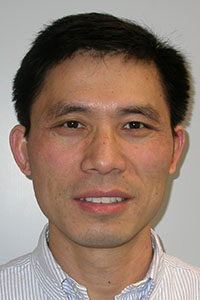
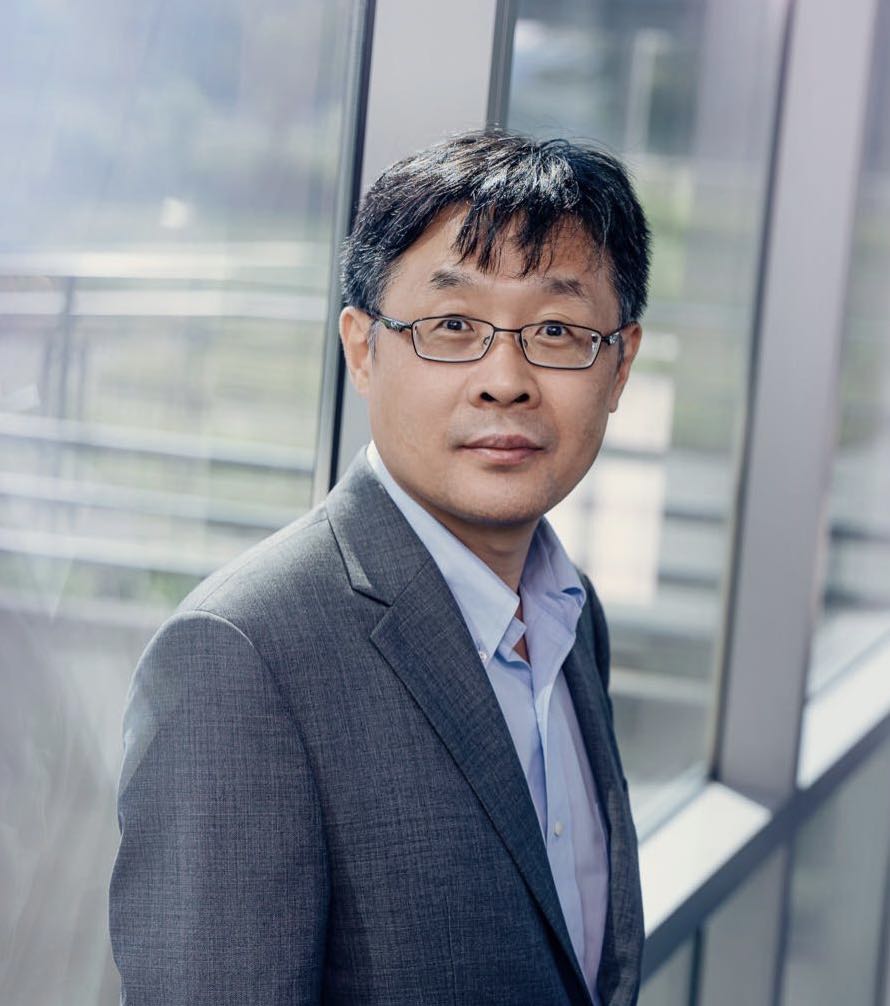
Jianlin Xia is a Professor of Mathematics at Purdue University, with a courtesy appointment in the Department of Computer Science. He joined the university in 2014. Xia holds a Ph.D. in Applied Mathematics from the University of California, Berkeley (2006). His research focuses on numerical linear algebra, fast algorithms for structured matrices, and their applications in computational science and engineering. His work addresses challenges in solving large-scale linear systems, eigenvalue problems, and partial differential equations (PDEs) using innovative methods like fast multipole techniques, hierarchical structures, and randomized algorithms. Key areas of research include: Design and analysis of fast algorithms for structured matrices (e.g., hierarchical, semiseparable, Cauchy matrices) Efficient direct and iterative solvers for PDEs, especially Helmholtz equations in seismic modeling Stability and robustness of numerical methods in high-performance computing Applications in wave propagation, inverse problems, and machine learning Xia’s contributions include advancements in low-rank approximations, divide-and-conquer eigenvalue decomposition, and scalable preconditioning techniques. His work emphasizes both theoretical analysis and practical implementation, often leveraging parallel computing architectures. Contact: xiaj@purdue.edu .
Professor Aida X El-Khadra is a leading theoretical physicist at the University of Illinois Urbana-Champaign, affiliated with the Department of Physics within the Grainger College of Engineering. She holds the rank of Professor since 2008, following roles as Associate and Assistant Professor. Her research focuses on precision calculations in lattice QCD, particularly in the context of the muon's anomalous magnetic moment (g-2) and hadronic vacuum polarization. She chairs the Muon g-2 Theory Initiative and is a key contributor to the Particle Data Group and Snowmass process. Education: PhD from UCLA (1989), Diplom in Physics from Freie Universität Berlin (1984). Research Highlights: Lattice QCD applications to Standard Model precision tests, CKM matrix determinations, and quantum simulations for high-energy physics. Her work addresses discrepancies between experimental muon g-2 results and theoretical predictions, with contributions to resolving these via lattice computations and data-driven analyses. Awards include the Simons Fellowship, AAAS Fellowship, and Fermilab Distinguished Scholar appointment.
Youssef Marzouk is a Professor of Aeronautics and Astronautics at MIT, serving as co-director of the MIT Center for Computational Engineering and director of the Aerospace Computational Design Laboratory. His research focuses on integrating physical modeling with statistical inference, emphasizing Bayesian computation, uncertainty quantification, and optimal experimental design. He holds a SB, SM, and PhD from MIT and has been recognized with prestigious awards including the DOE Early Career Award and the Junior Bose Teaching Prize. Education: PhD in Aeronautics and Astronautics, MIT SM in Aeronautics and Astronautics, MIT SB in Aeronautics and Astronautics, MIT Research Interests: Uncertainty Quantification techniques for complex systems Bayesian computational methods and inverse problem solutions Optimal experimental design strategies Interdisciplinary applications in geophysics, environmental science, and engineering Awards: 2022: Report to the President, Center for Computational Science and Engineering 2021: Bayesian Inference Software Framework (hIPPYlib-MUQ) 2012: MIT School of Engineering Junior Bose Award 2010: DOE Early Career Research Award Labs & Leadership: Aerospace Computational Design Laboratory (Director) MIT Center for Computational Engineering (Co-Director) Editorial Board roles: SIAM Journal on Scientific Computing, Advances in Computational Mathematics
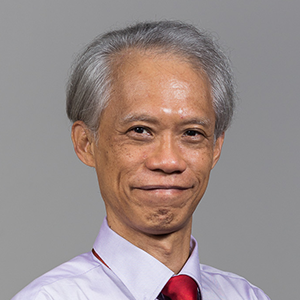
Rahul Jain is a Professor in the Department of Computer Science at the National University of Singapore (NUS), School of Computing. He was promoted to full Professor from January 2020, having previously served as Associate Professor (July 2013-July 2013) and Assistant Professor (November 2008-July 2013). He is also a Principal Investigator at the Centre for Quantum Technologies (CQT), Singapore since November 2008. Dr. Jain earned his Ph.D. in Computer Science from Tata Institute of Fundamental Research, Mumbai (2003) and B.Tech. in Electrical & Electronics Engineering from Indian Institute of Technology, Mumbai (1997). Prior to joining NUS, he conducted postdoctoral research at UC Berkeley (2004-2006) and at the Institute for Quantum Computing, University of Waterloo, Canada (2006-2008). His research spans quantum computation, information theory, complexity theory, communication complexity, and cryptography. Dr. Jain has made significant contributions to quantum information theory, particularly in quantum communication complexity, quantum key distribution, and quantum algorithms. His work bridges theoretical computer science with quantum information processing, exploring fundamental limits of quantum computation and communication. His research demonstrates strong expertise in both theoretical proofs and practical applications of quantum information principles. Analysis of Dr. Jain's recent publications (2022-2025) reveals a consistent focus on quantum cryptography foundations, quantum communication protocols, and quantum information theory. His work frequently appears in top theoretical computer science venues including FOCS, STOC, and QIP, as well as leading journals like IEEE Transactions on Information Theory. Key themes include non-malleable quantum codes, quantum state redistribution, quantum communication complexity, and quantum cryptographic protocols with rigorous security proofs. Award under the VISITING ADVANCED JOINT RESEARCH FACULTY SCHEME (VAJRA) 2017-18 by Department of Science and Technology, Government of India BEST of 2016 by ACM Computing Reviews Young Researcher Award, National University of Singapore, 2012 Best paper award at STOC 2010 IBM Distinguished Dissertation Award, 2005 TAA-Sasken Best Thesis Award, 2005-2006 Dr. Jain has supervised numerous graduate students who have secured positions at Harvard University, IBM, JPMorgan Chase, University of Waterloo, and other prestigious institutions. His research is supported by significant grants including the VAJRA Faculty Scheme award. He serves as Associate Editor for the Journal of Computer and System Sciences and on program committees for major conferences including ITCS 2025, FOCS 2022, and QIP 2022-2014. At CQT, he leads research in quantum information theory and quantum algorithms, contributing to Singapore's position as a regional hub for quantum computing research.
Alexander Bastounis is a Lecturer in Applied Mathematics at King's College London, affiliated with the Department of Mathematics and the King’s Institute for Artificial Intelligence. His research focuses on computational mathematics, optimization, and the trustworthiness of AI systems. He holds a PhD from the University of Cambridge and has held academic roles at institutions including Leicester University, City University of Hong Kong, and TU Berlin. Education: PhD in Applied Mathematics from DAMTP, University of Cambridge (2018). Earlier academic qualifications not specified. Research interests include foundational aspects of computational mathematics, AI limits and robustness, adversarial attacks, and inverse problems. His work explores computational barriers in estimation and learning, with recent attention on stealth attacks in AI models and feature selection reliability. Received the Leslie Fox Prize (2019) for work on inverse problems Contributed to SIAM News articles on compressed sensing and AI challenges Advising and grants: Currently supervises the EPSRC-funded project '50:50 Haleon/EPSRC DLA Studentship' (2025–2029). No listed students. Labs/teams: Active in King’s Institute for Artificial Intelligence and collaborates on interdisciplinary projects across computational mathematics and AI security.
Dr. HanQin Cai is the Paul N. Somerville Endowed Assistant Professor in the Department of Statistics and Data Science at the University of Central Florida (UCF), also serving as Director of the Data Science Lab. He holds a joint appointment with the Department of Computer Science. His research focuses on theoretical and algorithmic foundations of mathematical optimization, data science, and machine learning, with emphasis on non-convex algorithms, adversarial attacks, signal/image processing, and deep learning integration. He has secured NSF grants totaling over $2.6M, including a $121K single-PI grant and a $2.49M co-PI grant. His work has been recognized with the UCF OSCaR Award (2025) and IEEE Senior Member status (2024). Education: PhD in Applied Mathematical and Computational Sciences from University of Iowa (2018), with M.S. in Mathematics (2014) and M.C.S. in Computer Science (2017). Previously served as a Postdoc at UCLA Mathematics Department under Dr. Wotao Yin. Research highlights include: query-efficient zeroth-order optimization, robust signal processing with corrupted data, adversarial attacks on neural networks, and tensor-based methods for high-dimensional data analysis. His recent publications explore advanced techniques in matrix recovery, tensor decompositions, and explainable AI. Grants & Awards: NSF DMS-2304489 (2022–2025), NSF DUE-2321986 (2024–2029), UCF OSCaR Award, IEEE Senior Membership. Labs & Teams: Directs UCF's Data Science Lab, collaborates across disciplines in statistics, computer science, and engineering.
Cory Simon serves as Associate Professor in the Department of Chemical, Biological, and Environmental Engineering within Oregon State University's College of Engineering. His research integrates machine learning, optimization, and chemical engineering to advance materials discovery and environmental sensing systems. His academic foundation includes a Ph.D. in Chemical Engineering from the University of California, Berkeley and a B.S. in Chemical Engineering from The University of Akron. Simon's work centers on Bayesian methodologies for scientific challenges, featuring: Bayesian optimization for adaptive materials synthesis Statistical inversion of physical systems with uncertainty quantification Computational design of nanoporous sensor arrays Stochastic algorithms for robotic environmental monitoring Recent publications demonstrate accelerating focus on multi-fidelity optimization for molecular design and atmospheric water harvesting, bridging chemical engineering with computational science through data-driven approaches. Leading The Simon Ensemble research group, Simon champions a versatile 'buffet-style' research philosophy—drawing from mathematics, statistical mechanics, and machine learning to address interdisciplinary problems across chemistry, materials science, and environmental engineering.
Guifang Li is a Professor of Optics and Electrical & Computer Engineering at the University of Central Florida (UCF), affiliated with CREOL, The College of Optics and Photonics. He holds the position of Editor-in-Chief of Advances in Optics and Photonics . His academic journey includes a Ph.D. from the University of Wisconsin-Madison and leadership roles such as Director of the NSF IGERT program in Optical Communications and Networking at UCF. Dr. Li's research focuses on optical communication and networking , RF photonics , and all-optical signal processing . His innovations include pioneering work on photonic computing architectures and high-capacity optical communication systems. He co-founded Optium, UCF's first venture startup, which became a public company (OPTM) in 2006 and later part of II-VI. His scientific contributions are recognized through prestigious awards, including the NSF CAREER Award, Office of Naval Research Young Investigator Award, and fellowships from IEEE, OSA, SPIE, and the National Academy of Inventors. He has advised over 20 Ph.D. students and leads a multidisciplinary research group involving postdoctoral scholars and graduate students. Recent research trends in his publications emphasize photonic computing (e.g., photonic matrix processors, floating-point arithmetic) and advanced optical systems (e.g., quantum cascade lasers, MPLC-based demultiplexers). His work bridges fundamental optics with practical applications in telecommunications and sensing. Labs/Teams: His research team specializes in optical communication systems, photonic integrated circuits, and computational optics.
Alex Gittens is an Assistant Professor in the Department of Computer Science at Rensselaer Polytechnic Institute (RPI), joined in 2017. His research focuses on algorithmic trade-offs between computational efficiency and accuracy in large-scale linear algebra and machine learning contexts. He has expertise in kernel methods, randomized numerical linear algebra, and low-rank approximation techniques. Education: PhD in Applied and Computational Mathematics, Caltech (2013) Industry Postdoc at eBay Research Labs (2013-2015) Postdoctoral Scholar at International Institute of Computer Science (2015-2016) His research explores scalable machine learning algorithms, nonlinear and multilinear sketching applications, and sampling for low-rank tensor/matrix approximation. Current technical interests include attention mechanisms for knowledge graph completion, federated learning trade-offs, and causal inference in adversarial settings. Recent publication trends show active contributions in federated learning (privacy-fairness optimization), causal information extraction (financial text analysis), and adversarial machine learning (robustness-security trade-offs). His work emphasizes trustworthy ML systems and computational efficiency in high-dimensional data processing. Teaching includes foundational discrete mathematics (CSCI 2200) and advanced machine learning courses (CSCI 6968/4968). He offers advising through Slack channels and via email, focusing on course selection, research opportunities, and graduate school preparation.
Somayeh Moazeni is an Associate Professor at the School of Business, Stevens Institute of Technology. She holds a PhD in Computer Science from the University of Waterloo and has held academic appointments including Visiting Associate Professor at Northwestern University and Postdoctoral Research Associate at Princeton University. Her research focuses on Reinforcement Learning, Stochastic Dynamic Optimization, and applications in Energy Markets, Inventory Management, and Algorithmic Trading. She has authored over 30 peer-reviewed articles and serves as an associate editor for INFOR and PLOS One . Education: PhD (Computer Science, 2012), University of Waterloo; Postdoc (Operations Research, 2012-2014), Princeton University Industry Experience: Senior Risk Analyst at RBC (2011-2012), Risk Analyst at BMO (2010) Awards: IEEE Senior Member (2019), Anita Borg Institute GHC Faculty Scholar (2017), MITACS Poster Competition First Place (2009) Her research spans Bayesian Optimization , Resilient Network Design , and Energy Efficiency . Current funded projects include PSEG Foundation grants for energy resilience and NSF funding for distributed energy resource controls. She advises PhD students in Operations Research and Energy Systems and teaches graduate courses in Reinforcement Learning and Financial Engineering. Key Contributions: Developed stochastic optimization frameworks for energy storage, contact center reliability modeling, and risk-aware trading strategies. Her work on sequential learning for consumer-driven demand response programs has advanced smart grid applications.
Prof. Benjamin Stamm is a Professor of Numerical Mathematics at the University of Stuttgart, leading the Chair of Numerical Mathematics for High Performance Computing within Faculty 08. He holds a Ph.D. and master's degree in mathematics from École Polytechnique Fédérale de Lausanne (EPFL) and has previously worked at RWTH Aachen University, Sorbonne Université UPMC Paris 6, UC Berkeley, and Brown University. His research focuses on numerical analysis, scientific computing, and simulations, particularly efficient discretizations for PDEs, eigenvalue problems, error certification, reduced basis methods, and HPC implementations. He develops scalable numerical methods for problems in computational chemistry and physics, emphasizing accuracy, efficiency, and interdisciplinary collaboration with chemists, physicists, and materials scientists. Prof. Stamm’s work includes contributions to domain decomposition methods, polarization energy calculations, and software development like the ddX library. His publications span topics such as model order reduction, quantum simulations, and molecular dynamics. Collaborations and software tools underscore his commitment to bridging computational methods with real-world scientific challenges.
Luchang Jin is an Associate Professor in the Department of Physics at the University of Connecticut, where he is a member of the Particle-Astro-Nuclear (PAN) Group. His research focuses on theoretical particle physics and lattice Quantum Chromodynamics (QCD), with emphasis on precision calculations of hadronic contributions to fundamental constants like the muon's anomalous magnetic moment (g-2). He holds a Ph.D. in Physics from Columbia University (2016) and a B.Sc. in Physics from Peking University, Beijing, China (2011). Dr. Jin's work spans lattice QCD simulations, electroweak interactions, and high-precision calculations of hadron properties. Notable contributions include studies of hadronic light-by-light scattering, pion structure, and CKM matrix element determinations. His research has been recognized with awards including the DOE Early Career Award (2020) and the Kenneth G. Wilson Award (2019). He teaches advanced courses such as Quantum Field Theory and Mechanics at UConn, and his academic affiliations include membership in the American Physical Society. His publications emphasize computational methods in lattice gauge theory, including HMC algorithm improvements and quasi-distribution frameworks for parton distribution functions.
Burhaneddin İzgi serves as an Associate Professor in the Department of Mathematics Engineering at Istanbul Technical University, where he maintains an active research profile with projects extending through 2025. His work bridges theoretical mathematics with computational applications, particularly in game-theoretic problem solving. Research interests center on Game Theory and Stochastic Differential Equations, with specialized focus on matrix norm-based solution methods for zero-sum, fuzzy, and stochastic matrix games. Recent work integrates Artificial Intelligence techniques to address large-scale game complexity, reflecting interdisciplinary innovation across Numerical Analysis and Fuzzy Mathematics. Article trends (2022-2025) reveal consistent advancement of matrix norm methodologies across diverse game types, increasingly incorporating machine learning for computational efficiency. Publications demonstrate strong theoretical grounding in Mathematics while addressing practical applications in finance (e.g., IPO modeling) and decision systems. Scientific recognition includes: 2210 - Yurt İçi Yüksek Lisans Burs Programı (2008) 2211 - Yurt İçi Doktora Burs Programı (2010) Matematik Bölüm Birinciliği (2008) Üniversite İkinciliği ödülü (2008) Research funding includes TUBITAK-supported projects such as 'Stokastik Oyunlar İçin Matris Norm Tabanli Yeni Çözüm Yöntemleri Ve Yapay Zeka Uygulamalari' (2021-2023) and current grants developing chaos theory approaches for stochastic matrix games (2024-2025), demonstrating sustained external validation of his research program.
Harrison Huibin Zhou is the Henry Ford II Professor of Statistics and Data Science at Yale University. He has held leadership roles, including Department Chair of Statistics and Data Science (2018–present) and former Chair of Statistics (2012–2017). His academic career at Yale spans over two decades, with promotions from Assistant Professor (2004–2009) to Associate (2009–2010) and full Professor (2010–present). Research Interests: Dr. Zhou specializes in high-dimensional statistical theory, including nonparametric estimation, minimax theory, and applications in network analysis, machine learning, and functional data analysis. His work bridges theoretical foundations with computational methods, addressing challenges in modern statistical decision-making. Publications: His recent work focuses on spectral clustering, quantum state tomography, and optimal estimation in high-dimensional models. Notable contributions include theoretical guarantees for algorithms like the EM method in Gaussian mixtures and advancements in community detection in networks. Teaching: He teaches advanced courses such as Functional Data Analysis, Nonparametric Estimation, and Decision Theory, reflecting his expertise in statistical methodology and theory. Professional Service: Organized workshops on topics like Empirical Processes (2015) and High-Dimensional Data (2012), underscoring his role in fostering academic collaboration.
Associate Professor Leow Wee Kheng is affiliated with the Department of Computer Science at the School of Computing, National University of Singapore . His career spans over three decades with expertise in medical image analysis , computer vision , and surgical simulation . Ph.D. in Computer Science, University of Texas at Austin (1994) M.Sc. in Computer Science, National University of Singapore (1989) B.Sc. in Computer Science, National University of Singapore (1985) His research focuses on medical image analysis for craniofacial surgery and stroke diagnosis, 3D modeling of anatomical structures, and computer vision techniques like robust PCA and texture analysis . Recent work includes knee joint motion modeling and forearm rotation simulation for clinical applications. Key trends in his 2017-2025 publications involve skull reconstruction algorithms , multi-objective optimization for digital media, subject-specific biomechanical modeling , and low-rank decomposition techniques in visual computing. Collaborations include institutions like Singapore General Hospital and National Taiwan University Hospital . Scientific Awards : CAIP 2017 Best Paper Award 2007 Andrew P. Sage Best Transactions Paper Award Faculty Teaching Excellence Award (AY2015/16) Annual Teaching Excellence Award (AY2015/16) He has mentored numerous students in medical imaging , computer vision , and biomedical modeling . Current and former advisees include Chen Ying , Vineta Lum Lai Fun , and Long Huizhong (Ph.D.).