Andreas Westfeld is a Professor at the Faculty of Informatics and Mathematics , specializing in advanced research at the intersection of information security and digital media. His work addresses critical challenges in steganography , watermarking , and multilateral security systems. Current affiliation: Faculty of Informatics and Mathematics Academic rank: Professor Westfeld’s research focuses on steganography and steganalysis , with particular emphasis on vulnerabilities in audio and image-based data hiding systems, countermeasures against attacks, and cryptographic applications. His work also explores multimedia security and digital forensics , contributing to the understanding of attack models and secure protocol design. Recent publications highlight advancements in audio steganography , JPEG steganalysis , and watermarking techniques. Key themes include sensitivity analysis, regression-based restoration, and spatial analysis adapted to transformed domains. This body of work underscores his leadership in developing robust information security strategies for multimedia environments.
Daniel Bosk is a Lecturer in the Department of Theoretical Computer Science at the School of Electrical Engineering and Computer Science, Royal Institute of Technology (KTH) since 2020. Previously, he served as a university lecturer in computer engineering at Mid Sweden University, Sundsvall from 2011. Dr. Bosk's research spans two interconnected domains: computer security with focus on democracy-promoting technologies, privacy-enhancing systems, anonymous credentials, and secure communication protocols; and computer science education with emphasis on e-learning methodologies, question-based learning approaches, and adaptations to remote teaching environments. His work on "pure question-based learning" represents a significant contribution to educational innovation in technical fields. Analysis of his publication record reveals a consistent trajectory examining both technical security solutions and their educational applications. His security research investigates practical implementations of privacy technologies in social contexts, while his educational research analyzes student behavior patterns, error management in programming, and effective remote teaching methodologies. This dual focus is reflected in his teaching of courses like "The Role of the Cybersecurity Engineer in Society" which bridges technical knowledge with social implications. Dr. Bosk teaches across a comprehensive range of computer science courses at KTH including Algorithms and Data Structures, Programming Technologies, Applied Cryptography, and Scientific Theory and Scientific Methodology in Cybersecurity, serving in multiple capacities as teacher, examiner, course coordinator, and course manager. His extensive experience with distance learning since 2011 has positioned him as a specialist in adapting computer science education to various delivery formats.
Professor Elmar Tischhauser is a faculty member at Philipps University of Marburg in the IT-Security research group within the Department of Mathematics and Computer Science. His work focuses on symmetric cryptography, cryptanalysis, and cryptographic algorithms for high-performance and lightweight platforms. Research Interests: Dr. Tischhauser's research emphasizes symmetric encryption and authentication, hashing, applied cryptography, and security/privacy in e-Health and cloud infrastructures. His team investigates hash functions, block ciphers, and authenticated encryption schemes. Recent Publications include work on MILP modeling of Boolean functions, authenticated encryption modes, and cryptanalysis of lightweight algorithms. His articles address both theoretical and practical aspects of cryptographic security mechanisms. Best paper award (CANS 2012) Distinguished paper award (EUROCRYPT 2012, solicited to Journal of Cryptology) Best student paper award (2nd place) (ISC 2010) Teaching includes advanced cryptography, IT security, and seminars on cloud security and cryptanalysis. He supervises numerous B.Sc. and M.Sc. theses on cryptographic topics.
Jacques Stern is a renowned Professor of Computer Science at the École normale supérieure (ENS) in Paris, France, where he has held a position since 1992. He has also served as Director of the Computer Science Laboratory at ENS from 1996 to 2007 and as Chairman of the Board for Ingenico SA and the Agence Nationale de la Recherche (ANR). His work has significantly advanced cryptology, particularly in areas like public-key encryption, cryptanalysis, and cryptographic protocols. École polytechnique (1968) École normale supérieure (1968–1972) Agrégation de Mathématiques (1971) PhD in Sciences (1975) Jacques Stern's research spans foundational and applied aspects of cryptography. Key interests include complexity theory , public-key encryption , block ciphers , cryptographic protocols , and cryptanalysis . His work on coding theory and smart card applications bridges theoretical and practical security challenges. His publications emphasize cryptanalysis of public-key systems, signature schemes , and security proofs . Notable trends include lattice-based cryptography , algebraic attacks , and provable security frameworks. CNRS Gold Medal 2006 RSA Award for Excellence in Mathematics 2007 CNRS Silver Medal 2005 Prix Lazare Carnot 2003 Prix Science et Défense 2008 Fellow of IACR 2005 Jacques Stern has advised numerous researchers through collaborations with scholars like David Pointcheval, Antoine Joux, and Guillaume Poupard. His leadership roles at ENS, ANR, and ARCEP reflect his influence on national research and cybersecurity policy. He has contributed to cryptographic standards, including evaluations of AES candidates. As Director of the ENS Computer Science Laboratory (1996–2007), he fostered interdisciplinary research. His later advisory roles (e.g., ARCEP, 2012–) continue to shape electronic communications regulation.
Joseph Tonien is a Lecturer in the School of Computing and Information Technology at the University of Wollongong. His research spans cryptography, number theory, and combinatorial algorithms with applications to computer security. Dr. Tonien develops cryptographic primitives and analyzes vulnerabilities in public-key systems. Research focuses on RSA cryptosystem variants, polynomial enumeration, and algebraic structures in cryptography. Recent work establishes connections between number theory concepts and cryptographic security proofs. Tonien's publications demonstrate mathematical foundations of cryptography. Recent developments include new factorization attacks on RSA variants and enumeration methods for irreducible polynomials. He received a 2024 nomination for the Vice-Chancellor's Teaching Award for curriculum innovation in programming education. Dr. Tonien serves on program committees for cryptography conferences including AFRICACRYPT.
Associate Professor David J Paul is a computational scientist at the University of New England's School of Science and Technology within the Faculty of Science, Agriculture, Business and Law. With expertise spanning computer science, distributed systems, and applied technology, he has established himself as a multidisciplinary researcher bridging computer science with agriculture, sports science, and healthcare domains. His work consistently focuses on practical technology applications that address real-world challenges while maintaining data privacy and security. Dr. Paul earned his Bachelor's degrees in Mathematics and Computer Science from the University of Newcastle in 2004, followed by Honours in Computer Science in 2005, and completed his PhD titled "Deliberate Cooperation in Service-Oriented Environments: Dynamic Transactional Workflows for Web Services" in 2012. Prior to joining UNE in 2015, he worked at the Schizophrenia Research Institute from 2005-2015 and collaborated with the Health Behaviour Research Group starting in 2014. His research interests span networks and distributed systems (including Internet and Cloud computing), security and privacy, computer science education, sports science, agriculture, and e-Health. Dr. Paul has demonstrated particular strength in developing systems that integrate multiple disparate datasets while maintaining privacy, as evidenced by his work on the Australian Schizophrenia Research Bank and agricultural applications like ASKBILL and RamSelect. His recent work shows increasing focus on cybersecurity applications for SMEs, women's sports analytics, and precision agriculture technologies. Dr. Paul has secured multiple research grants including University of New England SABL Teaching & Learning Grants (2023), an Australian Council of Deans of ICT grant (2022-2023), SheepCRC projects (2015-2016), and a NeCTAR grant (2012). His extensive publication record demonstrates consistent productivity across both theoretical computer science and applied domains. School of Science and Technology Teaching Award (2017) for Computer Science curriculum redesign School of Science and Technology Development Award for COSC110 introductory programming unit With over 20 research students supervised across PhD, Master's, and Honours programs, Dr. Paul has established himself as a dedicated mentor. His current research portfolio spans cybersecurity for SMEs, precision agriculture technologies, sports analytics (particularly women's rugby league), and advanced cryptographic techniques. His work on QuON, ASKBILL, and RamSelect demonstrates his ability to create practical technological solutions that address specific industry challenges while maintaining rigorous academic standards.
Jean-François Biasse is Professor in the Department of Mathematics & Statistics at University of South Florida and Director of the Center for Cryptographic Research. His research specializes in computational number theory and post-quantum cryptography, particularly lattice-based and isogeny-based cryptographic schemes. He holds a PhD from École Polytechnique and has held positions at University of Waterloo and University of Calgary. His research develops: Algorithms for class group and unit group computation Cryptanalysis of post-quantum schemes Quantum-resistant cryptographic protocols Efficient implementations of number-theoretic algorithms He has contributed significantly to isogeny-based cryptanalysis. His publications address: Quantum attacks on cryptographic assumptions Subexponential algorithms in number theory Security of code-based signatures Ideal lattice problems in cyclotomic fields Recent work examines tradeoffs between classical and quantum attacks. Dr. Biasse leads research on privacy-preserving technologies through projects like Trace- and homomorphic encryption systems. He serves as associate editor for the International Journal of Computer Mathematics: Computer Systems Theory.
Christine Solnon is a Professor of Computer Science at INSA Lyon, affiliated with the CITI lab and Inria EMERAUDE team. Her research bridges Ant Colony Optimization (ACO) and Constraint Programming (CP) to solve complex combinatorial problems in vehicle routing, scheduling, and graph algorithms. Deputy head of science at Inria Lyon Centre Co-investigator in projects like ANR MAMUT (2022-2026) and ANR DeCrypt (2019-2022) Her work focuses on hybridizing ACO with CP for optimization, addressing time-dependent problems (e.g., Time-Dependent TSP with Time Windows ), multi-robot coordination, and differential cryptanalysis. Google Scholar lists 15 recent articles (2025-2023) exploring topics like non-crossing path planning for tethered robots, spatio-temporal traffic modeling, and algorithmic ethics. She mentors PhD students in areas such as Time-Dependent Vehicle Routing Problems and Mathheuristics , often co-supervising with institutions like Lab-STICC and LIRIS. Her software tools (e.g., AntSolver, Castor) demonstrate practical applications of her research.
Assoc Prof Anupam Chattopadhyay is an Associate Professor in the College of Computing & Data Science at Nanyang Technological University (NTU), Singapore. He also holds a courtesy appointment in the School of Physical & Mathematical Sciences. His research focuses on computer architecture, security, design automation, and quantum computing. Anupam received his PhD from RWTH Aachen University in 2008, followed by roles at CoWare R&D and RWTH Aachen as a Junior Professor before joining NTU in 2014. Education: B.E., Jadavpur University, India MSc, ALaRI, Switzerland PhD, RWTH Aachen University, Germany Research Interests: Anupam’s work spans quantum computing, hardware security, AI security, post-quantum cryptography, and emerging technologies. His contributions include novel high-level synthesis techniques for cryptography, reliability estimation flows for embedded processors, and exploration of coarse-grained reconfigurable architectures. His research has been featured in major outlets like The Economist and Asian Scientist. Awards: Borcher's plaque (2008) for outstanding doctoral dissertation Nomination for Best IP Award (ACM/IEEE DATE 2016) Nomination for Best Paper Award (International Conference on VLSI Design 2018) Advising & Grants: Anupam leads a team of over 20 researchers, overseeing projects funded by various grants. He has advised numerous doctoral students and collaborates with institutions like Temasek Labs and the Indian Statistical Institute. Labs & Teams: His research group focuses on advanced topics in secure computing, quantum-resistant systems, and hardware-software co-design, leveraging cutting-edge tools and platforms for next-generation technologies.
Rahinatou Njah is a Doctoral Researcher at Aalto University's School of Science, affiliated with the Department of Mathematics and Systems Analysis and the Algebra and Discrete Mathematics research group. She focuses on cryptography, particularly homomorphic encryption and cryptanalysis, with contributions to post-quantum security and algebraic structures. Education: Pursuing a doctoral degree in Mathematics/Computer Science at Aalto University. Research Interests: Cryptographic protocol design, lattice-based cryptography, security analysis of encryption schemes, and applications of algebraic structures in cryptography. Her work bridges theoretical mathematics and practical security challenges in the quantum era. Publications: Recent work includes studies on efficient polynomial arithmetic in homomorphic encryption systems and classical security analysis of abelian group-based encryption. Her research spans topics like cryptanalysis of cyclotomic structures and post-quantum cryptography verification. Collaborations: Collaborates internationally with researchers in cryptography and algebra, including institutions involved in Women in Numbers Europe initiatives.
Sorina Ionica is a Lecturer at the University of Picardie Jules Verne, specializing in Cryptography , Mathematics , and Artificial Intelligence . Her research focuses on the application of optimization techniques and algebraic geometry to cryptographic protocols, particularly in the context of genus 3 curves and isogeny-based cryptography. Research Interests: Cryptography, isogeny graphs, complex multiplication, index calculus, and AI-driven optimization algorithms. Projects: Involved in BforSAT (application of SAT solvers to cryptographic problems) and POSTCRYPTUM (post-quantum cryptography research). Recent Articles: Her work spans mathematical cryptography (e.g., CM curves and Weil descent attacks), algorithm optimization (Crossbred algorithm), and AI integration in cryptanalysis (tree search and SAT solvers). Labs: Sorina is affiliated with the OCIA Lab (Optimization and Cryptography, AI).
Kimmo Järvinen serves as a Visiting Professor in the Department of Electronics and Nanoengineering at Aalto University, actively contributing to the Adjunct Professor Asokan N. research group. His institutional affiliation centers on advancing cryptographic solutions for modern security challenges within the university's engineering ecosystem. His research spans cutting-edge cryptography with emphases on hardware security, embedded systems protection, and efficient algorithm design. Järvinen specializes in elliptic curve cryptography implementations, side-channel attack countermeasures, and hardware acceleration techniques for resource-constrained environments like IoT devices. His work bridges theoretical cryptographic constructs with practical hardware deployment, prioritizing both security robustness and computational efficiency in real-world applications. Analysis of his 2014-2018 publications reveals consistent innovation in finite field arithmetic optimization, scalar multiplication efficiency, and physical attack resistance. His research trajectory demonstrates increasing focus on IoT security integration, with significant contributions to FPGA-based cryptographic accelerators and lightweight implementations for constrained devices. Key thematic threads include endomorphism exploitation for performance gains, binary field operation optimization, and protocol-level privacy enhancements for mobile networks. Dr. Järvinen operates within Adjunct Professor Asokan's cybersecurity research collective, which explores hardware-software co-design approaches to cryptographic system vulnerabilities. This team environment fosters cross-disciplinary collaboration on securing next-generation communication infrastructures and embedded platforms.
Sylwia Stachowiak serves as an Assistant Professor at SWPS University within the Faculty of Design in Warsaw and the Department of Mathematics and Logic. Holding a Doctor of Engineering degree in information and communication technology, she bridges theoretical computer science with practical security applications through her research and teaching. Her research specializes in formal methods for analyzing computer network security systems, with particular focus on cryptanalysis of symmetric ciphers using computational techniques for solving Boolean satisfiability problems (SAT). This work represents a critical intersection of theoretical mathematics and real-world security solutions, emphasizing rigorous mathematical approaches to vulnerability assessment. Dr. Stachowiak contributed to a significant 2020 National Centre for Research and Development project (POIR.01.01.01-00-0829/18-00) conducted with the Institute of Computer Science of the Polish Academy of Sciences, developing secure communication protocols for the Warsaw Stock Exchange. Her teaching portfolio comprehensively covers foundational computer science subjects including cryptography and number theory, logic and set theory, discrete mathematics, and algorithms and data structures, reflecting her dual expertise in mathematics and computer science.
Carlo Sanna is an Associate Professor at the Department of Mathematical Sciences (DISMA) of Politecnico di Torino, Italy. His research focuses on algebraic and analytic number theory, cryptography, and their intersections, particularly in post-quantum and public-key cryptographic systems. Research Interests : Algebraic Number Theory, Analytic Number Theory, Cryptanalysis, Post-Quantum Cryptography, Public-Key Cryptography, Discrete Mathematics. Teaching : He teaches Linear Recurrences (PhD level) and Advanced Cryptography (Master's level) at Politecnico di Torino, while also lecturing Linear Algebra and Geometry for Aerospace and Management Engineering. Publications : His recent work spans Fibonacci partitions, Lucas sequences, post-quantum cryptographic algorithms, and properties of linear recurrences. Supervised PhD Students : Leonardo Errati (Post-Quantum Cryptography, 2025) Giulia Salvatori (2024) Federico Accossato and Enrico Guglielmino (2022) Giuliano Romeo (2021-2025, p-adic continued fractions) Research Projects : Algebraic Methods in Cryptanalysis (2025-2027, Scientific Director) QUBIP (Quantum-oriented browser updates, 2023-2026, Scientific Head) SERICS Spoke 5 (Cybersecurity, 2023-2025, Scientific Manager) Email : carlo.sanna@polito.it
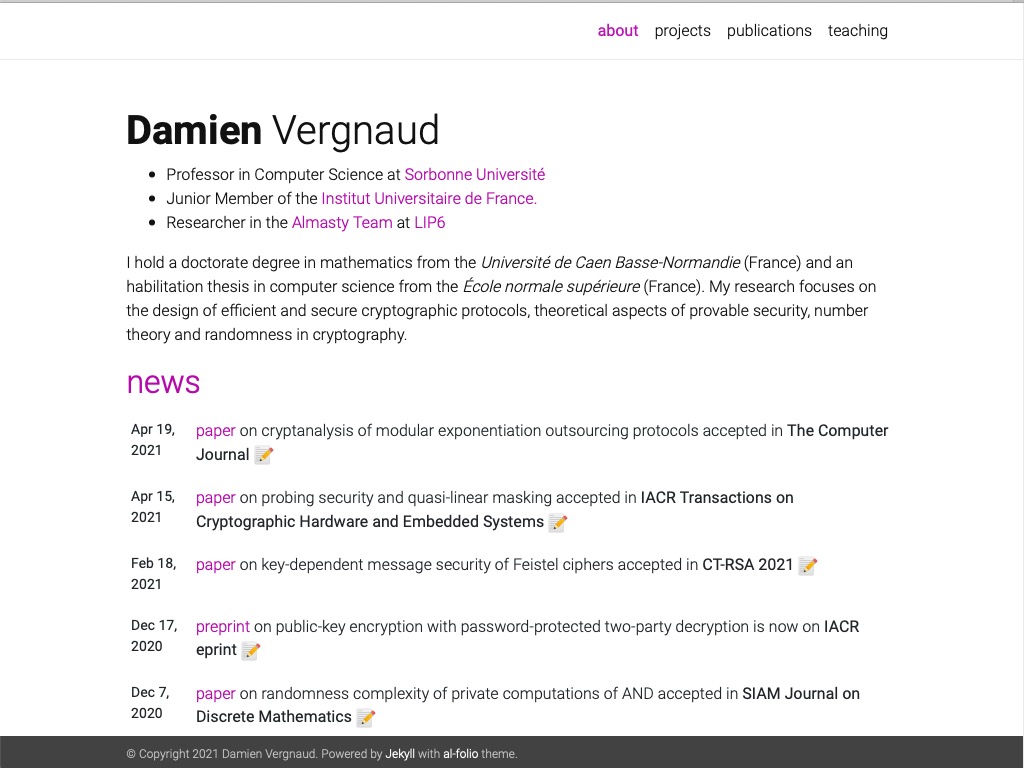
Dr. Damien Vergnaud is a Full Professor at Sorbonne University since September 2017, affiliated with the ALMASTY research team within LIP6 (Laboratoire d'Informatique de Paris 6), the Computer Science department of the Faculty of Science. His office is located at 4 place Jussieu, Paris, France, in Couloir 24-25, Étage 4, Bureau 412. Dr. Vergnaud holds a doctorate degree in mathematics from Université de Caen Basse-Normandie and an habilitation thesis in computer science from École normale supérieure. His research focuses on the design of efficient and secure cryptographic protocols, theoretical aspects of provable security, number theory, and randomness in cryptography. His work spans multiple domains including post-quantum cryptography, zero-knowledge proofs, secure implementation techniques against side-channel attacks, and cryptographic protocol analysis. He actively investigates how quantum computing impacts traditional cryptographic assumptions and protocols, as evidenced by his supervision of PhD students working on quantum-related cryptographic topics. Dr. Vergnaud's recent publications demonstrate a strong focus on post-quantum cryptographic techniques, zero-knowledge argument systems, and secure implementation methodologies. His research output shows consistent collaboration with both academic researchers and industry partners, particularly in practical cryptographic implementations. His work bridges theoretical foundations with practical security considerations, addressing challenges in modern cryptographic systems including resistance to quantum computing threats and side-channel analysis. Dr. Vergnaud actively supervises PhD students, currently mentoring three doctoral candidates and having successfully guided four students to completion in recent years. His supervision spans diverse topics within cryptography, including post-quantum cryptographic techniques, zero-knowledge arguments, secure implementations against physical attacks, and mathematical studies of pseudorandom number generators. He has served on numerous PhD defense committees, indicating his active role in the academic community. Dr. Vergnaud is a member of the ALMASTY research team at LIP6, which specializes in cryptographic algorithms and protocols. The team works on both theoretical foundations and practical implementations of cryptographic systems, with particular emphasis on security against various attack vectors including quantum computing threats and side-channel analysis.