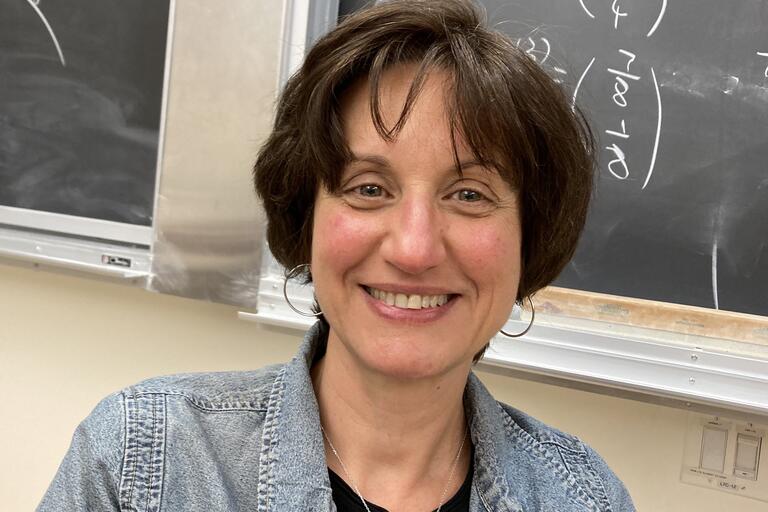
Zvezdelina Stankova is a Teaching Professor of Mathematics and Director and Founder of the Berkeley Math Circle at the University of California, Berkeley . Her contact details include an office in 713 Evans Hall and the email stankova@math.berkeley.edu . Research Interests: • Algebraic Geometry • Representation Theory • Combinatorics • Olympiad Problem-Solving • Mathematics Education Publications and Research Trends: Her work bridges Combinatorics and Algebraic Geometry , with a focus on permutation patterns, avoidance, and moduli spaces of curves. She has also contributed significantly to Mathematics Education through her leadership in the Berkeley Math Circle, emphasizing problem-solving techniques and outreach programs for students. Teaching and Outreach: Stankova has taught various courses at UC Berkeley, including MATH 52 Calculus II (2025), MATH 110 Linear Algebra , and MATH 74 Transition to Proofs . She actively engages with the Berkeley Math Circle, providing resources for mathematical competitions and advanced training for students.
Elette Boyle is an Associate Professor at Reichman University (IDC Herzliya) and a Senior Scientist at NTT Research . She holds a Ph.D. in Mathematics from MIT (advised by Shafi Goldwasser and Yael Tauman Kalai) and an undergraduate degree from Caltech . Education Ph.D. in Mathematics, MIT B.S. in Mathematics, Caltech Her research focuses on cryptographic solutions for secure data processing , particularly in secure multi-party computation , function/homomorphic secret sharing , and distributed point functions . Recent work explores topology-hiding communication , memory checking complexity , and sublinear-communication MPC . Key trends in her publications include: Advancements in Function Secret Sharing for branching programs and sparse vectors. Efficient Secure Multi-Party Computation protocols with preprocessing. Information-theoretic and computational Topology-Hiding Broadcast schemes. Optimized Oblivious Transfer with constant computational overhead. Scientific Awards European Research Council (ERC) Award Israeli Science Foundation (ISF) Grant United States Air Force Office of Scientific Research (AFOSR) Grant Google Research Scholar Award International Association for Cryptologic Research (IACR) Recognition As Director of the Foundations & Applications of Cryptography (FACT) Research Center , she leads collaborative work with institutions like Technion Israel , Cornell University , and NTT Research . Her students include Pierre Meyer (Ph.D.) , Matan Hamilis (Ph.D.) , and D'or Banon (MSc.) .
Jonas Bergström is a Professor in the Department of Mathematics at Stockholm University specializing in Algebra, Geometry, Topology, and Combinatorics. His research focuses on arithmetic geometry, moduli spaces, Siegel modular forms, and number theory, with extensive collaborations across international institutions including KTH Royal Institute of Technology. His research interests span algebraic geometry, topology, combinatorics, and number theory, with particular emphasis on moduli spaces of curves, abelian varieties, Siegel modular forms, and arithmetic geometry. Bergström's work bridges theoretical mathematics with computational approaches, often developing algorithms for complex mathematical structures. His research group actively explores commutative and homological algebra, complex and real algebraic geometry, arithmetic geometry, homotopy theory, and Ramsey theory. The most recent publications reveal a strong focus on cohomology of moduli spaces, Siegel modular forms, abelian varieties over finite fields, and L-functions. His work demonstrates a consistent pattern of combining algebraic geometry with number theory, particularly investigating arithmetic properties of algebraic varieties and developing computational methods for modular forms. The research shows increasing emphasis on algorithmic approaches and connections to theoretical physics through moduli space cohomology. Bergström has supervised several PhD students including Sjoerd de Vries (current), Stefano Marseglia, and Olof Bergvall (with Prof. Carel Faber). He currently mentors postdoctoral researchers Séverin Philip and Thomas Wennink, while former postdocs include Angelina Zheng, Valentijn Karemaker, Oliver Leigh, and Alex Samuel Bamunoba. His research is supported through collaborations with major mathematical networks including the Nordic number theory network and joint seminars with KTH. He is affiliated with the Algebra and Geometry Seminar (KTH and SU) and maintains active research connections through multiple collaborative projects, including joint work with Gerard van der Geer and Carel Faber on Hecke operators and Siegel modular forms. Bergström also contributes to open mathematical research through GitHub repositories containing computational results on cohomology of moduli spaces.
Pengtao Xie is an Associate Professor (tenured) in the Department of Electrical and Computer Engineering at UC San Diego, with cross-appointments in the Division of Biomedical Informatics and affiliations across multiple schools and institutes including the Halıcıoğlu Data Science Institute, School of Biological Sciences, and Skaggs School of Pharmacy. His research bridges human-inspired machine learning and healthcare applications. Education: PhD in Machine Learning, Carnegie Mellon University (2018) MS from Tsinghua University BS from Sichuan University Research Interests: His work focuses on machine learning inspired by human learning strategies , including learning by testing, interleaving, self-explanation, and teaching. These techniques are applied to large language models , foundation models , healthcare , and biomedicine . Recent efforts emphasize generative AI for medical image segmentation and protein function prediction. Scientific Awards: NIH MIRA Award (2025) NSF Career Award (2024) Best Graduate Teacher Award, ECE UCSD (2023) ICLR Notable-Top-5% Paper (2023) Global Top-100 Chinese Young Scholars in AI (2022) Tencent Faculty Award (2021) AMIA Doctoral Dissertation Award Finalist (2020) Siebel Scholarship (2014) Teaching & Mentorship: He has developed and taught courses such as Deep Generative Models , Probabilistic Graphical Models , and Linear Algebra and Applications . He actively mentors PhD, master's, and undergraduate students, with alumni now at CMU, Stanford, Mila, and industry roles. Labs & Teams: He leads a research group within the Center for Machine-Intelligence, Computing and Security and collaborates with the Institute for Genomic Medicine and Institute of Engineering in Medicine at UC San Diego.
Kiwan Maeng is an Assistant Professor in Computer Science and Engineering, focusing on the intersection of machine learning systems, privacy-preserving techniques, and low-latency computing architectures. His research emphasizes algorithm-system co-design for scalable and secure AI implementations. Research Trends : His recent work explores retrieval-augmented generation systems, low-latency diffusion models, privacy-preserving federated learning, and energy-harvesting intermittent computing frameworks. Publications highlight collaborations across machine learning, cryptography, and hardware-software co-design. Key Projects : He leads a 3-year NSF SaTC grant (2024-2027) addressing privacy-preserving data embedding for untrusted ML services, and contributes to serverless video analytics frameworks (SVDE) and VR streaming optimization (PIRATE). Technical Contributions : His scholarship spans 17 conference contributions and 3 journal articles since 2007, with notable work on memory encryption for edge devices, secure MPC-based inference, and sustainable AI systems. Current research focuses on balancing privacy guarantees with model utility while optimizing for environmental efficiency.
Taylor L. Hughes is a Professor in the Department of Physics at the University of Illinois at Urbana-Champaign. He focuses on theoretical condensed matter physics, particularly topological insulators/superconductors, quantum information/entanglement techniques, and mesoscopic transport in low-dimensional materials. His research also explores connections between high-energy physics, gravity, and condensed matter systems. Education : B.S. in Physics and Mathematics (2003, summa cum laude) from the University of Florida; Ph.D. in Physics (2009) from Stanford University under Shou-Cheng Zhang. Research Interests : Topological insulators and superconductors Quantum entanglement in condensed matter Mesoscopic transport in heterostructures Topological order and quantum Hall effect Spin-orbit coupling and low-dimensional systems Interdisciplinary links to high-energy physics Scientific Awards : Donald Biggar Willett Faculty Scholar (2020, 2022) ONR Young Investigator Award (2015) University of Illinois Center for Advanced Study Fellowship (2014) NSF CAREER Award (2014) Dean's Award for Excellence in Research (2014) Alfred P. Sloan Foundation Research Fellow (2013) Teaching and Advising : Hughes has taught advanced courses including Condensed Matter Physics I (PHYS 560) and Special Topics in Physics (PHYS 598 CMX). He actively mentors highly motivated undergraduate and graduate students in computational and theoretical physics projects.
Juergen Schmidhuber is Associate Professor at the Faculty of Informatics of Università della Svizzera italiana and a leading researcher at the Dalle Molle Institute for Artificial Intelligence (IDSIA USI-SUPSI). He is also Chief Scientist at NNAISENSE, a company dedicated to building practical general-purpose AI. His work has profoundly influenced modern artificial intelligence, particularly through the development of Long Short-Term Memory (LSTM) networks in 1991, now deployed across billions of devices for speech recognition, machine translation, and virtual assistants. His research interests span Artificial Intelligence, Deep Learning, Recurrent Neural Networks, Universal AI, Meta-Learning, Algorithmic Information Theory, Artificial Curiosity, Robotics , and Low-Complexity Art . He has pioneered mathematically rigorous frameworks for self-improving AI systems and formal theories of creativity and beauty. His work bridges theoretical foundations with real-world applications in computer vision, natural language processing, and autonomous robotics. The recent articles reflect a consistent trajectory of innovation, combining deep theoretical insights with scalable machine learning architectures. His publications emphasize sequence modeling, universal learning, intrinsic motivation, and computational creativity , demonstrating both foundational contributions and industrial impact. From LSTM to Goedel machines, his work consistently targets the long-term goal of self-improving general AI. Scientific Awards: Numerous awards in AI and machine learning (specific names not listed) Schmidhuber leads a research group at IDSIA, where he mentors students and researchers in advancing the frontiers of AI. His lab has secured significant recognition and industrial collaboration, though specific grants are not detailed. He promotes the 'New AI'—general, sound, and relevant to physics—and continues to explore the convergence of intelligence, computation, and the universe. Labs and Teams: Dalle Molle Institute for Artificial Intelligence (IDSIA USI-SUPSI) NNAISENSE (as Chief Scientist)
Paul Klemperer is the Edgeworth Professor of Economics at the University of Oxford, renowned for bridging theoretical economics with practical policy applications. His work has directly influenced major economic initiatives including the Bank of England's Product-Mix Auction and the UK's £22.5 billion 3G spectrum auction, demonstrating exceptional real-world impact in market design and regulation. His educational credentials feature a BA in Engineering (1st Class Honours with Distinction) from Cambridge University and an MBA (Top Student Award) with PhD from Stanford University, reflecting his interdisciplinary foundation. Klemperer's research centers on industrial organization, environmental economics, and auction theory. He co-invented 'strategic complements,' developed consumer switching cost theory, and pioneered supply function analysis for electricity markets. His scholarship consistently translates complex theoretical frameworks into actionable insights for finance, political economy, and climate policy, emphasizing practical applicability without sacrificing academic rigor. Recent publications reveal sustained innovation in auction algorithms, financial stability mechanisms, and equilibrium theory, with growing emphasis on climate economics and banking regulation. His work shows increasing collaboration with policymakers and economists like Jeremy Bulow to address contemporary crises through market design solutions. His scientific recognition includes: Foreign Honorary Member, American Academy of Arts and Sciences Foreign Honorary Member, Argentinian Economic Association Fellow, British Academy Fellow, Econometric Society Fellow, European Economic Association Klemperer has provided critical advisory services to multiple governments, notably designing the UK's mobile spectrum auction and assisting the US Treasury during the 2008 financial crisis. His policy engagement extends to serving on the UK Competition Commission, with research frequently funded through government contracts and central bank partnerships focused on market design challenges. He maintains active academic leadership as past or present Editor/Associate Editor for 12 economics journals, fostering scholarly discourse across industrial organization, finance, and environmental economics.
Prof. Ruth King is the Thomas Bayes’ Professor of Statistics at the University of Edinburgh’s School of Mathematics. Her research focuses on applying Bayesian statistical methods to ecological and public health challenges, including population estimation for hidden groups (e.g., injecting drug users, modern-day slaves) and wildlife conservation. She develops computationally efficient techniques for analyzing large datasets, such as spatial capture-recapture models for animal populations and spatio-temporal abundance models for hidden human populations. Key projects include estimating survival rates of guillemots (30,000 individuals) and improving capture-recapture models to account for animal movement dynamics. Her work bridges statistical methodology with real-world applications, emphasizing rigorous inference and scalable algorithms. King’s academic contributions span Bayesian modeling frameworks, parameter clustering in neuroscientific data, and hierarchical centering in random effects models. She collaborates with biologists and policymakers to address conservation and public health issues. Notable recent projects include incorporating memory effects into spatial capture-recapture models and developing semi-complete data augmentation for state-space models. Her interdisciplinary approach addresses challenges in ecology, epidemiology, and computational statistics, with a focus on methodological innovation for large-scale data. Her scientific contributions are highlighted through over 100 peer-reviewed articles, including work on integrated population models, animal movement dynamics, and hidden Markov models for seabird behavior. King emphasizes the importance of statistics in uncovering hidden information within datasets, advocating for robust methodologies that ‘stand up in court’ when applied to critical real-world problems.
LU Wen Feng is an Adjunct Associate Professor in the Department of Mechanical Engineering at the National University of Singapore (NUS), affiliated with the College of Design and Engineering. His research focuses on advanced manufacturing technologies, including additive manufacturing, robotics, and AI-driven systems. He explores sustainable design methodologies, smart manufacturing innovations, and bioprinting applications. Key areas include optimizing material processes, enhancing mechanical properties of printed materials, and developing autonomous robotic solutions for industrial tasks. Contact: mpelwf@nus.edu.sg , located at E3-02-07. Research Interests : His work bridges AI and manufacturing, emphasizing Knowledge graph integration for additive manufacturing, Autonomous robotic systems in industrial settings, Bioprinting for tissue repair with smart bioinks, Topology optimization for lightweight and sustainable structures, Material characterization and process engineering for 3D-printed composites. Recent Article Trends : LU Wen Feng's 2025 articles highlight advancements in AI-augmented manufacturing systems (e.g., MaViLa, AutoMEX) and sustainable design workflows. His 2024 studies address material anisotropy, corrosion behavior, and topology optimization strategies for lattice structures. These trends reflect his interdisciplinary approach to solving challenges in additive manufacturing, robotics, and biomedical applications. Awards : No scientific awards explicitly mentioned. Advising & Grants : No current graduate students or grants listed. His research likely integrates industry-academia collaborations given the focus on applied manufacturing technologies. Labs/Teams : Not explicitly detailed, but his work suggests involvement in advanced manufacturing labs and AI-robotics teams at NUS.
Simon Mak is an Assistant Professor of Statistical Science at Duke University and a Faculty Network Member of the Duke Institute for Brain Sciences. His educational background includes: Ph.D. in Statistics, Georgia Institute of Technology (2018) M.S. in Statistics, Georgia Institute of Technology (2018) B.S. in Statistics, Simon Fraser University (2013) Dr. Mak's research focuses on advanced statistical methodologies for complex scientific problems. His expertise spans statistical modeling , Bayesian inference , Gaussian process emulation , and uncertainty quantification . He applies these methods to nuclear physics (heavy-ion collisions), engineering (engine control systems), and music information retrieval, emphasizing scalability and interpretability in scientific computing. Analysis of his 2023-2025 publications reveals dominant trends in scalable Gaussian process methods for massive datasets and multi-fidelity simulations, particularly applied to high-energy physics and engineering systems. He has pioneered innovations in Bayesian optimization for expensive simulators and developed novel frameworks for online change-point detection in streaming data, demonstrating exceptional cross-disciplinary impact. Dr. Mak leads multiple significant research initiatives: Collaborative Research: Cost-Efficient and Confident Sampling for Modern Scientific Discovery (2023-2026) Science-Integrated Predictive modeLing (SCINPL) for scalable scientific computing (2022-2025) The X-SCAPE collaboration for statistically advanced nuclear collision modeling (2020-2025) These projects fund his development of statistical frameworks for scientific discovery in complex systems. He actively contributes to the JETSCAPE collaboration, developing multi-stage frameworks for studying jet quenching in heavy-ion collisions, and applies statistical methods through the Duke Institute for Brain Sciences to advance neuroscience research.
Andrew Li is an Associate Professor of Operations Research at Carnegie Mellon University's Tepper School of Business since 2024, previously serving as Assistant Professor since 2018. His research bridges statistics, optimization, and machine learning with applications to healthcare operations and retail management. Current teaching: Optimization, Business Analytics Capstone, and Topics in Optimization and Statistics PhD from MIT's Operations Research Center (2018), BS in Operations Research/Applied Mathematics from Columbia University (2012) Research Focus: Dr. Li develops data-driven decision frameworks for complex systems. Key areas include: Experience-based learning models with fairness constraints (organ allocation) Anomaly detection in low-rank matrices (retail inventory accuracy) Nanoparticle-based diagnostic systems for CAD and Alzheimer's Nonstationary demand forecasting in supply chains Publication Trends: Recent work combines bandit algorithms with healthcare applications (split liver transplants, CAD detection) and retail operations (inventory accuracy). Theoretical contributions include regret-optimal policies and entrywise anomaly detection guarantees. Scientific Honors: INFORMS Nicholson Award (2018) INFORMS Pierskalla Award (2021) NSF CAREER Award (2023) Professional Leadership: Active in INFORMS and CMU committees including MBA Analytics Curriculum, Thompson Award, and ENAiBLE AI-driven retail collaborative co-founder since 2021.
Noga Alon is a Professor at Princeton University (previously at Tel Aviv University since 1985), renowned for transformative contributions to Combinatorics and Theoretical Computer Science. His work bridges deep mathematical theory with computational applications, earning him the 2024 Wolf Prize and 2022 Shaw Prize in Mathematical Sciences. Education Ph.D. in Mathematics, Hebrew University of Jerusalem, Israel (1983) Research Interests Alon pioneers combinatorial methods with profound impacts across mathematics and computer science. His expertise spans Graph Theory, Combinatorial Algorithms (including Streaming Algorithms), Circuit Complexity, and Combinatorial Geometry/Number Theory. He innovatively applies Algebraic and Probabilistic Methods to solve fundamental problems, such as necklace splitting and signrank applications, driving advancements in both pure and applied domains. Scientific Awards 1989 Erdos Prize, Israel 1991 Feher Prize, Israel 1997 Member of the Israel National Academy of Sciences 2000 Polya Prize, SIAM, USA 2001 Bruno Memorial Award, Israel 2005 Landau Prize, Israel 2005 EATCS-ACM Goedel Prize 2008 Israel Prize in Mathematics 2008 Member of the Academia Europaea 2011 EMET Prize 2015 Fellow of the American Mathematical Society 2015 Łojasiewicz Lecture at Jagiellonian University 2017 Fellow of the Association for Computing Machinery 2021 Leroy P. Steele Prize for Mathematical Exposition (with Joel Spencer) 2022 Shaw Prize in Mathematical Sciences 2024 Wolf Prize in Mathematics Advising and Grants While Alon has undoubtedly mentored numerous students during his tenure at Tel Aviv University and MIT, specific advisee names are not documented in the source material. Similarly, grant funding details remain unspecified despite his extensive research output.
Feng Fu is an Associate Professor of Mathematics at Dartmouth College, with an adjunct appointment in Biomedical Data Science. He leads the Fu Lab, focusing on interdisciplinary research at the intersection of evolutionary game theory, computational social science, and biomedical data science. His academic roles include teaching courses such as Evolutionary Game Theory, Stochastic Processes, and Game Theory and Artificial Intelligence. Education: Senior Postdoc, ETH Zurich (2012-2015); Postdoc, Harvard University (2010-2012); PhD, Peking University (2010); B.S., Fudan University (2004). Research interests span evolutionary dynamics of cooperation, computational models of human behavior and social networks, cancer evolution, and behavioral epidemiology. Notable work includes studies on vaccine hesitancy, misinformation dynamics, and the hysteresis effect in vaccination uptake. His lab has received prestigious funding, including a Bill & Melinda Gates Foundation Grant (2019). Teaching and mentoring: Advised numerous graduate and undergraduate researchers, many of whom have received awards and advanced to academic or industry roles. Courses taught include QSS/MATH 30.04 (Evolutionary Game Theory) and MATH 146 (Game Theory and AI). Labs/Teams: Fu Lab at Dartmouth collaborates across disciplines, with projects in cancer immunotherapy modeling, network-based interventions, and computational social science. Recent lab highlights include advancements in understanding polarization and the development of targeted public health strategies.
Simon Dobson is a Professor of Computer Science and Deputy Head of the School of Computer Science at the University of St Andrews. His research focuses on complex systems, sensor analytics, computational tools for simulation, and data analytics. He leads grants exceeding EUR30M, including a £5M EPSRC-funded programme in Sensor Systems Software. He is a Fellow of the Royal Society of Edinburgh (2020) and advises the Scottish government. Education: BSc (University of Newcastle), DPhil (University of York), both in Computer Science. Professional: Chartered Engineer, Fellow of the British Computer Society. Research Interests: Complex systems, network science, higher-order networks, epidemiological modeling, and sensor data integration. Teaching: CS4203 (Computer Security), CS5728 (Complex Systems Modelling). Supervises PhD/MSc projects. Awards: Includes RSE Fellowship, BCS Fellowship, and multiple leadership roles in conferences and committees.