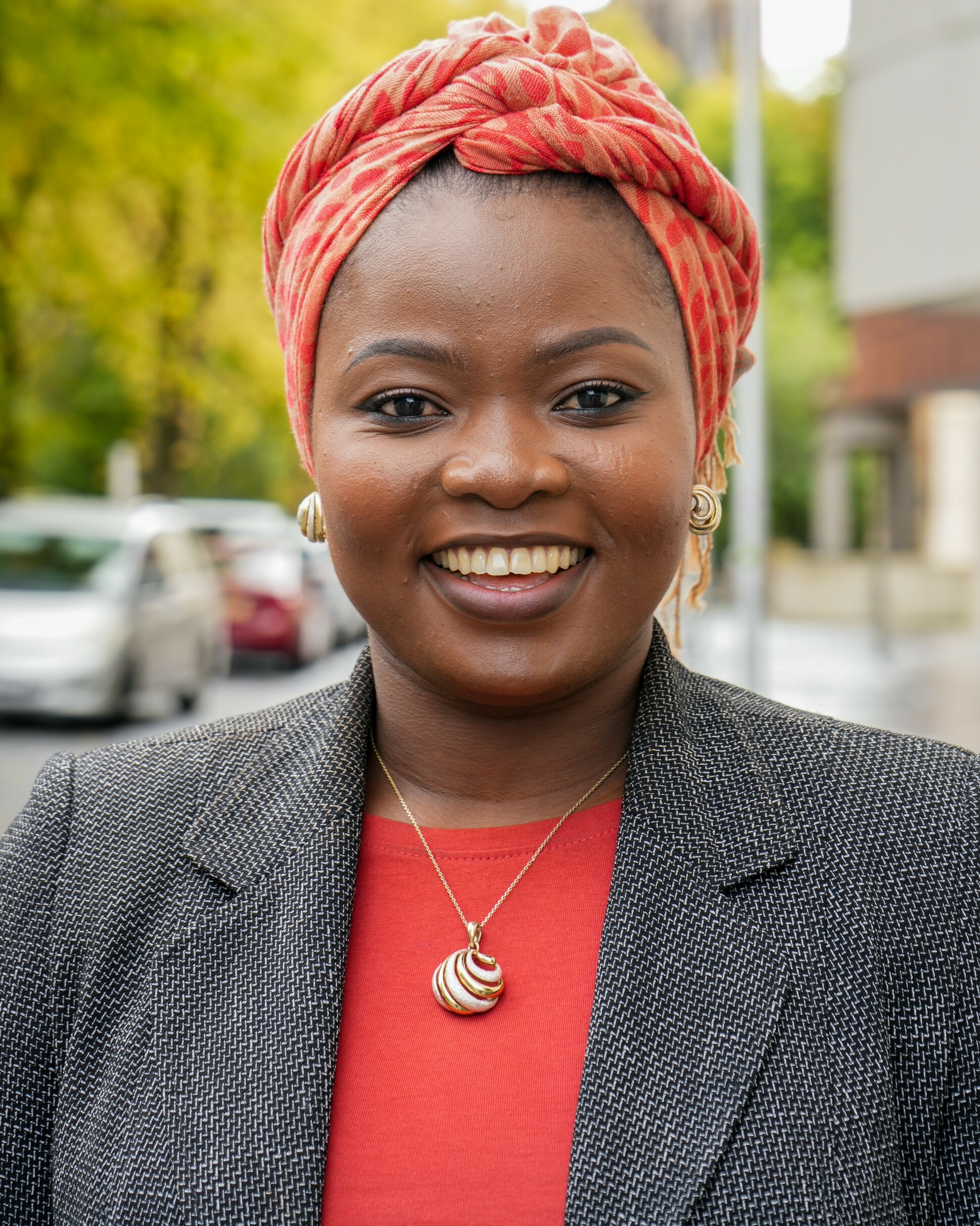
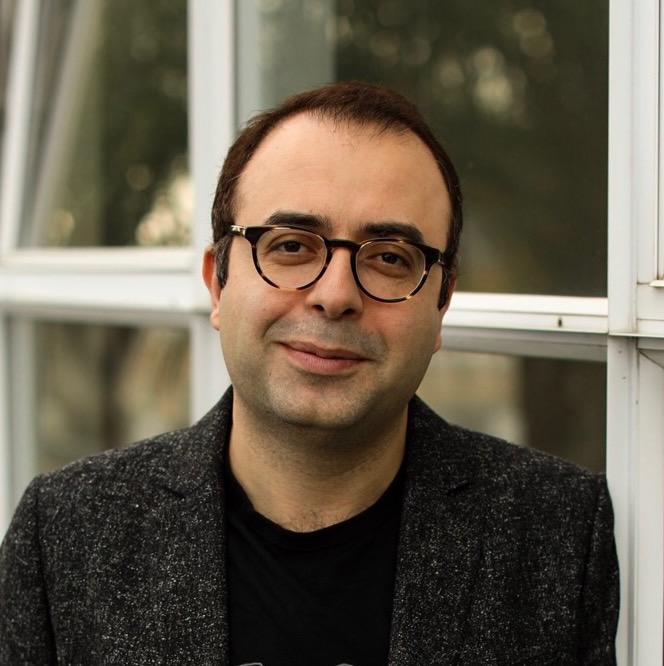
Sofiat Olaosebikan is a Lecturer in Algorithms and Complexity at the School of Computing Science, University of Glasgow. She joined the faculty in August 2020 and holds a PhD in Computing Science from the same institution. Her research focuses on algorithm design using graph theory, stable matchings, combinatorial optimization, and computational complexity. She is a member of the Formal Analysis, Theory and Algorithms (FATA) research group. Education: PhD in Computing Science (University of Glasgow, 2020), MSc in Mathematical Sciences (African Institute for Mathematical Sciences, 2015), BSc in Mathematics (University of Ibadan, 2012). Her research interests include bridging reinforcement learning with matching theory and designing algorithms for wireless communications. Notable contributions include work on the Student-Project Allocation Problem. She founded CSA Africa, which has trained over 500 students across Africa and online, securing £120,000 in funding. Her outreach efforts earned her recognition as a University of Glasgow Future World Changer (2018). Publications span topics like antenna selection in telecom systems and stable matching algorithms. Awards include Exceptional Promise endorsement from the Royal Academy of Engineering (2023) and Top 50 Women in Engineering (2022). Grants: CSA Africa secured funding from Global Challenges Research Fund, Glasgow Knowledge Exchange Fund, and others. Supervision: Currently supervising three PhD students focusing on algorithmics and network structures. Teaching: Leads Computing Science 1P since 2020/21.
Rahul Makhijani is a Lecturer at the University of California, Davis, and Senior Operations Research Scientist at Instacart specializing in logistics and matching algorithms. His research focuses on optimizing online marketplaces through algorithmic design and operations management. Ph.D. in Operations Research (Management Science & Engineering) from Stanford University (2019) M.S. in Statistics from Stanford University (2017) B.S. in Electrical Engineering from IIT Bombay (2013) Rahul’s research explores real-time marketplace optimization , with recent work on: Min-cost flow algorithms for recommendation systems Sequential matching in two-sided platforms Delay-aware matching protocols Content moderation queue simulations His work combines operations research , computer science , and statistical modeling to improve marketplace efficiency. While no formal awards are listed, his publications demonstrate expertise in both theoretical and applied algorithm design.
Christopher Stapenhurst is a Research Fellow with expertise in Economics and Game Theory. He holds a PhD in Economics, an MSc in Economics, and an MSc in Applicable Mathematics. His professional experience includes serving as an Assistant Economist at the Office for National Statistics. Stapenhurst's research focuses on applying game-theoretic mechanisms to policy design, inequality analysis, and environmental economics. Education PhD Economics MSc Economics MSc Applicable Mathematics Research Interests Game Theory applications in industrial policy and environmental governance Inequality measurement through ordinal data analysis Anti-corruption mechanisms and principal-agent frameworks International cooperation dynamics for pollution reduction Mathematical modeling of economic stability Statistical inference for economic indices Article Trends Stapenhurst's publications demonstrate an interdisciplinary focus combining economics, mathematics, and environmental policy. His recent work (2024-2025) centers on international cooperation mechanisms for marine pollution reduction and industrial policy optimization using social risk preferences. Earlier studies (2021-2023) explore corruption deterrence through strategic information control and inequality analysis via median-preserving spreads. The research spans theoretical game theory, empirical economic analysis, and environmental economics applications.
Ola Svensson is an Associate Professor at the School of Computer and Communication Sciences, EPFL. His research focuses on approximation algorithms, combinatorial optimization, computational complexity, and scheduling. He has been supported by grants including the ERC Starting Grant "OptApprox" (2014-2019), SNF grants, and the ERC Consolidator Grant "POTCO" (2023-). He teaches courses such as Advanced Algorithms and Approximation Algorithms and Hardness of Approximation. Education: PhD from IDSIA - Universita della Svizzera italiana (2009) and Master's from Uppsala University (2005). Research Interests: Design and analysis of approximation algorithms for NP-hard problems, scheduling, and computational complexity. He explores limitations of approximation techniques through hardness results and contributes to theoretical computer science. Publications span clustering, scheduling, and graph problems like the Traveling Salesman Problem. Recent work includes learning-augmented algorithms and robust optimization. Awards: I&C teaching award and best paper awards at FOCS (2017) and STOC (2018). Over a dozen PhD students advised, many entering postdocs or industry roles. Labs/Teams: Part of the theory group at EPFL, collaborating on academic projects and course development.
Ting Lei is an Associate Professor in the Department of Geography at the University of Kansas, located in Malott Hall #1021. His primary research interests focus on Geographic Information Science (GIS), including algorithmic development, geospatial computational methods, network analysis, location theory, and web GIS. He also explores remote sensing applications and advancements in GIS technology such as data structures, databases, computational geometry, and open-source software. His teaching covers GIS principles, transportation geography, and geo-computational methods. Dr. Lei's publications emphasize spatial data conflation, transportation network vulnerability, and optimization models for facility location. Recent works include studies on optimal spatial data matching, hub center interdiction problems, and unified location-allocation approaches integrating GIS and distributed computing. His research addresses real-world challenges in urban planning, water resources management, and celestial imaging analysis. Key research trends in his articles include computational GIS advancements, transportation infrastructure resilience, and interdisciplinary applications of geospatial technologies. No specific scientific awards are listed, though his extensive publication record highlights scholarly contribution. Advising and grants details are not provided in the text, but his active research in multiple geospatial domains indicates engagement with academic and applied projects.
Andrei Asinowski is a Researcher at the Institute of Mathematics at Alpen-Adria-Universität Klagenfurt. He has held academic appointments at institutions including Bielefeld University (2005–2006), University of Haifa (2006–2008), Technion (2008–2011), Free University of Berlin (2012–2015), and TU Wien (2015–2018). Since 2020, he leads the FWF-funded project 'Generic Rectangulations: Enumerative and Structural Aspects' (P32731). His research focuses on combinatorics, discrete mathematics, computational geometry, and enumerative combinatorics. Key interests include rectangulations, permutation patterns, lattice paths, and guillotine partitions. Research Interests: Combinatorics of rectangulations, permutation classes, enumerative combinatorics, geometric permutations, and algorithmic applications of discrete structures. His work bridges combinatorial theory and computational geometry, with recent emphasis on bijections between rectangulations and permutations, generating functions, and analytic methods. Grants & Projects: Principal Investigator of FWF Grant P32731 (since 2020), exploring enumerative and structural aspects of rectangulations. Collaborative projects include EuroGIGA's ComPoSe (2012–2015) and SFB F50's Algorithmic and Enumerative Combinatorics (2015–2018). Publications Trends: Recent work emphasizes rectangulation enumeration, permutation patterns, and analytic combinatorics techniques. Earlier contributions addressed geometric permutations, computational geometry, and lattice path enumeration.
Anna Bogomolnaia is a Professor of Economics at the Adam Smith Business School, University of Glasgow. She holds a PhD in Economics from Universitat Autonoma de Barcelona (1998) and a Master’s in Mathematics from St. Petersburg University (Russia). Her research focuses on mechanism design, matching and assignment problems, game theory, coalition formation, and network theory. She is affiliated with the Microeconomics research cluster at Glasgow. Her work emphasizes fair division, randomized social choice, and resource allocation mechanisms. Notable contributions include studies on fair assignment rules, competitive division of mixed manna, and guarantees in fair division under varying preferences. Her recent publications (2023-2025) explore congested assignment, scheduling optimization, and stochastic allocation frameworks. Bogomolnaia has held academic positions at the University of Nottingham, Southern Methodist University, and Rice University before joining Glasgow in 2013. She has received grants including a Spanish government fellowship for visiting researchers and Southern Methodist University’s research/travel grants. She serves as an associate editor for Economic Theory , Economic Theory Bulletin , and Review of Economic Design . Her teaching spans advanced microeconomic theory, game theory, and mathematical economics at both graduate and undergraduate levels.
Bart M.L. Smeulders is an Assistant Professor at Eindhoven University of Technology within the Mathematics and Computer Science school, specializing in Combinatorial Optimization . His research spans: Healthcare policy modeling for organ allocation systems Algorithmic game theory in transplantation markets Robust optimization techniques for medical logistics Key research outputs include: 2025: Policy evaluation simulator for Eurotransplant 2024: Kidney exchange complexity and optimization approaches 2025: Gender disparity analysis in liver allocation His work intersects computer science, operations research, and medical decision-making, contributing to UN Sustainable Development Goal 3 (Good Health and Well-being).
V. Dinesh Reddy is affiliated with SRM University Andhra Pradesh, Department of Computer Science and Engineering in Amaravati, India. He maintains an active research career with publications spanning from 2017 to 2025 across multiple prestigious venues including IEEE Access, Energy Informatics, Quantum Information Processing, and Sensors. Dr. Reddy's research interests span cloud computing infrastructure optimization, edge computing, quantum computing applications, image processing, and cybersecurity. His work demonstrates expertise in developing evolutionary algorithms, machine learning approaches, and optimization techniques to solve complex computing problems with practical applications in IoT security, vehicular networks, and medical diagnostics. His publication record shows consistent output with increasing collaboration and expanding research scope over time. The research demonstrates strong interdisciplinary connections between traditional computer science domains and emerging technologies like quantum computing, addressing real-world challenges in computing infrastructure efficiency and security. Dr. Reddy has collaborated extensively with researchers including G. R. Gangadharan, G. Subrahmanya V. R. K. Rao, Marco Aiello, Md. Muzakkir Hussain, and Ashu Abdul. His research appears well-funded given the scope and diversity of projects, with applications spanning sustainable data centers, edge computing for vehicular networks, and quantum computing implementations. His research spans multiple laboratory contexts, particularly in cloud computing infrastructure, quantum computing applications, and image processing. Dr. Reddy's future research directions appear to be expanding into more specialized quantum computing applications and advanced edge computing scenarios for vehicular networks, as evidenced by his most recent publications from 2024-2025.
Professor Anton Kolotilin is a faculty member at the University of New South Wales (UNSW), affiliated with the UNSW Business School. His research focuses on Microeconomic Theory and Information Economics, with particular emphasis on strategic communication, persuasion mechanisms, and game-theoretic models. He has contributed significantly to understanding optimal information disclosure strategies, the design of persuasive communication frameworks, and the economic implications of partisan gerrymandering. His work intersects with political economy, experimental design, and network formation models. Professor Kolotilin has an extensive publication record with over 13 journal articles, 3 working papers, and 13 preprints. His recent research explores topics such as the duality of persuasion, censorship as an optimal strategy, and the application of linear programming to information design. He frequently collaborates on interdisciplinary projects, bridging theoretical economics with practical policy analysis. Key research interests include mechanism design, Bayesian persuasion, strategic information transmission, and the analysis of social and economic networks. While no specific grants or awards are listed, his prolific output underscores his contributions to academic discourse in economics and related fields.
Amin Saberi is a Professor of Management Science and Engineering at Stanford University, with a courtesy appointment in Computer Science. His research focuses on algorithms, social network analysis, market design, and optimization, with applications in economics and computer science. He holds a B.Sc. from Sharif University of Technology (2000) and a Ph.D. in Computer Science from Georgia Institute of Technology (2004). He has been honored with the Terman Fellowship, Alfred P. Sloan Fellowship, and multiple best paper awards at FOCS, SODA, and EC. As founder and CEO of NovoEd, he pioneered scalable social learning platforms used globally. His academic roles include membership in ICME and Bio-X. Education: B.Sc., Computer Science, Sharif University of Technology (2000) Ph.D., Computer Science, Georgia Institute of Technology (2004) Research Interests: Algorithms, market design, optimization, social networks, and their applications in economics and operations research. His work spans theoretical contributions in approximation algorithms, stochastic optimization, and practical applications in ride-sharing markets and online advertising. Recent publications explore dynamic matching markets, envy-free resource allocation, and algorithms leveraging graph neural networks. Awards: Terman Fellowship Alfred P. Sloan Fellowship Best Paper Awards at FOCS, SODA, and EC Advising & Grants: Supervised over a dozen doctoral and master’s students. His research has been supported by grants focusing on dynamic resource allocation and algorithmic market design. Collaborations include Uber, Amazon, and academic institutions globally. Labs/Teams: Leads the Stanford Center for Computational Market Design. Active in interdisciplinary teams at ICME and Bio-X, integrating theoretical insights with practical applications.
Margarida Carvalho is an Associate Professor in the Department of Computer Science and Operations Research at Université de Montréal, where she holds the FRQ-IVADO Research Chair in Data Science for Combinatorial Game Theory. She is also an Associate Academic Member at Mila (Quebec AI Institute), contributing to their research in AI for Humanity. Her academic journey spans from Portugal to Canada, where she has established herself as a leading researcher at the intersection of operations research and game theory. Carvalho earned her bachelor's and master's degrees in mathematics from the Faculty of Sciences of the University of Porto (FCUP), followed by a PhD in Computer Science from the same institution in 2016. Her doctoral work, which focused on game theory applications for kidney exchange programs, earned her the prestigious 2018 EURO Doctoral Dissertation Award, making her the first Portuguese woman to receive this honor. After completing her PhD, she worked as an IVADO Postdoctoral Fellow at Polytechnique Montréal before joining Université de Montréal as an Assistant Professor in 2018. Her research focuses on combinatorial optimization and algorithmic game theory, with applications spanning healthcare (kidney exchange programs, hospital operations), sustainable development (electric vehicle infrastructure, urban planning), and education (school choice systems). She develops novel mathematical programming approaches to model and solve problems involving multiple decision-makers with potentially conflicting objectives. Her work bridges theoretical advances in optimization with practical implementations that address real-world challenges in resource allocation and decision-making under uncertainty. Notably, her research on fairness in kidney exchange programs has contributed to more equitable organ allocation policies. Her 15 most recent publications reveal a strong trend toward integrating game-theoretic concepts with practical optimization challenges, particularly in healthcare and sustainable infrastructure. She has pioneered approaches that balance utilitarian objectives with fairness considerations, developed novel formulations for bilevel and multilevel optimization problems, and created learning-based frameworks for complex decision environments. Her work consistently demonstrates how mathematical rigor can inform practical policy decisions in critical domains. 2018 EURO Doctoral Dissertation Award for her PhD thesis on game theory applications for kidney exchange programs Mathematical Programming 2024 Meritorious Service Award Teaching Excellence Award from Université de Montréal Supervised student Maria Bazotte receiving the Dupačová-Prékopa Best Student Paper Prize in Stochastic Programming Carvalho actively advises graduate students, with Marylou Fauchard (Master's) and William St-Arnaud (PhD) among her current advisees. Her research is supported by grants from Hydro-Québec, the Natural Sciences and Engineering Research Council of Canada (Discovery grant 2017-06054 and Collaborative Research and Development Grant CRDPJ 536757–19), and FRQ-IVADO. She serves as an associate editor for INFORMS Journal on Computing, OR Spectrum, and Dynamic Games and Applications, and is a founding board member and treasurer of the Bilevel Optimization Society. She teaches courses in Mathematical Programming, Operational Research Models, and Discrete Mathematics at Université de Montréal. Carvalho is affiliated with Mila (Quebec AI Institute), where she contributes to research initiatives focused on AI for Humanity, particularly in the areas of algorithmic fairness and sustainable development. Her FRQ-IVADO Research Chair supports her work on combinatorial game theory applications, and she collaborates with researchers across disciplines through the IVADO research community. She has been instrumental in establishing the Bilevel Optimization Society, creating a dedicated forum for researchers working on hierarchical decision-making problems.
Samuel Häfner is an Assistant Professor in Economics at the University of St. Gallen , with affiliations at the Zurich Center for Market Design and sciCORE facility at University of Basel. His research focuses on Applied Microeconomic Theory with emphasis on auctions, contests, contracts, and blockchain markets. Research interests include: Industrial Organization (contracts, auctions, contests) Blockchain Economics (decentralization, service provision) Game Theory (dynamic contests, equilibrium analysis) Recent publications analyze: Risk aversion in share auctions and TRQ rent estimation in Switzerland Optimal contracting for advice and information acquisition Front-running in candle auctions
Marco Furlotti is a Senior Lecturer at the Department of Management within Nottingham Business School at Nottingham Trent University. He leads undergraduate, graduate, and post-experience graduate modules while supervising PhD and DBA students, with prior faculty roles at Tilburg University and visiting scholar experience at Rotman School of Management. PhD in Business Administration from Bocconi University Industry experience in automotive, industrial machinery, and investment banking sectors Research Focus: Dr. Furlotti investigates organizational decision-making under uncertainty, strategic alliances, innovation governance, and temporary organization structures. His work bridges theoretical frameworks with practical applications in corporate R&D and entrepreneurial ventures. Article Trends: Recent publications emphasize organizational design for innovation, emotional competencies in experiential learning, and strategic partner selection in alliances, reflecting interdisciplinary engagement with economics, psychology, and business strategy. Teaching & Supervision: Leads doctoral course delivery and research while maintaining industry connections through executive positions and joint-venture management experience.
Sid Banerjee is an Associate Professor in the School of Operations Research and Information Engineering at Cornell University , with field memberships in the Computer Science Department , Electrical and Computer Engineering (ECE) , and the Center for Applied Mathematics . His research focuses on the intersection of data-driven decision-making , stochastic control , economic theory , and large-scale network algorithms , with applications to ride-sharing platforms, online marketplaces, and smart transit systems. His work has been recognized with prestigious awards including the NSF CAREER award , multiple grants from NSF (CNS 1955997, CNS 1952011, DMS 1839346), and support from ARL Network Sciences and Engaged Cornell . He has advised numerous PhD students and postdoctoral researchers, many of whom have transitioned to academic positions at institutions like MIT Sloan , Facebook Research , and Amazon . His recent publications analyze problems in fair allocation , information design , reinforcement learning , and market robustness , often combining tools from online algorithms , Bayesian game theory , and large-scale optimization . During 2021-2022, he was on sabbatical at the Simons Institute in Berkeley, co-organizing the program on Data-Driven Decision-Making .