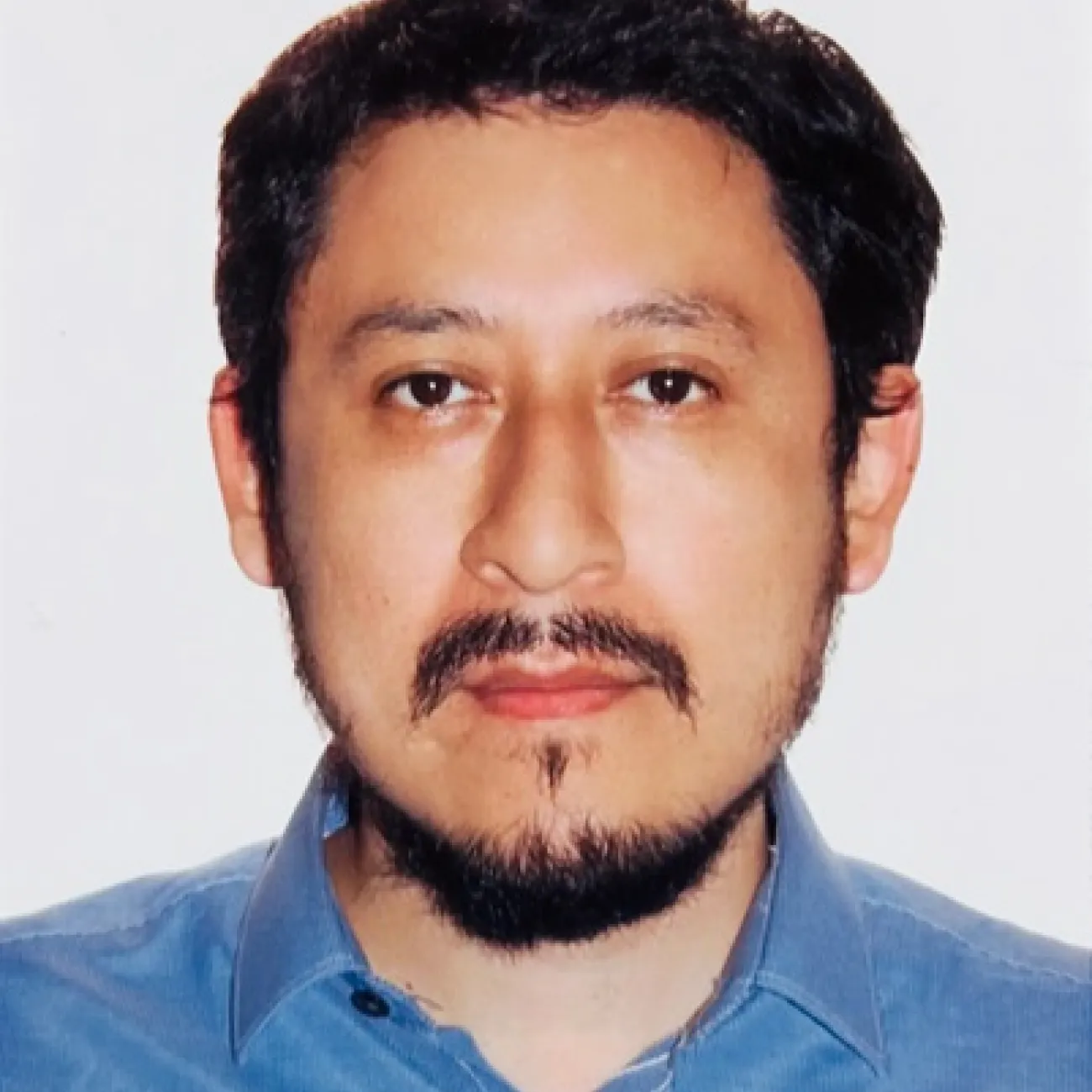
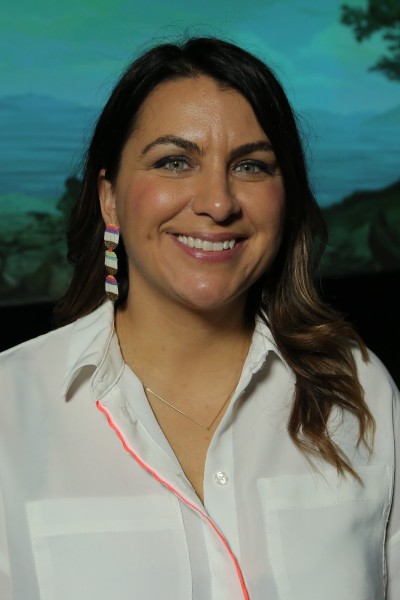
Dr. Ernesto Elias Vidal Rosas is a Lecturer at the School of Electronics and Computer Science, University of Southampton. Previously, he was a Postdoctoral Researcher at UCL Medical Physics and Biomedical Engineering Department. He specializes in neuroimaging and optical technologies with extensive expertise in near-infrared spectroscopy (NIRS), diffuse optical tomography (DOT), and wearable brain imaging systems. He is currently accepting PhD students. Research Focus: Dr. Vidal-Rosas leads research in neuroimaging methodologies and brain-computer interfaces. His work emphasizes wearable technologies for clinical and home-based monitoring, with applications spanning from neonatal care to motor rehabilitation. Key research domains include: Development of high-density diffuse optical tomography (HD-DOT) systems Integration of EEG and fNIRS for brain-computer interfaces Real-time processing algorithms for neurofeedback applications Non-invasive monitoring of therapeutic responses in oncology He is currently involved in the Horizon Europe PUREMIND project focused on preventing mental illness through multimodal biomarker analysis. Academic Activities: Actively advises PhD candidates in Computer Science and teaches undergraduate courses including Healthcare Technology Design (ELEC2231) and Digital Control System Design (ELEC3206). His pedagogical research includes developing virtual tools for engineering education. Affiliations: Member of the Digital Health and Biomedical Engineering research group and the Institute for Life Sciences at Southampton.
Dr Sean Anderson is a Senior Lecturer at the Department of Automatic Control and Systems Engineering , University of Sheffield , with over 15 years of experience in interdisciplinary research spanning robotics, control systems, and computational biology. He earned his MEng and PhD from the University of Sheffield, focusing on control systems and chemical engineering. Education: MEng in Control Systems Engineering, University of Sheffield (2001) PhD in Chemical and Process Engineering, University of Sheffield (2005) Research Interests include: Bioinspired robotics Adaptive and optimal control in biological systems Nonlinear system identification Computational neuroscience Acoustic and visual sensor fusion for localization His recent publications highlight innovations in robotic localization in hazardous environments, interpretable deep learning for control systems, acoustic sensing technologies, and data-driven modeling of complex systems. Key projects involve autonomous navigation in pipe networks, turbulence modeling, and biomedical signal processing. Grants and Funding: He has secured major grants from EU H2020 (£4M), EU FP7 (£2.9M), and EPSRC (£5.7M), focusing on bioinspired control algorithms, robotic safety, and infrastructure assessment. Teaching: He leads the ACS61011 Deep Learning module, emphasizing practical applications in robotics and signal processing.
Marc Sommer is a Professor of Biomedical Engineering and Psychology & Neuroscience at Duke University. He directs the Duke Institute for Brain Sciences and contributes to the Duke Initiative for Science & Society. His research focuses on neural circuits for cognition , particularly how the brain maintains visual perception and behavior through interactions between frontal cortex and subcortical regions. Key Techniques : Single neuron electrophysiology, optogenetics, psychophysics, computational modeling Translational Goals : Improving transcranial magnetic stimulation (TMS) and viral vector therapies for psychiatric and motor disorders Scientific Awards : Capers and Marion McDonald Award for Excellence in Teaching and Research (2021) Capers and Marion McDonald Award for Excellence in Mentoring and Advising (2017) Bass Fellow, Duke University (2017) Research Fellowship in Neuroscience, Alfred P. Sloan Foundation (2005) Marc Sommer's recent publications span visual stability across saccades , optogenetics in primates , TMS mechanisms , and viral vector applications . His work bridges cognitive neuroscience and biomedical innovation , with significant contributions to corollary discharge theory and neural circuit mapping . Lab Collaborations : Interdisciplinary partnerships across Duke University and external institutions, integrating engineering , neurobiology , and computer science to decode primate brain circuitry.
Oliver Janz is Professor of Modern History at the Department of History and Cultural Studies at Free University of Berlin, where he has been teaching since 2007. He previously served as Dean of the Department from 2017-2021 and has held visiting professorships at institutions including the German Historical Institute in Rome, University of Bern, and University of Trient. His academic leadership extends to editorial roles for multiple book series and journals focusing on modern Italian history, transnational history, and World War I studies. Doctorate (1991): Freie Universität Berlin - History of Protestant clergy in Prussia 1850-1914 (summa cum laude) Magister Artium (1985): Freie Universität Berlin - History Studies (1978-1985): History, Philosophy and Sociology at University of Heidelberg, Bielefeld, and Freie Universität Berlin Professor Janz specializes in several interconnected research areas that examine European history through transnational and comparative lenses. His primary focus is on the history of World War I, particularly examining commemoration practices, the cult of fallen soldiers, and the war's transnational dimensions. He has extensively researched the history of the European bourgeoisie, nation and nationalism in Europe, and the intersection of family, gender, and political identity. His work on Italian history spans from the Risorgimento through the Fascist period, with particular attention to religious and cultural dimensions of political movements. Janz is a leading scholar in transnational history methodology, exploring how historical phenomena transcend national boundaries and how comparative approaches can illuminate shared European experiences. Janz's scholarly output demonstrates a consistent focus on memory, commemoration, and the cultural dimensions of warfare, particularly World War I. His work reveals how societies process collective trauma through rituals, monuments, and narratives that intertwine religious, familial, and national identities. The international encyclopedia project 1914-1918-online represents a significant contribution to digital humanities, creating a global platform for understanding the war's multifaceted impacts. His research increasingly examines the digital representation of historical memory, bridging traditional scholarship with contemporary digital culture. Research fellowship from the DFG (2000-2004): "The Cult of the Fallen: Soldiers in Italy during the First World War" DAAD Fellowship (1996): "Exchange of Young Scholars between Italy and Germany" Fellow of the FAZIT-Stiftung (1990) Maison des Sciences de l'Homme Fellowship (1985) Fellowship Grant from the "Studienstiftung des Deutschen Volkes" (1979-1985) Professor Janz has supervised numerous master's students at Freie Universität Berlin, with thesis topics spanning European history from the 19th century to the contemporary period. His students have examined subjects including war commemoration, gender history, colonial encounters, and political movements across Europe. As editor of the "1914-1918-online" International Encyclopedia of the First World War, he has coordinated significant international research funding. His leadership extends to multiple research projects including Collaborative EuropeaN Digital/Archival Infrastructure (CENDARI), Making War, Mapping Europe, and studies on German Soldiers and the Ottoman Empire. Janz leads the research team focused on World War I studies at the Friedrich-Meinecke-Institut, which includes multiple researchers working on the 1914-1918-online encyclopedia project. His team collaborates with international partners across Europe and beyond, creating a network of scholars dedicated to transnational approaches to war history. The research group maintains strong connections with institutions including the German Historical Institute in Rome and participates in the Berlin Program for Advanced German and European Studies.
Giovanna Montenegro is an Associate Professor of Comparative Literature and Romance Languages at Binghamton University, serving as Director of the Latin American and Caribbean Area Studies Program (LACAS). Her research focuses on colonialism in Latin America and the Caribbean, with interdisciplinary interests in German Studies, cartography, ecocriticism, and visual culture. She has published extensively on topics including the Welsers’ colonial venture in Venezuela and Indigenous environmental resistance in the Guianas. Education: PhD in Comparative Literature from the University of California, Davis. Research interests include colonial history, environmental humanities, Indigenous and Maroon studies, and digital humanities. She has led study abroad courses in Peru and collaborated on projects addressing land rights for Saamaka communities in Suriname. Her work has been supported by prestigious fellowships such as the Fulbright U.S. Scholar Award, Newberry Library grants, and the American Association of University Women. Notable awards include the 2019 LASA-Venezuela Section Best Article Prize for her analysis of German cultural memory around the Welser colony. In teaching, she offers courses on colonialism, environmental literature, and world literature, reflecting her commitment to linking academic scholarship with public engagement through initiatives like mapping projects and community advocacy.
Dr. Rebecca K. Ivic is a Professor and Associate Dean of Research at the University of Alabama's College of Communication & Information Sciences. She holds a PhD and MA in Health Communication from Purdue University. Her research bridges health communication, public health, and computational social science to address global health challenges such as vaccine promotion and health equity. She currently serves as Senior Editor of the Journal of Health Communication and Co-Secretariat Lead for the Nature Medicine Commission's Quality Health Information for All initiative. Dr. Ivic has secured over $1.6M in research funding and contributed to 60+ peer-reviewed publications. She leads institutional research strategies, including a pilot funding program and strategic plans to enhance faculty and student research support. Her work emphasizes digital health directions, global partnerships, and evidence-based health information systems. She collaborates with multidisciplinary teams and international organizations to advance health equity through strategic communication frameworks. Key contributions include special journal collections, grant review roles for NIH and NSF, and partnerships with the CUNY School of Public Health. Dr. Ivic's research spans computational social science methodologies, social media discourse analysis, and health campaign effectiveness. Her recent work explores algorithmic impacts on misinformation, community support dynamics in online health spaces, and environmental health communication through social media networks.
Kyoko Iwaki is a Senior Lecturer at the Department of Literature of the University of Antwerp, with a focus on Japanese theatre, performance studies, and post-catastrophe narratives. She actively engages in collaborative research and holds internal governance roles, including membership in the Departmental Council for Literature and the Education Committee for the Educational Master in Languages. Her research explores Japanese contemporary theatre's intersections with ethics, digital performance, and nuclear trauma. Key themes include collaborative methodologies, liminality, and the philosophical implications of post-Fukushima art. Her work spans classical adaptations, avant-garde practices, and interdisciplinary approaches to performance. Recent publications analyze experimental Japanese theatre (Okada Toshiki, Sankai Juku), post-disaster memory, and the politics of digital pandemic spaces. She contributes to global discourse through interviews with practitioners and critiques of institutional frameworks in theatre and academia.
Narges Mahyar is an Associate Professor at the University of Massachusetts Amherst in the Manning College of Information and Computer Sciences (CICS) . She is currently on sabbatical with the Aviz team at the Inria Center, University of Paris-Saclay . Her research focuses on Human-Computer Interaction (HCI) , Information Visualization , and Digital Civics , aiming to empower communities through technology. Education: She holds a PhD in Computer Science from the University of Victoria, an MS in Information Technology from the University of Malaya, and a BS in Electrical Engineering from Tehran Azad University. She completed postdoctoral fellowships at the University of British Columbia (2014–2016) and the University of California San Diego (2016–2018). Research Interests: Her work addresses complex societal challenges like climate change, urban planning, and healthcare by designing inclusive technologies. Key areas include civic engagement, data visualization for equity, and integrating AR/VR for public participation. Notable projects include CommunityClick and RisingEMOTIONS , which enhance public input in decision-making. Publications & Awards: With over 50 publications, her work has received prestigious awards including Best Paper Awards at CHI 2023 , Eurovis 2022 , and CSCW 2020 . Her research emphasizes ethical design and inclusivity, particularly involving marginalized communities. Grants & Advising: She has secured grants totaling over $1.4 million, including NSF funding for projects like "Mapping Instability" . Advises PhD student Mahmood Jasim and collaborates with Ali Sarvghad and Pari Riahi on interdisciplinary research. Labs & Teams: Leads the HCI-VIS Lab at UMass, focusing on social computing and visualization. Collaborates internationally with teams like Aviz and Inria on civic tech initiatives.
Griffin Weber, M.D., Ph.D., is an Associate Professor of Medicine and Biomedical Informatics at Harvard Medical School (HMS) and Beth Israel Deaconess Medical Center (BIDMC). He directs the Biomedical Research Informatics Core (BRIC) at BIDMC. His research focuses on expertise mining, social network analysis, and biomedical informatics. Key contributions include developing Profiles RNS (an open-source research networking platform) and i2b2 / SHRINE federated query tools for clinical data. He holds MD and PhD degrees from Harvard (2007), and earlier degrees in bioengineering and computer science. Education: SB in Bioengineering (Harvard, 2000), SM/PhD in Computer Science (Harvard, 2004/2005), MD (Harvard, 2007). He served as Harvard Medical School's first Chief Technology Officer, building educational platforms for 500+ courses. His work spans DNA microarrays, breast cancer tumor modeling, and EHR bias analysis. Research Interests: Leveraging informatics to improve healthcare through federated data systems, team science dynamics, and EHR analysis. Projects include Profiles RNS for researcher networks and i2b2 for clinical data queries across institutions. He explores biases in EHR data filtering and visualizing healthcare system dynamics in biomedical data. Grant Leadership: Principal investigator on NIH grants addressing EHR biases (R01LM013345), healthcare system dynamics (U01CA198934), and scientific workforce networks (U01GM112623). Collaborator on PCORI and NIH-funded initiatives. Awards: 2020 Fellow of the American College of Medical Informatics; 2011 Top Podium Presentation (AMIA); 2007 Medical Technology Award (Massachusetts Medical Society). Labs/Teams: Leads BRIC at BIDMC, collaborates on i2b2/SHRINE, and contributes to the 4CE consortium for federated healthcare data analysis.
Aniket Ambekar is a Research Fellow at the Department of Chemical Engineering and Chemistry, Eindhoven University of Technology. His research focuses on multiphase flow dynamics in porous media, with expertise in computational fluid dynamics (CFD) and experimental validation techniques. He holds a PhD in Chemical Engineering from the Indian Institute of Technology Delhi (2022), an MSc in Computational Fluid Dynamics from National Institute of Technology (2016), and a BSc in Chemical Technology from the University of Pune (2013). Research interests include packed bed hydrodynamics, gas-liquid flow mechanisms, and the role of wettability in two-phase systems. His work combines high-resolution simulations (e.g., volume-of-fluid method) with experimental measurements to study flow regimes, interfacial dynamics, and phase distribution. Notable contributions address perforation effects in structured packings, particle aspect ratio impacts, and monolith gas-liquid interactions. He has received prestigious awards including the Marie Skłodowska-Curie postdoctoral fellowship (2022) and the Outstanding Ph.D. Thesis Award (2024). Collaborations span European institutions, focusing on energy-efficient separation processes and reactor design optimization.
Dr. Yizi Chen is a Researcher affiliated with the Professorship for Cartography at ETH Zurich's Department of Civil, Environmental and Geomatic Engineering. Their work focuses on advancing cartographic techniques through AI-driven methods, historical map analysis, and geospatial technologies. Key contributions include automated map vectorization, semantic segmentation of historical maps, and integrating multimodal data for robotic systems. They have published extensively in top-tier journals and conferences, addressing challenges in deep learning applications for geomatic engineering. Education details are not explicitly provided in the text. Research interests include semantic segmentation, generative AI for cartography, and steganography in image translation. Notable publications span topics from eye-tracking segmentation to urban land use mapping, reflecting a strong interdisciplinary approach. Dr. Chen collaborates on projects involving historical map digitization and benchmarking datasets for computer vision tasks. No awards or grants are mentioned. Their work contributes to advancing geomatic engineering through innovative solutions in digital mapping and spatial data analysis.
Brian Leventhal is an Associate Professor of Graduate Psychology and Director of the Assessment & Measurement PhD program at James Madison University. He holds a PhD in Research Methodology, Measurement, and Statistics from the University of Pittsburgh (2017), an MA in Applied Statistics (2013), and a BS in Mathematics from Clarkson University (2011). His work focuses on advancing psychometric methodologies, particularly in item response theory (IRT), Bayesian applications, and survey development. Leventhal’s research emphasizes multidimensional IRT, response style analysis, and the application of IRTree models to assess disengagement and validation processes. He leads the ITEMS (Interactive Tools for Measurement Education) initiative, developing online modules to enhance educational measurement practices. His recent work explores interprofessional collaboration between behavior analysts and school psychologists, as well as alignment between general education and program-specific learning outcomes. He has contributed to the NCME’s digital modules on data visualization and Monte Carlo simulations, and his articles frequently address methodological innovations in psychometrics. Leventhal is actively involved in James Madison University’s CARS (Center for Assessment and Research Studies), driving institutional assessment strategies and program evaluation initiatives.
Dr. Julie Nagam is a Professor in the Department of History at the University of Winnipeg holding the Canada Research Chair in Collaboration, Public Art, Interactive + Digital Media. She directs the Aabijijiwan New Media Lab and co-directs the Kishaadigeh Collaborative Research Centre, which occupies over 4000 square feet housing specialized digital media labs (sound, projection, VR, animation, video) and collaborative spaces for workshops, intergenerational gatherings, and dialogue. Her research centers on revealing the ontology of land as a carrier of memory, knowledge, and living histories through Indigenous contemporary art, digital/new media, public art, and critical curatorial theory. She leads the multi-million-dollar SSHRC Partnership Grant The Space Between Us (2021-2028), fostering international collaborations in public art and digital technologies, and pioneered the first virtual Nuit Blanche Toronto (2020-2022) featuring 175+ BIPOC artists, AR/VR works, and a 15-year archive. Her scientific recognition includes: Canada Research Chair in Collaboration, Public Art, Interactive + Digital Media Concordia University and Massey University (NZ) Scholar in Residence (2018/19) Terra Foundation Visiting Scholar at the University of Sydney (AUS) Through SSHRC funding, she mentors students attending international events like Nuit Blanche Paris and Venice Biennale. Her labs serve as hubs for digital makerspaces, place-based knowledge exchange, and intergenerational engagement, supporting international artistic collaborations and community-centered digital production.
Verónica Perales Blanco is a Professor in the Department of Fine Arts at the University of Murcia's Faculty of Fine Arts, specializing in Drawing. Her artistic research explores intersections of Art/Technology/Ecology , with a focus on ecofeminism , environmental activism , and corporeal perception . PhD in Fine Arts from Universidad de Castilla-La Mancha (2005) Co-founder of Transnational Temps art collective (2001) Coordinates Drawing While Moving educational innovation project Her work addresses planetary embodiment through outdoor learning, participatory installations, and multisensory mapping. Recent publications examine AI integration in artistic practices , interspecies empathy , and ecological awareness amplification . Current affiliations include: OPEN ART research group (GID-Grupo de Innovación Docente) Active Artistic Practices and Citizenship research group Key collaborations span: Stephanie Whitelaw (walking arts) Elise Ashby (ecological mapping) Fred Adam (cosmosis workshops)
Andreas Lechner is an Associate Professor at Graz University of Technology (TU Graz) , Institute of Building Science. He is also a Visiting Professor at TU Berlin and Politecnico di Milano , indicating an international academic presence. His office hours are available on Tuesdays from 9:00-11:00, with portfolio requirements for diploma inquiries. Research Focus: Lechner's work explores architectural typologies, urban peripheries, and sustainable building practices. His research emphasizes the intersection of theory, design, and practice, particularly through counterintuitive approaches to architectural typologies and their affordances. Publications Trends: Recent work focuses on hybrid architectural practices, typological affordances, and peripheral urbanism. He examines how architectural typologies can be reimagined through the lens of the "Peripherocene," a concept challenging traditional urban center/periphery dichotomies. Design Philosophy: Lechner's "Counterintuitive Typologies" approach challenges conventional design paradigms, particularly in his analysis of urban buildings and their transformative potential. His work on solar energy integration in architecture demonstrates a commitment to sustainable design. Academic Contributions: Through his publications in journals like Journal of Architecture and edited volumes like GAM series, Lechner has been examining architectural theory, material rethinking, and the paradoxes of urban development since at least 2012. Professional Engagements: He has been involved in exhibitions and curation activities, including guest curatorship at Haus der Architektur in Graz. His personal website and social media presence ( @a_alechner ) demonstrate a commitment to public architectural discourse.