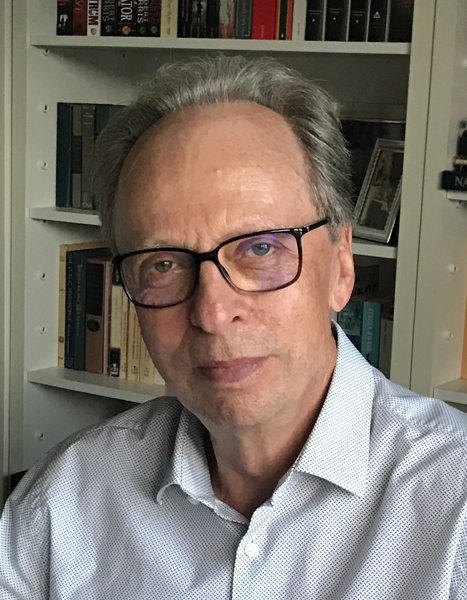
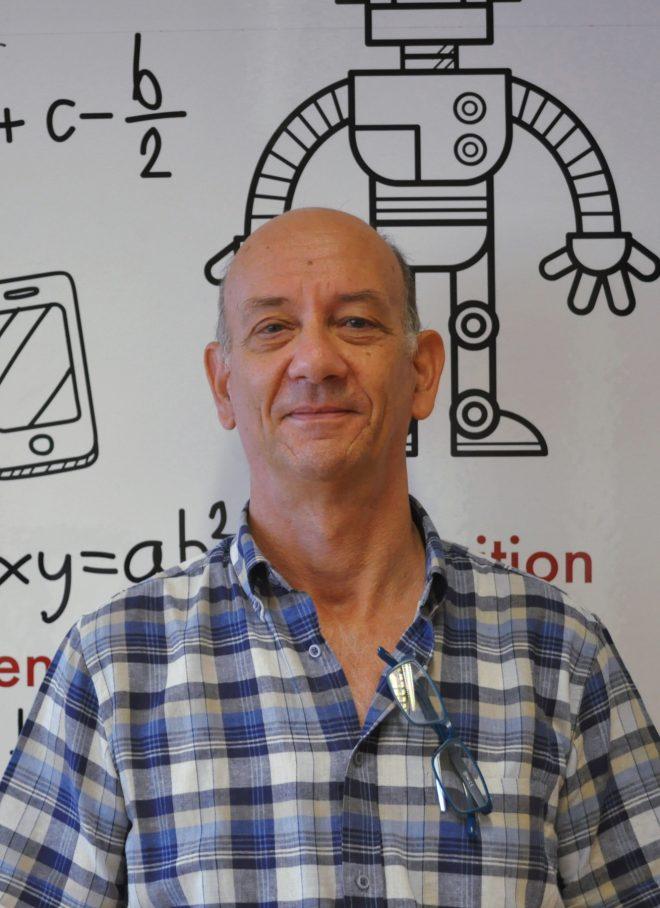
David Gabai is the Hughes-Rogers Professor of Mathematics at Princeton University's Department of Mathematics. His research focuses on topology, hyperbolic geometry, and low-dimensional topology, particularly in the study of 3-manifolds and knot theory. He has collaborated extensively with leading researchers in the field, addressing foundational questions in geometric topology and hyperbolic structures. His work explores topics such as Heegaard splittings, ending laminations, hyperbolic volume minimization, and the classification of exceptional 3-manifolds. Recent contributions include advancements in shrinkwrapping techniques, knot covering problems, and the interplay between geometric and topological properties of manifolds. While no specific educational background is detailed in the provided text, his affiliations and publications indicate a deep engagement with geometric topology. Awards and grants are not explicitly listed here. He has advised no listed students in the given data, though his collaborations suggest mentorship in research groups. His research often intersects with geometric structures, manifold decompositions, and topological dynamics, reflecting a commitment to advancing foundational questions in topology and geometry.
Prof. Dr. Wolfgang Steimle is a Professor at the Institute of Mathematics within the Faculty of Mathematics, Natural Sciences and Technology at the University of Augsburg, Germany. He serves as the Erasmus representative for the Institute and is a core member of the Differential Geometry research team, collaborating with Professors Bernhard Hanke and Peter Quast. His office is located in space 3020 (L1) with contact email wolfgang.steimle@math.uni-augsburg.de. Steimle completed his academic training at the University of Münster, earning a diploma (Master's equivalent) in 2007 with thesis "Whitehead-Torsion und Faserungen" and a PhD in 2010 under Tom Farrell and Wolfgang Lück with dissertation "Obstructions to Stably Fibering Manifolds". His research centers on Differential Geometry and Algebraic Topology , with primary focus on manifold classification , automorphisms of manifolds , Algebraic K- and L-theory , and positive scalar curvature . He bridges abstract homotopy theory with geometric applications, particularly through cobordism categories, Waldhausen K-theory, and the assembly map. His work connects higher category theory with classical manifold problems, yielding insights into metric spaces and curvature constraints. Analysis of his recent publications reveals a dominant trend in applying stable infinity-categories to geometric topology, with significant contributions to Hermitian K-theory and the topology of positive scalar curvature metrics. His research consistently integrates algebraic techniques with differential geometric structures, advancing understanding of manifold automorphisms and classification. As an educator, Steimle has taught extensively across all levels, including Bachelor courses in Linear Algebra and Topology, Master lectures in Algebraic Topology and K-Theory, and specialized seminars on Lie Groups, Reflection Groups, and Cobordism Categories. He has supervised doctoral researchers including Georg Frenck, Helge Frerichs, Andreas Huber, and Lukas Schönlinner within the Differential Geometry group.
Tomaso A. Poggio is the Eugene McDermott Professor in the Department of Brain and Cognitive Sciences at the Massachusetts Institute of Technology , an investigator at the McGovern Institute for Brain Research , a member of the Computer Science and Artificial Intelligence Laboratory (CSAIL) , and the director of both the MIT Center for Biological and Computational Learning (CBCL) and the multi-institutional Center for Brains, Minds and Machines (CBMM) . Research Interests Poggio’s research is fundamentally interdisciplinary, sitting at the intersection of computational neuroscience , machine learning , and computer vision . His work is driven by the conviction that learning is the core gateway to both biological intelligence and artificial systems. Current themes include: Mathematical foundations of statistical learning theory Engineering applications in computer vision, graphics, bioinformatics, and intelligent search Computational neuroscience of visual object recognition and the ventral stream of the visual cortex Scientific Awards & Honors Eugene McDermott Professorship, MIT Advising & Grants Over three decades, Poggio has advised a large cohort of doctoral and master’s students whose theses span machine learning, computer vision, neuroscience, and bioinformatics. Representative graduates include H. Jhuang, Stanley Bileschi, Jacob Bouvrie, Jennifer Louie, M. Kouh, Sayan Mukherjee, Ryan Rifkin, Alexander Rakhlin, Thomas Serre, Gene Yeo, and many others. His research has been continuously supported by major federal and private funding initiatives, most recently through the multi-institutional Center for Brains, Minds and Machines (CBMM) headquartered at the McGovern Institute since 2013. Laboratories & Teams Poggio directs the Poggio Lab (CBCL) at MIT, an interdisciplinary group comprising neuroscientists, computer scientists, mathematicians, and engineers. The lab collaborates closely with experimental neuroscientists to develop predictive computational theories of visual cortex function and to translate those insights into practical algorithms for computer vision and machine learning.
Prof. Marc Lackenby is a Professor of Mathematics at the Mathematical Institute, University of Oxford. His research spans topology, geometry, group theory, and their intersections, particularly focusing on low-dimensional topology and geometric algorithms. His editorial roles include serving as an editor for the International Mathematical Research Notices , Groups, Geometry and Dynamics , and the Forum of Mathematics, Pi and Sigma . He was previously an editor for the Journal of Topology (2007–2021) and the Journal of the LMS (2008–2013). Recent publications highlight his work on hyperbolic knots, triangulation complexity of 3-manifolds, and applications of machine learning to topological problems. His research bridges classical geometric topology and modern computational methods. Scientific awards include the LMS Whitehead Prize (2003), EPSRC Advanced Research Fellowship (2004–09), Philip Leverhulme Prize (2006), and the Frontiers of Science Award (2024). He was an invited speaker at the International Congress of Mathematicians (ICM) in 2010.
Byron Boots is the Amazon Professor of Machine Learning in the Paul G. Allen School of Computer Science and Engineering at the University of Washington, where he directs the UW Robot Learning Laboratory. He also serves as a Principal Research Scientist in the Seattle Robotics Lab at NVIDIA Research and co-chairs the IEEE Robotics and Automation Society Technical Committee on Robot Learning. Dr. Boots received his Ph.D. from the Machine Learning Department in the School of Computer Science at Carnegie Mellon University, where he was a member of the Sense, Learn, Act (SELECT) Lab co-directed by Carlos Guestrin and his advisor Geoff Gordon. Prior to joining the University of Washington faculty, he was an Assistant Professor in the School of Interactive Computing within the College of Computing at Georgia Tech, and before that, he completed a post-doc in the Robotics and State Estimation Lab directed by Dieter Fox at the University of Washington. Professor Boots' research focuses on the intersection of machine learning, artificial intelligence, and robotics, with particular emphasis on developing theory and systems that tightly integrate perception, learning, and control. His work spans computer vision, state estimation, localization and mapping, high-speed navigation, motion planning, and robotic manipulation. His group develops algorithms drawing from deep learning and neural networks, nonparametric statistics, graphical models, nonconvex optimization, quantum physics, online learning, reinforcement learning, and optimal control. The research demonstrates a strong theoretical foundation while maintaining practical relevance to real-world robotic systems. His recent publications reveal a clear trend toward integrating advanced machine learning techniques with robotics, particularly in model predictive control, motion planning, and learning-based approaches to robot control. His work shows increasing focus on developing theoretically grounded methods that can handle the complex, nonlinear dynamics of real-world robotic systems while maintaining computational efficiency. The publications span top venues including ICRA, CoRL, IROS, and NeurIPS, demonstrating broad impact across multiple subfields of robotics and AI. Finalist for Best Systems Paper at Conference on Robot Learning (CoRL-2021) Multiple papers selected for oral presentations at top robotics conferences Work recognized for theoretical contributions and practical applications in robot learning As director of the UW Robot Learning Laboratory, Boots leads a vibrant research group focused on fundamental and applied research in robot learning. The lab maintains strong collaborations with NVIDIA Research and has produced numerous high-impact publications that bridge theory and practice. Professor Boots teaches courses in autonomous robotics, machine learning, and reinforcement learning, contributing to both undergraduate and graduate education at the University of Washington.
Natasa Sesum is a Distinguished Professor in the Department of Mathematics at Rutgers University. Her research specializes in geometric flows and partial differential equations, with particular focus on Ricci flow, mean curvature flow, and their applications in geometric analysis. She maintains an active research program investigating singularity formation, ancient solutions, and asymptotic behavior in these flows. Her research explores fundamental aspects of geometric evolution equations, including: Classification of ancient solutions and singularity models Asymptotic behavior of flows on noncompact and singular surfaces Blow-up rates and curvature behavior at singular times Analytical aspects of Ricci and mean curvature flows Professor Sesum teaches across the mathematics curriculum, including undergraduate courses in Multivariable Calculus (Math 251), Linear Algebra (Math 350), Real Analysis (Math 311), and graduate courses on specialized topics in geometric analysis and PDEs (Math 510, Math 519). She has taught honors sections and maintains office hours by appointment.
Professor Celso Grebogi, Sixth Century Chair in Nonlinear & Complex Systems at the University of Aberdeen, is a globally recognized leader in nonlinear dynamics , chaos theory , and systems biology . He founded the Institute for Complex Systems and Mathematical Biology and co-founded the Aberdeen-Lanzhou-Tempe Research Centre. His career spans institutions including University of Maryland, University of São Paulo, and Max-Planck-Society (External Scientific Member since 1998).
Dr. Vahid Hosseini is an Associate Professor and Graduate Program Chair in the School of Sustainable Energy Engineering at Simon Fraser University (SFU). His research focuses on sustainable energy systems, urban air pollution, and clean mobility solutions. He holds a Ph.D. in Mechanical Engineering from the University of Alberta (2008), and M.A.Sc. and B.Eng. degrees from Sharif University of Technology (Iran). His academic roles include leadership in graduate academic programs and engineering education. Key research areas include thermo-fluid systems analysis, vehicle emissions reduction, and urban air quality modeling. He is actively involved in projects addressing real-world driving emissions, emission inventory development, and the impact of cold climates on transportation energy consumption and pollution. Notable contributions include studies on retrofit emission control devices for motorcycles, high-emitter vehicle identification, and policy recommendations for emission reduction. His work integrates experimental methods, computational fluid dynamics (CFD), and machine learning to tackle complex environmental challenges. Teaching interests span thermodynamics, fluid mechanics, and air pollution control engineering. Current courses include SEE 325 D100 Mechanical Design and Finite Element Analysis . Research highlights include collaborations on Tehran’s air quality management, particulate matter (PM2.5) source apportionment, and the development of high-resolution emission inventories. He contributes to international conferences and journals, with a focus on practical solutions for sustainable urban transportation systems.
João Paulo Costeira is an Associate Professor at the Department of Electrical and Computer Engineering, Instituto Superior Técnico (IST), Lisbon. He holds a PhD in Electrical and Computer Engineering from IST (1995) and was a Visiting Scientist at Carnegie Mellon University's Robotics Institute (1991–1995). His research focuses on Computer Vision, 3D Reconstruction, and Structure from Motion, with contributions to object recognition, robotics, and multimedia analysis. Education: PhD in Electrical and Computer Engineering, IST (1995); Visiting Scientist, CMU Robotics Institute (1991–1995). Roles: Coordinator of the Signal and Image Processing Group (SIPg), Co-director of the Carnegie Mellon|Portugal Dual PhD Program in ECE and Robotics (2007–2018), and Scientific Director of Carnegie Mellon|Portugal (2014–2018). Research Interests: João's work emphasizes 3D reconstruction from video, rigid and non-rigid motion analysis, and applications in robotics and urban surveillance. He has pioneered methods for motion segmentation and robust correspondence problems in computer vision. Publications: His recent work includes advancements in apple counting systems, rotation averaging for robotics, and domain adaptation for traffic density estimation. These contributions highlight his expertise in real-world computer vision challenges. Awards: None explicitly listed. However, his extensive publication record and academic leadership reflect significant scholarly impact. Advising & Grants: Supervised 13 PhD students, many co-advised with CMU faculty. Active in projects like CityCam (vehicle counting) and MultiDrone (robotics collaboration). Funded by FCT, EU, and industry partnerships. Labs/Teams: Leader of the Signal and Image Processing Group (SIPg) at ISR. Involved in NETSyS program for networked systems and robotics.
Prof. Vladimir Spokoiny is a leading figure in stochastic algorithms and nonparametric statistics at the Weierstrass Institute for Applied Analysis and Stochastics (WIAS) and Humboldt University of Berlin . His work bridges mathematical statistics with practical applications in finance, medicine, and machine learning. Born in 1959 in Moscow, USSR PhD from Lomonosov Moscow State University (1988) Habilitation from Humboldt University (1996) Head of WIAS research group since 2000 Professor at Humboldt University since 2002 Spokoiny's research focuses on adaptive nonparametric methods, high-dimensional data analysis, and statistical finance. His innovations in local homogeneity testing and propagation-separation methods have advanced volatility modeling, image analysis, and manifold learning. He employs Bayesian optimization frameworks and stochastic control techniques for financial instrument pricing. Recent scientific contributions include generalized bootstrap procedures for Bures-Wasserstein barycenters (2024), dimension-free Laplace approximation bounds (2023), and structure-adaptive manifold estimation (2022). His 19+ PhD students and editorial roles in top journals like The Annals of Statistics demonstrate sustained academic impact. International Statistical Institute member American Statistical Association fellow Institute of Mathematical Statistics member Bernoulli Society member
Adjunct Professor Evgeny Osipov is affiliated with La Trobe University's Business Analytics department. His research spans artificial intelligence, hyperdimensional computing, and neural network architectures. Academic Rank: Adjunct Professor Department: Business Analytics Email: E.Osipov@latrobe.edu.au Research interests include: Hyperdimensional computing and vector symbolic architectures Spiking neural networks and reservoir computing Hardware-efficient AI implementations Causal reasoning in large language models Self-organizing maps and spatiotemporal sequence learning Applications in smart cities and robotic navigation Recent research outputs demonstrate expertise in: Developing unsupervised learning frameworks using hypervectors Optimizing reservoir computing with cellular automata Creating memory-efficient neural network models Advancing hyperdimensional classification techniques Exploring causal graph integration in language models
David Hong is an Assistant Professor in the Department of Electrical and Computer Engineering at the University of Delaware. He holds a PhD from the University of Michigan, where he was an NSF Graduate Research Fellow, and previously served as an NSF Postdoctoral Research Fellow at the University of Pennsylvania. His research focuses on developing robust methods for analyzing heterogeneous and high-dimensional data, particularly through low-rank matrix and tensor techniques. Applications span medical imaging, radar systems, genomics, and astronomy. He emphasizes theoretical guarantees and practical algorithms for signal extraction and inverse problems. Education: PhD in Electrical Engineering and Computer Science (University of Michigan), NSF Postdoctoral Research Fellowship (University of Pennsylvania). Research Interests: Low-rank matrix/tensor methods, heterogeneous data analysis, unsupervised learning, and applications in healthcare, imaging, and sensor systems. His work addresses noise robustness, scalable algorithms, and real-world deployment challenges. Scientific Awards: Recipient of the NSF Postdoctoral Research Fellowship (2020) and NSF Graduate Research Fellowship (2015). Advising & Grants: Advisor to graduate students in machine learning and signal processing (no named advisees listed). Active NSF grant recipient for foundational and applied research in data science. Labs/Teams: Engaged in interdisciplinary collaborations through the University of Delaware's Center for Computational Research and Data Science initiatives.
Mehrtash Tafazzoli Harandi is an Associate Professor in the Department of Electrical and Computer Systems Engineering at Monash University, part of the Faculty of Engineering. His research focuses on machine learning and computer vision, particularly visual data analysis, with contributions to geometric deep learning, continual learning, and medical imaging. He holds editorial roles at IET Computer Vision , Frontiers in Imaging , and Journal of Imaging . Education & Previous Affiliations: Prior to Monash, he worked at NICTA (Canberra & Queensland Research Labs) and CSIRO-Data61. His Erdős number is 4 via a collaboration path through Richard Hartley. Research Interests: His work spans geometric learning, diffusion models, medical image analysis, and sustainable AI applications. Key areas include unlearning mechanisms in AI, 3D reconstruction compression, and robust MRI reconstruction using contrastive learning. Grants & Projects: He leads projects funded by ARC, US Air Force, and industry collaborations, including 'Can Machines Unlearn?' (ARC, A$790k) and 'Exploiting Geometries of Learning' (ARC, A$420k). His work addresses challenges in lifelong learning, model adaptation, and trustworthy AI from limited data. Awards: Recipient of Best Recognition Paper (IEEE DICTA 2013), NICTA Impact Award (2015), and multiple outstanding reviewer recognitions at top conferences. Teaching: Teaches courses on neural networks, computer vision, and advanced data analysis at Monash University. Supervises PhD students with a focus on mathematical and computational proficiency. Labs/Teams: Collaborates with the Australian Center for Robotic Vision (ACRV) and contributes to interdisciplinary projects at CSIRO-Data61. His research group explores cutting-edge AI applications in healthcare, manufacturing, and environmental sustainability.
Sebastian Goette is a Professor at the Mathematical Institute of the University of Freiburg, where he serves in the Department of Pure Mathematics. His office is located in Room 339 at Ernst-Zermelo-Straße 1, D-79104 Freiburg, Germany. He teaches courses including Differential Geometry, Algebraic Topology, and Mathematics, with office hours held on Wednesdays from 13:00 to 14:00. Professor Goette's research interests center on differential geometry, with particular focus on special holonomy, G2-manifolds, scalar curvature, and topological invariants. His work bridges pure mathematics with applications in mathematical physics, particularly in areas related to string theory and gauge theory. He employs advanced techniques from algebraic topology, spectral geometry, and Riemannian geometry to investigate the structure of manifolds and their classification. Analysis of his recent publications reveals a strong emphasis on the geometry and topology of 7-manifolds with special holonomy, particularly G2-structures. His research spans both theoretical developments in invariant theory and concrete classification results for specific manifolds. The work often involves sophisticated interactions between analysis, topology, and geometry, with applications to mathematical physics. Professor Goette is actively involved in multiple research collaborations, including the Simons Collaboration on Special Holonomy in Geometry, Analysis and Physics, the Research Training Group Cohomological Methods in Geometry, and the DFG Priority Programme Geometry at infinity, where he leads project 04 on Secondary invariants of foliations. He is scheduled to take a sabbatical in summer 2025.
Pascal Vincent is an Associate Professor at the Department of Computer Science and Operational Research , University of Montreal, and a key member of the Montreal Institute for Learning Algorithms (MILA) . He holds a PhD in Computer Science from the University of Montreal and has been pivotal in advancing machine learning and artificial perception. Education: PhD in Computer Science (University of Montreal, 2003) His research spans machine learning , deep learning , representation learning , and neural networks , focusing on unsupervised methods and geometrically inspired algorithms. He explores how intelligent systems can autonomously build meaningful representations from raw data, driven by principles like the manifold hypothesis . Key projects include generative stochastic networks , contractive autoencoders , and high-dimensional sequence transduction . His work has resulted in 15+ recent publications in top venues like NIPS, ICML, and CVPR. Scientific Awards : Best student-paper award at ICML 2012 Honorable mention at NIPS 2011 Funded by FCI, FRQNT, CRSNG, CIFAR, and IBM Pascal has supervised 15+ doctoral and Master’s students , including Florian Bordes, Tom Bosc, and Nicolas Boulanger-Lewandowski, across topics like representation learning and generative models . He is also a co-founder of the UNIQUE (Union Neurosciences & Intelligence Artificielle Québec) research consortium.