Antoine Grenier is a researcher in the Department of Electrical Engineering at Tampere University, focusing on Global Navigation Satellite Systems (GNSS), Approximate Computing, and Edge AI. His work spans signal processing, sensor technology, and low-power system design for positioning applications. Developing energy-efficient GNSS receivers using approximate computing Creating benchmarking environments for GNSS algorithms Analyzing ionospheric errors for LEO-PNT solutions Exploring consumer-grade sensors in Android wearables for robust positioning His recent publications (2022-2025) emphasize interdisciplinary applications of GNSS in IoT, edge computing, and satellite-based navigation systems. Collaborations with researchers like Elena-Simona Lohan and Aleksei Ometov highlight his contributions to open-access datasets and algorithm optimization frameworks.
Dr. Faycal Bouhafs is a Senior Lecturer at the School of Systems & Computing , UNSW Canberra . His research focuses on performance and reliability in wireless communication networks, with expertise in programmable networks, 5G/6G architectures, and IoT security. He leads initiatives in radio resource optimization and physical-layer security using software-defined approaches. Research Interests: Dr. Bouhafs investigates: Programmable wireless networks for dynamic resource allocation Beyond 5G/6G infrastructures supporting massive IoT deployments Security frameworks for cyber-physical systems and IoT ecosystems AI-driven optimization of radio access and network management Publication Focus: Recent works (2020-2025) demonstrate strong emphasis on: Software-defined wireless networking (SDWN) for spectrum sharing Physical-layer security via jamming and deep learning 6G resource optimization and IoT scalability Practical implementations using off-the-shelf equipment
Professor Tughrul Arslan holds the Chair of Integrated Electronic Systems at the School of Engineering, University of Edinburgh . He leads the Embedded Wireless and Wearable Sensor Systems (EWireless) Group and co-founded sensewhere Ltd. and Sofant Technologies . His research spans reconfigurable architectures, low-power wireless systems, and biomedical RF sensing. Academic Background: BEng and PhD in Electronics Professional Affiliations: Senior Member IEEE, Fellow IET, Chartered Engineer His work focuses on smart wearable devices , indoor positioning systems , and AI-driven healthcare monitoring . Recent publications emphasize microwave imaging for dementia detection , edge AI accelerators , and non-invasive tremor monitoring . Key contributions include patented technologies like the Reconfigurable Instruction Cell Architecture (RICA) . Award-winning academic, he has supervised over 40 PhD students and authored 400+ peer-reviewed papers. His external roles include Chief Technology Officer at sensewhere , driving commercialization of indoor navigation solutions.
Sreenivasa Reddy Yeduri is a Postdoctoral Fellow at the University of Agder , Department of Information and Communication Technology . He holds a Ph.D. from National Institute of Technology Goa and Indian Institute of Technology Hyderabad (2016-2021) and a Master of Technology from ABV-Indian Institute of Information Technology Gwalior (2014-2016). His research spans Wireless Communications , 5G Networks , UAV-Assisted Communications , Machine Learning , and Cyber-Physical Systems . Key areas include Hybrid Communication Systems , Physical Layer Security , Smart Sensing , and Computer Vision . Recent publications focus on Q-Learning for energy-efficient UAV networks, Deep CNN for hand gesture recognition, Spectrum Cartography , and Small World Network optimization in IoT contexts. Collaborations include IEEE/ACM Transactions, IEEE Sensors Journal, and Pervasive and Mobile Computing. He contributes to the Autonomous and Cyber-Physical Systems (ACPS) research group, integrating UAVs , Edge Computing , and Signal Processing in wireless communication frameworks.
Prof. Dr. Gernot R. Müller-Putz is a leading academic in neural engineering and brain-computer interfaces at the Institute of Neural Engineering , Graz University of Technology , within the Faculty of Computer Science and Biomedical Engineering . He leads both the institute and its associated Laboratory of Brain-Computer Interfaces , driving cutting-edge research in non-invasive neurotechnology and assistive systems. Research Interests: His work spans Brain-Computer Interfaces , EEG signal processing , neurorehabilitation , neuroprosthetics , and cognitive neuroscience . He focuses on decoding motor intentions, sensory feedback restoration, and developing interpretable AI models for neural data. His research bridges engineering, neuroscience, and clinical applications to enhance human-machine interaction and improve quality of life for individuals with disabilities. Recent Research Trends: Analysis of his latest publications (2024–2025) reveals a strong emphasis on EEG-based decoding of gait and reaching movements , cross-subject generalization using deep learning, sensory and proprioceptive restoration in amputees, and cognitive processing in augmented reality . These reflect a cohesive trajectory toward real-world, clinically viable BCI systems with robust and interpretable performance. Scientific Leadership and Editorial Roles: Specialty Chief Editor, Brain-Computer Interfaces , Frontiers in Human Neuroscience Associate Editor, Neuroprosthetics , Frontiers in Neuroscience Review Editor, Health Informatics , Frontiers in Digital Health Topic Editor, Neurophysiological foundations of videoconference fatigue He plays a significant role in shaping discourse in BCI and neural engineering through editorial leadership. Advising and Research Leadership: As head of the Institute of Neural Engineering and the BCI Laboratory, he mentors students and researchers, oversees multiple funded projects, and collaborates internationally. While specific students are not listed, his high publication output and editorial roles suggest active supervision and team leadership. His research is supported by ongoing grants in neural engineering and assistive technologies, though specific funding sources are not detailed here. Laboratories and Teams: Institute of Neural Engineering , Graz University of Technology Laboratory of Brain-Computer Interfaces (affiliated with the institute) These units form a hub for interdisciplinary research in neural signal processing, BCI development, and clinical translation.
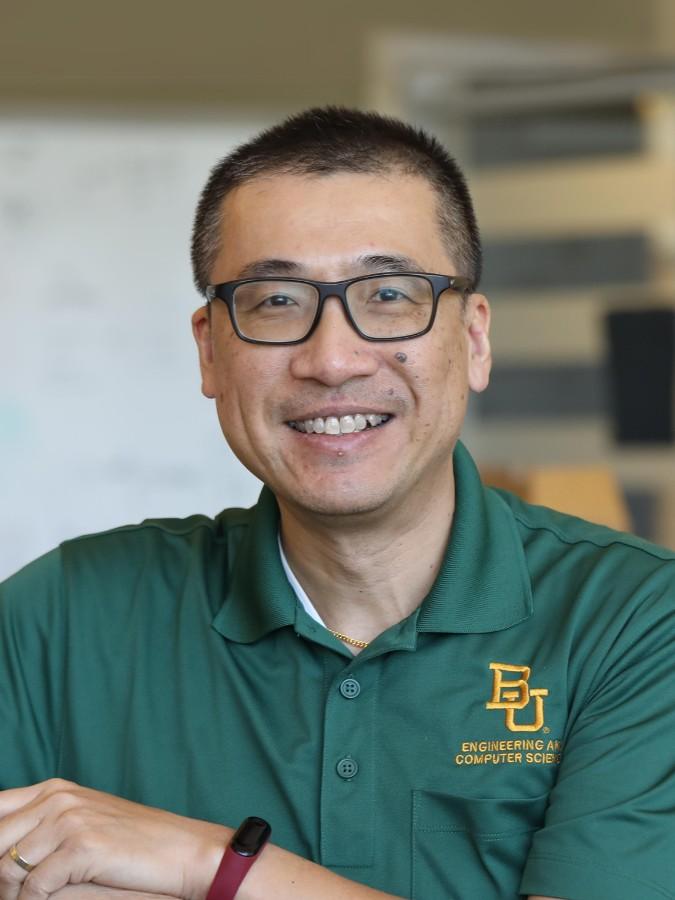
Dr. Vincent Leung is an Associate Professor in the Department of Electrical and Computer Engineering at Baylor University, College of Engineering. He leads the Bio-Electronics and RFIC (BEaR) Lab and maintains active research in neurotechnology and RF/mm-Wave ICs. He also holds concurrent appointments as a Faculty Research Engineer at the Naval Surface Warfare Center (Crane, IN) and as a Visiting Associate Professor at Brown University (Providence, RI). PhD, Electrical and Computer Engineering, University of California, San Diego (2004) M.Eng., Electrical Engineering, McGill University (1997) B.Eng. (Honors), Electrical Engineering, McGill University (1995) Dr. Leung's research focuses on cutting-edge integrated circuit design for biomedical and wireless applications. His work spans RF/mixed-signal ICs , ultra-low-power IoT systems , neural interfaces , and wireless communication electronics for both commercial and military use. He has extensive industry experience from Analog Devices, IBM, Silicon Labs, and Qualcomm, where he led RFIC development for 3G/4G smartphones. His recent publications show a strong trend toward distributed implantable systems and wireless neural interfaces , with high-impact work in Nature Communications and Nature Electronics . These studies emphasize asynchronous wireless networks , energy-efficient power transfer , and machine learning-enhanced circuit design , reflecting a convergence of biomedical engineering, low-power electronics, and AI-driven hardware innovation. Dr. Leung has taught graduate courses in Analog VLSI and RFICs at Columbia University and UCSD. He has co-authored over 50 technical papers and holds 13 U.S. patents. His lab is actively engaged in federally relevant research, particularly through collaboration with the Naval Surface Warfare Center, indicating significant grant and defense-related funding. He mentors students through the BEaR Lab and contributes to interdisciplinary neurotechnology initiatives. The BEaR Lab (Bio-Electronics and RFIC Lab) at Baylor University, led by Dr. Leung, focuses on developing advanced integrated circuits for biomedical and wireless applications. The lab specializes in low-power, high-performance RF and mixed-signal ICs for neurotechnology, IoT, and defense systems, fostering innovation in implantable and distributed sensor networks.
Yanliang Zhang is a Professor and the Advanced Materials and Manufacturing Collegiate Chair in the Department of Aerospace and Mechanical Engineering at the University of Notre Dame's College of Engineering. He directs the Advanced Manufacturing for Energy and Health (AMEH) Lab, where he leads cutting-edge research at the intersection of advanced manufacturing, energy conversion, and healthcare sensing technologies. His educational background includes: Ph.D. in Mechanical Engineering from Rensselaer Polytechnic University (2011) M.S. in Mechanical Engineering from Southeast University, China (2008) B.S. in Mechanical Engineering from Southeast University, China (2005) Professor Zhang's research spans multiple domains with a focus on thermal science and energy conversion . His work centers on developing innovative manufacturing techniques for functional materials and devices, particularly in the areas of thermoelectrics, flexible electronics, and advanced sensing systems. The lab employs an "Atomic to System Engineering" approach to bridge fundamental research with practical applications. Key research thrusts include: Additive manufacturing and scalable nanomanufacturing of functional materials Thermal and thermoelectric energy conversion, harvesting, and storage Advanced sensors for extreme environments and healthcare monitoring Autonomous materials discovery through high-throughput combinatorial methods Analysis of Professor Zhang's recent publications (2024-2025) reveals a strong emphasis on aerosol jet printing , thermoelectric devices , and machine learning-assisted manufacturing . His work demonstrates a progression from fundamental materials research toward integrated systems for energy conversion and healthcare applications. A notable trend is the increasing integration of AI/ML techniques with advanced manufacturing processes to optimize device performance and enable autonomous fabrication. Professor Zhang has received significant recognition for his work, including: International Thermoelectric Society 2020 Young Investigator Award His research program is supported by prestigious funding from the U.S. Department of Energy, National Science Foundation, and industry partners. Professor Zhang actively mentors the next generation of engineers through his laboratory, which includes postdoctoral researchers, PhD students, and undergraduate researchers working on diverse projects spanning from fundamental materials science to applied device engineering. The Advanced Manufacturing for Energy and Health Lab maintains strong collaborative ties with industry and national laboratories, facilitating the translation of research discoveries into practical applications. Current research directions include bioprinting, autonomous manufacturing systems, and next-generation thermoelectric technologies for energy harvesting and cooling applications.
Ignacio Rodriguez Larrad is a researcher at Aalborg University , affiliated with the Department of Electronic Systems under the Technical Faculty of IT and Design . His work focuses on wireless communication engineering, industrial IoT, and path loss modeling. He is currently involved in the 5G-enabled autonomous mobile robotic systems project. Current affiliations: Aalborg University, Spanish Researchers in Denmark (Vice-chairman) Research interests include 5G wireless networks, industrial IoT deployment, real-time locating systems, and antenna engineering. His work addresses practical challenges in factory environments and rural connectivity solutions. Recent publications highlight applications in corrosion mapping, robotic control, and network integration. Key trends involve deep learning for industrial automation, UWB technology, and multi-connectivity frameworks. Scientific Awards : 5G-prisen (2019) - Recognizing 5G research contributions Neal Shepherd Memorial Best Propagation Paper Award (2017) - Radio propagation studies Ignacio has co-supervised PhD research and participated in industry-focused projects. His activities include media engagement and presentations on industrial wireless systems at conferences.
Stephan Sigg is a Professor at Aalto University's Department of Information and Communications Engineering, where he leads the Ambient Intelligence research group . His research focuses on algorithm design for distributed systems, including RF sensing, context-based security, and device-free activity recognition. He serves on editorial boards for Elsevier Journal on Computer Communications and Springer Personal and Ubiquitous Computing , and actively contributes to conferences like IEEE PerCom and ACM Ubicomp. Research Interests: Dr. Sigg specializes in proactive computing, distributed adaptive beamforming, mobile crowdsourcing, and secure spontaneous device pairing. His work bridges wireless communication, machine learning, and ubiquitous systems to develop context-aware solutions for IoT environments. Publication Trends (2019-2025): Recent works demonstrate a strong emphasis on RF-based sensing (WiFi/mmWave radar/RFID) for human activity recognition, 5G-integrated sensing, privacy-preserving AI (federated learning), and healthcare applications. Multimodal approaches combining radar, video, and physiological signals are prominent. Awards: Summa cum laude dissertation honors in Computer Science (2008) VDI-Nordhessen Outstanding Dissertation Prize (2009) Research Leadership: Leads the Ambient Intelligence group exploring RF sensing, edge AI, and human-computer interaction. Collaborates extensively with industry on 5G/6G applications and IoT security. Supervises doctoral candidates in wireless systems and ubiquitous computing.
Sara Ranjbaran is a Visiting Professor at the Department of Computer Science under the Professorship Di Francesco Mario , affiliated with the School of Science . Her research focuses on advancing technologies for sustainable systems through contributions to the UN Sustainable Development Goals (SDGs), particularly in areas like IoT, Digital Twins, and Smart Cities. Research Interests : Internet of Things, Digital Twin architectures, Smart Cities, Distributed Algorithms, Probabilistic Modeling, and Cloud-Edge Computing. Publications : Her work spans 2023–2025, emphasizing efficient resource allocation, truthful mechanisms, and AI-driven solutions for IoT and Digital Twins. Collaborations : Active in external collaborations across Europe, focusing on multi-resource trading, edge computing, and IoE applications.
Muttukrishnan Rajarajan is a Professor at City University of London specializing in cutting-edge cybersecurity research with applications across critical infrastructure sectors. His work bridges theoretical innovation and practical implementation in decentralized systems, with verified institutional affiliation through r.muttukrishnan@city.ac.uk . His research program focuses on: Hardware-based authentication mechanisms exploiting physical device characteristics Privacy-preserving frameworks for healthcare, finance, and IoT ecosystems Blockchain integration for transparent data marketplaces and identity management Security solutions for smart grids, connected vehicles, and agricultural technology Advanced persistent threat mitigation using explainable AI techniques Analysis of his 2023-2025 publications reveals a strategic shift toward real-world deployment challenges, particularly in agriculture 4.0/5.0 security, BritCoin privacy implications, and federated learning for connected vehicles. His work consistently integrates cryptographic primitives with system-level design to address the tension between usability and security in decentralized environments. Professional Recognition: IEEE Senior Member for significant contributions to cybersecurity Professor Rajarajan actively shapes his field through peer review for Computers & Security and development of standardized security frameworks like the Unified Signature API Library. His research demonstrates strong industry relevance with direct applications in open banking security, drone privacy regulations, and smart grid resilience. Current investigations into crystal oscillator impurities for authentication and blockchain-enabled ML model evaluation indicate forward-looking research directions addressing emerging hardware and AI security challenges.
Huber Flores is a Professor in the Department of Computer Science at Aalto University's School of Science, specializing in pervasive computing, mobile sensing, and sustainable technology applications. His research bridges the gap between theoretical computer science and real-world environmental challenges through innovative applications of drone networks, thermal imaging, and AI systems. His research interests focus on Pervasive Computing , Mobile Sensing , Drone Networks , Environmental Monitoring , AI Applications , and Sustainable Computing . Flores develops systems that leverage everyday interactions and low-cost sensing to address environmental sustainability challenges, particularly in plastic pollution monitoring, urban air quality assessment, and resource optimization. His work on thermal dissipation sensing modalities represents a novel approach to human-environment interaction understanding. Analysis of his recent publications shows a strong trend toward integrating large language models with multi-sensor data for context reasoning, while maintaining focus on practical environmental applications. His research consistently addresses scalability challenges in city-scale autonomous drone deployments and sustainable computing through e-waste repurposing. Flores has received no explicitly mentioned scientific awards in the available literature, though his high publication volume in top-tier venues demonstrates significant recognition within the pervasive computing community. His collaborative work spans multiple international institutions, with frequent co-authorship patterns indicating strong connections with Petteri Nurmi, Sasu Tarkoma, Pan Hui, and Mohan Liyanage. His research has secured funding supporting work on drone networks, environmental monitoring systems, and AI robustness frameworks, though specific grant details aren't provided in the source material. Flores leads research on the SPATIAL architecture for AI trustworthiness, LIZARD for plastic litter monitoring, and SEAGULL for underwater plastics analysis, demonstrating his focus on applying computing to pressing environmental challenges through innovative sensing approaches.
Alessio Sacco is a Fixed-term Assistant Professor at the Department of Control and Computer Engineering (DAUIN) at Politecnico di Torino, Italy. He's affiliated with the NETGROUP - Computer Networks Group and actively contributes to research in computer networks, machine learning, and software-defined networking. Current academic position: Assistant Professor Research group: NETGROUP Key collaborations: Guido Marchetto, Flavio Esposito Research Interests focus on: Computer networks and communications Dynamic programming and reinforcement learning Machine learning applications in network management Software-defined networks Cybersecurity and privacy analysis Intelligent Internet of Things systems Recent Publications demonstrate expertise across: Network security verification (PathSafe) AI-driven agricultural optimization (FertilizeSmart) Cross-layer congestion control (Flecto) Reinforcement learning for computing continuum scheduling Explainable AI for network transparency (ClearNET) Multi-agent exploration systems (MARS) Scientific Contributions include: Commercial research on network security and anomaly detection ERC sector expertise in distributed systems and machine learning Teaching in computer engineering programs since 2019 Advising involves: Supervising Federico Rinaudi (ongoing) Co-supervising Doriana Monaco (ongoing)
Professor Jörg Ott holds the Chair for Connected Mobility at Technische Universität München (TUM) in the Faculty of Informatics since August 2015. He is also an Adjunct Professor at Aalto University, where he previously served as Professor for Networking Technology from 2005 through 2015. His academic career includes positions as Assistant Professor at Universität Bremen (1997-2005) and research staff with teaching responsibilities at TU Berlin (1992-1997). His research spans network architectures, protocol design, and networked systems , with current focus areas including network and system architectures, robust networking, mobile networked systems, adaptive real-time communication, and network measurements. He has made significant contributions to delay-tolerant networking, edge computing, and internet protocols. Professor Ott has served the networking community extensively, including as co-chair of IETF working groups (MMUSIC, SIP), co-chair of IRTF DTNRG, Treasurer of ACM SIGCOMM, Vice-chair of IEEE Comsoc TCCC, and General Co-Chair of major conferences including ACM SIGCOMM 2012, ACM MobiSys 2018, and ACM CoNEXT 2021. He is currently chair of the Steering Committee of the ACM CoNEXT conference and member of TUM Ethics Board for non-medical sciences. Best Paper Award at ACM ICN conference (2015) Best Student Paper Award at Packet Video Workshop (2012) Professor Ott has supervised numerous students and researchers, with current members of his research group including Wolfgang Wörndl, Ljubica Kärkkäinen, and Leonardo Tonetto. He has co-founded multiple technology companies including Tellique Kommunikationstechnik GmbH, Lysatiq GmbH, Spacetime Networks Oy, and NeMu Dialogue Systems Oy (callstats.io). His teaching portfolio includes courses on Connected Mobility Basics, Edge Computing and the Internet of Things, and Wireless Internet Communication.
Bengt Oelmann is a Professor of Electrical Engineering at Mid Sweden University, working within the Department of Computer and Electrical Engineering (DET) and affiliated with the STC Research Centre. He holds a PhD in Engineering and is based in Sundsvall. His academic career spans several decades with continuous research output from the 1990s through to 2025. Professor Oelmann's research interests focus on energy harvesting technologies, wireless sensor networks, and instrumentation systems. His work bridges theoretical modeling with practical implementation, particularly in the context of Internet of Things (IoT) applications. He has made significant contributions to variable reluctance energy harvesting, vibration-based power generation, and indoor photovoltaic systems for powering wireless sensors. His research often involves developing self-powered monitoring systems that can operate autonomously in industrial and environmental settings. His publication record shows a clear trend toward increasingly sophisticated embedded systems that integrate machine learning for on-device processing, reducing the need for data transmission and enabling truly autonomous sensor networks. Recent work demonstrates applications in structural health monitoring, agricultural monitoring, and industrial IoT systems. Professor Oelmann collaborates extensively with S. Bader and other researchers across multiple institutions. His work appears in high-impact journals including IEEE Transactions on Instrumentation and Measurement, Sensors, and Applied Energy. His research projects include HydroSense, ASIS (Autonomous Sensors for Industrial Wireless Sensor Networks), and SMART (Smarta system och tjänster för ett effektivt och innovativt samhälle). As an educator, Professor Oelmann has supervised numerous research projects and has contributed to the development of hardware platforms for rapid prototyping of wireless sensor networks (SENTIO). His work bridges the gap between theoretical electrical engineering and practical implementation in real-world monitoring scenarios.