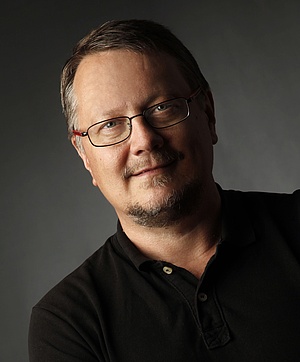
Günter Klambauer is a Professor at the Institute for Machine Learning , Johannes Kepler University Linz, and leads the LIT Artificial Intelligence Lab in Austria. His research bridges artificial intelligence with life sciences , focusing on deep learning applications in retinal imaging , drug discovery , and hydrological modeling . Affiliation: JKU Institute for Machine Learning & LIT Artificial Intelligence Lab Key Research Areas: Medical Imaging AI, Biological Sequence Modeling, Generative Models for Molecules, Time-Series Forecasting His recent publications highlight extended LSTM architectures (xLSTM) for biological sequence modeling, contrastive learning in retinal imaging, and in-context learning for low-data drug discovery. He has pioneered frameworks like TiRex for zero-shot forecasting and LaM-SLidE for spatial dynamical systems. Scientific Awards: Austrian Life Science Award (2012) Award of Excellence (2014) ELLIS Society Scholar (2020) Director, ELLIS Machine Learning for Molecules Discovery Program (2023) Professor Klambauer collaborates extensively on AI-driven biomedical projects , including retinal image analysis and antibody design, while advancing foundational neural network architectures for diverse domains from healthcare to climate modeling.
Dr. Sebastian Schlund is Professor and Head of Research Area Industrial Engineering at TU Wien's Institute of Management Science. Leads research on human-machine interaction, Industry 4.0, cyber-physical assembly systems, and workplace design in industrial environments. Research focuses on production management, human-robot collaboration, and adaptive workplace systems. Key projects include developing assistive technologies for industrial assembly and hybrid cyber-physical learning environments. Recipient of Best Paper Award at 22nd International Production Research Conference Honored in Future Lab Produktionsarbeit 4.0 initiative Teaches courses on production systems, assistive technologies, and industrial engineering. Education includes doctorate in engineering from University of Wuppertal and diploma in transportation from Technical University of Berlin.
Reinhard Neugschwandtner is an Associate Professor at the Institute of Agronomy , University of Natural Resources and Life Sciences, Vienna . His research focuses on sustainable crop production, soil science, and precision agriculture in Pannonian climates. Key projects: Agri-photovoltaic systems, digitalization in agriculture, drought-tolerant legumes, autonomous robotics in crop technology Leadership roles: Project leader in 8+ research initiatives since 2014 Research Interests : Dr. Neugschwandtner specializes in: Soil health and earthworm ecology under different tillage systems Nitrogen dynamics in legume-cereal intercropping systems Digital tools for canopy parameter estimation and precision farming Life cycle assessment of agricultural practices Climate-smart crop management strategies Scientific Awards : Awardee of five prestigious honors including: Kardinal-Innitzer-Förderungspreis (2017) Klaus Fischer Innovationspreis für Technik und Umwelt (2016) Walter-Kubiena-Preis (2008) BISi Award (2003) Publications & Presentations : Over 171 publications and 102 presentations focusing on: Long-term tillage experiments Winter crop adaptation Intercropping efficiency Digital agriculture tools Soil nutrient dynamics
Antonio Rodríguez-Sánchez is an Associate Professor in the Intelligent and Interactive Systems group at the Department of Computer Science, Universität Innsbruck (since 2019). He holds a PhD from York University (2010) and has held academic roles in Austria, Canada, and Spain. His research focuses on Explainable AI, computational neuroscience, deep learning, computer vision, robotics, and medical imaging. Education: PhD in Computer Science, York University (Canada), 2010 M.Sc. in Computer Science, Universidade da Coruña (Spain), 1998 B.Sc. in Computer Science, Universidad de Córdoba (Spain), 1996 3-year Bachelor in Biology, Autonomous University of Madrid (Spain), 1998–2001 Research Interests: His work bridges AI and neuroscience, emphasizing explainable systems, medical imaging analysis, robotics, and deep learning applications. Recent trends in publications highlight advancements in healthcare AI (REM sleep disorder prediction), robotic recycling, and computer vision for environmental monitoring. Teaching & Advising: Teaches courses like Deep Learning, Computer Vision, and Algorithms. Supervises PhD/MSc students (e.g., Safoura Rezapour-Lakani, Sebastian Stabinger). Active in EU-funded projects like PaCMan (FP7-ICT) and IntellAct. Labs & Projects: Leads research in the Intelligent and Interactive Systems group, focusing on interdisciplinary AI applications. Projects include automated avalanche detection and robotic recycling systems.
Stefan Rass is a Professor at the Institute of Networks and Security within the Faculty of Engineering & Natural Sciences at Johannes Kepler University Linz (JKU), where he leads the LIT Secure and Correct Systems Lab. As Principal Investigator for FFG-funded projects including reSilienz (digital supply chain resilience, 2023–2025) and ITPUK (AI signature verification, 2022–2024), he bridges theoretical game theory with practical cybersecurity solutions for critical infrastructures and robotics systems. His research spans game-theoretic security models (patrolling games, defense-in-depth strategies), quantum cryptography (QKD network architectures), and cyber deception frameworks like Honeyquest for measuring honeypot effectiveness. Recent work addresses robotics security benchmarking (RobotPerf), cryptographic instruction chaining for control flow protection, and risk assessment methodologies for interdependent infrastructures. His mathematical decision-making approach integrates bounded rationality and stochastic modeling to solve real-world security challenges. Professor Rass actively shapes the field through program committee roles (ARES 2023), peer reviews, and invited talks on security transparency. His current projects focus on cost-benefit-aware monitoring for cyber-physical systems and quantum key distribution standardization, reflecting Austria’s strategic priorities in digital resilience. The LIT Secure and Correct Systems Lab under his direction develops foundational theories while deploying tools for industrial applications, particularly in critical infrastructure protection and secure robotics workflows.
Franz Wotawa is a Professor of Software Engineering at Graz University of Technology. He holds a M.Sc. (1994) and PhD (1996) from Vienna University of Technology. He has served as head of the Institute for Software Technology from 2003–2009 and since 2020. His research focuses on model-based reasoning, software testing, autonomous systems, and diagnosis, with over 390 peer-reviewed publications. He founded Softnet Austria (2006) to bridge research and industry. He leads the Christian Doppler Laboratory for Quality Assurance Methodologies for Autonomous Cyber-Physical Systems since 2017 and has supervised 90+ master and 36+ PhD students. His awards include the 2016 Lifetime Achievement Award from the International Diagnosis Community. He is a member of Academia Europaea, IEEE, and AAAI. **Education**: M.Sc. in Computer Science, Vienna University of Technology, 1994 PhD, Vienna University of Technology, 1996 **Research Interests**: Model-based reasoning, qualitative reasoning, theorem proving, mobile robotics, verification/validation, software testing/debugging, AI, and autonomous systems. **Notable Projects**: A-IQ Ready (2022–2026): Quantum sensing for autonomous systems. ALFA (2024–2027): AI for smart diagnosis in building automation. Bilateral AI (2024–2029): Combining symbolic and sub-symbolic AI. VARCOS (2025–2028): Vehicle-road cooperative systems for autonomous driving. **Awards & Memberships**: Lifetime Achievement Award (2016, International Diagnosis Community) Senior Member, AAAI Member of Academia Europaea, IEEE, ACM, and Austrian Computer Society **Labs/Teams**: Christian Doppler Laboratory for Quality Assurance Methodologies (since 2017). Active in Cluster of Excellence “Bilateral AI” at TU Graz.
Peter Mohr-Ziak is a researcher affiliated with both the Institute of Computer Graphics and Vision at the University of Technology Graz (TU Graz) and VRVis Forschungs GmbH. His primary focus areas include Augmented Reality (AR) and Mixed Reality (MR) systems, specifically in the domains of AR visualization, content generation for AR, and head-mounted display (HMD) technologies. He is actively involved in projects with AVL List GmbH in addition to his academic research. Academic Rank: Researcher at TU Graz Education: Telematics, TU Graz Peter's research interests center on creating interactive AR systems with applications in industrial assembly, remote assistance, and education. His work spans technical aspects of AR visualization and practical implementations for skill training (e.g., guitar tutorials) and complex tasks like maxillofacial surgery. He investigates spatial rendering techniques, adaptive perspective models, and light field applications in mixed reality environments. Recent research trends include: 2024: Expanding into human-robot interaction and AR affordance templates 2023: Developing interactive guitar tutorials and state-aware configuration detection systems 2022: Advancing focus cues in video see-through MR and assembly instruction authoring 2019-2020: Improving HMD interaction with TrackCap and light field remote assistance 2017: Creating adaptive perspective rendering and video tutorial retargeting systems Scientific recognition includes: 2021: ISMAR Best Conference Paper 2017: CHI Best Paper Honorable Mention He contributes to projects at TU Graz's Institute of Computer Graphics and Vision, including collaborations with VRVis Forschungs GmbH and AVL List GmbH, while maintaining personal interests in photography and drone flying.
Prof. Elmar Rueckert is the Chair of the Cyber-Physical-Systems Institute at Montanuniversität Leoben in Austria since March 2021. He holds a PhD in Computer Science from TU Graz (2014) and previously served as a Senior Researcher at TU Darmstadt (2014–2018) and Assistant Professor at the University of Lübeck (2018–2021). His research focuses on Cyber-Physical Systems, Robotics, Machine Learning, and Human Motor Control, with applications in industrial automation, healthcare robotics, and environmental sustainability. Key research interests include stochastic machine/deep learning, reinforcement learning, brain-computer interfaces, and tactile learning. His work bridges robotics, neuroscience, and AI, emphasizing practical applications such as autonomous navigation, exoskeleton control, and sensor-based recycling technologies. Rueckert has led projects like the AI Robot Lab funded by Robert Bosch Stiftung and the KIRAMET recycling initiative. Recent publications highlight advancements in neural networks for industrial condition monitoring, multimodal robotic learning, and environmental infrastructure modeling. Awards include the German Young Researcher Award (2019) and the Advanced Robotics Best Paper Award (2018). Rueckert advises a team of researchers, including notable students like Daniel Tanneberg (PhD graduate, 2019) and Linus Nwankwo (best student paper winner, 2023). His lab develops open-source tools like ROMR and collaborates on datasets like EnvoDat for robotic spatial reasoning.
Andreas Brandstätter is a PostDoc Researcher in the Cyber-Physical Systems department at TU Wien. His work focuses on multi-agent systems, autonomous robotics, and control theory with applications to drone flocking and autonomous racing. He is affiliated with the Scuderia Segfault team, TU Wien’s autonomous F1TENTH racing group. His research emphasizes distributed control mechanisms and sensor-based coordination in robotic systems. Education: Completed a Diploma Thesis (2019) on local positioning systems for quadcopters at TU Wien. Research Interests: Developing algorithms for multi-agent coordination, predictive control in autonomous vehicles, and leveraging sensor networks for real-time system adaptation. His work intersects robotics, machine learning, and formal methods in control systems. Publications (Selected): 5 peer-reviewed articles in top robotics venues (ICRA, ISoLA) since 2019, focusing on flock formation, predictive control, and autonomous systems. Advising: Supervised a 2024 diploma thesis on coordinated ground-aerial vehicle control. Labs/Teams: Active contributor to Scuderia Segfault, advancing autonomous racing and real-world robotics applications.
Ramin Hasani is a researcher at TU Wien's Cyber-Physical Systems department. He holds a Dr.techn. (Doctor of Engineering) and specializes in machine learning applications for robotics, control systems, and biologically-inspired neural networks. His work focuses on developing interpretable neural architectures like Liquid Time-Constant Networks and Neural Circuit Policies, emphasizing safety and stability in autonomous systems. Hasani's research bridges neural network theory with practical robotics challenges, including autonomous racing, medical data analysis, and adversarial robustness. Key research areas include continuous-time neural networks, formal verification of neural ODEs, and bio-inspired control mechanisms derived from biological neural circuits (e.g., Caenorhabditis elegans). He collaborates extensively with institutions like MIT and ETH Zurich, contributing to projects in health-monitoring systems and end-to-end robot learning frameworks. His publications consistently address real-world challenges such as sepsis prediction via reinforcement learning and robust CNN architectures for image classification. Recent work highlights include developing stable recurrent networks through Gershgorin loss functions and advancing zero-shot transfer learning for autonomous systems. Hasani's interdisciplinary approach integrates principles from neuroscience, control theory, and machine learning to create auditable, high-performance AI solutions for cyber-physical environments.
Ronald Ortner is a Professor and Chair of Information Technology, leading research in reinforcement learning, Markov decision processes, and computational learning theory. His work emphasizes theoretical foundations and practical applications in autonomous systems and optimization. He has published extensively since 2004, with notable contributions to bandit algorithms, regret analysis, and exploration strategies in dynamic environments. Research Focus: Reinforcement Learning, Markov Processes, Optimization Key Contributions: Regret bounds in MDPs, adaptive algorithms, transfer learning quantification Ortner engages in academic activities such as conference presentations and peer reviews, focusing on advancing algorithmic approaches in AI and machine learning. His research spans interdisciplinary areas including robotics, energy systems, and probabilistic modeling.
Stefan Rass is a full Professor at Alpen-Adria-Universität Klagenfurt (AAU), with additional affiliation at Johannes Kepler University Linz (JKU). He holds the academic title Univ.-Prof. (Universitätsprofessor) and possesses advanced degrees including PD (Privatdozent), Dipl.-Ing. (Diplom-Ingenieur), and Dr. (Doctor). His research spans multiple institutions and projects, with a focus on security and risk management through game theory applications. Professor Rass's research interests center around Security and Risk Management, Decision and Game Theory for Security, Security Infrastructures (including Key Distribution and Management, PKI, and Authentication), Unconditional and network security, Applied Quantum Cryptography, and Complexity Theory and Statistics in Security. His work bridges theoretical computer science with practical security applications, particularly in quantum networks and critical infrastructure protection. His recent publications demonstrate a strong trend toward interdisciplinary security research, combining game theory with quantum cryptography, robotics security, and AI-powered penetration testing. The articles reveal increasing focus on practical applications of theoretical security concepts, with notable work in quantum networks, deniable encryption techniques, robotics security benchmarking, and AI-assisted security testing. His research shows consistent evolution from theoretical foundations toward real-world implementation challenges. Professor Rass leads multiple ongoing research projects including Machine Learning for Risk Management, Safe and Secure Robotic Systems Engineering (SEEROSE), Simulation and analysis of critical network infrastructures in cities (ODYSSEUS), and security for cyber-physical value networks Exploiting smaRt Grid systems (synERGY). These projects, primarily funded by FFG (Austrian Research Promotion Agency), demonstrate his leadership in securing critical infrastructure and developing next-generation security frameworks.
Jasmin Wachter is a Researcher at the Institute for Artificial Intelligence and Cybersecurity at Alpen-Adria-Universität Klagenfurt. Her work focuses on interdisciplinary research at the intersection of cybersecurity, machine learning, and game theory. She holds a Diplom-Ingenieur (Dr.) and dual undergraduate degrees (BSc, BA), reflecting her multidisciplinary background. Her research interests span critical areas such as IT security, data science, cryptology, and risk management. She contributes to advancing methodologies for secure systems, adversarial modeling in cybersecurity, and ethical AI frameworks. Her recent publications highlight innovations in attack graph modeling, security game theory applications, and human-robot collaboration safety protocols. While currently affiliated with the Faculty of Technical Sciences, her work emphasizes both foundational research and practical solutions for modern cybersecurity challenges. She is actively involved in the institute's research initiatives, though no specific awards or student advisement roles are documented in the provided materials.
Ezio Bartocci is a Full Professor in Formal Methods for Cyber-Physical Systems Engineering at TU Wien's Faculty of Computer Science. He leads the Trustworthy Cyber-Physical Systems (TrustCPS) Group within the Cyber-Physical System Research Unit. His research focuses on formal verification, probabilistic systems, and runtime monitoring, with applications in autonomous systems, safety-critical software, and embedded systems. Roles & Affiliations: Full Professor, TU Wien (100% research focus) Principal Investigator in projects funded by EU, WWTF, FFG, and industry partners Chair of the Curriculum Commission for Computer Engineering Editor-in-Chief of the Formal Methods in Outer Space series Research Interests: Formal methods for CPS: verification, synthesis, and runtime monitoring Probabilistic programming and loop analysis Temporal logic specifications and mining Automated tools for safety-critical systems (e.g., Polar, MoonLight) Applications in healthcare, robotics, and autonomous vehicles Key Projects: ProbInG (2020–2025): Analyzing probabilistic loops ARTIST (2021–2026): AI and robotics safety EdgeAI (2022–2025): Optimizing embedded processing TAIGER (2023–2027): Trustworthy AI and CPS Grants & Funding: €10M+ secured from EU Horizon 2020, WWTF, FFG, and industry partners like TTTech Auto AG. Academic Leadership: Teaches courses on logical methods, CPS engineering, and scientific research at TU Wien. Supervises PhD students in formal methods and CPS domains. Tools Developed: Polar (probabilistic loop analyzer), MoonLight (spatio-temporal monitoring), and FIM (fault injection tool).
Andrea M. Tonello is a Full Professor at the Institute of Networked and Embedded Systems, University of Klagenfurt, Austria, where he chairs the Embedded Communication Systems Lab. He previously held positions at the University of Udine, Italy, where he was an Associate Professor and founded the Wireless and Power Line Communication Lab (WiPLi Lab). His research spans power line communications, wireless systems, embedded communications, smart grids, and machine learning applications in signal processing. Doctor of Engineering, University of Padova (1996) Doctor of Research, Telecommunications, University of Padova (2003) His research interests focus on next-generation communication systems, including power line and wireless networks, signal processing, machine learning for communications, UAV systems, and smart grid technologies. He has made significant contributions to PLC channel modeling, full-duplex communications, and information-theoretic learning for communication systems. His work integrates theoretical innovation with practical implementation in real-world networks. The most recent publications highlight a strong trend toward integrating machine learning and information theory into communication systems, particularly in power line and wireless networks. Themes include f-divergence based classification, mutual information estimation, neural decoding (MIND), noise-robust receivers, and topology-aware machine learning for PLC quality prediction. There is also a notable focus on UAV control, full-duplex PLC, and digital pre-distortion techniques for high-speed converters. IET 2016 Premium Award Best Paper Award, ISPLC 2016 Best Student Paper Award, ISPLC 2016 Aerospace Best Paper Award, 2018 Best Paper Award, ISPLC 2021 Best PhD Dissertation Award, 2019 IEEE ComSoc Distinguished Lecturer (2018) Two Awards from IEEE ComSoc TC-PLC (2019) University of Klagenfurt Technology Scholarships (2019) Dr. Tonello has supervised numerous PhD and Master’s students, including notable advisees such as Nunzio A. Letizia, Davide Righini, and Babak Salamat. He has led over 10 institutional and multiple industrial research projects with a total funding exceeding 20 million euros. He played a key role in promoting international academic collaboration, including Erasmus agreements, joint PhD programs with INSA Rennes and Ecole Polytechnique de Grenoble, and a joint master’s program with the University of Klagenfurt. He founded and led the WiPLi Lab at the University of Udine, which received around 3 million euros in funding and involved over 60 researchers and students. He also founded WiTiKee s.r.l., a spin-off company specializing in PLC for smart grids. Currently, he chairs the Embedded Communication Systems Lab at the University of Klagenfurt, focusing on next-generation networked and embedded communication technologies.