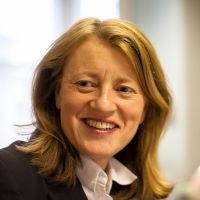
Helen Margetts is a Professor of Society and the Internet at the Oxford Internet Institute (University of Oxford) and a Professorial Fellow at Mansfield College. She specializes in digital technology's impact on governance, public policy, and political behavior. Her research bridges political science, computational social science, and policy analysis. Margetts leads the Public Policy Programme at the Alan Turing Institute, focusing on data science and AI applications in policy-making. Education: BSc in Mathematics, University of Bristol MSc in Politics and Public Policy, LSE (1990) PhD in Government, LSE (1996) Research Interests: Role of social media in collective action Ethical use of AI in government Policy implications of data science Electoral systems and political extremism Awards: Fellow of the British Academy (2019) OBE (2019) Friedrich Schiedel Prize (2018) W.J.Mckenzie Prize (2017) Advising & Grants: Supervised doctoral students including Thomas Vogl and Bertie Vidgen. Led major research initiatives like the Alan Turing Institute's Public Policy Programme involving 60 researchers across 10 universities. Labs/Teams: Director of the Public Policy Programme at the Alan Turing Institute, leading projects on hate speech, social information, and criminal justice AI applications.
Maarten de Rijke is a Professor at the University of Amsterdam's Informatics Institute, leading the Information Retrieval Lab (IRLab). He specializes in information retrieval, machine learning, and recommendation systems, focusing on neural ranking models, fairness, and conversational search. His work bridges theory and practice, addressing challenges in reproducibility, robustness, and ethical AI. He supervises numerous PhD students and postdocs, including recent defenses by Barrie Kersbergen, Antonis Krasakis, and Vera Provatorova. His lab collaborates internationally, organizing events like SIGIR workshops and the Search Engines Amsterdam (SEA) meetup. Key awards include the Best Reproducibility Paper Award (2025) and Best Paper at WSDM 2021. Research interests span generative retrieval, adversarial robustness, and fairness in ranking. Notable projects include the FULTR dataset, FairDiverse toolkit, and studies on empathetic conversational systems. He actively promotes open science through reproducible methodologies and community-driven benchmarks.
Lori L. Holt is a Professor of Psychology at the University of Texas at Austin (UT-Austin), where she leads the Holt Lab. Previously, she served as faculty at Carnegie Mellon University (1999–2023), contributing to the Center for the Neural Basis of Cognition. Her research focuses on auditory cognitive neuroscience, exploring how learning, attention, and neural mechanisms shape speech perception and communication. She holds a BS and PhD in Psychology from the University of Wisconsin-Madison (1995, 1999). Her work investigates the neural foundations of listening, emphasizing adaptive plasticity in speech perception, statistical learning dynamics, and the interplay between sensory input and cognitive processes. Recent studies examine how short-term sound statistics influence perceptual weighting, the impact of accent exposure on speech production, and neural correlates of auditory category learning. The Holt Lab, equipped with EEG facilities, advances understanding of voice perception, speech motor control, and neurocognitive adaptation. Dr. Holt teaches courses such as Behavioral Neuroscience (PSY 332) and Biopsychology (PSY 308), reflecting her expertise in linking biological mechanisms to psychological processes. Her research has been published in leading journals, with a focus on auditory neuroscience, statistical learning, and neurorehabilitation.
Kevin Vinsen is a Senior Research Fellow at the University of Western Australia, working in the Data Intensive Astronomy (DIA) Program of the International Centre for Radio Astronomy Research (ICRAR) since 2009. He is also affiliated with the UWA Defence and Security Institute and holds an ORCID ID of 0000-0001-5332-3784. His work focuses on translating ICRAR software capabilities into practical industry applications across diverse domains. His research interests include: Peta-scale systems High-performance Computing Machine Learning applications in multiple fields Wave and weather forecasting Digital Assistive Technologies Agricultural applications of ML Large language models Vinsen heads the Translation and Impact work of the DIA team and leads the development of Machine Learning systems. His current projects include ML for wave forecasting on the NW shelf, wind and temperature forecasting, honey traceability and provenance, and digital assistive technology for people with disabilities. His work contributes to UN Sustainable Development Goals related to industry, oceans, agriculture, food, disability, and defense. His research output demonstrates a strong trend toward applying machine learning techniques to solve real-world problems across astronomy, environmental science, agriculture, and disability support. This interdisciplinary approach showcases the versatility of his computational expertise across scientific and social domains. Vinsen has an h-index of 11 with 621 citations across 33 research outputs. As the ICRAR/UWA Summer Studentship Co-ordinator, he mentors emerging researchers and contributes to building research capacity. His collaborative network spans multiple institutions and research areas, reflecting his ability to bridge academic research with practical applications.
Rafał Biedrzycki is an Assistant Professor at The Institute of Computer Science within Warsaw University of Technology's Faculty of Electronics and Information Technology. His research focuses on optimization algorithms, evolutionary computation, and machine learning applications. He holds a PhD in Information Science (2009) and a D.Sc. (2024). Key research interests include evolutionary algorithms (e.g., Differential Evolution, CMA-ES), optimization techniques for real-world problems (e.g., compressor scheduling, optical networks), and algorithm benchmarking. He has contributed to improving constraint-handling methods and hybrid algorithm designs. Received team awards for scientific achievements from Warsaw University of Technology (2019, 2023) and teaching excellence (2021, 2024). Active in interdisciplinary projects, including the DAFNE initiative for data fusion systems (2010-2011). Supervises research in optimization, machine learning, and computational electromagnetics. His work bridges theoretical algorithm development with practical applications in engineering and data analysis. Recent efforts include analysis of CEC competition algorithms and parameter-tuning methodologies.
David Caldwell is an Associate Professor at the School of Education within UniSA Education Futures at the University of South Australia. His research focuses on transdisciplinary learning, particularly in the context of ecojustice and place-based education. He co-led the Fresh Water Literacies project, funded by UniSA's Research Themes Investment Scheme, which developed interdisciplinary curricula to address sustainability and ecological literacy in primary education. His work often bridges education, environmental science, and social semiotics. Key contributions include publications on pre-service teacher training, linguistic analysis in sports discourse, and innovative pedagogical approaches in diverse educational settings. He collaborates with regional organizations like Natural Resources Management (NRM) and emphasizes collaborative, transdisciplinary research. His recent work explores NLP applications in creativity assessment and the role of language in shaping cultural identities. David also serves as a Research Degree Supervisor, contributing to the academic development of emerging scholars in education and linguistics. His research highlights intersections between education, ecology, and cultural systems, aiming to foster socially just and scientifically literate communities.
Sagar Samtani is an Associate Professor and Weimer Faculty Fellow at the Kelley School of Business , Indiana University. He serves as Director of the Kelley’s Data Science and Artificial Intelligence Lab (DSAIL) . His research focuses on Artificial Intelligence for Cybersecurity , including cyber threat intelligence, deep learning, and dark web analytics. He holds a PhD from the University of Arizona (2018), and has received prestigious awards such as the Indiana University Outstanding Junior Faculty Award (2023) and IEEE Big Data Security Junior Research Award (2023). Education : PhD in Information Systems, University of Arizona, 2018 MSMIS, University of Arizona, 2014 BSBA, University of Arizona, 2013 Research Interests : Samtani’s work addresses cybersecurity challenges through AI, including proactive threat detection, vulnerability assessment, and healthcare analytics. He emphasizes explainable AI (XAI) for transparency in cybersecurity systems. Grants & Awards : NSF Grant: CyberCorps SFS Program ($2.3M, 2020–2025) NSF Grant: AI4Cyber Research Education ($300K, 2020–2022) Multiple teaching awards, including the Trustees Teaching Award (2023) and recognition as one of Top 50 Undergraduate Professors (2022) Labs & Teams : Leads the DSAIL lab, focusing on AI-driven solutions for business and cybersecurity. Collaborates with NSF-funded initiatives on cyber AI education and threat intelligence.
Simon David Goldstein is an Associate Professor at the Dianoia Institute of Philosophy within the Faculty of Theology and Philosophy. His research focuses on epistemic logic, formal epistemology, philosophy of language, and AI ethics. He explores topics such as knowledge norms, epistemic modalities, and ethical implications of AI systems. Research Interests: AI Ethics: Examining AI safety, deception, and existential risks Epistemic Logic: Investigating knowledge fragility, contextualism, and modal credence Philosophy of Language: Analyzing dynamic semantics and attitude reports Formal Epistemology: Probability and modal reasoning in epistemic contexts Recent Work Trends: Recent publications emphasize interdisciplinary approaches to AI ethics, integrating technical AI challenges with philosophical frameworks. His work on epistemic modals and contextualism bridges semantics and epistemology. Advising & Grants: No specific grants or advisees listed. Active in collaborative research with institutions like the Dianoia Institute. Labs/Teams: Affiliated with the Dianoia Institute's research groups on ethics and epistemology.
Maxime CORDY is a Research Scientist at the Interdisciplinary Centre for Security, Reliability and Trust (SnT) , University of Luxembourg, within the Security, Design and Validation group (SerVal) . He holds a PhD from the University of Namur (Belgium, 2014) and specializes in software engineering, applied artificial intelligence, and cybersecurity. His work focuses on adversarial machine learning, deep learning robustness, and model checking for critical systems. Research interests include adversarial attacks on tabular data , energy system optimization , code understanding models , and software quality assurance . Recent projects address challenges in secure AI deployment, automated test generation, and fault detection in large language models. Publications emphasize empirical studies on adversarial defenses, data augmentation for code models, and energy consumption forecasting. He contributes to tools like Daedalux (variability-aware model checking) and benchmarks like Tabularbench for adversarial robustness evaluation. Current affiliations include leadership within the SerVal group and collaborations on interdisciplinary projects such as MALETSQUE (Machine Learning Techniques for Software Quality Evaluation). His work bridges theoretical computer science with practical applications in energy systems, medical imaging, and space program design.
Torsten Steinhoff is a Professor of Didactics of the German Language at the Department of Germanic Studies, University of Siegen, Faculty of Arts and Humanities. His research and teaching focus on theoretical, methodological, and empirical aspects of language acquisition and instruction from elementary to university levels. His primary research interests include: Writing didactics (Schreibdidaktik) Vocabulary didactics (Wortschatzdidaktik) Language-specific and disciplinary learning (Sprache im Fach) Digital communication and AI in education Development of complex learning arrangements (Lernarrangements) Steinhoff investigates how digital tools like ChatGPT can be integrated into writing instruction, promoting argumentative writing through structured learning tasks. His recent work (2023–2025) analyzes human-AI collaboration in writing, proposing models such as GPT as Ghost, Partner, or Tutor. He emphasizes a post-digital didactic approach, balancing traditional literacy with digital competencies. His publications reflect a strong trend in digital transformation of writing, multilingual education, and empirical interventions in secondary classrooms. He leads research projects funded by BMBF and MKW NRW, including the "AI Writing Arrangements" project tested in 8th-grade classes. Scientific contributions and collaborations: Co-editor of research handbooks on empirical writing didactics Collaborator with scholars like Nicole Marx, Katrin Lehnen, and Joachim Grabowski Active contributor to journals such as Didaktik Deutsch , BiSS-Journal , and Waxmann publications Hosts a research team at lernarrangements.de He advises on academic language development, text procedures, and vocabulary transfer across modalities and subjects. His lab develops open educational resources (OER) for digital writing and communication, contributing to platforms like Twillo.
Timothy Baldwin is a Professor at the University of Melbourne, School of Computing and Information Systems, with additional affiliation at Mohamed bin Zayed University of Artificial Intelligence in UAE. His research spans natural language processing, large language models, and multilingual AI systems. His research interests focus on the safety, reliability, and ethical aspects of large language models. He investigates bias evaluation and debiasing techniques, uncertainty quantification methods, fact-checking systems, and multilingual model safety. His work addresses critical challenges in making AI systems more transparent, reliable, and culturally aware, with particular attention to low-resource languages and cross-cultural differences. Baldwin's recent publications demonstrate a strong focus on evaluating and improving the safety of language models across diverse linguistic contexts, developing tools for fact verification, and understanding the internal mechanisms of large language models. His research shows increasing emphasis on practical applications with real-world impact, particularly in multilingual settings and safety-critical domains. His scientific contributions include foundational work on multilingual NLP, bias mitigation techniques, and frameworks for evaluating LLM safety across different cultural contexts. His research has been published in top-tier venues including ACL, NAACL, EMNLP, and ICLR. Baldwin actively mentors students and junior researchers, with frequent collaborations with Haonan Li, Xudong Han, and Fajri Koto, among others. His research group appears to focus on practical applications of NLP with strong ethical considerations, particularly regarding model safety and cultural sensitivity.
Dame Til Wykes is a Clinical Professor at King’s College London, leading the School of Mental Health & Psychological Sciences and the Service User Research Enterprise (SURE) . Her work focuses on psychological treatments for schizophrenia , cognitive remediation therapy , and digital mental health services , with international impact on research strategies through projects like European ROAMER and UK Mental Health Research Goals . Education : PhD (University of Sussex), MPhil (King’s College London), BSc (University of Nottingham) Leadership : Head of School (2020–present), Co-Director of SURE, NIHR Maudsley BRC Cluster Lead Research Themes : • Cognitive Remediation Therapy for schizophrenia and psychosis • Digital Mental Health Tools (RADAR-CNS, CIRCuiTS™ software) • Service User Involvement in research design and implementation • Ward Design and Therapeutic Environments in psychiatric inpatient care Selected Scientific Awards : British Psychological Society (2014) GUINNESS WORLD RECORD for Largest Mental Health Lesson Damehood from the Queen (2016) EPA Outstanding Achievement Award SIRS Lifetime Achievement Award (2024) Leadership and Collaborations : President of the Schizophrenia International Research Society (SIRS), Fellow of multiple academies (Medical Sciences, Social Sciences), and Trustee of Weight Concern. She co-leads projects like ECLIPSE and MEMReD , and has contributed to 17 Pharmacological and Psychosocial Treatments in Schizophrenia (3rd ed.).
Farhad Javanmardi is a Researcher at Aalto University within the Department of Information and Communications Engineering. His work focuses on applying advanced computational methods to speech and biomedical signal analysis. Research Interests: Speech processing, voice disorders, machine learning, deep learning, biomedical signal processing, computational linguistics, and health informatics. His recent research trends emphasize the use of transformer-based models and wav2vec2 for robust detection of heart failure and voice pathologies in telephony environments. He investigates database-independent approaches, severity classification, and data augmentation techniques to improve model generalizability. Publications appear in journals like Speech Communication and Computer Speech and Language , as well as conferences including ICASSP and INTERSPEECH .
Li Nguyen is an Assistant Professor of Linguistics and Multilingual Studies at Nanyang Technological University (NTU), Singapore . Their work bridges linguistics with computational approaches, focusing on language variation, contact phenomena, and multilingual NLP. Education: PhD in Linguistics (University of Cambridge), Master’s in General and Applied Linguistics (Australian National University) Research interests include: Language variation and change in multilingual/diasporic communities Computational sociolinguistics and NLP for low-resource varieties Syntax-pragmatic interface in bicultural contexts Code-switching and heritage language documentation Recent publications highlight collaborations on Vietnamese-English and other code-switched language pairs, with a focus on NLP applications and corpus-based analysis. Their work has gained recognition through grants like the NTU Start-up Grant and Cambridge Language Sciences funding . Scientific awards: Cambridge International Scholarship, Philological Society Fieldwork Grant Li Nguyen actively collaborates on projects involving sociolinguistically informed NLP and community-driven language documentation. They have contributed to the development of the CanVEC corpus for Vietnamese-English speech research.
Marta Halina is a University Associate Professor in the Philosophy of Cognitive Science at the University of Cambridge, affiliated with the Department of History and Philosophy of Science. She serves as a Senior Research Fellow at the Leverhulme Centre for the Future of Intelligence and is a Fellow of Selwyn College. Her academic journey began with a PhD in Philosophy and Science Studies from the University of California, San Diego in 2013, followed by a McDonnell Postdoctoral Fellowship in the Philosophy-Neuroscience-Psychology Program at Washington University in St. Louis before joining Cambridge in 2014. Halina's educational background includes a PhD from UC San Diego (2013) and postdoctoral training at Washington University in St. Louis. Her academic trajectory reflects a strong interdisciplinary foundation bridging philosophy, cognitive science, and neuroscience. Her research focuses on nonhuman animal cognition, mechanistic explanation, and artificial intelligence, with particular emphasis on comparative cognition and the philosophical foundations of cognitive science. Halina investigates how researchers design studies to address complex questions about animal minds, arguing that current methods in comparative cognition often face challenges with hypothesis underdetermination by empirical evidence. She advocates for additional behavioral constraints on theorizing, known as 'signature testing,' while emphasizing the need to incorporate neuroscience and biology more substantially into animal cognition research. Her work on major transitions in cognitive evolution proposes treating the evolution of cognition as a series of major evolutionary transitions to better comprehend cognitive complexity across species. Analysis of Halina's recent publications reveals a clear trajectory toward computational comparative cognition. Her work increasingly integrates AI and machine learning techniques with traditional comparative cognition approaches, exemplified by her development of the Animal-AI Testbed. This platform allows for direct comparison between AI systems, humans, and animals on cognitive tasks, revealing that while AI and children perform similarly on basic navigational tasks, children outperform AI on more complex cognitive tests requiring object permanence. Her research demonstrates how computational modeling can generate novel hypotheses about animal behavior that generate precise, testable predictions beyond what traditional experimental methods alone can achieve. McDonnell Postdoctoral Fellowship Halina directs research initiatives at the Leverhulme Centre for the Future of Intelligence, particularly focusing on the intersection of AI and animal cognition. Her work on the Animal-AI Environment has received significant funding and collaborative support, enabling interdisciplinary research that bridges computer science, cognitive science, and biology. She actively collaborates with researchers across multiple institutions to develop computational frameworks for understanding nonhuman animal cognition. Halina leads significant research initiatives through the Leverhulme Centre for the Future of Intelligence, where she develops the Animal-AI Environment—a research platform for conducting cognitive experiments with artificial agents, humans, and nonhuman animals in directly comparable, ecologically valid contexts. This environment facilitates interdisciplinary collaboration between computer scientists, engineers, biologists, and cognitive scientists, reducing the 'language barrier' between these fields and enabling cross-pollination of ideas and methodologies.