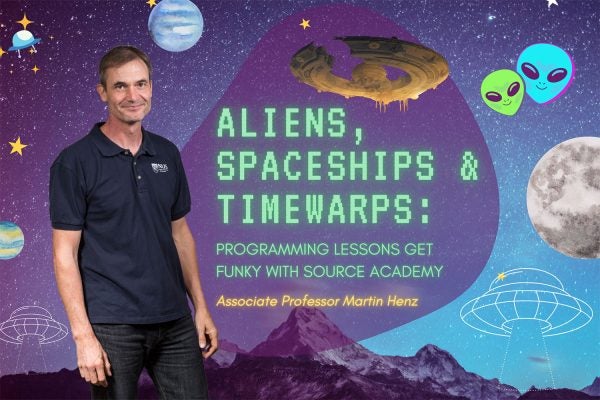
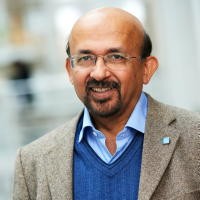
Martin Henz is an Associate Professor at the National University of Singapore , affiliated with the School of Computing and its Department of Computer Science . His academic journey includes an M.Sc. in Computer Science from Stony Brook University (1993) and a Dr.rer.nat. in Computer Science from Saarland University (1997). He has also worked as a Research Scientist at the German Research Centre for Artificial Intelligence. Research Focus : Scalable Experiential Learning, Systems for Teaching/Learning, AI in Education, Programming Languages, Algorithms, and Constraint Programming. Key Projects : Source Academy (immersive programming environment), Deep Teaching (LMS enhancements), and NUS Seafarers (maritime experiential learning). Publications span education technology, programming languages, and sustainable engineering, with recent works focusing on JavaScript-based pedagogy, automated question generation, and electric vehicle conversions. He supervised Rahul Singhal 's PhD, leading to the educational startup Cerebry, and co-founded Workforce Optimizer Pte Ltd with Alan Sevugan. Awards : NUS Annual Digital Education Award (2021) NUS Annual Teaching Excellence Award (2016/17) Fulbright Scholarship (1990) Startup @ Singapore Champion (2001)
Hina Tabassum is an Associate Professor at the Lassonde School of Engineering , York University, Canada, specializing in 5G/6G wireless communications and sensing applications. She was awarded the York Research Chair in 2023 for her work in 5G/6G-enabled mobility and sensing. Areas of Expertise: THz communications, WiFi sensing, and multi-band wireless systems Editorial Roles: Area Editor for IEEE OJCOMS and Associate Editor for multiple IEEE journals Research Focus : Ultra-reliable low-latency communication Reconfigurable intelligent surfaces (STAR-RIS) Machine-type communications Energy-efficient network design Scientific Recognition : Stanford's Top 2% World Researchers (2021-2024) Lassonde Innovation Early-Career Researcher Award (2023) N2Women Rising Stars (2022) Multiple IEEE Exemplary Editor/Reviewer Awards
Dr. Ahmed S. Ibrahim is an Associate Professor in the Department of Electrical & Computer Engineering at Florida International University (FIU), leading the Wireless Innovation Lab (WIL). He holds a Ph.D. from the University of Maryland and M.S./B.S. degrees from Cairo University. His research focuses on wireless communications, vehicular networks, millimeter wave systems, and geometric machine learning applications in network optimization. Education: Ph.D., Electrical Engineering, University of Maryland, College Park (2009) M.S., Electronics and Electrical Communications, Cairo University (2004) B.S., Electronics and Electrical Communications, Cairo University (2002) Research Interests: Dr. Ibrahim specializes in advanced wireless communication systems, including drone-assisted aerial networks, vehicular communications, and millimeter wave technologies. His work integrates Riemannian geometry and machine learning to address challenges in network optimization, security, and resource allocation. Recent projects include applying geometric frameworks to link scheduling, beamforming, and interference management. Key Contributions: His NSF CAREER-funded research ( CNS-2144297 ) explores Riemannian-geometric tools for low-latency wireless networks. Notable outputs include frameworks for RIS-assisted ISAC systems, massive MIMO resource allocation, and satellite network scheduling. Awards: NSF CAREER Award (2022-2027) Rising Star Award, Florida Academy of Science (2022) Advising & Grants: He mentors Ph.D. students in geometric machine learning and wireless systems. Current projects include Riemannian-geometry-based scheduling and NSF-funded studies on mmWave vehicular communications. His lab collaborates with industry and academic institutions on 5G/6G network solutions. Labs & Teams: Director of the Wireless Innovation Lab (WIL), focusing on 6G research, network testbeds, and interdisciplinary projects combining signal processing, AI, and communications.
Oscar Carl Olof Dahlsten is an Associate Professor in the Department of Physics at City University of Hong Kong. He works in the field of quantum information science with research spanning information thermodynamics, foundations of quantum theory, and quantum computation and machine learning. His academic journey includes training at Imperial College and previous positions at ETH Zurich, NUS Singapore, Oxford University, and SUSTech before joining CityUHK. Dahlsten's research interests focus on the intersection of quantum mechanics and information theory. His work explores how quantum systems process information, the thermodynamic implications of quantum operations, and the application of quantum principles to computational problems. Key areas include quantum causal inference, quantum energy harvesting, black hole information theory, and quantum machine learning algorithms. His fingerprint analysis shows strong contributions to Quantum Theory (100%), Statistical Mechanics (55%), Quantum Dot physics (55%), and Free Energy concepts (40%). Recent publications demonstrate a strong trend toward experimental validation of quantum information concepts, particularly in quantum causal inference and quantum thermodynamics. His work bridges theoretical foundations with practical applications, especially in energy harvesting and quantum computing. The integration of quantum principles with thermodynamic laws appears as a consistent theme across his recent publications. Dahlsten currently serves as Principal Investigator for the GRF project 'Exploiting Quantum Systems for More Efficient Extraction of Energy From Random Sources' starting September 1, 2025. He actively supervises PhD students in quantum information science and is accepting new PhD candidates. His research group focuses on cutting-edge problems at the intersection of quantum information, thermodynamics, and computation.
Alexandru G. Bardas is an Associate Professor at the University of Kansas in the Department of Electrical Engineering & Computer Science (EECS) and the Institute for Information Sciences (I2S) . He received his PhD from Kansas State University under advisors Xinming (Simon) Ou and Scott A. DeLoach. His research focuses on cybersecurity from a systems perspective , including moving target defenses, security operations center (SOC) metrics, DevOps security, power grid cybersecurity, and defensive technologies for political activists. He explores UDP-based DDoS detection, DNS traffic analysis, and the intersection of AI with cybersecurity, emphasizing foundational knowledge over tool-specific training. Key research areas: Cybersecurity, Systems Security, Moving Target Defenses, SOC Metrics, DevOps Security Recent publications in ACSAC 2024 , USENIX Security 2024/2023 , and IEEE Security & Privacy 2022 Dr. Bardas has received significant recognition including: NSF CAREER Award (2022) for SOC automation Bellows Scholar (2021) at KU NSA SoS Honorable Mention (2023) He actively advises students across disciplines, with graduates now at Sandia National Laboratories , Blue Cross Blue Shield , and Pacific Northwest National Laboratory . Dr. Bardas participates in NSF grant reviews , serves on program committees for SOUPS and MILCOM , and leads outreach initiatives like the GenCyber Summer Camp .
Professor Sir Bashir M. Al-Hashimi is currently Vice President (Research & Innovation) at King’s College London and holds the ARM Professorship in Computer Engineering there. He is also a Visiting Professor in Electronics and Computer Science at the University of Southampton. Prior to academia, he worked in the electronics design industry for eight years before joining the University of Southampton in 1999, where he became a personal Chair holder in 2004. His research focuses on energy-efficient computing systems, low-power testing, and energy-harvesting technologies, with a strong emphasis on smart city applications and wearable computing. He has led numerous interdisciplinary projects funded by the EPSRC and industry, including the PRiME Programme Grant and the EPSRC-funded Spatial Computational Learning consortium. He has supervised 45 PhD students and authored/co-authored nearly 400 technical papers, earning eight best paper awards and contributing to five books. His honors include a CBE (2018), knighthood (2025), Fellowship of the Royal Society (2023), and roles on the Research Excellence Framework panels. He founded the Arm-ECS industry-academia center in 2008, promoting energy-efficient computing research.
Wafi Danesh is an Assistant Professor in the Department of Engineering Programs at SUNY New Paltz, part of the School of Science & Engineering. He holds a PhD in Electrical and Computer Engineering from the University of Missouri Kansas City (2022). Prior to academia, he served as a Senior Engineer I - Design at Microchip Technology Inc. (2022-2023). His research focuses on hardware security, leveraging machine learning for FPGA Trojan detection and secure 3D IC design. Teaching interests include System-on-Chip Design, Digital Logic Fundamentals, and Computer Architecture. Education: PhD in Electrical and Computer Engineering, University of Missouri Kansas City, 2022 Research Interests: Dr. Danesh explores cutting-edge methods to enhance hardware security, including AI-driven approaches for IoT device protection and thermal management in 3D integrated circuits. His work bridges machine learning and physical hardware vulnerabilities, emphasizing FPGA security and PUF-based solutions for wireless systems. Publications Trends: His articles span FPGA Trojan detection via NLP and unsupervised learning, thermal challenges in 3D ICs, and neuromorphic computing innovations. Recent work highlights automated security tools and multi-valued computing for energy efficiency. Awards: None explicitly listed in the provided materials. Advising & Grants: No formal advisees or grants are mentioned. His professional activities center on research and teaching.
Miguel F. Anjos is Professor and Chair of Operational Research at the School of Mathematics, University of Edinburgh , and holds the NSERC-Hydro-Québec-Schneider Electric Industrial Research Chair on Optimization for Smart Grids at Polytechnique Montréal. He received his B.Sc. (1992), M.S. (1994), and Ph.D. (2001) from McGill, Stanford, and Waterloo respectively. Research Theme Head of Data and Decisions at Edinburgh Founding Director of Trottier Institute for Energy Editor-in-Chief of Optimization and Engineering Research Interests: His work bridges mathematical optimization with smart grid applications , focusing on conic optimization, optimal power flow, demand response, and facility layout. He applies these techniques to energy storage, electric transportation, and industrial systems. Scientific Awards: Méritas Teaching Award (2012) Humboldt Research Fellowship (2009) Queen Elizabeth II Diamond Jubilee Medal (2013) Elected Fellow of EUROPT and Canadian Academy of Engineering Academic Service: Served on Mathematical Optimization Society Council, SIAM Activity Group on Optimization, INFORMS Optimization Society Vice-Chair, and Mitacs Research Review Committee. Hosts benchmark datasets: QAPLIB, FLPLIB, Jones Benchmark.
Roland N. Horne is the Thomas Davies Barrow Professor of Earth Sciences at Stanford University and Senior Fellow at the Precourt Institute for Energy. He holds positions in the Department of Energy Science & Engineering and is an Affiliate at the Stanford Woods Institute for the Environment. With degrees from the University of Auckland (BE, PhD, DSc), Horne has established himself as a leading expert in geothermal reservoir engineering and energy production optimization. His research focuses on inverse problems in reservoir modeling, including tracer analysis of fractures, computer-aided well test analysis, production schedule optimization, and automated history matching. Horne has made significant contributions to understanding geothermal reservoir engineering and multiphase flow of boiling fluids through porous materials and fractures. The analysis of his recent publications (2023-2025) reveals a strong emphasis on enhanced geothermal systems (EGS), with particular focus on flexible operations, economic modeling, and advanced characterization techniques. His work increasingly incorporates machine learning approaches for reservoir analysis and has expanded into microbial tracing methods for interwell connectivity assessment. There's also significant attention to US geothermal resource potential and integration into the broader energy transition. Honorary Member of the Society of Petroleum Engineers Member of the US National Academy of Engineering Multiple SPE Distinguished Lecturer appointments (1998, 2009, 2020) John Franklin Carl Award recipient Five Best Paper awards from Geothermal Resources Council Patricius Medal from German Geothermal Society Core Values Award from Women in Geothermal (2023) Horne has supervised 60 PhD and 135 MS students throughout his career. His current teaching includes undergraduate and graduate courses in Fundamentals of Energy Processes, Geothermal Reservoir Engineering, Mass and Energy Transport in Porous Media, and Well Test Analysis. He previously served as President of the International Geothermal Association (2010-2013) and Technical Program Chair for multiple World Geothermal Congress events. Horne maintains active research collaborations worldwide, including with the University of Tokyo (where he was a Fellow of the School of Engineering in 2016) and China University of Petroleum. His current research group focuses on advancing EGS technologies and developing more accurate reservoir characterization methods for geothermal applications.
Akshay Narayan is a Senior Lecturer (Educator Track) at the School of Computing, National University of Singapore (NUS), where he teaches senior undergraduate and graduate-level courses in AI Planning and Decision Making, as well as introductory and intermediate-level Software Engineering courses. Education: Ph.D. in Computer Science from National University of Singapore (completed in 2020) M.Tech. in Information Technology from International Institute of Information Technology Bangalore, India B.E. in Computer Science & Engineering from Visveswaraya Technological University, India Research Interests: Dr. Narayan's research spans multiple domains within computer science with a primary focus on artificial intelligence and its applications. His current research centers on transfer learning in reinforcement learning, multi-agent decision making, and AI planning. He has also made significant contributions to cloud computing research, particularly in areas such as smart metering, chargeback systems, power-aware cloud metering, and workload analysis for virtual machine sizing. His work bridges theoretical foundations with practical applications, addressing real-world challenges in computing systems. He has recently expanded his research to include technology in education, exploring how AI can be integrated into teaching and learning processes. Publication Trends: Dr. Narayan's publication record demonstrates a clear evolution from foundational work in cloud computing to more recent explorations in reinforcement learning and AI education. His early work focused on practical applications in cloud systems, including smart metering and QoS monitoring. More recently, his research has shifted toward AI planning, decision making, and the educational applications of AI. This progression shows his ability to adapt to emerging fields while maintaining a strong foundation in systems research. Awards and Recognition: Teaching and Mentoring: Dr. Narayan teaches a variety of courses at NUS including CS2113 Software Engineering & Object-Oriented Programming, CS3219 Software Engineering Principles and Patterns, CS3268 Responsible AI: From Algorithms to Impact, and IT5100F Industry Readiness: Data Analytics and AI in Practice. He has also taught CS4246/CS5446 AI Planning and Decision Making. His teaching approach integrates his research expertise with practical applications, providing students with both theoretical foundations and hands-on experience. He has taught these courses across multiple academic years from AY-2013/14 through AY-2020/21. Research Groups and Collaborations: Dr. Narayan has collaborated with researchers across multiple institutions, including work with Prof. Tze Yun Leong at NUS (his PhD advisor), Shrisha Rao, Zhuoru Li, and others. His research has often involved interdisciplinary collaborations that bridge theoretical computer science with practical system implementations.
Jingxian Wang is an NUS Presidential Young Professor and Assistant Professor in the Department of Computer Science at the National University of Singapore's Faculty of Computing. His research builds next-generation wireless systems and satellite networks, with primary focus on integrating AI with wirelessly networked devices from WiFi to satellites. He earned his PhD from Carnegie Mellon University and previously served as a research scientist at Microsoft Research in Redmond, where he led the Smart Surface for 6G and Space initiative. His educational journey includes: PhD, Carnegie Mellon University Wang's research spans Wireless Systems , Satellite Networks , Artificial Intelligence , and Internet of Things , emphasizing AI-augmented wireless systems. His interdisciplinary work bridges robotics , materials science , and AI to develop sustainable sensing methods, robust communication networks, and multimodal AI techniques. Key projects include Multimodal AI for IoT (funded by Microsoft's Accelerate Foundation Models Program) and Satellite IoT Networks. His publication trends reveal accelerating integration of AI into wireless systems, with recent focus on satellite networking, soft robotics actuation, and generative models for IoT. The research consistently targets real-world deployment challenges in battery-free systems and space networks. His scientific contributions have earned prestigious recognition: ACM SIGMOBILE Doctoral Dissertation Award 2023 Communications of the ACM Research Highlights (2021, 2022) ACM SIGMOBILE Research Highlights 2021 Best Paper Awards at IPSN 2021 and UbiComp 2020 Microsoft Research Fellowship 2020 Emerging Rockstar in IEEE Pervasive Computing 2024 Wang actively mentors doctoral students and postdoctoral researchers through his AIoT Group. His grant portfolio includes Microsoft's Accelerate Foundation Models Research Program funding for multimodal AI projects, with ongoing work targeting satellite IoT infrastructure and wireless-powered soft robotics. Future directions emphasize foundation models for space networks and battery-free IoT systems. He leads the AIoT Group, fostering cross-disciplinary collaboration between computer scientists, roboticists, and materials engineers to pioneer wireless sensing and actuation technologies.
Dr. Iñaki Esnaola is a Senior Lecturer at the Department of Automatic Control and Systems Engineering, University of Sheffield, and a Visiting Research Collaborator at Princeton University. He holds a MSc from the University of Navarra (2006) and a PhD from the University of Delaware (2011). His research focuses on information theory, machine learning, and cybersecurity, particularly in cyberphysical systems like smart grids. His work addresses data integrity, privacy, robust estimation, and optimal sensor placement. Research interests include: Information theory and data science, machine learning and high-dimensional statistics, cybersecurity (especially data injection attacks), privacy, robust estimation, and sensor placement optimization. Recent projects involve empirical risk minimization with regularization, stealth attacks on control systems, and compressive sensing for environmental monitoring. Key publications include studies on relative entropy in machine learning, sensor placement for sewer networks, and stealth attacks in smart grids. He leads a research group with ongoing projects in resilient cyberphysical systems and received a UKRI grant for advanced manufacturing. His work bridges theoretical foundations with real-world applications in energy systems and environmental monitoring.
Mahdi Boloursaz Mashhadi is a Lecturer in Communications and AI at the Institute for Communication Systems (ICS), part of the School of Computer Science and Electronic Engineering at the University of Surrey, UK. He is a Surrey AI Fellow and an IEEE Senior Member, with a focus on advancing AI-driven wireless communication systems. He holds B.S., M.S., and Ph.D. degrees in mobile telecommunications from Sharif University of Technology, Tehran, Iran. Prior to joining Surrey, he served as a postdoctoral research associate at Imperial College London’s Intelligent Systems and Networks (ISN) Research Group (2019–2021). His research interests span AI/ML integration with wireless systems, including semantic communications, federated learning, generative AI for telecom, and beamforming optimization in massive MIMO architectures. He also explores edge computing, distributed deep learning frameworks, and energy-efficient communication designs using reconfigurable intelligent surfaces (RIS). Mahdi has been recognized with the IEEE EWDTS Best Paper Award and IEEE ComSoc Exemplary Reviewer Awards (2021–2022). He leads the UKTIN/DSIT 12M£ national project TUDOR and collaborates with industry on cutting-edge 5G/6G innovations. He has contributed to the ITU’s AI/ML in 5G challenge as a panel judge and serves as an editor for Springer’s Wireless Personal Communications Journal. His roles include advising on government/industry projects and advancing interdisciplinary research at the 5G/6G Innovation Centre. He emphasizes practical implementations of AI in telecommunications, aiming to bridge theoretical advancements with real-world applications.
Professor Ahmed Hemani is a faculty member at the Division of Electronics and Embedded Systems, KTH Royal Institute of Technology, affiliated with the Digital Futures Faculty. He holds the role of PI for the project 'New Chip Architectures for Industrial Vision' and leads research in reconfigurable computing, memristor-based systems, and hardware acceleration for AI and edge computing. His work bridges theoretical computer science with practical VLSI design and embedded systems development. He actively contributes to cross-disciplinary initiatives at Digital Futures, a joint center with Stockholm University and RISE Research Institutes of Sweden focused on digital innovation. His research emphasizes scalable FPGA/HPC architectures, low-power neuromorphic systems, and optimization techniques for custom silicon solutions. Current projects include a Lego-inspired edge AI framework and memristor-driven MIMO acceleration. Teaching responsibilities span advanced courses in SOC design, digital system verification, and embedded systems. He supervises advanced-level degree projects across computer engineering and ICT innovation specializations, emphasizing hands-on hardware-software co-design methodologies. Recent publications highlight innovations in memristor applications, FPGA-based acceleration, and reconfigurable architectures for neural networks and bioinformatics. His work addresses challenges in dark silicon utilization, energy-efficient computation, and high-performance embedded systems.
Professor Raja Jurdak is a leading academic in distributed systems and applied data sciences at Queensland University of Technology (QUT), where he directs the Trusted Networks Lab. He holds dual roles as Professor of Distributed Systems and Chair in Applied Data Sciences, alongside leadership in the Centre for Data Science. His research focuses on dynamic network modeling, blockchain-based trust frameworks, and IoT applications, with particular emphasis on cybersecurity, energy efficiency, and mobility-driven diffusion processes. Jurdak formerly led CSIRO's Distributed Sensing Systems Group and maintains a visiting scientist role there. Education: PhD in Information and Computer Science, University of California, Irvine MS in Computer Networks and Distributed Computing, University of California, Irvine BE in Computer and Communications Engineering, American University of Beirut Research Interests: Network science, blockchain technology, IoT security, sustainable energy systems, and data-driven decision-making. His work bridges theoretical advancements with practical applications in smart grids, health surveillance, and urban mobility. Awards: Finalist for the 2019 Eureka Prize, multiple CSIRO accolades, and IEEE Senior Member status. His research has received industry recognition for interdisciplinary innovation, including the DiNeMo project's real-time disease surveillance system. Advisory & Grants: Leads high-impact projects funded by government and industry partnerships. Supervises PhD candidates in areas like decentralized data processing and privacy-preserving AI. Holds editorial roles at journals such as Ad Hoc Networks and PLoS ONE . Labs & Teams: Directs the Trusted Networks Lab at QUT, fostering collaborations with institutions like Oxford University and MIT. His work emphasizes cross-disciplinary teams to address global challenges in cybersecurity and sustainable systems.