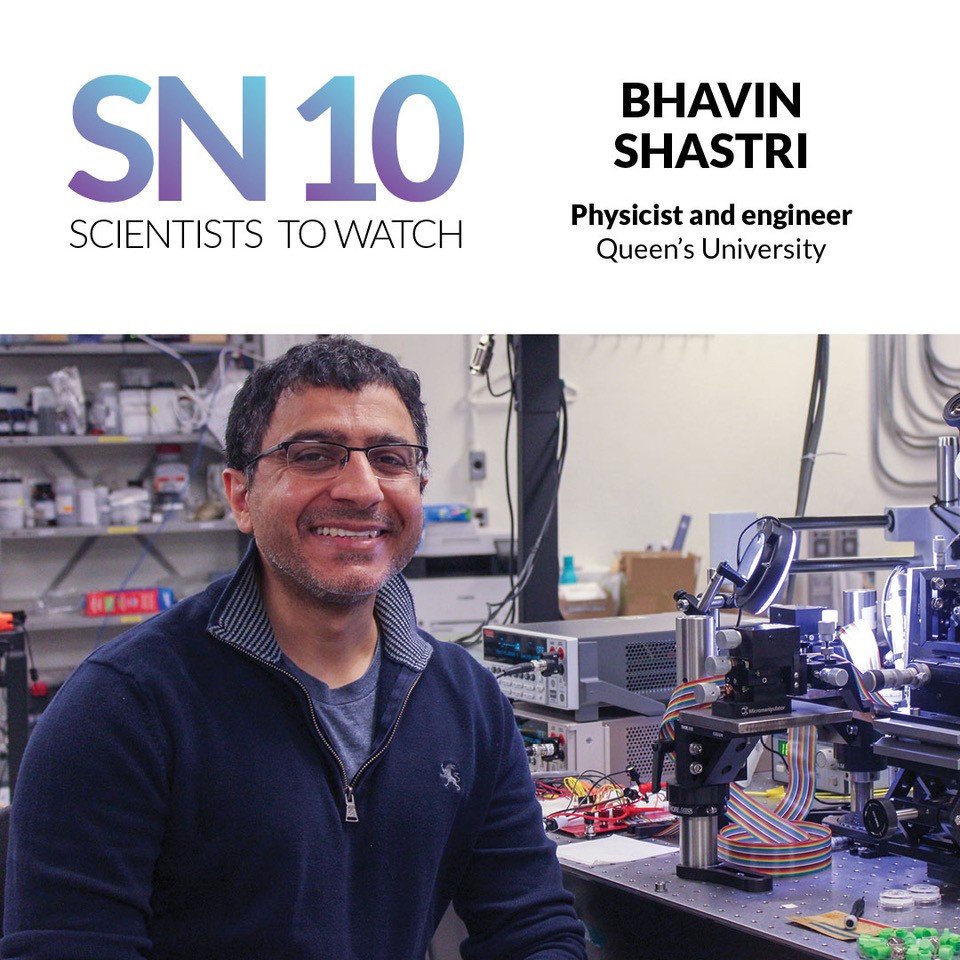
Bhavin Shastri is Canada Research Chair in Neuromorphic Photonic Computing and Assistant Professor of Engineering Physics at Queen's University. He directs research developing light-based computing systems that mimic neural processing for AI applications. His lab designs photonic integrated circuits that implement neural network architectures on chip-scale platforms. Research focuses on overcoming limitations of conventional computing through nanophotonic physics and novel materials. Publications demonstrate advances in photonic tensor cores, quantum photonic neural networks, and microwave photonic processors. Recent work achieves orders-of-magnitude improvements in processing speed and energy efficiency over electronic systems. Awards include: Alfred P. Sloan Research Fellowship (2025) Royal Society of Canada College Member (2024) Science News SN10 Scientist to Watch (2024) SPIE Early Career Award (2022) As Scientific Co-Director of NSERC's NUCLEUS program, he leads national efforts in photonic computing. Guides 12+ graduate students researching silicon photonics, neuromorphic architectures, and quantum photonics.
Roland N. Horne is the Thomas Davies Barrow Professor of Earth Sciences at Stanford University and Senior Fellow at the Precourt Institute for Energy. He holds positions in the Department of Energy Science & Engineering and is an Affiliate at the Stanford Woods Institute for the Environment. With degrees from the University of Auckland (BE, PhD, DSc), Horne has established himself as a leading expert in geothermal reservoir engineering and energy production optimization. His research focuses on inverse problems in reservoir modeling, including tracer analysis of fractures, computer-aided well test analysis, production schedule optimization, and automated history matching. Horne has made significant contributions to understanding geothermal reservoir engineering and multiphase flow of boiling fluids through porous materials and fractures. The analysis of his recent publications (2023-2025) reveals a strong emphasis on enhanced geothermal systems (EGS), with particular focus on flexible operations, economic modeling, and advanced characterization techniques. His work increasingly incorporates machine learning approaches for reservoir analysis and has expanded into microbial tracing methods for interwell connectivity assessment. There's also significant attention to US geothermal resource potential and integration into the broader energy transition. Honorary Member of the Society of Petroleum Engineers Member of the US National Academy of Engineering Multiple SPE Distinguished Lecturer appointments (1998, 2009, 2020) John Franklin Carl Award recipient Five Best Paper awards from Geothermal Resources Council Patricius Medal from German Geothermal Society Core Values Award from Women in Geothermal (2023) Horne has supervised 60 PhD and 135 MS students throughout his career. His current teaching includes undergraduate and graduate courses in Fundamentals of Energy Processes, Geothermal Reservoir Engineering, Mass and Energy Transport in Porous Media, and Well Test Analysis. He previously served as President of the International Geothermal Association (2010-2013) and Technical Program Chair for multiple World Geothermal Congress events. Horne maintains active research collaborations worldwide, including with the University of Tokyo (where he was a Fellow of the School of Engineering in 2016) and China University of Petroleum. His current research group focuses on advancing EGS technologies and developing more accurate reservoir characterization methods for geothermal applications.
Jingxian Wang is an NUS Presidential Young Professor and Assistant Professor in the Department of Computer Science at the National University of Singapore's Faculty of Computing. His research builds next-generation wireless systems and satellite networks, with primary focus on integrating AI with wirelessly networked devices from WiFi to satellites. He earned his PhD from Carnegie Mellon University and previously served as a research scientist at Microsoft Research in Redmond, where he led the Smart Surface for 6G and Space initiative. His educational journey includes: PhD, Carnegie Mellon University Wang's research spans Wireless Systems , Satellite Networks , Artificial Intelligence , and Internet of Things , emphasizing AI-augmented wireless systems. His interdisciplinary work bridges robotics , materials science , and AI to develop sustainable sensing methods, robust communication networks, and multimodal AI techniques. Key projects include Multimodal AI for IoT (funded by Microsoft's Accelerate Foundation Models Program) and Satellite IoT Networks. His publication trends reveal accelerating integration of AI into wireless systems, with recent focus on satellite networking, soft robotics actuation, and generative models for IoT. The research consistently targets real-world deployment challenges in battery-free systems and space networks. His scientific contributions have earned prestigious recognition: ACM SIGMOBILE Doctoral Dissertation Award 2023 Communications of the ACM Research Highlights (2021, 2022) ACM SIGMOBILE Research Highlights 2021 Best Paper Awards at IPSN 2021 and UbiComp 2020 Microsoft Research Fellowship 2020 Emerging Rockstar in IEEE Pervasive Computing 2024 Wang actively mentors doctoral students and postdoctoral researchers through his AIoT Group. His grant portfolio includes Microsoft's Accelerate Foundation Models Research Program funding for multimodal AI projects, with ongoing work targeting satellite IoT infrastructure and wireless-powered soft robotics. Future directions emphasize foundation models for space networks and battery-free IoT systems. He leads the AIoT Group, fostering cross-disciplinary collaboration between computer scientists, roboticists, and materials engineers to pioneer wireless sensing and actuation technologies.
Kathleen H. Sienko is the Arthur F. Thurnau Professor in the Department of Mechanical Engineering at the University of Michigan's College of Engineering. She directs the Sienko Research Group, a multidisciplinary lab focused on developing technological solutions at the intersection of healthcare and engineering. Her work spans medical device design, design science, and engineering education with a strong emphasis on global health contexts. Dr. Sienko earned her Ph.D. in Medical Engineering and Bioastronautics from the Harvard-MIT Division of Health Sciences and Technology (HST) program in 2007, an S.M. in Aeronautics & Astronautics from MIT in 2000, and a B.S. in Materials Engineering from the University of Kentucky in 1998. Ph.D., Medical Engineering and Bioastronautics, Harvard-MIT Division of Health Sciences and Technology, 2007 S.M., Aeronautics and Astronautics, Massachusetts Institute of Technology, 2000 B.S., Materials Engineering, University of Kentucky, 1998 Her research focuses on sensory augmentation, rehabilitation engineering, biomechanics, and medical device design with emphasis on global health contexts and task-shifting devices. She has pioneered efforts to incorporate global health technology constraints within engineering design education at undergraduate and graduate levels, establishing field sites in sub-Saharan Africa and Asia where numerous devices have been conceptualized and refined with local stakeholders. Her work in design science examines how and when designers use prototypes in development cycles and how prototypes assist during stakeholder interactions and user requirements identification. Her recent publications reveal a strong trend toward human-centered approaches in global health design, with increasing focus on stakeholder engagement, contextual factors in engineering design, and equity considerations in health technology development. Her work bridges biomechanics, rehabilitation engineering, and design methodology with applications in balance assessment, medical device development for low-resource settings, and engineering education. Dr. Sienko has received numerous prestigious awards including the NSF CAREER Award, University Undergraduate Teaching Award, Provost's Teaching Innovation Prize, and the Miller Faculty Scholar Endowed Award. Her recognition spans teaching excellence, research innovation, and outreach contributions. NSF CAREER Award, 2009 Provost's Teaching Innovation Prize, 2012 Miller Faculty Scholar Endowed Award, 2013 University Undergraduate Teaching Award, 2012 Raymond J. and Monica E. Schultz Outreach and Diversity Award, 2011 She has advised numerous graduate students including Nick Moses (who defended his dissertation in December 2023), Lucy Spicher, Marty Kilbane, and Ibrahim Mohedas. Her research has been supported by significant grants from the National Science Foundation, including the CAREER program, Research Initiation Grants in Engineering Education, and the Graduate Research Fellowship program, as well as funding from the University of Michigan's Rackham Merit Fellows program and Center for Research on Learning and Teaching. The Sienko Research Group operates as a talented multidisciplinary lab developing novel methodologies to create technological solutions addressing pressing societal needs at the healthcare-engineering intersection. Current research thrusts include Design Science, Autonomous Vehicles, Balance, Sensory Augmentation, and Wearable Devices, with particular emphasis on how design ethnography can inform medical device development and how engineering students develop ethnographic skills for global health contexts.
Veronica Santos is a Professor and Inclusive Excellence Officer in the Department of Bioengineering at the University of California, Los Angeles (UCLA) Samueli School of Engineering. She serves as Associate Dean for Inclusive Excellence and Faculty Affairs, and directs the UCLA Biomechatronics Laboratory. Santos holds a Ph.D. in Mechanical and Aerospace Engineering from Cornell University and a B.S. in Mechanical Engineering from UC Berkeley, with minors in Biometry and Music. Ph.D., Mechanical and Aerospace Engineering (Biometry minor), Cornell University (2007) B.S., Mechanical Engineering (Music minor), University of California, Berkeley (1999) Her research spans robotics, haptics, and human-machine systems, focusing on grasp and manipulation, tactile sensors, prosthetics, and neural control of movement. She integrates machine learning and stochastic modeling with biomechanical studies of hand function, bridging robotics and biomedical applications. The 15 most recent publications highlight trends in tactile sensing for robotics, granular media interaction, and human-robot collaboration. A significant portion explores neural network applications for tactile perception, tendon-driven actuation systems, and biomimetic sensor design. Many papers address practical challenges in robotic manipulation, including shear force measurement, edge orientation detection, and autonomous learning through reinforcement strategies. 2018: Robohub.org '25 women in robotics you need to know about' 2018-2019: Defense Science Study Group Selectee 2017: UCLA Mechanical and Aerospace Engineering Teaching Award 2010: NAE Frontiers of Engineering Education Symposium Selectee 2010: NSF CAREER Award As director of the UCLA Biomechatronics Lab, she leads multidisciplinary teams developing advanced robotic systems for applications ranging from mine defusal to prosthetics restoration of touch sensation. Her work has received media coverage from ASME, National Geographic, and Nature, and she was featured in a $100M gift to UCLA that underscores private donors' growing role in public universities.
Professor Michael Bell is the Foundation Professor of Ports and Maritime Logistics at the University of Sydney Business School's Institute of Transport and Logistics Studies. He holds a BA from Cambridge University, MSc and PhD from Leeds University, and has held roles including Director of Imperial College London's PORTeC and academic positions at Newcastle University and Karlsruhe Technical University. His research focuses on ports, transport networks, sustainability, and intelligent transport systems. He has authored over 150 publications, including seminal works like Transportation Network Analysis . Current projects include circular economy diversification for ports and autonomous delivery systems. Awards include fellowship in multiple transport societies. Education: BA (Economics) Cambridge (1975), MSc (Transportation) Leeds (1976), PhD (Freight Distribution) Leeds (1981). Postdoctoral research at Karlsruhe Technical University (1982–1984). Research Interests: Ports logistics, transport network resilience, urban logistics, cybersecurity in supply chains, and sustainable transport policy. Publications span 40+ years, emphasizing empirical and theoretical advancements in maritime systems, network modelling, and policy analysis. Recent work explores autonomous systems integration and port diversification strategies. Grants include a 2023 iMOVE CRC project on land use trip surveys and a 2022 ARC Discovery Project on automated transport decisions. Media appearances address global trade disruptions (e.g., Suez Canal blockage), autonomous vehicles, and port sustainability. Led PORTeC (Imperial College) and co-founded the Institute of Transport and Logistics Studies at Sydney. Active in policy advisory roles for government agencies and industry bodies.
Ebenezer Fanijo is an Assistant Professor at the School of Building Construction, part of the College of Design at Georgia Institute of Technology. He joined in Spring 2023 and specializes in sustainable and smart-resilient infrastructure, focusing on low-carbon construction materials and alternative energy sources. His work addresses carbon emissions in building materials and processes through advanced research on cementitious composites, recycled materials, and green technologies. Dr. Fanijo holds a B.S. in Building Construction (Obafemi Awolowo University, Nigeria), M.S. in Civil Engineering (University of Idaho, 2019), and a Ph.D. in Civil Engineering with a concurrent MEng in Materials Science and Engineering from Virginia Tech (2022). He is also a Professional Engineer (P.E.) and LEED Green Associate with over five years of construction sector experience. Education: B.S. Building Construction, Obafemi Awolowo University, Nigeria (First Class Honours) M.S. Civil Engineering, University of Idaho (2019) Ph.D. Civil Engineering & MEng Materials Science, Virginia Tech (2022) Research Interests: His research spans sustainable construction materials, concrete durability, green technologies using recycled/by-product materials, 3D-printed cementitious materials, and advanced sensing for structural monitoring. He emphasizes decarbonizing infrastructure and developing innovative composites to reduce lifecycle emissions. Awards: NSBE Golden Torch Award (2022) – Recognized as Graduate Student of the Year National/international awards for research excellence Teaching & Advising: Dr. Fanijo teaches courses on construction materials, green technologies, and sustainable practices. He developed core curricula such as Construction Materials and Methods and Green Construction Technology . His advising focuses on student mastery of material properties and their integration into environmental performance frameworks. Professional Contributions: He has led funded research projects, published widely in peer-reviewed journals, and pioneered work on alkali-silica reactivity mitigation, asphalt mix design optimization, and corrosion monitoring. His lab integrates AI and nanoscale techniques for material analysis.
Prof. Dr. Florian Knoll is a full professor in Computational Imaging at the Department of Artificial Intelligence in Biomedical Engineering (AIBE) at Friedrich-Alexander-Universität Erlangen-Nürnberg. He leads the Computational Imaging Lab, focusing on machine learning applications in medical imaging, particularly accelerating MRI through innovative reconstruction algorithms and translating them into clinical practice. His research emphasizes improving MRI speed, artifact robustness, and accessibility, alongside developing quantitative biomarkers for disease processes. Knoll's work is funded by NIH grants, including projects on machine learning for musculoskeletal imaging, MR fingerprinting, and deep learning frameworks for MRI reconstruction. He is a key figure in open science initiatives, co-creating the fastMRI dataset with Facebook AI, providing public access to over 1300 knee and 7000 brain MRI scans. He currently serves as deputy editor of Magnetic Resonance in Medicine and chairs the ISMRM Reproducible Research Study Group. His contributions extend to reproducible research, maintaining GitHub repositories with code for image reconstruction techniques (e.g., AGILE, gpuNUFFT) and educational materials. He teaches medical imaging fundamentals at FAU, integrating theoretical and practical insights for students and researchers. Grants: NIH R01EB024532, R21EB027241, P41EB017183, R01EB029957 Labs/Teams: Computational Imaging Lab, fastMRI initiative Software: GitHub repositories for MRI reconstruction (e.g., github.com/FlorianKnoll )
Prof. Dr. Franziska Mathis-Ullrich is a Professor at Friedrich-Alexander-University Erlangen-Nuremberg (FAU) leading the Surgical Planning and Robotic Cognition Lab (SPARC) in the Department of Artificial Intelligence in Biomedical Engineering. Previously, she was an Assistant Professor at Karlsruhe Institute of Technology (KIT) from 2019 to 2023. Her research focuses on minimally invasive robotic systems, soft robotics, and embedded machine learning for surgical applications. She holds a PhD in Microrobotics from ETH Zurich (2017), with earlier degrees from the same institution. Education: B.Sc. and M.Sc. in Mechanical Engineering and Robotics (ETH Zurich, 2009–2012) Ph.D. in Microrobotics (ETH Zurich, 2017) Research Interests: Minimally invasive medical robotics, soft robotic systems, AI-driven surgical assistance, microrobotics, and robot-assisted surgery. Her work emphasizes translating robotics innovations into clinical applications through interdisciplinary collaboration. Key Awards: IEEE ICRA Best Paper Award in Medical Robotics (2014) IEEE BioRob Best Student Paper Award (2016) ICRA Microassembly Challenge First Prize (2014 & 2015) Forbes 30 under 30 (2017) Grants & Projects: Leading a Bavarian State Ministry-funded project on endometriosis diagnostics (€3M). Active in multidisciplinary collaborations with Erlangen University Hospital. Serves as Vice-President of the German Society for Computer- and Robot-assisted Surgery (CURAC). Labs & Teams: Directs the SPARC Lab, which develops cognitive robotic systems for surgical planning and execution. Collaborates with institutions like Max Planck, Fraunhofer, and Helmholtz.
Dr. Thuc Vo is an Associate Professor in Civil Engineering at La Trobe University, Australia. His expertise lies in structural engineering, composite materials, and machine learning applications. He previously held roles at Northumbria University (UK) and Airbus’ Advanced Composite Training and Development Centre. His research focuses on shear deformation theories for composite structures and machine learning for structural engineering. He has authored over 120 publications in prestigious journals and conferences. Education & Experience: Associate Professor, La Trobe University (2019–present) Senior Lecturer & Program Leader in Civil Engineering, Northumbria University (2013–2019) Lecturer at Airbus’ Advanced Composite Training and Development Centre/Wrexham Glyndwr University (2011–2013) Research Associate, University of Liverpool (2010–2011) Research Interests: Composite material analysis (FGMs, nanoporous materials) Machine learning for structural prediction Vibration and buckling analysis Advanced beam and plate theories Collaboration & Supervision: Offers supervision for masters/PhD students and collaborates on industry projects. His work bridges theoretical mechanics with data-driven approaches, addressing challenges in smart materials and structural optimization.
Elliot Hui, Ph.D., is an Associate Professor in the Department of Biomedical Engineering at the University of California, Irvine (UCI), within the Samueli School of Engineering. His research focuses on biological microtechnology, including spatial cell biology, microscale tissue engineering, global health diagnostics, and microfluidic computing. He leads the Hui Lab, which develops tools for automating biochemical reactions, controlling cellular organization, and understanding tissue development dynamics. Key achievements include pioneering microfluidic logic systems for autonomous laboratory automation and creating novel cell culture platforms to study intercellular communication in tissues. His work bridges engineering and biology, addressing challenges in diagnostics and regenerative medicine. Notable contributions include the development of a programmable finite state machine for microfluidic control and a SLAS Fellowship awarded to his student Erik. Research Interests: Microfluidic devices, cell-cell interaction modeling, tissue engineering, and lab-on-a-chip systems. Labs/Teams: Hui Lab at UCI, specializing in microscale biological systems and automation. Publications span topics such as microfluidic computing architectures, tissue dissociation devices, and Bayesian experimental design. His work emphasizes applications in global health diagnostics and mechanistic studies of cellular processes.
Dr Caroline Roney is a UKRI Future Leaders Fellow and Lecturer in Computational Medicine at Queen Mary University of London's School of Engineering and Materials Science. Her research focuses on developing engineering methodologies to personalize treatment for cardiac arrhythmias, combining signal processing, machine learning, and computational modeling to predict optimal patient-specific therapies. She holds a MMath from the University of Oxford, MRes and PhD from Imperial College London, and has held fellowships at Liryc Institute and King's College London. Her work integrates clinical imaging and electrophysiological data to advance atrial fibrillation treatment strategies. Education: MMath in Mathematics, University of Oxford MRes in Biomedical Research, Imperial College London PhD in Cardiac Signal Processing, Imperial College London Research Interests: Development of patient-specific digital twins for atrial fibrillation, computational modeling of fibrosis, and integration of machine learning with clinical data. Awards: UKRI Future Leaders Fellowship, Fondation Lefoulon Delalande Fellowship (2015–2017), MRC Research Fellowship (2017–2021). Affiliations: Digital Environment Research Institute (DERI), Visiting Lecturer at King's College London. Her research group has secured £9.3M in grants, including EPSRC and MRC funding, to advance virtual atrial modeling and AI-driven healthcare tools. Key collaborations include industry partners like Acutus Medical and RHYTHM AI, focusing on clinical translation of computational models.
Surl-Hee Ahn is an Assistant Professor in the Department of Chemical Engineering at the University of California, Davis. Her research focuses on using molecular dynamics (MD) simulations and enhanced sampling methods like the weighted ensemble (WE) to study biological systems, including proteins, nanocrystals, and drug discovery for tuberculosis and other diseases. She leads the Ahn Lab, which develops cutting-edge computational tools, such as ParGaMD and DeepWEST, to advance kinetic and thermodynamic sampling in simulations. Education: Ph.D. in Chemistry (Chemical Physics), Stanford University M.S. in Chemistry, University of Pennsylvania M.A. in Mathematics, University of Pennsylvania B.A. in Biochemistry and Mathematics, University of Pennsylvania (Magna Cum Laude, Vagelos Scholar) Research Interests: Molecular dynamics simulations, enhanced sampling methods, computational drug discovery, vaccine design, protein interactions, and nanomaterial dynamics. Her work bridges computational biology, materials science, and pharmacology, with applications to infectious diseases and neurodegenerative disorders. Awards and Recognition: 2020 ACM Gordon Bell Prize Winner (SC20) for SARS-CoV-2 spike dynamics simulations 2021 Chancellor’s Outstanding Postdoctoral Scholar Award Finalist MIT Rising Stars in Mechanical Engineering (2018) ACS PHYS Division Young Investigator Award (2021) Grants & Collaborations: Her research is supported by grants from SC20/SC21 and leverages high-performance computing for multiscale modeling. She collaborates on projects like #COVIDisAirborne, combining AI with computational microscopy. Labs & Teams: The Ahn Lab at UC Davis emphasizes interdisciplinary training in computational methods and their application to real-world biomedical challenges.
Davide Donadio is a Professor of Chemistry at the University of California, Davis. His research focuses on molecular modeling and simulations of materials, particularly in non-equilibrium processes, thermal transport, and nanostructure assembly. He leads the Naotheory Group, which develops predictive multiscale models for energy-related materials. Education : Habilitation in Materials Science, Italian Ministry for University and Research (2013) Ph.D. in Materials Science, University of Milano (2003) M.S. in Physics, University of Milano (1998) Research Interests : His work spans molecular-level understanding of energy conversion, thermal management, and nanostructure formation. Key areas include phononics, thermoelectrics, and interfacial phenomena in materials like ice surfaces, semiconductors, and clathrates. He employs machine learning and first-principles methods to bridge simulation and experiment. Awards : UC Davis Hellman Fellow (2017–2018) Young Scientist Award, Italian Institute for the Physics of Matter (1998) Grants & Labs : His funding and collaborations drive advancements in nanostructured materials and computational tools like PLUMED tutorials. The Naotheory Group actively publishes in high-impact journals and collaborates internationally on thermal transport and materials design.
Hao Chen, Ph.D. is an Associate Professor in the Department of Statistics at the University of California, Davis. His research focuses on statistical methodology for high-dimensional and non-Euclidean data, including anomaly detection, graph-based methods, and change-point analysis. He also explores AI security, multimodal models, and geospatial applications. His work bridges statistical theory and practical machine learning challenges. Education: Ph.D., Graduate Group in Biostatistics, Stanford University Research Interests: Dr. Chen’s expertise spans statistical methods for streaming data, categorical data analysis, and allele-specific copy number variation. He has pioneered work in detecting signals in complex datasets and developing robust AI systems. His recent focus includes mitigating modality interference in LLMs, enhancing model safety via guardrails, and advancing geospatial AI through projects like GeoLM. Publications: His recent work addresses cutting-edge topics such as multimodal model vulnerabilities, unlearning algorithms, and clinical radiology applications. Key themes include improving model robustness, ethical AI design, and interdisciplinary data integration. Labs/Teams: Engages in collaborative projects at UC Davis, though specific lab names are not listed in the provided information.