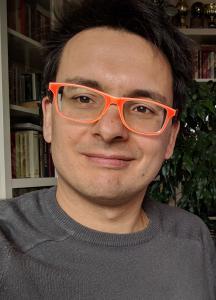
Eric MedvetView profile
Associate Professor
Eric Medvet is an Associate Professor of Computer Engineering at the Department of Engineering and Architecture (DIA), University of Trieste, Italy. He leads the Evolutionary Robotics and Artificial Life Lab and co-leads the Machine Learning Lab. His research focuses on Evolutionary Computation, Machine Learning, and their applications to robotics, including Grammatical Evolution, Genetic Programming, and soft robotics. He received the Google Faculty Research Award 2019 for a project on modular soft robots and co-authored a best paper at EuroGP 2024. His recent work emphasizes interpretable control policies, quality-diversity optimization, and evolutionary learning of formal specifications. Medvet teaches advanced courses on machine learning, evolutionary robotics, and programming, consistently updating curricula to reflect cutting-edge research. His labs are hubs for interdisciplinary projects, blending theory with practical implementations in robotics and AI. Research Interests: Medvet’s research spans evolutionary algorithms applied to robotics, with a focus on modular systems. He explores how genetic programming and grammatical evolution can optimize robotic designs and controllers. His work on ‘totipotent neural controllers’ and ‘body-brain co-evolution’ exemplifies efforts to create adaptable, specialized robots. He also investigates formal methods (e.g., STL specifications) for system validation and interpretable AI models. Recent trends in his publications reflect a shift toward practical applications, such as wearable movement analysis and sim-to-real transfer in robotics. Awards: Google Faculty Research Award 2019, EuroGP 2024 Best Paper Award Labs: Evolutionary Robotics and Artificial Life Lab, Machine Learning Lab Teaching: Courses include Advanced Programming, Introduction to Machine Learning, and Evolutionary Robotics, with a focus on Java and practical software development. Medvet’s approach integrates theoretical rigor with hands-on experimentation, emphasizing open-source tools like JGEA and 2D-VSR-Sim. His work bridges computational intelligence and real-world robotics challenges, driving innovation in both fields.