Konstantinos Nikitopoulos is a Professor at the University of Surrey , UK, specializing in Wireless Communications and Signal Processing . His research focuses on MIMO Systems , Open-RAN , and Non-Linear Processing for next-generation wireless networks. His recent work explores Analogue Processing for Tbps Wireless Systems and Neuromorphic Computing in MU-MIMO detection. He has developed frameworks like MIMO-SoftiPHY and SACCESS for software-based radio acceleration and power-efficient network design. Key Publications : Power-Efficient RIC, NL-COMM, NeuroMIMO Collaborators : Rahim Tafazolli, George Katsaros, Marcin Filo His research impacts 6G Network Development through innovations in Beamforming , Channel Estimation , and Software-Defined Radios .
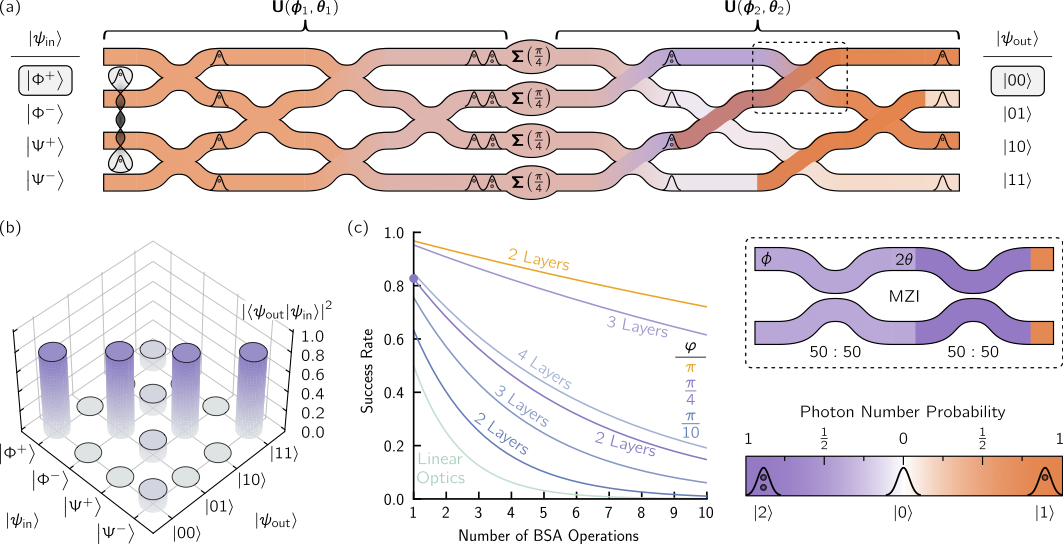
Bhavin J. Shastri is an Assistant Professor in the Department of Physics, Engineering Physics and Astronomy at Queen's University in Canada. His research explores the physics of light for computing , pushing frontiers in information and signal processing through photonic computing and quantum/neuromorphic photonics . He is affiliated with the Centre for Nanophotonics and NUCLEUS , a pan-Canadian photonic computing program funded by NSERC CREATE, bridging artificial intelligence and quantum information . Canada Research Chair & Principal Investigator Faculty Affiliate at Vector Institute (2020-) Editorial Board Member of JPhys Photonics (2019-) Member of IEEE Photonics Society Technical Affairs Council (2019-) Visiting Researcher Scholar at Princeton University (2018-) Shastri Lab members have access to world-class shared facilities, including the Centre for Nanophotonics (CFI-Innovation Fund), Nanofabrication Kingston , the Centre for Advanced Computing , and the Digital Research Alliance of Canada . The lab takes an interdisciplinary approach combining nanophotonics with complex systems on emerging substrates. His research focuses on silicon photonics , nanophonic processors , and photonic integrated circuits with applications to deep learning , nonlinear programming , and quantum information science . His articles show consistent exploration of quantum photonic neural networks , photonic memory systems , and optical signal processing for machine learning and quantum technologies . 2020 IUPAP Young Scientist Prize in Optics 2014 Banting Postdoctoral Fellowship 2012 D. W. Ambridge Prize 2011 IEEE Photonics Society Graduate Student Fellowship 2011 NSERC Postdoctoral Fellowship Multiple Best Student Paper Awards Shastri's lab supervises Ph.D. candidates and postdoctoral fellows working on quantum photonics , neuromorphic computing , and photonic AI systems . His recent work includes photonic tensor cores for scientific computing , quantum photonic neural networks , and all-optical memory systems. Shastri Lab designs programmable nanophotonic processors with potential to outperform microelectronic processors in energy efficiency and computational speeds by seven and four orders of magnitude respectively. Their work spans from device design to system-level implementations in optical computing for machine learning and quantum information processing .
Shimeng Yu is a full professor at the Georgia Institute of Technology's School of Electrical and Computer Engineering, holding the Dean’s Professorship. He earned his B.S. from Peking University (2009) and M.S./Ph.D. from Stanford University (2011/2013). His research focuses on semiconductor devices, non-volatile memories, 3D integration, and AI hardware accelerators. Yu leads SRC/DARPA JUMP 2.0 centers on memory/storage and 3D integration, with over 400 publications and 30,000+ citations (H-index 82). He serves on flagship conference committees (e.g., IEDM, VLSI) and editorial boards (IEEE EDL, JETCAS). Education: B.S., Microelectronics, Peking University (2009) M.S./Ph.D., Electrical Engineering, Stanford University (2011/2013) Research Themes: Emerging non-volatile memories for AI Monolithic 3D integration Energy-efficient computing systems His work spans device fabrication, circuit design, and system-level co-optimization. Recent projects are funded by NSF, DARPA, DOE, and industry partners (TSMC, Intel, Samsung), totaling >$17M. His lab, located at the Pettit Microelectronics Research Center, develops prototypes with cleanroom access. Awards: IEEE Fellow (2024) ACM/IEEE DAC Under-40 Innovators Award (2020) NSF CAREER Award (2016) Multiple editorship roles and distinguished lecturer appointments (IEEE EDS/CASS) Grants & Funding: Lead of two SRC/DARPA JUMP 2.0 centers Total research funding exceeds $17M
Grant Bollmer is an Associate Research Professor in the Department of Communication at the University of Maryland, College Park. His research focuses on digital cultures, critical theory, cultural studies, and the history of science. He holds a Ph.D. in Communication Studies from the University of North Carolina at Chapel Hill. His work examines topics such as influencer culture, emotion measurement, media materialism, and the philosophical implications of technology. Key publications include The Influencer Factory (2024), The Affect Lab (2023), and Materialist Media Theory (2019). His research has been supported by grants from the National Endowment for the Humanities and a residency at the Media Archaeology Lab. Bollmer’s recent scholarship explores AI ethics, absurd temporalities, and neo-feudal economic structures. He has received awards including the NC State CHASS Outstanding Junior Faculty Award and contributed to a magazine issue honored by the Canadian National Magazine Awards. His current projects include studies on 'bad' video games, generative AI in brain decoding, and the intersection of capitalism and billionaire behavior. Bollmer’s interdisciplinary approach synthesizes Marxist theory, media archaeology, and critical cultural analysis.
Talal Shaikh is an Associate Professor at Heriot-Watt University's School of Mathematical and Computer Sciences in Dubai. He serves as Director of Undergraduate Studies and Programme Director for BSc Computer Science, BSc CS (AI), and MSc Software Engineering. With a decade of industry experience as a Chief Information Officer and Software Engineer, he bridges practical insights with academic research. Research Interests: Pervasive Computing, IoT/M2M, AI/ML, WiFi Sensing for Healthcare, Financial Machine Learning, Educational Technology Awards: Teaching Excellence Awards (2017/18), Fellow of the Higher Education Academy (FHEA), multiple Learning and Teaching Oscars (2016, 2017, 2018) His work spans Ubiquitous Computing and IoT , focusing on sensor networks and WiFi-based sensing for healthcare. In Artificial Intelligence , he applies ML to robotics, financial analytics, and educational innovation. Recent articles analyze Reinforcement Learning , Emotion Recognition , and WiFi Sensing applications. His teaching emphasizes student-centric learning, with over 100 supervised dissertations achieving distinctions. Collaborations include international conferences and interdisciplinary research in smart environments and adaptive systems.
Dr. Weihua Zhuang is a University Professor and University Research Chair in the Department of Electrical and Computer Engineering at the University of Waterloo. She holds prestigious fellowships from IEEE, Royal Society of Canada, and other organizations. Her research focuses on future communication networks, including 6G, network virtualization, autonomous vehicles, and smart grids. She has led groundbreaking work on MAC protocols like VeMAC for vehicular networks and has contributed extensively to AI-driven network management. Education : Doctorate in Electrical Engineering, University of New Brunswick, Canada (1993) M.Sc. and B.Sc. in Electrical Engineering, Dalian Maritime University, China Research Interests : Dr. Zhuang's work spans wireless networking, IoT, autonomous systems, and smart infrastructure. She explores solutions for network architecture evolution, machine learning applications in communication systems, and service customization for dynamic environments. Her recent projects include digital twin-driven networks, cross-modal transmission strategies, and AI-native slicing for 6G. Awards : Women's Distinguished Career Award (IEEE VTS, 2021) R.A. Fessenden Award (IEEE Canada, 2021) Fellowships from IEEE, RSC, CAE, EIC Grants & Professional Activities : She led the Tier I Canada Research Chair in Wireless Communication Networks (2010–2024) and has held roles such as IEEE VTS President (2023–2024). Her grants include the NSERC Discovery Accelerator Supplements and PREA awards. She edits journals like IEEE Transactions on Vehicular Technology and co-chairs major conferences. Labs & Teams : Her research group focuses on network architecture, AI-driven protocols, and vehicular communication. Collaborations include projects on 6G, satellite-terrestrial integration, and edge computing for autonomous systems.
Adlen Ksentini is a Professor at EURECOM, a leading graduate school and research center in Sophia Antipolis, France, specializing in digital science and communication systems. His extensive research focuses on next-generation mobile networks (5G/6G), network management, and the integration of artificial intelligence with telecommunications infrastructure. Dr. Ksentini actively contributes to major EU research initiatives including 6G-BRICKS and AC3, serving as a key researcher and project leader in the development of future network architectures. Dr. Ksentini's research interests center around network slicing, intent-based networking, edge computing, and the application of machine learning to network management problems. His work bridges theoretical advancements with practical implementations in 5G/6G systems, with particular emphasis on zero-touch network management, energy efficiency optimization, quality of service assurance, and the integration of large language models with network operations. His research has significantly contributed to the development of O-RAN (Open Radio Access Network) frameworks and the evolution of network automation. His recent publication trends reveal a strategic shift toward AI-native network architectures, with increasing focus on integrating large language models (LLMs) with network management systems. His work demonstrates a clear progression from traditional network management approaches to more autonomous, AI-powered systems capable of intent-based configuration, self-optimization, and predictive maintenance. The publications show strong emphasis on practical implementations within the 6G research ecosystem, addressing critical challenges in network slicing, resource allocation, and energy efficiency. As a research supervisor, Dr. Ksentini mentors several PhD students including Abdelkader Mekrache, Karim Boutiba, Bouziane Brik, and Houda Hafi, who frequently appear as co-authors on his publications. His research is primarily funded through major EU research projects such as 6G-BRICKS (Building Reusable Testbed Infrastructures for Cloud-to-Device Breakthrough Technologies) and AC3 (which focuses on Cloud Edge Continuum). Dr. Ksentini is actively involved with the 6G-BRICKS project consortium and the AC3 project team, where he contributes to developing next-generation network architectures that integrate communication, computing, and sensing capabilities. His work within these projects focuses on creating reusable testbed infrastructures and addressing security and trust management challenges in the cloud-edge continuum.
Mauro Pezzè is a Full Professor of Software Engineering at the Università della Svizzera italiana (USI) and Università di Milano Bicocca, leading the STAR research group since 2006. He holds a laurea from the University of Pisa and a PhD from Politecnico di Milano. His research focuses on software testing, analysis, self-adaptive systems, and cloud systems. He has held editorial roles, including Editor-in-Chief of ACM Transactions on Software Engineering and Methodologies (TOSEM), and served on numerous program committees. Education: Laurea (Pisa), PhD (Politecnico di Milano). Professional roles include Dean of the Faculty of Informatics at USI (2009-2013), visiting scientist at UC Irvine and Edinburgh, and technical lead for international projects. He co-authored a seminal book on software testing (Wiley, 2007), with over 670 citations. Research Interests: Software Testing, Self-Adaptive Systems, Cloud Computing, AI in SE, Sustainable Software. Projects include work on field-based testing, failure prediction in distributed systems, and neuro-symbolic approaches for test oracles. Grants and Advising: Led STAR Lab projects in self-healing systems, GUI testing, and semantic matching. Advised numerous PhD/postdoc students (e.g., Ciniselli, Di Grazia, Qiu). Collaborations with European tech firms on R&D initiatives. Labs/Teams: STAR Group at USI/Constructor Institute, Bicocca, and Politecnico di Milano. Current members include postdocs and PhD students working on AI-driven testing and cloud reliability.
Alva L. Couch is an Associate Professor at Tufts University's School of Engineering, Department of Computer Science, with a career spanning over 30 years. His work bridges network/system administration, autonomic computing, and hydrologic data science, focusing on scalable solutions for data management and automated system administration. Education: Ph.D. in Mathematics (1988), B.S. in Architecture (1978), and B.A. in Bassoon/Contrabassoon Performance (1978). Research Interests His research centers on: Network and System Administration: Tools like SLINK, Maelstrom, and Babble for dependency analysis, cloud migration, and policy enforcement. Geo-informatics: MEDFORD metadata language and HydroShare platform for hydrologic data curation and discovery. Autonomic Computing: Promise theory, convergent operators, and closure models for self-managing systems. Recent Work Trends His 2024-2018 publications emphasize: Cloud-based hydrologic data management (AnVILMEDFORD, HydroShare) Metadata standards for interdisciplinary research Machine learning for system administration Agent-based resource sharing models Scientific Awards Liebner Teaching Award (1996) Seymour Simches Advising Award (2017) Best Paper Awards: LISA 1996, AIMS 2008, LISA 2001 LISA 2000 Best Student Paper (with Michael Gilfix) Contributions He developed key software like Peep (network auralization) and Slink (configuration management), supported by NSF grants and industry partnerships. His work with CUAHSI's Water Data Center shapes national hydrologic data infrastructure. He also advocates for science education and privacy in computing.
Abbas Edalat is a Professor of Computer Science and Mathematics at Imperial College London, and an Adjunct Professor at the Institute for Research in Fundamental Sciences, Tehran. He leads two research groups: Algorithmic Human Development and Continuous Data-Types and Exact Computation. His work spans computational mathematics, psychotherapy models, and exact real-number computation. Notably, he received the LICS 2017 Test-of-Time Award for foundational contributions to logic in computer science. Research interests include self-attachment psychotherapy, computational differential calculus, topology, and bisimulation in probabilistic systems. He has pioneered exact computation frameworks for real numbers, geometry, and dynamical systems, with applications in neuroscience and artificial intelligence. Professional activities include keynote talks at conferences like IJCNN and workshops on psychotherapy in Iran and the UK. Teaching includes advanced courses on dynamical systems, quantum computing, and computational techniques. He advises PhD students globally and chairs initiatives like the Science and Arts Foundation to expand educational access in developing nations. His interdisciplinary work bridges mathematics, computer science, and clinical psychology.
Dr. Jose Manuel Sánchez Peña is a Full Professor at Universidad Carlos III de Madrid (UC3M), affiliated with the Grupo Universitario de Tecnologías de Identificación (GUTI). His research focuses on precision agriculture technologies, optoelectronics, and neuroscientific interfaces. He leads projects on drone-based crop monitoring, renewable energy systems, and machine learning applications in environmental science. Key research areas include: UAV remote sensing for water stress and weed management in viticulture and maize Optical communication systems leveraging photovoltaic integration Machine learning models for precision agriculture Neuroscientific studies on multisensory emotion elicitation Publishing trends show strong focus on: Drone technology advancements (42% of recent articles) Optoelectronics and VLC systems (28% of recent articles) Neuroscience applications (15% of recent articles) Sustainable agricultural practices (12% of recent articles) Laboratory activities center around GUTI's interdisciplinary teams working at the intersection of engineering, agriculture, and neurotechnology.
Dr. Daniel R Obaid is a Clinical Associate Professor and Consultant Cardiologist at Swansea University Medical School , specializing in Biomedical Sciences . His clinical academic work at the Morriston Regional Cardiac Centre and ILS 2 Clinical Imaging Facility focuses on advanced cardiovascular imaging and interventional cardiology. Expertise in Interventional Cardiology , Cardiac CT , and Atherosclerotic Plaque Imaging Significant contributions to patient safety and human factors in cardiovascular procedures Recipient of the Young Investigator Prize from the Society of Cardiovascular CT, USA His research integrates invasive and non-invasive imaging techniques to identify vulnerable plaques, with publications spanning atherosclerosis , clot microstructure , and AI applications in cardiology . Current studies include virtual TAVR simulations and biomechanical analysis of plaque stress . Recent collaborative work explores low-dose radiation protocols , LDL transport modeling , and anti-inflammatory effects of GLP-1 agonists , reflecting interdisciplinary approaches to cardiovascular risk mitigation. Available for postgraduate supervision , Dr. Obaid has contributed to undergraduate medical professionalism and cardiovascular physiology modules (PM-241F, PM-266).
Andreu Casas Salleras is a Lecturer in Political Communication at Royal Holloway University of London, within the Department of Politics, International Relations and Philosophy. He is also a Faculty Associate at the Center for Social Media and Politics at New York University. He holds a PhD in Political Science from the University of Washington (2018). Prior roles include Assistant Professor at VU Amsterdam and Moore Sloan Research Fellowships at NYU's Center for Data Science. His research focuses on computational political science, examining social media's impact on collective action, policy-making, polarization, and content moderation by platforms. Key research areas include political communication dynamics, legislative politics (e.g., amendment processes), and computational methods (text-as-data, images-as-data). His work has been published in outlets like Science Advances and American Political Science Review , and he authored a book with Cambridge University Press. Funding sources include the European Research Council, NWO, and NSF. Current projects include a NWO-VENI grant on political biases in content moderation and a Horizon Europe-funded project on simulating media information environments. Dr. Casas has delivered invited talks on topics such as YouTube content moderation during the 2024 U.S. election and the geopolitics of social media deplatforming. His research contributes to UN Sustainable Development Goals related to education and societal resilience. He has no listed advisees but leads multiple research initiatives as Principal Investigator.
Eugene Koonin is a Senior Investigator at the National Center for Biotechnology Information (NCBI), National Library of Medicine (NLM), NIH, and holds adjunct professorships at Georgia Institute of Technology, Boston University, and the University of Haifa. A leading figure in evolutionary biology and computational genomics, he has made foundational contributions to comparative genomics, virus evolution, and the analysis of horizontal gene transfer. Education: BS in Biochemistry, Moscow State University (1978) PhD in Molecular Biology, Moscow State University (1983) Research Interests: His work spans evolutionary genomics, virus-host coevolution, discovery of novel viruses through metagenomics, and the evolutionary regimes of human cancers. He pioneered the Clusters of Orthologous Genes (COG) system and investigates thermodynamic principles underlying evolution. Publications: His recent work includes groundbreaking studies on gut viromes, RNA virus diversity, anti-CRISPR protein discovery, and SARS-CoV-2 pathogenicity. These publications reflect his integrative approach to computational biology. Scientific Awards: NIH Distinguished Investigator (2019) Benjamin Franklin Prize for Open Access (2019) Doctor Honoris Causa, Wageningen University (2018) Georgy Gamow Prize (2018) Member, National Academy of Sciences (2016) Israel Pollak Lecture Award (2011) Leadership & Collaborations: He has chaired major conferences (e.g., Gordon Research Conference on Genomics) and served as Editor-in-Chief of Biology Direct and Associate Editor of Genome Biology and Evolution . His lab at NCBI includes researchers like Kira Makarova and Yuri Wolf.
Dr. Frederick Scholl is an Associate Teaching Professor and Director of the Cybersecurity Program at Quinnipiac University's School of Computing and Engineering. He leads university-level online cybersecurity master's programs, focusing on curriculum development, student recruitment, career placement, and industry collaboration. His expertise spans enterprise information systems management, security policy development, ISO compliance, HIPAA, NIST, and risk management frameworks. He has held academic roles at Vanderbilt University, Lipscomb University, and NYU Polytechnic School of Engineering. Education: PhD in Cybersecurity-related field from Cornell University. Professional experience includes roles in automobile manufacturing (Nissan Americas), IT services (Monarch Information Networks), and research (Columbia University, Rockwell International Science Center). Research interests emphasize bridging cybersecurity education with industry needs, compliance standards, and real-world risk mitigation strategies. Recent work includes cybersecurity competitions fostering student problem-solving, AI-driven threat detection research, and healthcare enterprise security programs. Media engagements and thought leadership on topics like Biden's cybersecurity executive order and tech policy. Program recognitions include grants expanding access to cybersecurity education and awards for workforce development initiatives.