James Davis is an Assistant Professor in the Elmore Family School of Electrical and Computer Engineering at Purdue University. His research focuses on engineering robust computing systems through socio-technical approaches, emphasizing software correctness, security, and usability. He applies empirical methodologies to evaluate the practical impact of technical solutions. Research interests include software supply chain security, deep learning reproducibility, regular expression optimization, IoT cybersecurity, and the socio-technical challenges in system design. His work bridges theoretical foundations with real-world applications, addressing issues like regex denial-of-service (ReDoS), model reuse in AI, and developer practices for safety-critical systems. Recent publications span topics such as actor reputation metrics in software supply chains, AI safety for downstream developers, and edge-computing optimizations for vision transformers. His interdisciplinary approach integrates empirical studies, formal verification, and human-centered design principles. No scientific awards are explicitly mentioned in the provided materials. His advising record is currently unspecified, though his research group likely engages in collaborative projects with industry and academia. He contributes to initiatives like the Sigstore ecosystem and open-source security tooling, reflecting his commitment to practical impact.
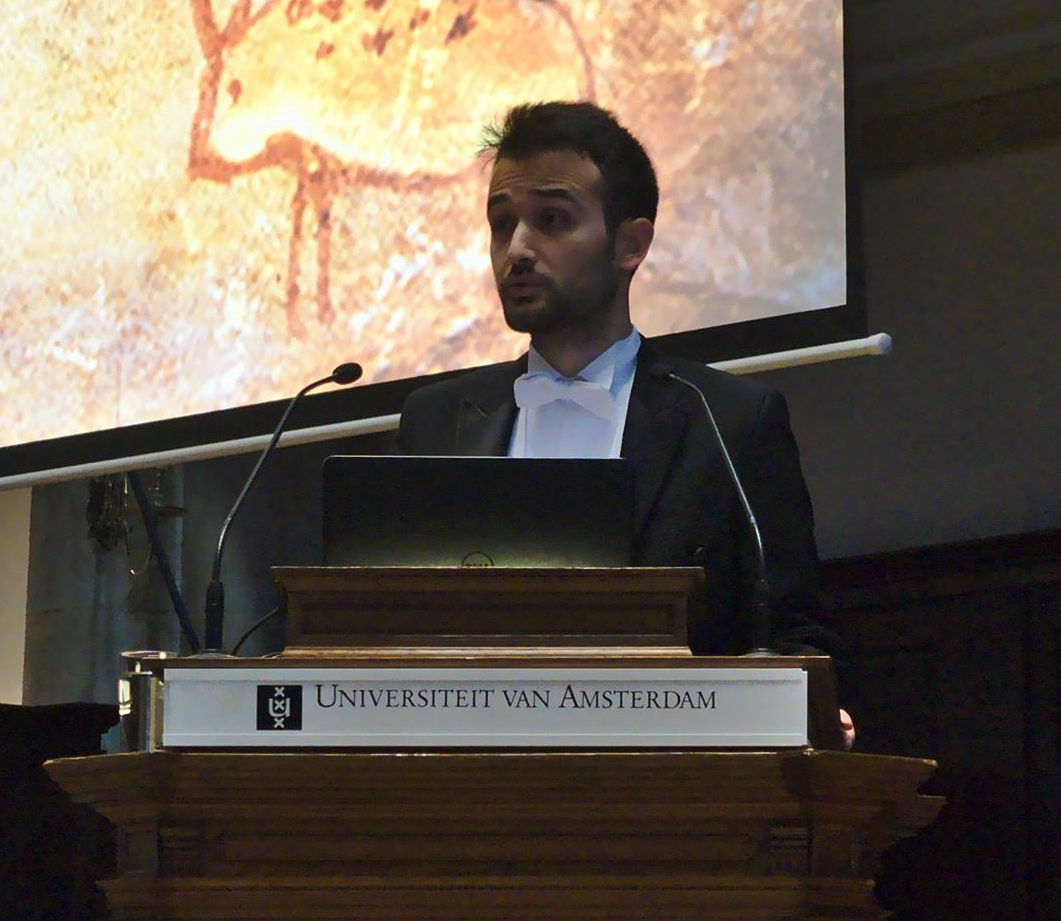
Sezer Karaoglu is a Lecturer and part-time postdoctoral researcher at the Computer Vision Group, Informatics Institute, University of Amsterdam. He is also the CTO and Co-Founder of 3DUniversum, a technology spin-off of the University of Amsterdam that provides state-of-the-art 2D/3D computer vision solutions. Additionally, he has co-founded other startups including Scanm and 3DHealthScan. Dr. Karaoglu received his PhD from the Computer Vision Group, Informatics Institute, University of Amsterdam, with research funded by the COMMIT project. His educational background includes a double master's degree: an optics, image and vision master's degree from University Jean Monnet in France and a media technology master's degree from Gjovik University College in Norway. He completed his undergraduate studies with honors at Istanbul Technical University in Telecommunication Engineering. His research focuses on Artificial Intelligence and 3D Computer Vision, with specific interests in SLAM, re-localization, 3D reconstruction, 3D object detection and segmentation, synthetic media, generative AI, deep fake creation and detection, and VR/AR technologies. His work has significant applications in healthcare, particularly in using deepfake technology for therapy for victims of sexual violence-related PTSD and moral injury, as documented in a Frontiers in Psychiatry article. Analyzing his recent publications reveals a strong trend toward neural scene reconstruction, intrinsic image decomposition, and the application of diffusion models to computer vision problems. His research increasingly integrates 3D scene understanding with language models, as evidenced by his work on language-to-3D scene generation. The applications span from healthcare (deeptherapy.ai) to media authenticity (deepfake detection) and industrial applications. ICT.OPEN Poster Award (3rd Position), Oct'13 Pascal VOC'12 Classification challenge, 2nd Position, Sep'12 Pascal VOC'12 Detection challenge, 3rd Position, Sep'12 Best project award at Nokia and CIMET project competition Outstanding reviewer at CVPR'21 PROVADA Future Startup Battle winner Best Dutch AI startup by Valuer Dr. Karaoglu has supervised numerous PhD, Master's, and Bachelor's students, demonstrating his commitment to academic mentorship. His research has attracted significant media attention, with features on Dutch national TV programs including NPO, VPRO, RTL, and international outlets like BBC News. He has received research funding through the COMMIT project during his PhD studies and has successfully translated his research into commercial applications through his startups. His work on deepfake technology has been applied in innovative therapeutic contexts through DeepTherapy.ai, showing the real-world impact of his research. Dr. Karaoglu leads research efforts at the Computer Vision Group Amsterdam and through his company 3DUniversum, which has developed applications like weScan, DeepTherapy, and FairFake.ai. His team collaborates with various institutions including the Netherlands Film Academy for grief therapy applications using deepfake technology. The DeepTherapy project represents a particularly impactful application of his work, using deepfake technology to help victims of sexual violence confront perpetrators in therapeutic settings.
Tudor Dumitras is an Affiliate Associate Professor at the University of Maryland, College Park, holding appointments in the Department of Electrical and Computer Engineering (ECE) and the Department of Computer Science (CS). He is affiliated with The Maryland Cyber Security Center (MC2), where he leads research initiatives in cybersecurity and cryptography. His work focuses on malware detection, system security, and analyzing real-world vulnerabilities like the Heartbleed bug. Dumitras has collaborated with institutions such as Northeastern and Stanford Universities on critical security challenges, including SSL certificate reissuance and revocation strategies. His research interests span machine learning applications in cybersecurity, network security protocols, and adversarial attack mitigation. Notable contributions include developing automated tools for vulnerability exploitation prediction (SCAVY) and investigating the robustness of machine learning models against adversarial examples. Dumitras advises PhD students Simge Tekin and Kamala Varma, focusing on advancing cybersecurity through data-driven approaches. Key projects include analyzing software adoption patterns, studying zero-day attacks, and improving PKI security. His work often bridges academic research with industry practices, leveraging big data from sources like Symantec's WINE system. Dumitras has published extensively on topics ranging from malware behavior analysis to hardware fault attacks on neural networks.
Alexander Bastounis is a Lecturer in Applied Mathematics at King's College London, affiliated with the Department of Mathematics and the King’s Institute for Artificial Intelligence. His research focuses on computational mathematics, optimization, and the trustworthiness of AI systems. He holds a PhD from the University of Cambridge and has held academic roles at institutions including Leicester University, City University of Hong Kong, and TU Berlin. Education: PhD in Applied Mathematics from DAMTP, University of Cambridge (2018). Earlier academic qualifications not specified. Research interests include foundational aspects of computational mathematics, AI limits and robustness, adversarial attacks, and inverse problems. His work explores computational barriers in estimation and learning, with recent attention on stealth attacks in AI models and feature selection reliability. Received the Leslie Fox Prize (2019) for work on inverse problems Contributed to SIAM News articles on compressed sensing and AI challenges Advising and grants: Currently supervises the EPSRC-funded project '50:50 Haleon/EPSRC DLA Studentship' (2025–2029). No listed students. Labs/teams: Active in King’s Institute for Artificial Intelligence and collaborates on interdisciplinary projects across computational mathematics and AI security.
Prof. Dr.-Ing. Stefan Schulte is a Full Professor at Hamburg University of Technology, leading the Institute for Data Engineering and the Christian Doppler Laboratory Blockchain Technologies for the Internet of Things (CDL-BOT). He holds a diploma in Economics and a Bachelor's in Computer Science from the University of Oldenburg, followed by a Master's in Information Technology (with Merit) from the University of Newcastle. After completing his PhD at TU Darmstadt in 2010, he held roles as Postdoctoral Researcher at TU Wien, Assistant Professor (tenure-track), and eventually Associate Professor before joining TU Hamburg in 2021. His research focuses on data engineering, blockchain technologies applied to IoT, elastic computing, and quality-of-service (QoS) aspects in smart systems. Notable contributions include work on fog computing, federated learning, and cross-blockchain interoperability. He has published over 140 papers in top-tier venues like IEEE Transactions on Services Computing and ACM Computing Surveys. Key awards include Best Paper Awards at the IEEE International Conference on Blockchain (2020) and the European Conference on Service-Oriented and Cloud Computing (2023). Prof. Schulte chairs major conferences such as the IEEE International Conference on Fog and Edge Computing (ICFEC 2025) and serves on editorial boards for journals like IEEE Transactions on Services Computing. He leads CDL-BOT, a lab exploring blockchain applications in IoT and manufacturing. His industrial collaborations include projects like SIMPLI-CITY (smart mobility) and CREMA (cloud-based manufacturing). Current research emphasizes blockchain interoperability, federated learning frameworks, and edge-AI systems. He actively reviews proposals for the German Research Foundation, EU programs, and industry initiatives.
Jonas Fritzsch is a Lecturer and Research Associate at the University of Stuttgart's Institute of Software Engineering (ISTE), specifically within the Empirical Software Engineering (ESE) department. He holds a postdoctoral position and focuses on advancing software architecture, microservices, and quality assurance methodologies. His research emphasizes modernizing monolithic applications through architectural refactoring and evaluating cloud-native systems' impacts on software quality. His work spans empirical studies on industry practices—such as challenges in microservices evolvability and résumé-driven development—as well as formal verification techniques for safety-critical systems. Dr. Fritzsch leads the Team Fritzsch , contributing to both academic publications and industrial collaboration. Key areas of exploration include: Migrating monolithic architectures to microservices with a focus on quality-driven methodologies Assessing software quality in cloud-native and DevOps environments Empirical investigations into developer behaviors and tool usability His advisory work includes guiding over 20 students in theses and projects, covering topics like LLM-powered paper discovery, refactoring tools, and microservices adoption in cyber-physical systems. Notable contributions include defining résumé-driven development and developing systematic approaches for microservice migration. His research bridges theoretical advancements with practical industry applications, emphasizing empirical validation and tool support.
Elaina Hyde is an Associate Professor in the Department of Physics and Astronomy at York University, serving as Director of the York Allan I. Carswell Observatory. She is affiliated with the Faculty of Science and eligible to supervise graduate students in the Physics and Astronomy program. Her research focuses on galactic archaeology, galaxy formation, and data science for astrophysics, leveraging cloud computing and machine learning. She has contributed to major initiatives like the GALAH survey and studies of the Sagittarius stream. Her work combines observational astronomy with technical leadership in telescope operations and public outreach. Hyde is also a certified Google Cloud Trainer and Engineer, integrating industry-level data science practices into academic and educational contexts. Education & Professional Background : While specific educational details are not listed, her roles indicate advanced expertise in astrophysics and data science. She has held technical and leadership positions in telescope operations and academic observatories. Research Interests : Hyde's work bridges computational and experimental astrophysics, emphasizing: Galactic archaeology via chemical and kinematic analysis of stellar populations Data-driven approaches to galaxy formation modeling Development of automated spectroscopic pipelines (e.g., GALAH survey) Machine learning applications for spectral classification and dimensionality reduction (e.g., t-SNE techniques) Astronomy education through public telescope access and interdisciplinary training Publications Overview : Her recent work focuses on the GALAH survey's chemical and kinematic inventory of the solar neighborhood, Sagittarius stream dynamics, and machine learning-enhanced spectral analysis. Key themes include stellar abundance trends in open clusters, tidal debris identification, and multi-survey data integration with Gaia. Labs & Teams : Leads the York Allan I. Carswell Observatory, fostering observational astronomy research and public engagement. Collaborates with global telescope networks and industry partners in cloud computing.
Yvo Desmedt is the Jonsson Distinguished Professor in Computer Science at the University of Texas at Dallas and Director of the Cyber Security Research and Education Institute. An IACR Fellow and member of the Belgium Academy of Science, he invented e-Passports and e-Visas in 1988. His research spans cryptography, quantum computing, network security, and critical infrastructure protection. Desmedt pioneered techniques in binary software hardening including control-flow integrity and object flow integrity protections. Recent innovations include crook-sourcing for intrusion detection improvement and confidential computing for deep learning inference. His work bridges theoretical cryptography with practical security applications, earning recognition including the NSF IUCRC Technology Breakthrough Award. With over 200 publications, he has chaired major conferences including Crypto and Public Key Cryptography. Current projects examine vulnerability detection using graph learning and renewable control-flow integrity mechanisms for software security.
Lane Harrison is an Associate Professor in the Department of Computer Science at Worcester Polytechnic Institute (WPI), where he directs the Visualization and Information Equity lab (VIEW). His research leverages cognitive and perceptual principles to improve information visualization and visual analytics systems, with critical applications in cybersecurity and health-risk communication for high-stakes decision-making. His educational background includes a BS (2009) and PhD (2013) in Computer Science from the University of North Carolina, Charlotte. Prior to WPI, he was a Postdoctoral Researcher at Tufts University's Visual Analytics Lab. Harrison's research focuses on empirical evaluation of visualization techniques , investigating how cognitive principles can optimize user performance with visual representations. He develops design guidelines for effective visualizations in domains like cybersecurity and healthcare, while creating adaptive systems that integrate models of user abilities. His work bridges theoretical foundations with practical applications to address real-world challenges in data interpretation. Analysis of his 2016-2021 publications reveals consistent emphasis on user-centered evaluation methodologies , including crowdsourcing and controlled experiments. Key trends include quantifying exploration behaviors in web visualizations, addressing cognitive biases in data reproduction, and developing healthcare-focused analytics for drug interactions and risk communication. His research demonstrates strong interdisciplinary connections between visualization, cognitive science, and domain-specific applications. His scientific recognition includes: Best Paper Award at ACM CHI 2016 for adaptive interface research Harrison secures significant research funding including an NSF Grant (2022) for visualization studies and participates in an 11-school AI collaboration for intelligence professionals (2025). He teaches data visualization and web programming courses, mentoring students through the VIEW lab on projects applying visualization techniques to social issues and scientific domains. He directs the VIEW lab at WPI, which develops computational methods to understand how people engage with data visualizations while emphasizing equitable information access. Current projects integrate user modeling with visualization systems to optimize design for diverse cognitive abilities and application contexts.
Tse-Hsun (Peter) Chen is an Associate Professor in the Department of Computer Science and Software Engineering at Concordia University, Montreal. He leads the Software PErformance, Analysis, and Reliability (SPEAR) lab, focusing on improving software quality through log analysis, AIOps, and mining software repositories. His research collaborates with companies like Microsoft, BlackBerry, and Ericsson. Education: PhD, MSc, and BSc in Computer Science from Queen's University and the University of British Columbia. Awards include the Gina Cody Research Award (2021) and recognition as one of the world's most active software engineering researchers (JSS study). Research interests include software testing, DevOps, and leveraging LLMs for SE tasks. Recent work emphasizes log parsing with LLMs (e.g., LibreLog) and fault localization. Graduates from his lab hold academic positions at institutions like York University and DePaul University. Teaching includes courses on software verification, testing, and process management. Active in program committees for ICSE, FSE, and MSR. Over 50 publications in top venues like TSE, ICSE, and FSE.
W. Michael Petullo is an Assistant Professor in the Department of Comp Sci & Comp Engineering at the University of Wisconsin-La Crosse. He holds a Ph.D. in Computer Science from the University of Illinois at Chicago, and prior academic degrees from DePaul University and Drake University. Before academia, he served a 20-year career in the Army, including roles teaching in the Department of Electrical Engineering and Computer Science and leading cyber operations software development. His research focuses on software and network security, operating systems, and open-source software development. Education: Ph.D. in Computer Science, University of Illinois at Chicago M.S. in Computer Science, DePaul University B.S. in Computer Science, Drake University Research Interests: His work emphasizes secure operating system design, network security protocols, and open-source tool development. Recent efforts include the Aquinas Learning System for courseware automation and PivotWall for SDN-based information flow control. He also explores user behavior in cybersecurity contexts and educational applications of cyber defense exercises. Teaching: Currently instructs CS120 (Software Design I), CS410/510 (Open Source Development), and CS455/555 (Fundamentals of Information Security). Past courses include operating systems concepts and secure software development. Labs & Projects: Maintains the Aquinas Learning System project and contributes to Ethos operating system research. Active in developing minimal-latency networking solutions and secure kernel interfaces.
Manuel Rigger is an Assistant Professor at the National University of Singapore in the School of Computing and leads the Trustworthy Engineering of Software Technologies (TEST) Lab . His research focuses on improving data-centric systems , particularly their reliability, having found over 1,000 unique bugs in database systems. Education : PhD in Computer Science (2019) and MSc in Software Engineering (2015) from Johannes Kepler University Linz; MPhil in Chinese Philosophy (2015) from Xiamen University Research Highlights : Developed SQLancer – an automated testing framework that found 500+ bugs in DBMSs; created Query Plan Guidance (QPG) for efficient logic bug detection; received best paper awards at ICSE '23 and EuroSys '24 Scientific Awards : Recipient of 6 distinguished artifact/reviewer awards Major industry support from Google, AWS, and Microsoft Developed tools adopted by Oracle GraalVM and SQLite Teaching : Lecturer for CS3213 Foundations of Software Engineering and CS6223 Advanced Topics in Software Testing . Supervises multiple PhD/MSc theses on database testing and compiler reliability.
Dr. Yulong Gao is an Assistant Professor in the Department of Electrical and Electronic Engineering at Imperial College London, affiliated with the Control and Power Research Group. He holds a B.E. in Automation from Beijing Institute of Technology (2013), M.E. in Control Science & Engineering (2016), and a joint Ph.D. in Electrical Engineering from KTH Royal Institute of Technology and Nanyang Technological University (2021). He has held postdoctoral positions at Oxford University and KTH. His research focuses on formal verification and control, machine learning, and their applications to safety-critical systems, including autonomous systems and control synthesis under uncertainty. His work emphasizes robust control strategies, data-driven optimization, and formal methods to ensure safety in dynamic systems. Recent publications address challenges in autonomous vehicle motion planning, risk-aware Bayesian neural networks, and adaptive task planning using temporal logic. He has contributed to stochastic modeling, distributed MPC, and resilient control under cyber-physical threats. Research affiliations include the Control and Power Research Group at Imperial College London, leveraging interdisciplinary collaboration to advance theoretical and applied control systems research.
Dr. Leonie Baumann is an Assistant Professor in the Department of Economics at McGill University, specializing in Economic Theory, Networks, Mechanism Design, and Game Theory. She holds a Ph.D. (summa cum laude) and M.Sc. in Economics from the University of Hamburg, and dual B.A. degrees from the University of Siegen. Currently on maternity leave, Dr. Baumann previously served as a Postdoctoral Research Associate at the University of Cambridge. Her research explores social interactions in microeconomic theory, with a focus on network formation dynamics, strategic evidence disclosure, and robust implementation mechanisms. Recent work examines how network structures influence economic decision-making and resource allocation. Dr. Baumann's publications demonstrate consistent focus on network economics and game-theoretic modeling, with emerging applications in discrimination mechanisms and evidence disclosure. Her methodological approaches combine theoretical rigor with computational innovations. Awards & Recognition: Vice-Chancellor's Innovation Award (2020) Econometric Society Travel Grant (2015) Multiple research grants including SSHRC and FQRSC funding Supervision & Service: Currently advising 4 doctoral students on topics ranging from biosolvent characterization to indoor air quality Active editorial board member for Journal of Mathematical Economics Organizes international conferences on economic theory
Arno Siebes is Professor of Algorithmic Data Analysis in the Department of Information and Computing Sciences at Utrecht University's Faculty of Science. His research focuses on data mining methodologies, particularly pattern mining and Minimum Description Length (MDL) principles. Key research areas include: Developing efficient algorithms for pattern discovery Applying MDL to data characterization Creating interpretable models for complex datasets Addressing challenges in data science education Recent publications demonstrate applications in diverse domains including mobility analysis, genomic screening, and pandemic response. His work combines theoretical foundations with practical implementations for knowledge discovery.