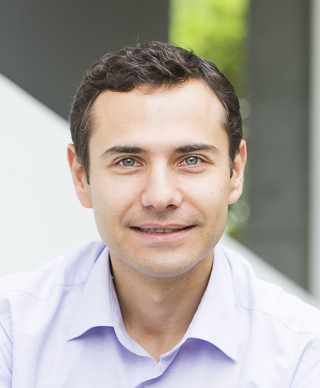
Roberto Togneri is a Professor and Senior Honorary Research Fellow at the University of Western Australia's School of Electrical, Electronic and Computer Engineering. He has been affiliated with the university since 1988, following his PhD in 1989. His research focuses on signal processing, speech recognition, machine learning, and biometrics, with notable contributions to audio-visual recognition systems and fraud detection. Education: PhD in Electrical Engineering (University of Western Australia, 1989). Research interests include feature extraction for audio signals, neural network models for speech and speaker recognition, and applications of machine learning to fraud prevention. His work has been recognized with awards such as the Education Innovation Award (ICASSP 2019) and grants from the Australian Research Council (e.g., DP110103336 for a 3D Audio-Visual Speech Recognition System). Key projects include developing robust speech recognition systems in adverse environments and advancing graph-based fraudster group detection using spatio-temporal data. He has also contributed to editorial roles in IEEE Signal Processing Magazine and authored over 214 research outputs. Funding highlights include $279,000 for a 3D audio-visual speech recognition system (2011–2013) and $230,000 for robust speech recognition in hostile environments (2010–2012). His research aligns with UN SDGs related to innovation and infrastructure.
Prof Raphaël Phan is a Professor and Deputy Head of the School of IT at Monash University Malaysia. His expertise spans security, cryptography, malicious AI, emotion recognition, motion analysis, and generative AI. He has published over 220 papers and led significant projects including privacy-preserving data mining funded by UK MoD and Malaysian government grants exceeding RM4 million. He co-designed the BLAKE hash function (SHA-3 finalist) and has an h-index of 50. Education: PhD in Cryptography (Multimedia University, 2005), MEngSci (2001), BEng (Hons) Computer Engineering (1999). Research focuses on adversarial AI, brain networks, and secure systems. Current projects include Æmbience: emotion-aware virtual assistants using motion magnification. Supervised 15 PhD graduates and 19 current students. Professional affiliations: Chartered Engineer (IET, UK), HEA Fellow, Board of Engineers Malaysia. Recent work emphasizes causal bias detection in micro-expressions, brain tumor detection via advanced YOLOv8, and generative adversarial networks for medical imaging. His work bridges cybersecurity with neuroscience applications.
Associate Professor Dan Dongseong Kim is Deputy Director of UQ Cybersecurity and an Associate Professor at The University of Queensland (UQ), Australia. Previously, he held permanent academic positions at The University of Canterbury (UC), New Zealand (2011-2018) as a Senior Lecturer and Lecturer. His research focuses on Cybersecurity and Dependability for AI, IoT, Autonomous Vehicles, Cloud Computing, and Moving Target Defenses (MTD). Doctor of Philosophy in Computer Engineering from Korea Aerospace University Postdoctoral Research at Duke University (2008-2011) Visiting Scholar at University of Maryland (2007) Dan's work explores Graphical Security Models , Moving Target Defense for proactive resilience, and AI-Driven Cybersecurity with emphasis on adversarial robustness and interpretable models. His recent publications (2024-2025) span journals like IEEE Transactions on Dependable and Secure Computing and conferences such as DSN , addressing automated defense, evolving attacks, and hardware-aware security frameworks. He has advised 15 Ph.D. graduates, including researchers now at institutions like RMIT University, La Trobe University, and CSIRO's Data61. Current supervision includes projects on Automated Penetration Testing , AI-Based Intrusion Response , and Moving Target Defense . Dan's research is funded by agencies including the Republic of Korea's Agency for Defence Development and US Army Research Lab . His professional roles include Associate Editor for IEEE Communications Surveys and Tutorials and Steering Committee Chair for IEEE PRDC .
JuHyun Lee is an Associate Professor of Architecture and Computational Design in the School of Built Environment at the Faculty of Arts, Design and Architecture (ADA), University of New South Wales (UNSW) Sydney, where they also hold the prestigious title of Scientia Academic. With a professional background in architecture and construction (1998-2002), they have held academic positions across Australia including a five-year post-doctoral fellowship at the University of Newcastle (2012-2017) and a senior research fellowship at the University of South Australia (2018), following earlier research and teaching roles in South Korea (2003-2011). Lee specializes in architectural design computing, design cognition, and urban complexity, integrating computational methods, cognitive science, and architectural theory to advance architectural intelligence and human-centered design. Their research spans architectural visualization, analysis and design methods, algorithm/protocol design, and data visualization with computational approaches. They have established a strong research program examining the intersection of language, culture, and design cognition, particularly focusing on cross-cultural design communication between Australia and Korea. Lee's recent publications demonstrate a clear trajectory toward increasingly sophisticated integration of computational methods with architectural design theory, particularly in the areas of shape grammar, space syntax, and machine learning applications. Their work shows consistent focus on practical applications of computational design methods to real-world architectural problems, with growing emphasis on cross-cultural collaboration and intelligent design systems. The research portfolio reveals a deepening engagement with AI and machine learning techniques applied to architectural design assessment and generation. Scientia Academic at UNSW Sydney Associate Fellow of the Higher Education Academy (AFHEA, 2020) As an educator, Lee develops cutting-edge courses in computational design and Building Information Modeling (BIM), integrating experiential learning and industry engagement. They have secured over $11 million in research funding, including multiple ARC Discovery Projects and an Australia-Korea Foundation grant. Lee co-directs the Advanced Architectural Analytics Laboratory (A 3 LAB), leading interdisciplinary research on design automation, spatial analysis, and machine learning applications in architecture, while also leading cross-cultural initiatives like the Australia-Korea Architects' Network (AKAN). Lee supervises multiple HDR students working on culturally sustainable urban design, socio-spatial patterns in public housing, and computational layout generation. Their research has significant implications for improving design communication across cultural boundaries and developing more coherent, clear, and accessible built environments through computational design approaches.
Dr. Bo Liu is an Associate Professor in the School of Computer Science at the University of Technology Sydney (UTS), where he serves as a core member and director of the AI Security and Privacy (AISP) Research Lab at the Australian Artificial Intelligence Institute (AAII). With expertise spanning cybersecurity, privacy protection, AI and machine learning, and wireless communications, Dr. Liu has established himself as a leading researcher in the field of AI security and privacy. Dr. Liu earned his PhD from the Department of Electronic Engineering at Shanghai Jiao Tong University in 2010. His academic journey at UTS has progressed from Senior Lecturer (November 2019-December 2022) to his current position as Associate Professor (January 2023-present). Dr. Liu's research focuses on the critical intersection of artificial intelligence and security, particularly addressing emerging threats in the age of advanced AI systems. His work spans multiple dimensions of security and privacy, including deepfake detection, privacy-preserving data synthesis, AI model security, and fair machine learning. He has pioneered approaches to detect AI-generated content, protect visual privacy through de-identification techniques, and address the complex relationship between algorithmic fairness and privacy preservation. His publication record demonstrates significant contributions across multiple cutting-edge research areas, with particular emphasis on detecting and mitigating threats from generative AI systems. His recent work reveals a strong focus on deepfake detection across multiple modalities (images, video, and audio), privacy-preserving techniques for sensitive data, and the security implications of emerging AI architectures like Retrieval-Augmented Generation systems. Dr. Liu has secured substantial research funding, including as Lead Chief Investigator on multiple ARC Discovery and Linkage Projects, totaling over $3.5 million AUD. His industry collaborations include partnerships with the NSW Department of Planning and the Reserve Bank of Australia, demonstrating the practical applicability of his research. As an academic leader, Dr. Liu serves as Associate Editor for IEEE Transactions on Broadcasting and actively contributes to the academic community through conference organization, peer review for top-tier venues, and assessment for ARC grant schemes. He also teaches courses including Penetration Testing, Ethical Hacking and Offensive Security, and supervises Masters and PhD students in cybersecurity and privacy research.
Associate Professor Fengling Han is affiliated with RMIT University's School of Computing Technologies in Melbourne, Australia. He holds the rank of Associate Professor since January 2022. His research focuses on complex networks, industrial electronics, AI/machine learning, and network security. Notable contributions include steganography frameworks for healthcare data, sliding mode control for energy systems, and blockchain applications in surveillance and voting systems. His work spans interdisciplinary areas such as renewable energy integration, battery management systems, and privacy-preserving recommendation systems. He has supervised numerous projects, including AI-driven chatbots, medical imaging watermarking, and peer-to-peer energy trading systems. Han's service roles include conference reviewing and committee memberships in international conferences like IEEE and ISMST. Research Interests: His expertise spans electrical engineering, control systems, and AI applications. Key areas include battery management, cybersecurity, and smart manufacturing. Recent projects emphasize Industry 5.0 technologies, blockchain for data integrity, and deep learning for steganalysis. Teaching and Supervision: Teaches network security, data communication, and IT infrastructure. Current supervision includes AI-powered business modeling, medical imaging tampering detection, and renewable energy sharing systems. Over 14 research projects are documented, reflecting his interdisciplinary impact. Awards and Recognition: While specific awards are not listed, his extensive publications (over 150 outputs) and high citation counts (e.g., 119 citations for the Industry 5.0 survey) highlight his scholarly contributions.
Chee-Ming Ting is an Associate Professor in the School of Information Technology at Monash University Malaysia. His expertise lies in machine learning, data science, and biomedical engineering, with a focus on signal processing, computational neuroimaging, and computer-aided detection. Previously, he held positions at King Abdullah University of Science and Technology (Research Scientist) and Universiti Teknologi Malaysia (Senior Lecturer). He has authored over 26 journal papers and 43 conference papers, and has secured research grants totaling RM2.5 million as PI/Co-PI. Education: PhD in Mathematics - Statistics, Master of Engineering in Electrical Engineering, and Bachelor of Engineering (Hons.) in Electrical & Electronics Engineering. Research interests include biomedical signal/image analysis, deep learning, spatio-temporal modeling, and neuroimaging applications for disease prediction and patient monitoring. He has supervised 9 graduate students (4 PhD, 5 Masters) and currently oversees 10 PhD candidates. Awards include the IEEE Signal Processing Society Malaysia's Research Excellence Award (2019, 2022) and several national/international innovation awards. His work contributes to UN Sustainable Development Goals related to health and technological advancement. Key projects include frameworks for neurological disease prediction using brain networks and generative adversarial networks for medical imaging enhancement.
Associate Professor Tongliang Liu is affiliated with the School of Computer Science at the University of Sydney, serving as Director of the Sydney Artificial Intelligence Centre and Trustworthy Machine Learning Lab. He holds a BEng and PhD, and is an ARC Future Fellow. His research focuses on trustworthy machine learning, including adversarial defense, causal representation learning, and robust AI systems. He has authored over 200 papers in top venues like NeurIPS and ICML, and serves as co-Editor-in-Chief of Neural Networks. Research Interests: Developing reliable algorithms for machine learning, emphasizing generalizability and safety. Specific areas include learning with noisy labels, causal inference, and foundational model ethics. He aims to bridge theoretical guarantees and practical applications in computer vision and data mining. Awards: 2024 CORE Award, 2023 IEEE AI's 10 to Watch, 2022 ARC Future Fellowship. Notable recognitions include Eureka Prize shortlist and DECRA. Advising & Grants: Supervises 12 PhD/Master’s students on topics like trustworthy AI, causal discovery, and quantum machine learning. Leads grants on robust learning and AI safety. Labs: Sydney AI Centre and Trustworthy Machine Learning Lab.
Professor Jes Sammut is a faculty member at the University of New South Wales (UNSW) in the School of Biological, Earth & Environmental Sciences . He serves as Deputy Dean for External Engagement and leads the UNSW Aquaculture Research Group , while also holding the position of Deputy Director (International) at the Centre for Marine Science & Innovation. Additionally, he is an Honorary Research Fellow at ANSTO , where he uses nuclear tools to study seafood provenance. His research spans biological, physical, and social sciences, focusing on aquaculture solutions across Australia, Vietnam, Papua New Guinea, Indonesia, India, Thailand, and the Philippines.
Julia Powles is an Associate Professor at the UWA Law School and Director of the UWA Tech & Policy Lab. Her research focuses on privacy, intellectual property, internet governance, and the legal and political dimensions of data, automation, and AI. She has led investigations into high-profile cases like the NHS/Google DeepMind data breach and Sidewalk Labs’ smart city project. Currently, she advises on national robotics strategy, responsible AI, and privacy policies in Australia. With a background spanning academia, policy, and law, she holds roles in global committees and contributes to media outlets like the New Yorker and Financial Times. Her work bridges legal frameworks and technological innovation, emphasizing ethical governance and societal impact. Education: BSc (Hons) ANU, LLB (Hons) UWA, BCL Oxford, PhD Cantab. Expertise includes AI ethics, data privacy, and regulatory policy. Recent projects address drone delivery systems, corporate accountability of Big Tech, and governance in health monitoring. Awards include the 40 Under 40 Award for WA (2022) and Poynter Fellowship (2018). Grants include the Children’s Online Safety Program (2024–2027) and Minderoo Foundation initiatives. She chairs the PRIS Universities Network and co-chairs international tech policy summits. Roles: Director, UWA Tech & Policy Lab; Expert on National AI Centre, WA Privacy Committee. Research: Over 100 outputs, focusing on AI governance, corporate liability, and tech ethics.
Dr. Guangyao Si serves as an Associate Professor at the School of Minerals and Energy Resources Engineering, University of New South Wales (UNSW). With extensive international experience studying and working across three continents, he has established himself as a prominent researcher in mining engineering disciplines. His educational background includes graduating as the top student from China University of Mining Technology in 2010, followed by a PhD at Imperial College London under Professor Sevket Durucan. After completing his thesis in 2015, he continued as a Research Associate at Imperial College London until December 2017, when he joined UNSW. Mining Engineering Mine Ventilation Rock Mechanics Mine Safety Coal Mine Methane Geomechanics and resources geotechnical engineering Applied geophysics Dr. Si's research program focuses on developing safer, smarter, and more sustainable mining technologies. His work spans coal seam gas capturing and utilization, goaf management, spontaneous combustion prevention, multiphysics coupled simulation, mining-induced seismicity management, and machine learning applications in mining. His research integrates reservoir engineering, geophysics, geostatistics, and geomechanics to address modern mining industry challenges. With over AUD 12 million secured in research funding as lead or co-investigator, his projects include significant ARC Linkage and ACARP grants addressing critical mining safety and efficiency issues. His work demonstrates strong industry relevance through collaborations with major mining companies including Anglo American, Glencore, BMA, South32, and Centennial. Research Excellence (Early Career) Award-Faculty of Engineering UNSW Excellent Scientific Editor (JRMGE, 2022) Best Reviewer (IJCS&T, 2022) High Impact Paper Award (Engineering Journal) MINESOC Best Lecturer (2018) Unearthed Young Innovator Award (2018) Dr. Si actively supervises numerous PhD students across mining health and safety, mining geomechanics, mining-induced seismicity, and mine ventilation research areas. He teaches core mining engineering courses including Mining Geomechanics (MINE3310), Mine Ventilation (MINE3510), Mining Systems (MINE3430), and Advanced Mine Ventilation (MINE4510). He serves on the Editorial Board of the Journal of Rock Mechanics and Geotechnical Engineering and is a member of the International Rock Mechanics Society, Australasian Institute of Mining and Metallurgy, and Society of Mining, Metallurgy and Exploration.
Dongming Xu is an Associate Professor in Business Information Systems at the University of Queensland Business School. She holds a PhD from the City University of Hong Kong in Information Systems and has established herself as a prominent researcher in the field of information systems with over 100 publications in top-tier journals and conference proceedings. Her educational background includes a PhD from City University of Hong Kong in Information Systems, though specific details about earlier degrees are not provided in the available text. Dr. Xu's research focuses on the confluence of information technology use and innovation, with particular emphasis on IT entrepreneurship, social media applications in business contexts, and business intelligence systems. Her work explores how information systems influence society and business performance, with applications spanning disaster management, eFinance, eHealth, and knowledge management. She combines theoretical model building with laboratory and field experiments, often developing prototype systems to validate her research. Her publication record demonstrates consistent high-quality output across multiple domains of information systems research, with recent work emphasizing digital disruption, platform ecosystems, social media in disasters, healthcare technology, and micro-learning applications. Her research shows a clear trajectory from foundational work on intelligent agents and decision support systems toward contemporary topics in digital transformation and platform-based innovation. Associate Editor, Information & Management Associate Editor, Journal of Electronic Commerce Research Associate Editor, Australasian Journal of Information Systems Dr. Xu has supervised numerous PhD students to completion, with research topics spanning digital disruption, IT startup development, social media in disasters, conceptual modeling, and environmental management. She has received multiple research grants, including current funding for 'Empowering Australia's Visual Arts via Creative Blockchain Opportunities' (2023-2026) and past projects on 'Smart micro learning with open education resources' (2018-2022). Her research has been supported by various agencies including the Hong Kong Government Research Grant Council, The National Natural Science Foundation of China, The University of Queensland, and City University of Hong Kong. She leads research in several key areas including IT entrepreneurship, business intelligence systems, and social media applications across multiple domains. Her work often involves developing innovative systems such as web-service-agent-based family wealth management systems, decision support systems for securities exception management, and knowledge management systems for disaster management.
Professor Valentyn Panchenko is a leading academic in Economics at the UNSW Business School, specializing in advanced econometric methodologies and financial modeling. Holding a PhD from the University of Amsterdam and an MPhil from the Tinbergen Institute, his research bridges theoretical econometrics with real-world financial applications, emphasizing big data analysis, network structures, and dependence modeling in economic systems. His expertise spans financial econometrics, time series analysis, non-parametric statistics, and agent-based economic simulations. He focuses on Granger causality, model evaluation, structural economic modeling, and bounded rationality with heterogeneous agents. His work has secured significant grants including ARC Discovery Projects and DECRA fellowships, enabling cutting-edge research on market dynamics and economic interactions. Professor Panchenko's publications appear in top-tier journals like the Journal of Econometric Theory, AEJ: Micro, Journal of Economic Dynamics & Control, and Journal of Banking & Finance. His methodological contributions include novel approaches to copula-based forecasting, nonlinear causality testing, and evolutionary learning models in strategic economic environments. While specific student advising details aren't provided, his research leadership demonstrates sustained impact across econometric theory, financial markets, and experimental economics.
Professor Ibrahim Khalil is a faculty member in the School of Computing Technologies at RMIT University, Melbourne, Australia. He holds a PhD in Computer Science from the University of Bern (2003) and has extensive industry experience in Silicon Valley focusing on secure network protocols. His research spans Security, Privacy, Federated Learning, Blockchain, Quantum Computing, and Distributed Systems. He leads high-impact projects funded by ARC grants (DP250100582, DP220100215, etc.) and international initiatives like the EU’s SELFY project. His work addresses challenges in secure AI data analytics, privacy-preserving systems, and critical infrastructure protection. Khalil supervises PhD/Masters students on topics ranging from federated learning security to quantum-enhanced machine learning. Education: PhD in Computer Science (University of Bern, 2003); prior roles at EPFL, Osaka University, and industry tech hubs. Research Interests: Privacy-Preserving Technologies Blockchain Applications in Healthcare and Supply Chains Quantum Computing for Machine Learning Secure Edge Computing and Federated Learning IoT Security and Critical Infrastructure Protection Grants & Collaborations: Over 10 major grants since 2017, including ARC Discovery/Linkage Projects and international partnerships (QNRF, EU). Notable projects include Privacy-Aware Digital Twins for Critical Infrastructure and Federated Learning frameworks for GenAI models. Advising & Labs: Active supervisor of 25+ research projects since 2013, focusing on anomaly detection, secure data analytics, and blockchain-based systems. Collaborates with industry partners on defense and healthcare tech.
Associate Professor Mahsa Baktashmotlagh is an ARC Future Fellow at the School of Electrical Engineering and Computer Science, University of Queensland. Her research focuses on machine learning techniques applied to visual data analysis, biomedical data (e.g., antibacterial activity prediction), and cybersecurity. She holds a PhD from the University of Queensland (2014) and has contributed to over 50 peer-reviewed publications. Her research interests include domain adaptation, deep learning, and robust generalization across domains. Notable contributions include the development of DI-NIDS (a domain-invariant network intrusion detection system) and advancements in open-set domain adaptation. Her work bridges theoretical machine learning with practical applications in healthcare and computer vision. Education: PhD in Machine Learning, The University of Queensland (2014) Awards: ARC Future Fellowship (202X) Research Themes: Domain Adaptation, Cybersecurity, Biomedical AI Her recent work explores challenges in cross-domain generalization, adversarial machine learning, and scalable 3D object detection. She is actively involved in supervising graduate students and collaborates on interdisciplinary projects involving robotics and medical imaging.