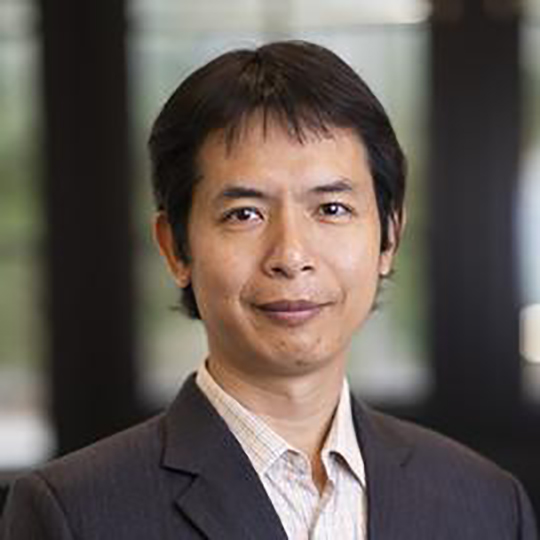
Dr. Peichen Zhong is an Assistant Professor in the Department of Materials Science and Engineering at the National University of Singapore (NUS). He leads the Applied Machine Learning and Materials Modeling (AM³) Group, focused on advancing computational methods for clean energy technologies. His research integrates machine learning with atomistic simulations to tackle challenges in battery materials, disordered materials, and sustainable energy systems. Education: B.S. in Physics from University of Science and Technology of China (2018); Ph.D. in Materials Science from UC Berkeley (2023, advised by Prof. Gerbrand Ceder); Postdoctoral training at Lawrence Berkeley National Lab and BIDMaP, co-advised by Persson, Cheng, and Krishnapriyan. Research Interests: Computational modeling of battery cathodes/electrolytes, AI-driven interatomic potentials, statistical mechanics in disordered materials, and generative models for scientific discovery. Key areas include Li/Na-ion batteries, solid-state reactions, and sustainable energy materials. Awards: BIDMaP Emerging Scholar Fellowship (UC Berkeley CDSS, 202?), 2023 Rising Stars in Materials Science (CMU/MIT/Stanford). Labs/Teams: The AM³ Group at NUS MSE focuses on interdisciplinary research combining theory, computation, and AI4Science. Current openings include PhD students and postdoctoral researchers.
Dr. Wenwu Xu is an Associate Professor in the Department of Mechanical Engineering at San Diego State University (SDSU), affiliated with the College of Engineering. His research focuses on advanced materials science, nanotechnology, and computational modeling of material behavior. He specializes in investigating dislocation dynamics, electric field effects on materials, and the development of novel processing techniques for metallic and ceramic composites. His work spans topics such as hydrogen embrittlement, nanocrystalline material properties, and 3D printing of bioinspired structures. He employs molecular dynamics simulations, atomistic modeling, and experimental validation to study material deformation, sintering mechanisms, and phase stability. Xu’s contributions include pioneering quasi-instantaneous materials processing via high-intensity electrical nano-pulsing and designing recyclable piezoelectric composites for wearable sensors. His research has been published in over 40 peer-reviewed articles since 2007, reflecting a sustained focus on nanoscale material behavior, thermodynamic stability, and industrial applications. While no awards are explicitly listed, his extensive publication record underscores his expertise in materials engineering and computational methods. Dr. Xu’s lab (via mmm.sdsu.edu ) likely explores cutting-edge materials processing and characterization techniques, though specific grants or advising roles are not detailed in the provided text.
Dane Morgan is a Professor in the Department of Materials Science & Engineering at the University of Wisconsin-Madison, College of Engineering. His research focuses on computational materials science for materials design, including ab initio electronic structure modeling, multiscale methods, and machine learning applications in materials discovery. His work spans nuclear materials, battery and fuel cell electrodes, and electronic materials. Education : PhD, 1998, University of California, Berkeley MS, 1994, University of California, Berkeley BA, 1992, Swarthmore College Research Interests : Computational materials science, ab initio methods for electronic structure and thermokinetics, machine learning for materials discovery, electrochemical systems modeling, and applications in nuclear materials, batteries, and electronic materials. His work integrates advanced computational techniques with experimental validation. Scientific Awards : 2024 APL Materials, Editors Pick 2023 Microscopy and Microanalysis Best Paper Award (Instrumentation and Software category) 2023 IEEE Transactions on Plasma Science Best Paper Award 2023 Kellet Mid-Career Award 2015 TMS Materials Genome Initiative Ambassador 2006 3M Technical Nontenured Faculty Grant
Dr. Kristin A. Persson is a Professor and Daniel M. Tellep Distinguished Professor in Engineering at the University of California, Berkeley's Department of Materials Science and Engineering. She leads the Persson Group at Lawrence Berkeley National Laboratory (LBNL), focusing on atomistic computational methods for energy materials. As director of the Materials Project, she pioneers high-throughput computing and data-driven approaches to accelerate material discovery for clean energy applications, including batteries, electrolytes, and photocatalysts. Her research spans lithium-ion and multivalent batteries, with a focus on electrolyte design, interfacial chemistry, and sustainable materials. Persson has directed the Materials Project since its inception, a global initiative to computationally predict material properties and provide open-access data. She holds affiliations with LBNL’s Energy Sciences Area and collaborates with industry and academia on projects like the Electrolyte Genome and piezoelectric materials databases. Key achievements include election to the National Academy of Engineering (2025), Royal Swedish Academy of Sciences (2024), and Fellowships from the AAAS (2022) and APS (2021). Her group’s work has produced over 200 publications, with recent highlights on disordered cathodes, ML-driven material predictions, and circular polymers. Persson advises a dynamic team of ~50 graduate students, postdocs, and staff, fostering interdisciplinary innovation in energy storage and materials informatics. Awards include DOE’s Distinguished Scientist Fellowship (2024), Cyril Stanley Smith Award (2022), and Web of Science Highly Cited Researcher recognition (2020). Her lab’s infrastructure supports projects from computational workflows to experimental collaborations, with a focus on translating theory into real-world energy solutions.
Mathias Niepert is a Professor at the Institute for Artificial Intelligence within the Faculty of Computer Science, Electrical Engineering and Information Technology at the University of Stuttgart. His research focuses on advancing machine learning techniques with applications in scientific computing, graph neural networks, and medical imaging. He is particularly known for contributions to physics-informed neural networks, equivariant models, and graph learning frameworks. Key research areas include: Scientific Machine Learning for PDEs and molecular modeling Graph neural networks and their theoretical limitations Medical vision-language models and multimodal learning Efficient neural network architectures (transformers, FNOs) Domain knowledge integration in deep learning His work often bridges theoretical foundations with practical applications, as evidenced by extensive publications (2018–2025) on topics like adaptive message passing, equivariant networks, and medical imaging systems. He has contributed to benchmark development through initiatives like PDEBench and pioneered methods for equivariant diffusion models and molecular representation learning. His current projects emphasize: Improving generalization in Fourier Neural Operators Addressing oversmoothing in graph networks Combining physics principles with neural architectures Medical AI applications through multimodal fusion
Dr. Xiaofeng Qian is an Associate Professor in the Department of Materials Science & Engineering at Texas A&M University, with joint appointments in Physics and Astronomy, and Electrical & Computer Engineering. His research focuses on materials theory , quantum materials design , and high-throughput computational discovery , particularly for 2D materials and energy applications . Educational Background: Ph.D., Nuclear Science and Engineering, Massachusetts Institute of Technology (2008) B.S., Engineering Physics, Tsinghua University (2001) Research spans first-principles electronic structure methods , nonlinear optical responses , and multiscale modeling of electronic, thermal, and ionic transport. Key areas include quantum spin Hall effect , ferroelectric switching , and machine learning for materials prediction . Notable Awards: Dean of Engineering Excellence Award (2024) Engineering Genesis Multidisciplinary Award (2024) AZZ Faculty Fellow (2021) NSF CAREER Award (2018) Manson Benedict Fellowship (2006) Actively recruiting PhD, MS, and UG researchers with backgrounds in physics, materials science, or computational methods. Collaborates extensively on hybrid AI-materials projects and topological device concepts .
Arslan Mazitov is a Researcher and Doctoral Assistant at the École Polytechnique Fédérale de Lausanne (EPFL) , affiliated with the School of Engineering (STI) and the Institute of Materials (IMX) . He is part of the Computational Science and Modelling Laboratory (COSMO) , focusing on computational materials science with an emphasis on van der Waals materials, optical properties, and machine learning applications. His research explores novel materials for photonics, energy storage, and nanotechnology. Mazitov's work bridges theory and experiment, employing advanced modeling techniques to predict material behavior and design innovative solutions. Key research areas include van der Waals heterostructures , optical anisotropy engineering , and AI-driven materials discovery . He has contributed to studies on semiconductors, 2D materials, and interfacial phenomena. His computational methods address challenges in predicting material stability, optical properties, and surface behavior under various conditions. Active in collaborative projects, Mazitov's work has practical implications for photonic devices, energy storage systems, and nanoscale engineering. His research emphasizes interdisciplinary approaches, combining computational modeling with experimental validation to advance material innovation.
Professor Rodrigo Freitas holds the TDK Professorship in Materials Science and Engineering at MIT. His research focuses on computational materials design, bridging atomistic simulations with mesoscale microstructural analysis. He leads the Freitas Research Group, specializing in machine learning-driven modeling of materials kinetics and solidification processes. Education: B.S. and M.S. in Physics, University of Campinas, Brazil M.S. and Ph.D. in Materials Science & Engineering, UC Berkeley Research Interests: Professor Freitas investigates microstructural evolution in metals and alloys using advanced computational methods. Key areas include solidification mechanisms, interstitial atom behavior in superalloys, and machine learning applications for materials discovery. His work emphasizes bridging atomistic and mesoscale phenomena to guide industrial applications like semiconductor manufacturing and battery design. Publications Trend: Recent work emphasizes machine learning potentials for alloy modeling, short-range order analysis in high-entropy alloys, and kinetic modeling of complex chemical systems. Themes include alloy phase stability, defect dynamics, and data-driven materials discovery. Labs/Teams: Leads the Freitas Research Group at MIT, which develops novel computational tools for materials engineering.
Prof. Dr. Ulrich Kleinekathöfer is a Full Professor of Theoretical Physics at Constructor University (formerly Jacobs University Bremen) in the School of Science. His research focuses on computational physics and biophysics, particularly on light-harvesting complexes, membrane transport, and quantum dynamics in biological systems. He leads the Computational Physics and Biophysics research group and coordinates the MSCA Doctoral Training Network "PhotoCaM". His educational background includes: PhD from Max-Planck-Institut für Strömungsforschung, Göttingen (1996) Diploma in Physics from Universität Göttingen (1993) Habilitation in Physics from Technische Universität Chemnitz (2002) Prof. Kleinekathöfer's research spans multiple areas of computational biophysics and theoretical physics. His primary interests include excitation energy transfer in light-harvesting complexes , molecular transport through membrane channels and nanopores , and quantum dynamics in open systems . His group develops and applies advanced computational methods including molecular dynamics simulations, quantum chemistry calculations, and machine learning approaches to study these phenomena. A significant portion of his work focuses on photosynthetic systems, particularly how energy is transferred and converted in natural light-harvesting complexes, with implications for renewable energy technologies. His recent publications demonstrate a strong trend toward integrating machine learning with traditional computational methods, particularly in the fields of quantum chemistry and molecular dynamics. There's a clear focus on multifidelity approaches that balance computational efficiency with accuracy. His work spans from fundamental quantum dynamics to applied research on antibiotic transport mechanisms, showing remarkable breadth while maintaining depth in computational methodology development. His notable recognition includes: Tan Chin Tuan Exchange Fellowship, NTU Singapore (2019) Prof. Kleinekathöfer has supervised numerous PhD students and postdoctoral researchers, with a current group comprising several PhD candidates and research associates. His research is supported by multiple funding sources including the Deutsche Forschungsgemeinschaft (DFG), European Union through MSCA Doctoral Network PhotoCaM, and previously through the Innovative Medicines Initiative "Translocation" and Marie Curie Training Program "Translocation". His collaborative network spans internationally, with partnerships at institutions in Germany, USA, Greece, and Switzerland. The Computational Physics and Biophysics Group operates within Constructor University's research infrastructure, utilizing high-performance computing resources for their simulations. The group maintains active collaborations with experimental groups to validate and inform their computational models, creating a strong interdisciplinary research environment focused on understanding fundamental biophysical processes at the molecular level.
Chandrika Sadanand is an Assistant Professor in the Department of Mathematics at Bowdoin College. She holds a PhD from Stony Brook University and a BS from the University of Toronto. Her research focuses on low-dimensional topology and geometry, specifically exploring curves on surfaces, hyperbolic geometry, billiards, translation surfaces, and 3-manifolds. She has held postdoctoral positions at the University of Illinois Urbana Champaign, Technion, and Hebrew University of Jerusalem. Dr. Sadanand teaches courses in mathematical reasoning, geometry, and topology. Her recent courses include MATH 2020 (Introduction to Mathematical Reasoning), MATH 2404 (Geometry), and MATH 3402 (Topology). She has also mentored undergraduate research projects on flat surfaces and participated in outreach activities through programs like the Stony Brook Math Summer Camp and WISE. Her research contributions include studies on translation surfaces of infinite type, billiards dynamics, and geometric structures. She has contributed to innovative conferences like the Nearly Carbon Neutral Geometry and Topology Conferences through video presentations. Her work bridges pure mathematics with computational methods, addressing questions in geometric topology and dynamical systems.
Timon Rabczuk is a Chaired Professor of Computational Mechanics at the Institute of Structural Mechanics, Bauhaus-Universität Weimar, Germany, since 2009. He previously held positions as Senior Lecturer at the University of Canterbury (2007-2009), Postdoctoral Fellow at Technical University of Munich (2005-2007), and Postdoctoral Fellow at Northwestern University (2002-2005). His research focuses on computational mechanics, materials science, and numerical methods for multi-scale and multi-field problems involving material failure, plasticity, and large deformations. Research Contributions : He develops models for virtual material design, enabling lightweight structures and energy storage applications. His work bridges natural and engineering sciences and has been implemented in commercial/open-source software. He has published over 600 papers, 9 book chapters, and 3 books (including two in 2023). His research spans 2D materials, composites, machine learning interatomic potentials, flexoelectricity, and biomechanical engineering. Scientific Awards : ERC Consolidator Grant (2013), Thomson Reuters/Clarivate Analytics Highly Cited Researcher (2014-2021) Editorial Roles : Editor-in-Chief of CMC-Computers, Materials and Structures; Executive Editor of FSCE-Frontiers of Structural and Civil Engineering; Associate Editor of multiple journals including International Journal of Impact Engineering and Applied Physics A. He has graduated 38 PhD students and secured over €25 million in research funding from national and European agencies.
Shuiwang Ji is a Professor and Truchard Family Endowed Chair in the Department of Computer Science & Engineering at Texas A&M University, where he also holds Presidential Impact Fellow and Chancellor EDGES Fellow titles. He specializes in machine learning, AI for science/engineering, and language models/agents. His research bridges theoretical advances and practical applications in materials science, quantum chemistry, and biomedical engineering. Education: Ph.D. in Computer Science from Arizona State University (2010). Research focuses on equivaraint neural networks for symmetry-aware learning, graph-based molecular modeling, and generative AI for scientific discovery. He develops algorithms that integrate physics principles with deep learning, addressing challenges in materials design, PDE solving, and biomolecular structure prediction. Publications emphasize symmetry-aware architectures (e.g., equivariant Fourier neural operators), efficient interatomic potential computations, and diffusion models for protein/DNA design. Recent work explores trustworthiness in LLMs and causal reasoning in graph neural networks. Awards include NSF CAREER Award (2014), IEEE Fellow (2023), and Texas A&M teaching excellence awards. His work has been recognized in top venues like NeurIPS, ICML, and ICLR. His research group collaborates on projects funded by NSF, NIH, and industry partners, advancing AI applications in healthcare, robotics, and environmental science.
Jim Pfaendtner is a Professor in the Department of Chemistry and serves as the Louis Martin-Vega Dean of Engineering at North Carolina State University. His research focuses on computational molecular science and engineering, with particular emphasis on biomimetic materials, nanoparticle self-assembly, and machine learning applications in chemistry. He leads interdisciplinary projects integrating molecular simulations, advanced materials design, and catalytic processes. Education details are not explicitly provided in the text, but his academic roles suggest advanced training in chemical engineering or chemistry. His work spans theoretical and experimental collaborations, including studies on peptoid-based materials, quantum dot superlattices, and enzyme engineering. Key research themes include: (1) biomimetic mineralization using sequence-defined polymers, (2) computational design of corrosion inhibitors and sustainable materials, (3) machine learning models for interatomic potentials and molecular design, and (4) electrochemical systems in energy storage. His team employs advanced simulation techniques like metadynamics and molecular dynamics to probe complex systems. Notable recent achievements include the FOMMS Medal Lecture (2024), leadership in developing predictive models for silica nanoparticle assembly, and contributions to chemical recycling of plastics via novel catalytic methods. His group actively publishes in high-impact journals like Journal of Physical Chemistry and Nano Letters . Current projects include: (1) hierarchical materials from high-information macromolecules, (2) AI-driven retrosynthetic pathway analysis, and (3) dynamic control of bioinspired nanomaterials. He collaborates with industry on sustainable chemical processes and biocatalyst development.
Aiichiro Nakano is Professor of Computer Science with joint appointments in Physics & Astronomy, Quantitative & Computational Biology, and the Collaboratory for Advanced Computing and Simulations at USC. He holds a Ph.D. in physics from University of Tokyo (1989) and has authored over 485 refereed publications in scalable algorithms, scientific machine learning, and computational materials science. Research develops AI-driven simulation methods for materials discovery, quantum computing applications, and exascale molecular dynamics. Recent work focuses on foundation models for molecular simulations, high-energy-density polymers, and nanocatalysis under extreme conditions. Publications show consistent contributions to computational science infrastructure, with accelerating focus on machine learning interatomic potentials and quantum-classical computing integration. Research bridges theoretical development with high-performance computing implementations. National Science Foundation CAREER Award
Ngoc Cuong Nguyen is a Principal Research Scientist in the Department of Aeronautics and Astronautics at MIT and a member of the MIT Center for Computational Engineering. His research focuses on computational mechanics, numerical simulation, and advanced numerical methods such as hybridizable discontinuous Galerkin (HDG) methods for multi-scale and multi-physics problems. Education: PhD in High Performance Computation for Engineered Systems (2005), National University of Singapore BEng in Aeronautical Engineering (2001), Ho Chi Minh City University of Technology Research Interests: Computational Mechanics, Molecular Mechanics, Nanophotonics Numerical Simulation & Optimization, Scientific Computing, Machine Learning Reduced Basis Methods, High-Order Methods (e.g., HDG), Uncertainty Quantification Key Projects: Development of HDG methods for fluid dynamics, structural mechanics, and electromagnetics Plasmonic nanostructure simulations using quantum hydrodynamic models Space weather modeling via GPU-accelerated HDG approaches Optimization of photonic crystals and nanostructured materials Large-eddy simulation (LES) of hypersonic flows and buffet phenomena Labs & Teams: Active contributor to the MIT Center for Computational Engineering, leading projects in numerical methods, computational fluid dynamics, and interdisciplinary applications of advanced simulation techniques.