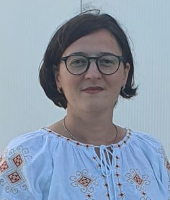
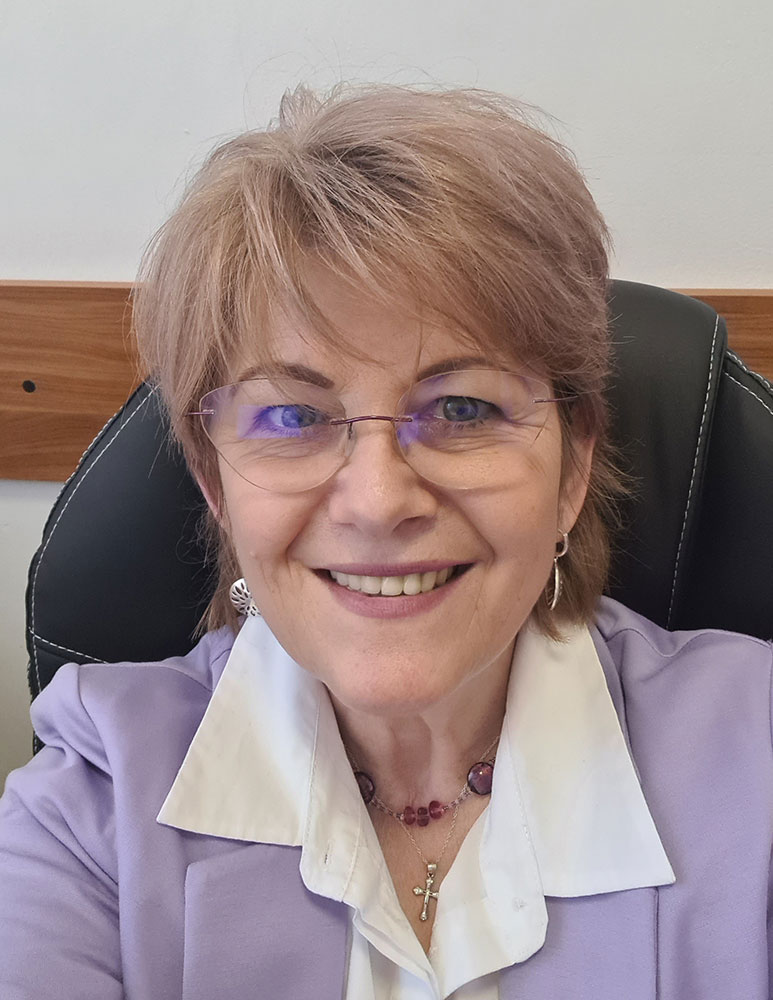
Antonella Elisa Chesca is a Lecturer at the Department of Fundamental, Prophylactic and Clinical Specialties, Faculty of Medicine, Lucian Blaga University of Sibiu. Her research focuses on leveraging MALDI-TOF mass spectrometry and machine learning for rapid diagnosis of acute respiratory infections, including SARS-CoV-2 and non-COVID pathogens. She collaborates with Kazakh institutions on clinical data analysis and algorithm optimization. Education: Not explicitly detailed but implied by academic rank and research output. Research Interests: Host-pathogen interactions, diagnostic technology development, and application of machine learning to mass spectrometry data. Her work emphasizes low-resource clinical settings and cross-geographic data integration. Article Trends: Recent publications highlight MALDI-TOF MS/ML pipelines for ARI differentiation, fungal allergy diagnostics, and standardized laboratory protocols. Keywords span biotechnology, data science, and clinical microbiology, with subfields including host mucosal perturbations and algorithm recalibration. Collaborations: Affiliated with Karaganda Regional Clinical Hospital and Karaganda Medical University in Kazakhstan. Co-authors include international researchers in machine learning and clinical microbiology.
Dana Petcu is a Professor at the Computer Science Department of the Faculty of Mathematics and Computer Science at West University of Timisoara. She serves as Director of both the Institute for Advanced Environmental Research and Institute e-Austria Timisoara. With expertise in distributed and parallel computing, she has published over two hundred papers on Cloud, Grid, Cluster, and HPC computing. She is also the chief editor of the open-access journal Scalable Computing: Practice and Experience (SCPE) and has coordinated multiple European Commission-funded projects. Education: Ms. Degree in Computer Science Ph.D. in Numerical Analysis Dana Petcu's research focuses on distributed and parallel computing systems. Her current interests include Cloud & Grid computing, and HPC & Cluster computing. Previously, she worked on Mathematical software, Numerical methods, and Computer graphics. Her work bridges theoretical foundations with practical implementations, particularly in resource management, scheduling algorithms, and scalable computing architectures. She has developed significant expertise in applying these technologies to scientific computing, data-intensive applications, and multi-cloud environments. Her scholarly output demonstrates consistent focus on cloud and distributed computing evolution. Over the past decade, her research has shifted from foundational grid computing to modern cloud technologies, edge computing, and exascale systems. Key themes include resource management across heterogeneous environments, autonomic systems, security SLAs, and multi-cloud portability. Her work shows increasing interdisciplinary connections, particularly with AI/ML techniques applied to resource optimization and anomaly detection in large-scale systems. Scientific Awards: Maria Sibylla Merian-Award (2005) IBM Faculty Award (2009) MLNR Award "Spiru Haret" (2015) Romanian Academy Award "Gheorghe Cartianu" (2015) Dana Petcu has advised numerous graduate students through various master's programs in Distributed and Parallel Computing. She has secured substantial research funding as coordinator of FP7 projects HOST and SPRERS, and as scientific coordinator of mOSAIC. Her grant portfolio includes multiple European Commission-funded initiatives focused on cloud computing infrastructure, resource management, and multi-cloud environments. She has also contributed to EU Research Activities in Cloud Computing as an editor, demonstrating her leadership in shaping European research agendas in this field. She leads the Computer Science Research Center (CCI) and High Performance Computing Service Center (HPC-UVT) at West University of Timisoara. Her teams develop and maintain significant infrastructure for distributed computing research, including simulation environments like CloudSim and iFogSim. She has established strong connections between academic research and practical applications through Institute e-Austria Timisoara, fostering technology transfer and innovation in cloud computing solutions.
Smetanin Serhiy Valentinovich is a Senior Lecturer in the Department of Physical Culture and Sports Management at Zaporizhzhia Polytechnic National University. With over 17 years of academic service since 2007, he contributes significantly to physical education and sports science education. His academic journey includes dual engineering and sports education backgrounds, providing a unique interdisciplinary perspective to his teaching and research. Zaporizhzhia State Engineering Academy (1995): Mechanical Engineer in Metallurgical Machines and Equipment Zaporizhzhia Institute of Personnel Management (2006): Teacher of Physical Education and Sports Zaporizhzhia National Technical University (2007): Master of Physical Education and Sports Dr. Smetanin's research spans multiple dimensions of physical education, with particular emphasis on specialized populations and innovative methodologies. His work demonstrates a strong commitment to advancing both theoretical understanding and practical applications in sports science. His research interests include biomechanics of physical activities, sports psychology applications, innovative teaching methodologies, and health preservation through physical education. Analysis of his recent publications (2020-2024) reveals a clear trend toward interdisciplinary approaches to physical education, with increasing focus on technology integration, specialized population needs (children, elderly women), and innovative exercise methodologies. His work shows a consistent evolution from traditional sports science toward more holistic, technology-enhanced approaches to physical education that address diverse population needs. Honorary certificate from the Zaporizhzhia Regional Department of the Committee for Physical Education and Sports of the Ministry of Education and Science of Ukraine (2021) As an educator, Dr. Smetanin teaches multiple core subjects including Athleticism, Biomechanics, Gymnastics with teaching methods, Information technologies in physical education and sports, and Sports and pedagogical improvement. His teaching approach integrates theoretical knowledge with practical applications, emphasizing the development of professional competencies in physical education specialists. His work on distance learning methodologies has been particularly relevant in recent educational contexts. Dr. Smetanin's research activities are closely connected to practical applications in sports education and health preservation. His work on non-traditional gymnastics methods, morning exercise routines for schoolchildren, and emotional state assessment during physical activities demonstrates a commitment to developing evidence-based approaches to physical education that can be implemented in real-world settings.
Prof. Dan Cristea is a faculty member at the Faculty of Computer Science, Alexandru Ioan Cuza University (UAIC), specializing in Artificial Intelligence and Natural Language Processing. He holds a PhD and is a corresponding member of the Romanian Academy. His research focuses on computational linguistics, knowledge representation, and historical document deciphering, with notable projects like DeLORo for old Cyrillic texts and EUROLAN Summer Schools. He has supervised numerous students in AI and NLP projects, including systems for question-answering, sentiment analysis, and agent-based models. His work bridges theoretical linguistics with practical applications in digital heritage preservation and multilingual technologies. Education: PhD (not explicitly stated in text), but his academic rank implies doctoral qualifications. Research Interests: AI applications in NLP, discourse analysis, computational linguistics, and cultural heritage digitization. Projects include MappingBooks for geographical text navigation, CoBiLiRo for bimodal corpora, and Sentimatrix for sentiment analysis. He collaborates internationally on corpora like EuReCo and has developed tools for dependency parsing and semantic annotation. Key Achievements: Corresponding member of the Romanian Academy Lead developer of the Corpus of Contemporary Romanian Language (CoRoLa) Pioneered AI-driven historical document transcription systems Grants and Collaborations: Involved in EU-funded projects like i-Librarian and i-Publisher. Collaborates with institutions globally on NLP and corpus linguistics. Labs/Teams: Director of the NLP-Group@UAIC-FII and heads the DeLORo project team.
Volodymyr Valentynovych Vasilevsky is a Senior Lecturer at Zaporizhzhia Polytechnic National University's Faculty of Electrical Engineering. Holding a Candidate of Technical Sciences degree, his career has focused on electromechanical systems and power transformer insulation analysis since joining the university in 2012. Education: Master's in Electrical Machines and Devices (Zaporizhia National Technical University, 2011) Research: Specializing in insulation resource modeling, neural network applications for transformer diagnostics, and lifecycle management of power equipment Key Contributions: Developed layered models for insulation resource consumption, automated evaluation systems for transformer diagnostics, and defect distribution dynamics models Contact: Email lisses@ukr.net , Office 520a, Zhukovsky St. 64
Mihai Mocanu is a Lecturer at the University of Craiova, affiliated with the Faculty of Automatic Control, Computers and Electronics. His work spans machine learning, educational data mining, and medical imaging technologies. Research Interests: He focuses on developing interpretable machine learning models, particularly using decision trees for educational data mining and GIS analysis. His work also includes designing e-learning systems with personalized recommendation workflows and enhancing engagement through data-driven approaches. Notable Contributions: Mihai has pioneered segmentation techniques for 3D medical imaging, created adaptive learning systems with stacked models, and explored social network impact on education. His research integrates pedagogical agents and usability evaluation frameworks in e-learning platforms.
Cristian Mihaescu is a Lecturer at the Department of Computer Science and Engineering (DCTI), University of Craiova, within the Faculty of Automatic Control, Computers and Electronics. He is actively involved in teaching and research related to machine learning, distributed systems, and educational data mining. Teaching: Data Structures and Algorithms, Parallel and Distributed Algorithms, Machine Learning, Distributed Systems Engineering Research Focus: Machine learning applications in education, social network analysis, and compiler optimization Technological Interests: Microservices, data mining, and intelligent system design
Corina Botoca is an Associate Professor at the Politehnica University of Timișoara, Faculty of Electronics and Telecommunications. She joined the university in 1988 as an assistant, progressing to works manager (1996–2006), and has held her current position since 2006. Her research focuses on neural networks applied to signal processing, telecommunications, and medical diagnostics, with notable contributions in nonlinear systems and image analysis. She has authored/co-authored books on neural networks and signal processing techniques, and her work includes pioneering studies on prostate cancer prediction using neural networks (accuracy exceeding 95%). Botoca has received the ETC Excellence Award in 2004 and 2006. She serves on multiple academic committees, including quality assurance and accreditation, and has led significant grants such as the PN II bilateral project on facial expression recognition (2009–2010). Her teaching innovations include courses on cellular neural networks and data communications. She has established research labs like B712 (Data Communications) and B219 (Selected Topics on Communications Networks), advancing interdisciplinary research in medical imaging and telecommunications. Her publications span over three decades, with key articles in IEEE and WSEAS journals. Notable works include 'Nonlinear complex channel equalization using a radial basis function neural network' (2004) and 'Cellular neural network processing of CEUS examination' (2016). Botoca’s administrative roles include membership in the Department Council and leadership in quality assurance initiatives, reflecting her dual commitment to research and institutional governance.
Sorin Anagoste is a Professor and Vice Dean for Academic Affairs at FABIZ, part of the Bucharest University of Economic Studies. His primary affiliation is with the Bucharest Business School (BBS), where he contributes to academic leadership and faculty governance. He holds a PhD and focuses on interdisciplinary research at the intersection of business strategy, technology, and innovation. His academic career spans over two decades, with a strong emphasis on advancing education and research in digital transformation, artificial intelligence, and entrepreneurship. Prior roles include leadership in mergers and acquisitions studies, transformational leadership research, and Lean Six Sigma methodologies. Research Interests: Artificial Intelligence applications in business decision-making Digital transformation strategies Entrepreneurship dynamics across generations Impact of AI on political and economic systems Knowledge dynamics in organizational contexts Recent work emphasizes the societal implications of AI, including election influence via LLMs, post-pandemic consumer behavior, and Romania's economic interdependencies through Leontief matrix analysis. He has authored over 35 articles on topics ranging from robotic process automation to sustainable development. Professional Activities: Academic leadership in business education reform Consultancy on digital strategy for enterprises Founder of BBS's strategic frameworks for chatbot implementation
Prof. Donciu Codrin is a full professor at the Department of Electric Power Engineering, Technical University of Iasi. His research spans interdisciplinary fields including signal processing, image processing, earthquake early warning systems, and textile engineering. He leads projects on seismic response analysis using uniaxial shaking tables, non-invasive eye safety systems (e.g., Opto-Guard), and ESD-protective textiles. His work integrates hardware design (e.g., electrodynamic actuators) with advanced algorithm development for applications like video-based distance measurement and apparel sizing estimation. Research projects include: Signal Processing : OFDM modulation, DFT/FFT algorithms, and seismic waveform analysis Computer Vision : Pattern recognition, 3D reconstruction, and human-centric interface design Structural Engineering : Earthquake simulation platforms and early warning system validation Textile Innovation : Conductive fabric development for ESD protection and functional garments Recent publications focus on seismic wave analysis (2023–2025), optoelectronic safety systems (2022), and ultrasonic sensing technologies (2020–2021). His work bridges theoretical signal processing with real-world applications in disaster preparedness and ergonomic design.
Ioana Mădălina PETRE is a Lecturer at the Department of Engineering and Industrial Management within the Faculty of Technological Engineering and Industrial Management at the University of Technical Education in Brașov (UNITBV). Her research focuses on industrial engineering, human resources management, and the application of pneumatic muscles in rehabilitation equipment and precise positioning systems. She has conducted experimental studies on cutting parameters' influence on machining efficiency, biomechanical analyses of exercise techniques, and the integration of Industry 4.0 principles in sustainable manufacturing. Her work spans diverse fields including e-learning systems, smart horticulture frameworks, and material surface engineering. Notable contributions include developing rehabilitation equipment inspired by biomimetic principles and analyzing the impact of e-learning platforms during crises. She has published extensively in peer-reviewed journals, with a focus on interdisciplinary applications of engineering and technology in education, healthcare, and manufacturing. Her research trends highlight a strong emphasis on practical industrial solutions, sustainable technologies, and the intersection of biomechanics with engineering design. While no specific grants or awards are listed, her publications indicate active participation in collaborative research projects with colleagues from various disciplines. Dr. PETRE’s research group likely engages in experimental setups involving advanced manufacturing processes, robotic systems for rehabilitation, and data-driven analyses of industrial and educational systems. Her work reflects a commitment to bridging theoretical engineering principles with real-world applications in healthcare, education, and sustainable production.
Delia Monica Duca Iliescu is a Lecturer in the Department of Computer Science at the Faculty of Mathematics and Computer Science of Transilvania University of Brașov. Her research focuses on Artificial Intelligence, Machine Learning, and Game Theory, with applications in e-learning, health informatics, and digital twin architectures. She has published works on AI’s impact on chess, didactic methods in modern learning environments, and health parameter monitoring systems. Her recent research explores educational technology innovations and telecommunications-based health data management. She holds a formal academic email address: delia.duca@unitbv.ro.
Prof. Petru Adrian COTFAS holds a position as Professor in the Department of Electronic and Computers at the Faculty of Electrical Engineering and Computer Science, Technical University of Brașov (UNITBV). His work focuses on advancing renewable energy systems, hybrid energy technologies, and IoT-based monitoring solutions. He leads research on photovoltaic cell optimization, thermoelectric generator performance, and cybersecurity in smart energy systems. His contributions include developing virtual instrumentation frameworks (e.g., LabVIEW-based tools) and experimental setups like the RELab system for studying solar/wind energy dynamics. Research Interests: Characterization of renewable energy systems (hybrid photovoltaic-thermoelectric configurations) IoT integration for remote energy monitoring and control Metaheuristic algorithms for parameter extraction in solar cells Cybersecurity resilience for smart energy infrastructure Energy efficiency in industrial systems (e.g., AHU optimization) Key Contributions: Prof. COTFAS has pioneered studies on dust impact mitigation for solar panels, developed novel methods for concentrated solar power systems, and addressed cybersecurity vulnerabilities in IoT-enabled energy grids. His work bridges theoretical models (e.g., multi-junction solar cell theory) with practical implementations like FPGA-based remote laboratories. Over 60 peer-reviewed articles since 2016 showcase his interdisciplinary approach to energy sustainability and technological innovation.
Vlad Popescu is an Associate Professor at the Department of Electronics and Computers, Faculty of Electrical Engineering and Computer Science, Technical University of Brasov. His research focuses on telecommunications, IoT, cognitive radio systems, and multimedia applications. He has authored numerous publications in top journals and conferences, including work on 6G-enabled smart cities, edge-cloud orchestration, and QoE-driven smart home systems. His research explores cutting-edge topics such as immersive multi-sensory experiences, real-time object detection, and energy-efficient architectures for Android TV integration. Popescu has contributed to open-source satellite simulators and pioneered studies on blockchain-based TV advertising systems. His work bridges theoretical advancements with practical implementations in smart home environments, IoT gateways, and next-generation wireless networks. Award-winning research includes innovations in SDR-based satellite gateways and hardware-software partitioning for embedded systems. His collaborative projects address challenges in distributed video applications, D2D communications, and social IoT frameworks for smart tourism management.
Prof. Lazar Maria serves as a Professor in the Department of Environmental Engineering and Geology at the Faculty of Mining, University of Petroșani Technical. She also holds the administrative role of Vice-Rector for Scientific Research, overseeing research initiatives at the institution. Her work focuses on sustainable mining practices, environmental rehabilitation of degraded lands, and the integration of AI in ecological planning. Key research areas include soil restoration, water quality management, and the valorization of industrial byproducts. Research emphasizes case studies in regions like the Jiu Valley and Rovinari mining basins, addressing challenges such as mine closure risks, waste management, and the ecological reclamation of abandoned sites. Recent studies explore AI-driven solutions for mine site design, sustainable copper extraction techniques, and methods to accelerate pedogenesis on waste dumps. Publications highlight innovative approaches to land rehabilitation, seismic stability assessments, and the environmental implications of mining projects like Certej. Despite no listed scientific awards or advisees, her contributions to sustainable resource recovery and policy-relevant research are significant.