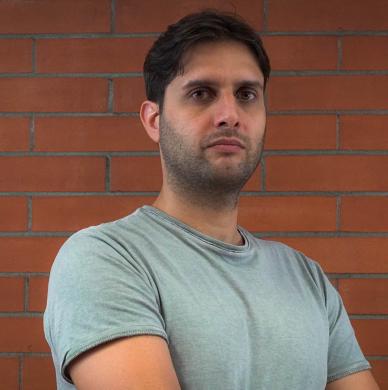
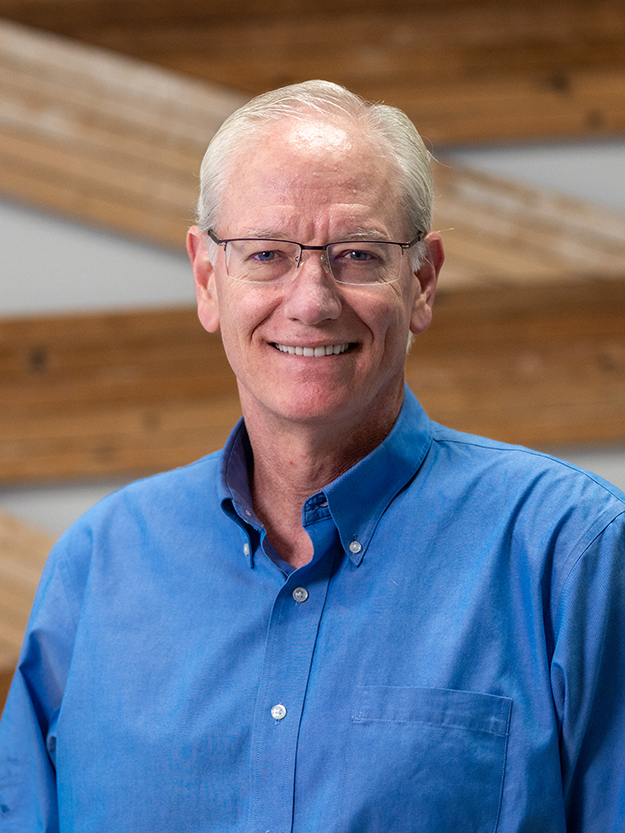
Ana Andrés Payán is a Lecturer in Chemical Engineering at the University of Cantabria, Spain. Her research focuses on Sustainable Environmental Management of hazardous wastes and marine sediments, with contributions to the development of eco-efficient construction materials using industrial byproducts. She has collaborated on R+D projects at European and national levels, emphasizing both academic and industrial partnerships. Since 1992, she has taught Chemical, Industrial, and Marine Engineering courses at the undergraduate level and contributed to postgraduate programs with quality awards. Her work integrates environmental toxicology, materials science, and waste management to address sustainability challenges. Key research areas include recycling industrial byproducts into construction materials (e.g., slag, fly ash), assessing ecotoxicological impacts via bioassays (luminescent bacteria, sea urchin embryogenesis), and optimizing waste management strategies through multi-criteria analysis. She emphasizes circular economy principles and collaboration with industry to achieve sustainable outcomes. Her publications (2025–2021) highlight innovation in alkali-activated binders, eco-toxicity testing, and material durability. No scientific awards are listed, but her work has been applied in regional planning and industrial ecology initiatives. She leads research in the GER group , focusing on environmental and materials science applications.
Paul Zhou is a Senior Lecturer in the Department of Management at Monash University. He holds a PhD in Supply Chain and Operations Management from Hong Kong Polytechnic University (2018), a Master’s in Electronic Commerce from the University of Hong Kong, and a Bachelor’s in Global Supply Chain Management from Hong Kong Polytechnic University. His research focuses on Sustainable Operations Management, Global Supply Chain Networks, and applications of Big Data Analytics/Machine Learning in business operations. He has led projects such as 'Supply Chain Governance Solutions for the Gig Economy' (2025-2028) and 'Machine Learning for Civil Construction Safety' (2019-2022). His work has been featured in top journals like Production and Operations Management and Journal of Operations Management . Notable achievements include the 2017 IACMR Presidential Award for his study on environmental incidents’ market impacts. Zhou’s research explores sustainable supply chain practices, DEI commitments’ market effects, and geopolitical influences on global operations. He serves as Oceania Co-Editor for Journal of Supply Chain Management and reviewer for multiple journals including Production and Operations Management .
Jonathan W. Hurst is a Professor of Robotics at Oregon State University's College of Engineering, Mechanical, Industrial, and Manufacturing Engineering department. He co-founded the Oregon State University Robotics Institute and serves as CTO and co-founder of Agility Robotics. He holds degrees from Carnegie Mellon University: B.S. in Mechanical Engineering, and M.S./Ph.D. in Robotics. His research focuses on legged locomotion fundamentals, merging machine learning with traditional control methods to achieve advanced robotic mobility. Education: B.S. Mechanical Engineering (Carnegie Mellon), M.S. and Ph.D. Robotics (Carnegie Melllon). Research emphasizes numerical studies, animal data analysis, simulation models, and physical robot prototyping. Key areas include dynamic gaits, passive compliance in movement, and bio-inspired design. His work aims to enable robots to navigate environments like humans, with commercial applications via Agility Robotics. Awards include the 2018 OSU Faculty Innovator Award, Engelbrecht Young Faculty Award (2014), and Popular Mechanics Breakthrough Innovators recognition (2012). He leads the Dynamic Robotics Laboratory and collaborates on projects such as the Cassie robot. Grants and industry partnerships support his research, advancing robotics for economic productivity and quality-of-life improvements. His lab integrates academic and applied research, producing both scholarly publications and commercializable technologies.
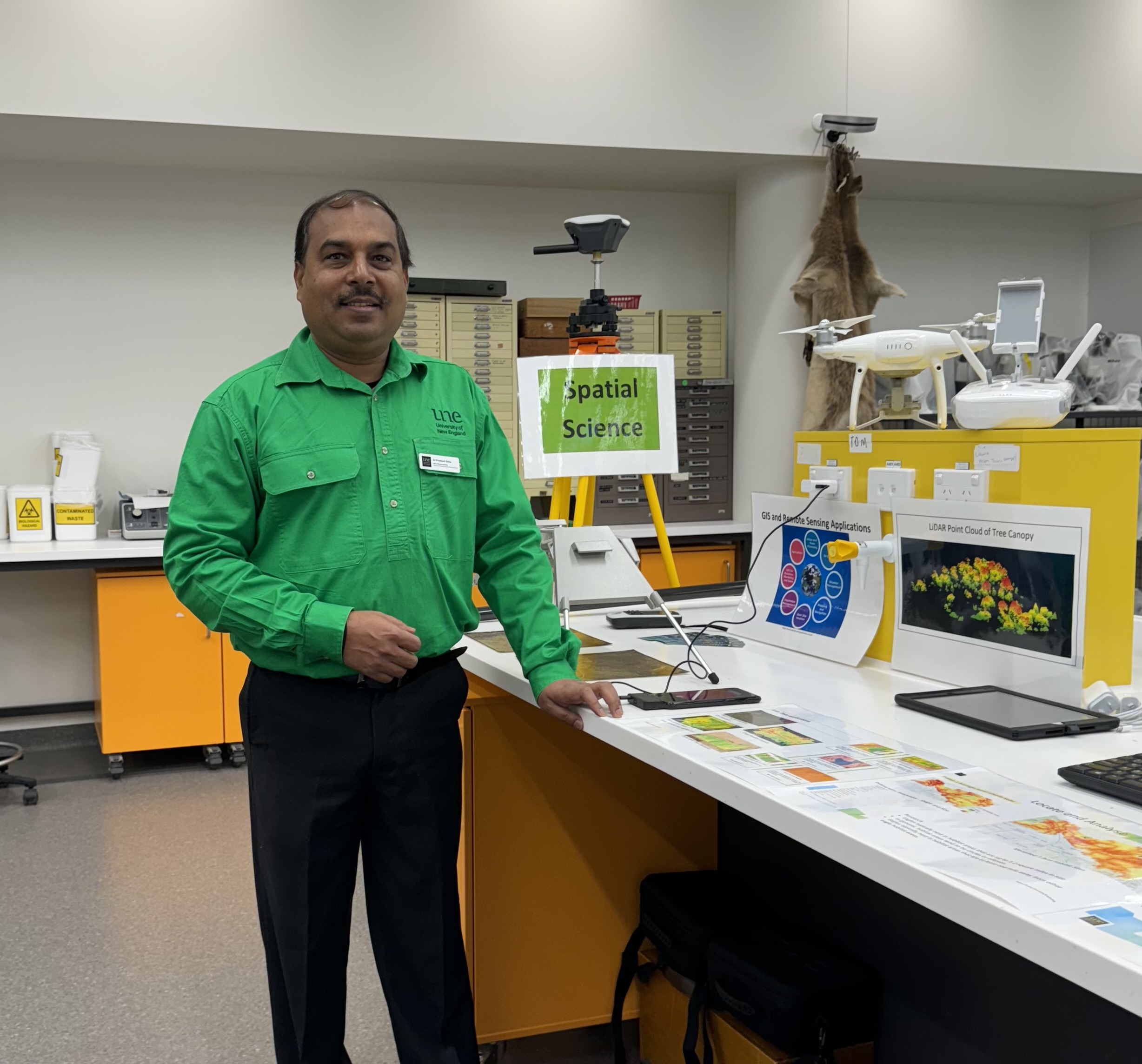
Dr. Priyakant Sinha is a Senior Lecturer in Spatial Science at the University of New England's School of Environmental and Rural Science, with over 20 years of research experience in remote sensing and geospatial science. He specializes in applying remote sensing technologies to agriculture, environmental monitoring, and natural resource management. His research focuses on: Advanced agricultural remote sensing and precision agriculture Time-series crop monitoring and yield prediction UAV/Drone-based 3D imaging for farm management Vegetation species mapping and change detection Hyperspectral and LiDAR data analysis Dr. Sinha teaches courses in GIS, spatial analysis, precision agriculture, and remote sensing applications. He has successfully supervised multiple PhD students in areas ranging from flood hazard mapping to drought monitoring using earth observation data. Technical expertise includes advanced digital image processing, GIS analysis and modeling, and specialized software including ENVI, ArcGIS, QGIS, and Pix4D. He develops innovative methods for temporal change analysis using machine learning and Google Earth Engine.
Dr. Jooh Lee is a Professor of Management at Rowan University's William G. Rohrer College of Business. He holds a Ph.D. in Management Science from the University of Mississippi and an M.S. from Colorado State University. His research examines operational linkages between strategy and performance, with emphasis on sustainability, reputation, CEO compensation, and technology impacts. Lee has published over 130 scholarly articles focusing on international business strategy and operational efficiency. His recent work analyzes ESG performance, R&D-exports synergies, and reputation- compensation relationships using advanced modeling techniques. Research methodologies include neural networks, comparative international analyses, and longitudinal performance studies. Honors include holding The Campbell Professorial Chair. His teaching portfolio includes Operations Management, Managerial Decision Making Tools, and Business Forecasting at MBA and undergraduate levels.
Prof. G. Scott Watson is a Professor in the Department of Physics at Syracuse University, affiliated with the College of Arts & Sciences. His research focuses on the interplay between fundamental particle physics and cosmology, particularly early universe cosmology, inflationary models, dark matter/energy, and string theory applications. He holds a Ph.D. in Physics from Brown University (2005) and B.S. degrees in Mathematics and Physics from the University of North Carolina at Wilmington (2000). Key research interests include string phenomenology as a quantum gravity framework, probing inflationary scenarios through cosmic microwave background (CMB) studies, and exploring dark matter origins. He leads major projects like CMB-S4 and contributes to the CMBPol mission concept. Watson has received the American Physical Society Outstanding Referee Award (2021) and serves on high-profile collaborations such as the Inflation Probe Study Analysis Group (IPSAG). Teaching responsibilities include advanced courses like Quantum Field Theory, Relativity and Cosmology, and Quantum Mechanics II. He actively mentors students through independent studies and advises on graduate admissions. Watson has secured significant grants, including a Department of Energy-funded project on theoretical particle physics and cosmology (2013–2025) and NSF support for cosmic acceleration research (2018–2023).
Abbas Heydarnoori is an Assistant Professor in the Department of Computer Science at Bowling Green State University (USA) since 2022, and previously held a faculty position at Sharif University of Technology (Iran) from 2012 to 2022. He earned his Ph.D. in Computer Science from the University of Waterloo (Canada, 2009), and M.Sc. and B.Sc. in Software Engineering from Sharif University of Technology (2001 and 1999). His research focuses on AI-driven software engineering (AI4SE/SE4AI), leveraging data science and AI to address challenges like fault localization, bug prediction, and code comprehension. He analyzes software repositories (e.g., GitHub, Stack Overflow) to improve developer productivity and software quality. He has contributed to tools like CrowdSummarizer and ExceptionTracer, and his work spans topics such as microservices architecture, API usage analysis, and code summarization. Teaching includes graduate/undergraduate courses on AI for Software Engineering, Database Systems, and Software Engineering. His service roles include editorial board membership at Science of Computer Programming , and PC membership in conferences like MSR, SANER, and FSE. His research group actively publishes on automated code analysis, documentation generation, and developer productivity tools, with a focus on empirical and data-driven approaches.
Jakub Macina is a Doctoral Fellow at the ETH AI Center and a PhD Candidate at ETH Zürich . He works in the intersection of Natural Language Processing and Learning Sciences as part of the Language, Reasoning and Education Lab (led by Prof. Mrinmaya Sachan) and the Professorship for Learning Sciences and Higher Education (led by Prof. Manu Kapur). Forbes 30 Under 30 in Science & Education 2023 Recipient of ETH AI Center Fellowship ( Co-founder of a health-tech startup with seed investment Research Interests : Focus on generative large language models (LLMs), dialogue tutoring systems , pedagogical alignment of AI models, and mathematical reasoning . His work explores: Reinforcement learning for pedagogical steering LLM evaluation frameworks Socratic question generation Stepwise error detection and remediation Student-teacher interaction modeling Publications span top conferences like EMNLP , ACL , NeurIPS , and RecSys , with particular emphasis on educational applications of LLMs and dialogue-based learning systems . Scientific Awards : Forbes 30 Under 30 in Science and Education (2023) 2nd Place in ACM IT SPY Computer Science Master's Thesis Competition (2017) ETH AI Center Fellowship (2021) Leadership & Teaching includes: Managing team of 6 data scientists Teaching Assistant for Machine Learning and NLP courses at ETH Zurich Developing large-scale ML pipelines for recommender systems Open-source contributions to Discourse and Google Summer of Code projects
Donato Romano serves as Associate Professor at The BioRobotics Institute of Scuola Superiore Sant'Anna, Italy, where he coordinates the Bio-Robotic Ecosystems Lab and co-founded the spin-off company HUBILIFE srl. His interdisciplinary work bridges robotics, biology, and AI to develop biohybrid systems for biodiversity preservation, sustainable environmental management, and life support in extreme scenarios including space exploration. With over 90 publications and an H-index of 27 (Scopus, March 2025), he has established significant academic leadership through editorial roles across 12+ international journals. Romano's educational foundation includes advanced degrees with honors: an M.Sc. in Agriculture Science and Technologies (2014) and a PhD in BioRobotics (2018), both from Scuola Superiore Sant'Anna. His academic journey includes visiting scholar positions at Khalifa University and substantial industry-academia collaboration through HUBILIFE srl, which commercializes bioinspired devices for human daily life improvement. His research program focuses on bioinspired and biomimetic robotics with particular emphasis on animal-robot interaction, biohybrid systems, and natural intelligence. Key projects address critical global challenges: SENSORBEES develops biohybrid environmental surveillance for ecological monitoring; REGOLIFE investigates lunar soil-terrestrial organism interactions for space agriculture; and OCEAN ROBOCTO explores marine ecosystem solutions. This work demonstrates a strategic progression from fundamental behavioral studies toward applied ecological and extraterrestrial systems. Analysis of his recent publications reveals strong trends in AI-driven behavioral analysis, with deep learning increasingly applied to entomological studies and pest management. The research spans agricultural applications (precision monitoring traps, larval detection systems), ecological conservation (biodiversity surveillance), and extreme-environment adaptation (lunar regolith studies). A distinctive feature is the consistent integration of biohybrid approaches where living organisms and robotic systems create synergistic capabilities exceeding either component alone. Romano's scientific recognition includes election as Junior Fellow of the Italian Academy of Engineering and Technology (2025), the Lucani fuori dal Comune award (2024), and multiple best-thesis prizes. His editorial leadership spans high-impact journals including IEEE Transactions on Medical Robotics and Bionics and Pest Management Science, where he serves as Associate Editor. As principal investigator, Romano coordinates major international projects totaling over €15M in funding: HORIZON-EIC's SENSORBEES (2024-2029), ASI's REGOLIFE (2024-2027), National Geographic's OCEAN ROBOCTO (2024-2026), and PRIN's COSMIC (2023-2025). His teaching portfolio includes PhD courses in Biosystems for Biorobotics and M.Sc. instruction in Bionics Engineering at Scuola Superiore Sant'Anna and University of Pisa. The Bio-Robotic Ecosystems Lab under Romano's direction pioneers biohybrid technologies where living organisms and robotic systems create integrated solutions. Current initiatives include SENSORBEES' environmental monitoring swarms, REGOLIFE's moonworm colonization systems, and HUBILIFE's commercial vector-control devices. The lab maintains active collaborations with space agencies, agricultural institutes, and conservation organizations, positioning biohybrid systems as next-generation tools for planetary-scale challenges.
Dr. Minliang Yang is an Assistant Professor in Food Sustainability at North Carolina State University's Department of Food, Bioprocessing & Nutrition Sciences. Her research focuses on system-level analyses (TEA, LCA, machine learning) to advance food sustainability, particularly through plant-based foods, cellular agriculture, and greenhouse gas mitigation strategies. She holds a B.S. in Food Science from Henan University of Technology (2012), M.S. and Ph.D. in Agricultural and Biosystems Engineering from Iowa State University (2014/2018), and a postdoctoral fellowship at Lawrence Berkeley National Laboratory (2022). Her work spans biofuel production, bioproduct valorization, and sustainable biorefinery systems. Key contributions include optimizing biomass pretreatment methods (e.g., low-moisture anhydrous ammonia), developing plant-based platforms for human milk oligosaccharides, and evaluating the economic viability of carbon-negative fuels. Dr. Yang's interdisciplinary approach integrates engineering, biology, and economics to address global food system challenges. Recent publications emphasize co-processing agricultural residues, machine learning-driven process modeling, and cost-benefit analyses of bio-based materials. Her research highlights the potential of integrating plant biotechnology with advanced analytics to create scalable, sustainable solutions for food and energy systems.
Mauro Pezzè is a Full Professor of Software Engineering at the Università della Svizzera italiana (USI) and Università di Milano Bicocca, leading the STAR research group since 2006. He holds a laurea from the University of Pisa and a PhD from Politecnico di Milano. His research focuses on software testing, analysis, self-adaptive systems, and cloud systems. He has held editorial roles, including Editor-in-Chief of ACM Transactions on Software Engineering and Methodologies (TOSEM), and served on numerous program committees. Education: Laurea (Pisa), PhD (Politecnico di Milano). Professional roles include Dean of the Faculty of Informatics at USI (2009-2013), visiting scientist at UC Irvine and Edinburgh, and technical lead for international projects. He co-authored a seminal book on software testing (Wiley, 2007), with over 670 citations. Research Interests: Software Testing, Self-Adaptive Systems, Cloud Computing, AI in SE, Sustainable Software. Projects include work on field-based testing, failure prediction in distributed systems, and neuro-symbolic approaches for test oracles. Grants and Advising: Led STAR Lab projects in self-healing systems, GUI testing, and semantic matching. Advised numerous PhD/postdoc students (e.g., Ciniselli, Di Grazia, Qiu). Collaborations with European tech firms on R&D initiatives. Labs/Teams: STAR Group at USI/Constructor Institute, Bicocca, and Politecnico di Milano. Current members include postdocs and PhD students working on AI-driven testing and cloud reliability.
Giuliano Casale is a Professor in the Department of Computing at Imperial College London, leading the Quality of Service Research Lab (QORE). His research focuses on performance assurance, resource management, and fault-tolerance in distributed systems. He teaches courses on Probability and Statistics and Scheduling and Resource Allocation at undergraduate and Master’s levels. Casale’s work spans cloud computing, edge AI, and machine learning applications in system modeling. Key contributions include methodologies for performance engineering, anomaly detection, and automated resource management in large-scale systems. He actively participates in international conferences, delivering keynote speeches on topics such as performance evaluation and AI-driven systems. His research integrates queueing theory, machine learning, and generative models to address challenges in distributed software systems. Casale also engages in service activities like PhD admissions tutoring and collaborates on projects involving resilience planning and cloud service optimization. His lab, QORE, emphasizes practical solutions for real-world distributed systems, including edge federations and serverless architectures. Casale’s work bridges theoretical performance analysis with industrial applications, contributing to advancements in both academia and industry.
Joe Geunes is a Professor and Associate Department Head for Graduate Affairs in the Department of Industrial & Systems Engineering at Texas A&M University, holding the Mike and Sugar Barnes Professorship. His research focuses on production planning, supply chain management, logistics, and operations optimization. He earned his Ph.D. in Business Administration (Management Science & Operations Research) and M.B.A. from The Pennsylvania State University in 1999 and 1993, respectively. Dr. Geunes has received notable accolades including Fellow of the Institute of Industrial Engineers (2015), Marilyn and L. David Black Faculty Fellow (2022), and Best Reviewer Award from Omega (2022). His work spans infrastructure network restoration, supply chain resilience, and optimization algorithms for logistics systems. Recent projects address railcar operations, distribution network fortification, and disaster response strategies. Education: Ph.D., Business Administration (Management Science & Operations Research), The Pennsylvania State University – 1999 M.B.A., The Pennsylvania State University – 1993 Awards: Fellow, Institute of Industrial Engineers – 2015 Marilyn and L. David Black Faculty Fellow – 2022 Best Reviewer Award, Omega – 2022 Best Application Paper, IISE – 2018 His research integrates mathematical modeling and computational methods to address real-world challenges in supply chain design, inventory management, and infrastructure resilience. Recent publications emphasize multi-modal logistics, robust optimization under uncertainty, and post-disaster network recovery strategies.
Dr. Jose Manuel Sánchez Peña is a Full Professor at Universidad Carlos III de Madrid (UC3M), affiliated with the Grupo Universitario de Tecnologías de Identificación (GUTI). His research focuses on precision agriculture technologies, optoelectronics, and neuroscientific interfaces. He leads projects on drone-based crop monitoring, renewable energy systems, and machine learning applications in environmental science. Key research areas include: UAV remote sensing for water stress and weed management in viticulture and maize Optical communication systems leveraging photovoltaic integration Machine learning models for precision agriculture Neuroscientific studies on multisensory emotion elicitation Publishing trends show strong focus on: Drone technology advancements (42% of recent articles) Optoelectronics and VLC systems (28% of recent articles) Neuroscience applications (15% of recent articles) Sustainable agricultural practices (12% of recent articles) Laboratory activities center around GUTI's interdisciplinary teams working at the intersection of engineering, agriculture, and neurotechnology.
Professor Rashid Rashidzadeh is a faculty member in the Faculty of Engineering at the University of Windsor. He specializes in Machine Learning, IoT Security, and Autonomous Systems, with a focus on integrating these technologies into engineering education. He has advised numerous students in first-year design courses and advanced research projects, including work on autonomous emergency vehicles, IoT security for 5G devices, and hyperloop pod development. His teaching responsibilities include the Cornerstone Design course, where students develop autonomous systems and navigate engineering challenges. He has organized workshops on Python and Machine Learning, engaging both university and high school students. His research projects span industrial automation (e.g., Hiram Walker distillery software integration) and high-stakes competitions like the SpaceX Hyperloop Pod Challenge. Professor Rashidzadeh has mentored over 30 students in projects such as: Programming model railcars to navigate obstacle courses Designing cybersecurity safeguards for 5G IoT devices Building hyperloop pods for high-speed transport competitions His work emphasizes hands-on learning and industry collaboration, with projects showcased in media and academic platforms.