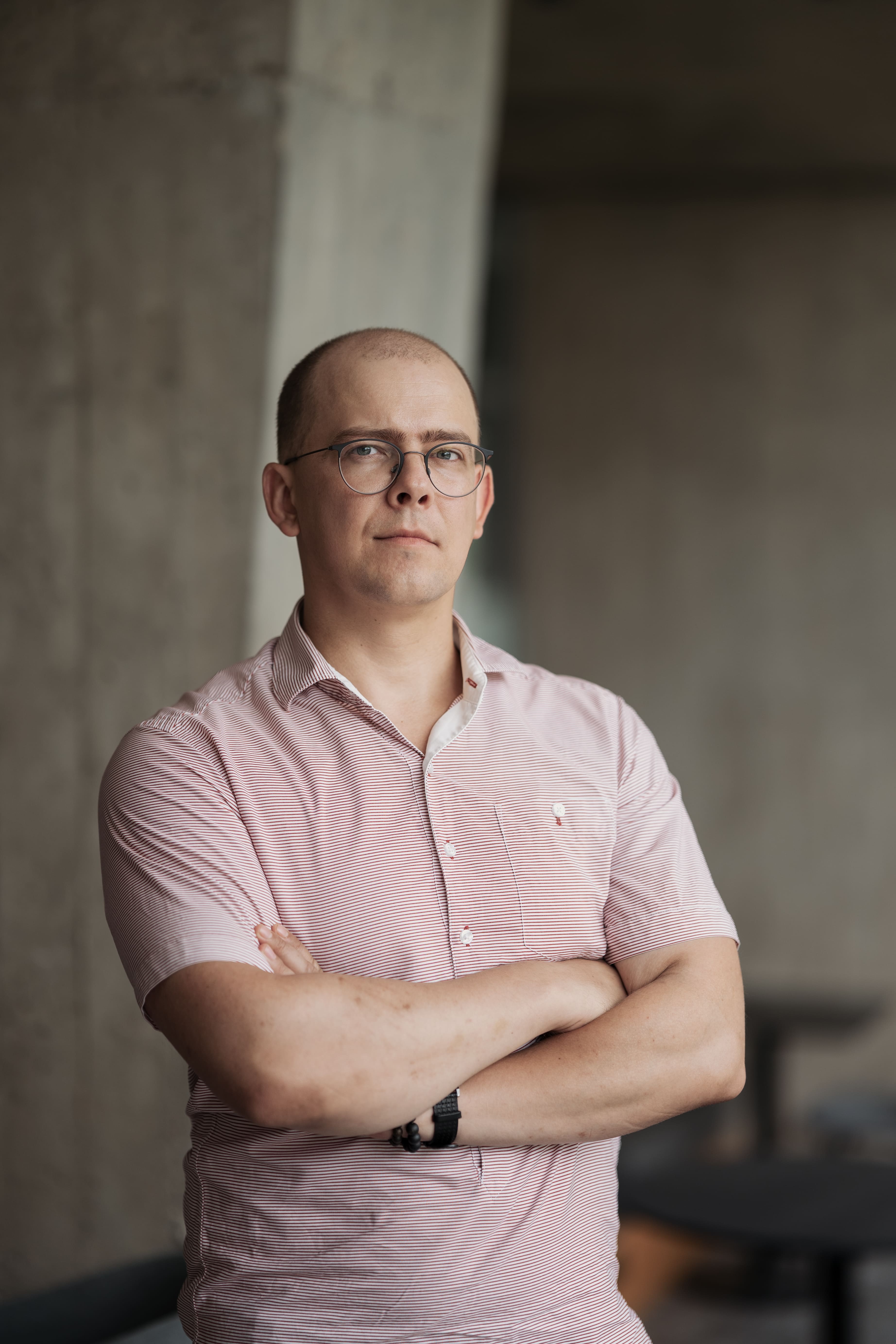
Marco Marcozzi is a researcher at the Vilnius University Blockchain and Quantum Technologies Group. His work focuses on blockchain systems, quantum computing, and performability analysis of fault-tolerant protocols. Research Interests : Blockchain technology, quantum computing, Byzantine fault tolerance, consensus protocols, and data-driven system performance modeling. Key Contributions : Led studies on quantum-enhanced machine learning, performability analysis of PBFT systems, and classification of DLT consensus protocols using clustering algorithms. Publications Trend : Recent works emphasize quantum computing applications in blockchain systems, performability modeling for fault-tolerant architectures, and machine learning approaches to consensus protocol analysis across disciplines like computer science and system reliability engineering. Current Affiliation : Blockchain and Quantum Technologies Group, Vilnius University, Akademijos St. 4, Vilnius.
Oskaras Klimašauskas is a Researcher affiliated with the Cognitive Computing Group at Vilnius University's Institute of Data Science and Digital Technologies. His work focuses on reinforcement learning applications in autonomous vehicle navigation and route optimization. His research explores Artificial Intelligence , Machine Learning , and Visual Environment Development . Recent publications (2024-2025) demonstrate his expertise in applying reinforcement learning to autonomous driving scenarios, including route navigation, track driving, and interactive route computing environments. The articles reflect interdisciplinary work at the intersection of Computer Science , Data Science , and Software Engineering . Key sub-fields include simulation, optimization, intelligent navigation systems, and vehicle control algorithms. Though no formal awards are listed, his publications indicate active research contributions.
Arnold Budžys is a Junior Researcher at the Vilnius University Institute of Data Science and Digital Technologies , focusing on cybersecurity, machine learning, and behavioral biometrics. His work addresses critical infrastructure security, insider threat detection, and keystroke dynamics-based authentication. Research Highlights : Keystroke biometrics, anomaly detection, deep learning, data fusion, and red team tactics. Technical Focus : Behavioral analysis, neural networks, security frameworks, and adversarial attack modeling. His publications reveal a trend toward integrating advanced AI techniques with cybersecurity protocols to enhance authentication accuracy and threat prevention in sensitive systems.
Roles & Affiliations: Assistant Professor at the Department of Organizational Information and Communication Research, Faculty of Communication, Vilnius University. Active in research projects, academic conferences, and editorial roles. Education: PhD in Mathematics and Informatics (2012), Vilnius University, Thesis: 'The applications of datamining methods to personalized learning environments.' MA in Informatics (1995), Vilnius Pedagogical University. Research Interests: Focus on e-learning methodologies, big data processing, educational technology, and business intelligence. Explores applications of machine learning in finance and personalized learning systems. Publications & Projects: Over 15 articles in peer-reviewed journals and conferences (e.g., Applied Sciences, Mykolas Romeris University Proceedings). Led the EU-funded project 'Development and Introduction of Multilingual Teacher Education Programmes in Georgia and Ukraine (DIMTEGU)' (2012–2016). Active in conference organizing and editorial work. Grants & Memberships: Participated in EU-funded projects. Member of the National Association of Distance Education (NADE), Lithuanian Association of Distance and e-Learning (LieDM), and Lithuanian Computer Society (LIKS). Labs & Teams: Involved in research groups focused on educational technology, data analytics, and digital transformation initiatives within the Faculty of Communication.
Goda Klumbytė is a Lecturer and post-doctoral researcher at the University of Kassel, working within the Participatory IT Design department in the Faculty of Electrical Engineering and Computer Science. She is an interdisciplinary scholar bridging informatics with humanities and social sciences, with particular expertise in feminist new materialism, posthumanism, and human-computer interaction. Her research focuses on creating more contextualized and accountable machine learning systems through feminist and critical theoretical approaches. Her research interests include Critical Algorithm Studies, Science and Technology Studies, Human-Computer Interaction Design, Feminist Epistemology, Critical Theory, Posthumanism, and New Materialism. She approaches the study of algorithmic systems from a feminist perspective that emphasizes situated knowledges, intersectionality, and material-semiotic approaches to technology design. Her recent publications demonstrate a clear trend toward developing feminist frameworks for explainable AI and accountable machine learning systems. Her work examines how critical theoretical concepts from social sciences and humanities can be integrated into computing practices, with particular attention to how power relations and structural inequalities manifest in algorithmic systems. She has been particularly active in exploring how feminist intersectional perspectives can reshape approaches to AI explainability and accountability. Co-edited 'More Posthuman Glossary' with R. Braidotti and E. Jones (Bloomsbury, 2022) Published in 'Posthuman Glossary' (Braidotti & Hlavajova, 2018) Contributed to 'Everyday Feminist Research Praxis' (Leurs & Olivieri, 2015) Published in journals including Online Information Review, Digital Creativity and ASAP Presented at major informatics conferences including ACM's CHI, nordiCHI and FAccT Dr. Klumbytė leads significant research projects including 'AI Forensics: Accountability through Interpretability in Visual AI Systems' (funded by Volkswagen Foundation, 2022-2025) and 'CF+: Reconfiguring Computing Through Cyberfeminism and New Materialism' (University of Kassel, 2018-2019). She also serves as one of the editors of the critical computing blog 'engines of difference,' which provides a platform for critical perspectives on computing and technology.
Dr. Dervinis Donatas is an Assistant Professor at the Department of Electrical and Electronic Engineering, VU Šiauliai Academy. His research focuses on Renewable Energy, Automation, Computer Vision, and Cybersecurity, with a strong emphasis on practical applications in industrial systems and educational technologies. He holds a Doctor of Science in Electrical and Electronics Engineering and has over 22 months of academic experience. His educational background includes advanced studies in electrical engineering, complemented by a prolific career in research. Key research areas include solar energy systems, image processing, and automated systems for transportation and security. He contributed to the development of a textbook on Image Processing (2012) and has been affiliated with the eLABa research group. Donatas has authored or co-authored over 15 peer-reviewed publications, exploring topics such as energy-efficient cloud computing, password security, and real-time video analysis for human recognition. His work bridges theoretical advancements with practical implementations in fields like industrial automation and biomedical engineering. While no specific awards are listed, his publications appear in reputable journals like Applied Scientific Research and Professional Studies: Theory and Practice . His academic advising and grant activities are not explicitly detailed, though his research often involves collaborative projects with institutions like Tallinn University of Applied Sciences and Šiauliai State College. Donatas is actively involved in the eLABa research team, focusing on innovative solutions in electrical engineering and technology education. His future work continues to emphasize sustainable energy systems and advanced computer vision applications.
Roles & Affiliation: Professor at the Regional Development Institute of Šiauliai Academy (Vilnius University). Previously served as Professor and Head of the Department of Electronics at Šiauliai University. Specializes in Computer Science, Environmental Science, and Biometrics, with a focus on airborne pollen recognition, deep neural networks, and bioaerosol monitoring. Doctorate in Electrical and Electronic Engineering from Kaunas University of Technology (1999). Research Interests: Combines computer vision and machine learning to advance automated pollen classification, allergen forecasting, and health impact analysis. Explores applications of AI in environmental monitoring, biometrics, and medical diagnostics. Publications: Over 50 peer-reviewed articles, with recent work emphasizing real-time pollen detection systems, health correlations of airborne allergens, and automated bioaerosol monitoring. Key projects include EU-funded initiatives on synergistic effects of pollen and air quality, and real-time pollen forecasting. Grants & Projects: Led EU FP6 projects (COGAIN, MICOLE) on eye-tracking technology for disabled users. Active in Lithuania’s Research Council and EU Structural Funds projects focusing on pollen and environmental health. Labs & Teams: Collaborates with interdisciplinary teams in Šiauliai Academy’s Department of Electronics and bioaerosol research groups. Part of international networks like ISCA and IEEE, contributing to standards in eye-tracking and environmental monitoring.
Professor Šaulienė Ingrida serves as a Professor and Chief Researcher at Vilnius University Šiauliai Academy, specializing in aerobiology and environmental science. Her work focuses on pollen properties, allergen mitigation, and public health impacts. She has held leadership roles, including Vice-Rector for Science and Art, and directs the University Research Institute. Education: Doctor of Biomedical Sciences (Botany). Research Interests: Aerobiology, pollen dispersion dynamics, allergenic potential of urban flora, and development of monitoring technologies. Her projects include automated pollen detection systems and EU-funded initiatives like EO4EU and REALTIME. Key Projects: Leading initiatives such as AI-augmented Earth Observation (EO4EU), allergen forecasting (PASYFO), and standardized bioaerosol monitoring guidelines. She also chairs COST Action ADOPT and serves in international aerobiology organizations. Awards: Doctor Honoris Causa from Daugavpils University (2016), multiple ministerial commendations, and researcher accolades. Active in editorial roles for journals like Frontiers in Allergy and Zemdirbyste-Agriculture . Grants & Labs: Over 20 funded projects since 2005, focusing on ragweed management, pollen forecasting, and urban green space policies. Collaborates with institutions across Europe on environmental and health initiatives.
Linas Petkevičius serves as an Associate Professor at Vilnius University's Faculty of Mathematics and Informatics, actively teaching courses including Introduction to Quantum Computing across 10 consecutive academic years from 2016/2017 through 2025/2026 as evidenced by institutional schedules. His research demonstrates remarkable interdisciplinary breadth spanning quantum computing algorithm optimization, medical diagnostics through digital pathology analysis, and satellite-based environmental monitoring. He develops machine learning solutions for breast cancer prognosis using Ki67 heterogeneity metrics, creates quantum circuit schemes adapted to hardware constraints, and implements deep learning models for algal bloom detection in Baltic waters using Sentinel-2 data. His work consistently bridges theoretical computer science with practical healthcare and environmental applications. Analysis of his 15 most recent publications (2023-2025) reveals three dominant research thrusts: 1) Quantum computing optimization for NISQ devices, 2) Medical image analysis focusing on spatial tumor microenvironment characterization in breast cancer, and 3) Remote sensing applications using transformer models and few-shot learning for satellite change detection. His publications show increasing specialization in combining deep learning architectures with domain-specific constraints across these fields. Scientific Awards: No scientific awards were mentioned in the provided materials. Advising and Grants: The provided texts contain no information regarding student advisement, research grants, or funded projects.
Dalia Breskuvienė is a PhD student and junior researcher at the Cognitive Computing Group of Vilnius University’s Institute of Data Science and Digital Technologies. Her research spans Machine Learning, Data Mining, and Fraud Detection , focusing on optimizing classifier training for highly imbalanced data in financial contexts. Doctoral Studies : Enrolled from 2021 to 2025 under supervisor Prof. Gintautas Dzemyda. Research Focus : Addresses challenges in fraud detection by innovating feature selection, encoding, and training strategies for imbalanced datasets. Publications : Explores autoencoders, clustering techniques, and concept drift in machine learning models. Conferences : Presented her work at annual Computer Science Engineering PhD Student Conferences in Vilnius (2022–2023).
Professor Igor Belov is a Senior Researcher and Professor at Vilnius University's Institute of Data Science and Digital Technologies, specializing in analytic number theory, information security, and mathematical modeling. His research spans theoretical mathematics with practical applications in finance and computer science, particularly focusing on zeta functions, prime number theory, and stable distribution models. Education: Doctor of Physical Sciences (Mathematics) from Vilnius University and Vilnius Gediminas Technical University (2004) Master's degree in Statistics from Vilnius University (1999) Bachelor's degree in Mathematics Applications from Vilnius University (1997) Professor Belov's research interests center on analytic number theory with emphasis on Riemann zeta function and Dirichlet L-functions, combinatorial analysis, information security, and mathematical modeling of financial data using stable distributions. His recent work explores fractal structures related to zeta functions, efficient algorithms for zeta function calculations, and applications of machine learning in financial document analysis and securities price forecasting. His publication record demonstrates a strong trajectory from pure mathematical research toward interdisciplinary applications. While maintaining a robust foundation in analytic number theory, his recent work increasingly bridges theoretical mathematics with practical computing applications, particularly in financial modeling and information security. This evolution reflects a strategic expansion of his research impact across multiple domains. Scientific Awards: 1st place at the Vilnius Young Mathematicians' Olympiad (1990) Honorable mention at the Lithuanian Young Mathematicians Olympiad (1991) Letter of Commendation at the Lithuanian Young Mathematicians Olympiad (1992) Professor Belov actively supervises doctoral research and has served on numerous dissertation defense committees. He currently mentors four doctoral students working on zeta function algorithms, financial forecasting, document recognition, and blockchain acceleration. His research has been supported by multiple grants including the LMT project P-SV-23-9 on Mandelbrot bulbs visualization associated with the Riemann zeta function. He has also participated in international research collaborations at CINECA supercomputing center and Karlsruhe Institute of Technology. As a member of the Smart Technologies Research Group, Professor Belov contributes to Vilnius University's leadership in mathematical research and its applications, particularly in the areas of zeta function analysis and computational finance.
Prof. habil. dr. Leonidas Sakalauskas is an Affiliated Scientist at the Smart Technologies Research Group within the Institute of Data Science and Digital Technologies at Vilnius University. His extensive research career spans mathematical modeling, stochastic programming, and statistical analysis with significant contributions across multiple disciplines. He maintains an active research profile with recent publications extending into 2025. Professor Sakalauskas' research focuses on stochastic programming, mathematical modeling, financial mathematics, statistical analysis, optimization, and queueing theory. His work demonstrates a consistent pattern of interdisciplinary research, bridging theoretical mathematics with practical applications in finance, social sciences, and computer science. He has developed innovative approaches to agent-based modeling, fractal analysis, and Monte Carlo methods, contributing significantly to both theoretical frameworks and practical implementations. His recent publications reveal a continuing evolution of research interests, with increasing emphasis on data science applications, computational social science, and advanced statistical modeling techniques. The articles demonstrate sophisticated methodological approaches to complex problems across diverse domains including financial modeling, social cohesion analysis, and network performance optimization. Throughout his career, Professor Sakalauskas has maintained a strong publication record in high-impact journals and conference proceedings, reflecting his ongoing engagement with the international research community. His work shows consistent methodological rigor combined with practical relevance across multiple application domains. Professor Sakalauskas has collaborated extensively with researchers across Lithuania and internationally, demonstrating strong teamwork and interdisciplinary engagement. His research has practical applications in financial modeling, social science analysis, and computational systems optimization, contributing to both theoretical advances and real-world implementations.
Dr. Ana Rita Alves Dos Santos Rodrigues is a Researcher at the Kaunas University of Technology (KTU) within the Institute of Biomedical Engineering , where she works in the Biomedical Device Innovation Laboratory . Her primary scientific and practical interests include electrophysiology, biomedical signal processing, non-invasive indicators of hemostasis, biomedical algorithm development, and machine learning. Fields of Interest Electrophysiology Biomedical Signal Processing Non-invasive Indicators of Hemostasis Development of Biomedical Algorithms Machine Learning She contributes to KTU's research projects such as SV/115 and SV3240188. For direct inquiries, reach her at ana.rodrigues@ktu.lt .
Tadas Žižiūnas is a researcher at the Faculty of Communication , Vilnius University , specializing in the intersection of 3D technologies , artificial intelligence , and cultural heritage preservation . His work focuses on developing automated systems for monitoring urban heritage, applying advanced digital methods to historical artifact analysis, and integrating spectroscopy with 3D modeling in archaeological contexts. Academic Qualification: PhD (2019) in cultural heritage research, Vilnius University Key research areas include digital urban heritage practices , AI-driven preservation tools , and 3D technology applications in archaeology . His publications demonstrate a consistent focus on technological innovation in heritage management, with projects funded by the European Regional Development Fund (2018–2022). His recent work explores democratization of heritage conservation through 3D scanning and AI, while earlier contributions examined spectroscopy for historical document analysis and augmented reality for preserving genius loci in urban settings. Notable projects include the Automated Heritage Monitoring of Urbanised Areas initiative, which combines AI with 3D digitization to assess risks to cultural assets.
Ignas Kalpokas is an Associate Professor at the Department of Public Communications, Faculty of Political Science and Diplomacy, Vytautas Magnus University. Holding a Doctor of Sciences degree (2015) and promoted to Associate Professor in 2019, his research spans political communication, digital media, information warfare, and post-truth phenomena. He actively engages in interdisciplinary projects, including the Vytautas Kavolis Interdisciplinary Research Institute, focusing on the intersection of technology, politics, and philosophy. Languages: Native Lithuanian, Very Good English His scholarly work explores synthetic media, algorithmic governance, and the human-AI relationality, with publications emphasizing cybersecurity, digital ethics, and democratic resilience. He participates in academic forums, lectures, and workshops addressing digital transformation and media pluralism, particularly in the Baltic region and European Union.