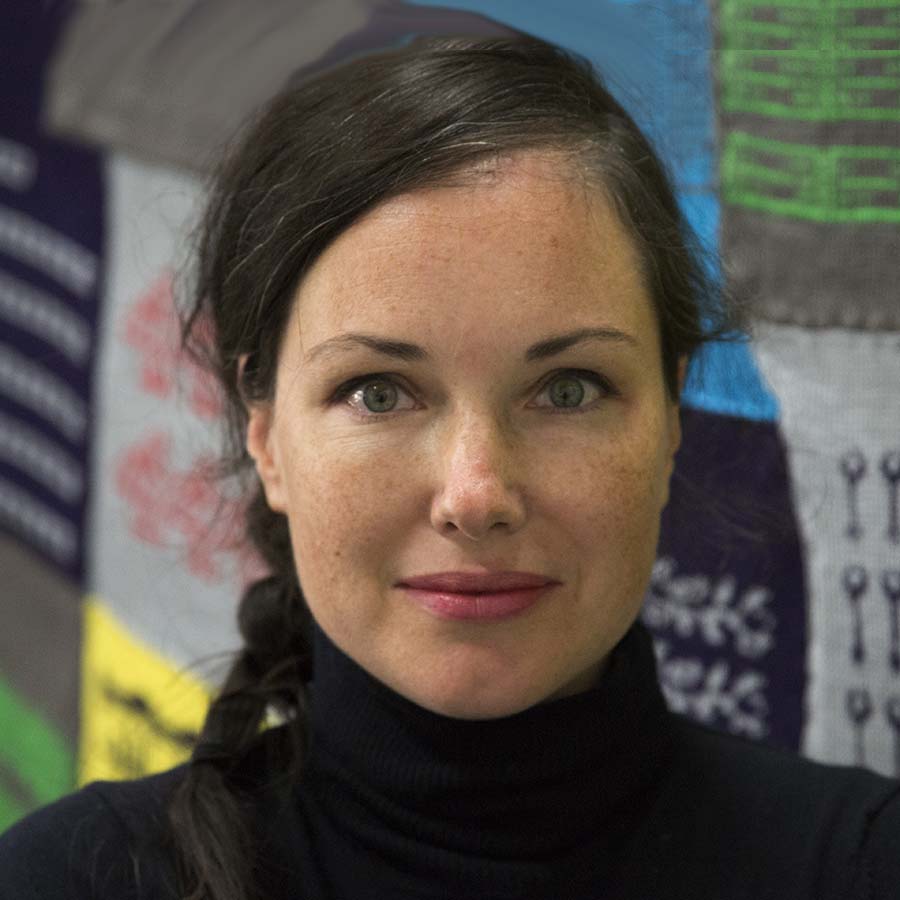
Henrike Schmitz is a Lecturer in Textile Design at Burg Giebichenstein Kunsthochschule Halle since 2023. Her work bridges transformative creative processes in the textile industry, focusing on recycling methods and implementation strategies in knitted structures, alongside conceptual exploration of material situationships and regional production in areas with local textile expertise. Education: MA in Textile and Surface Design from Kunsthochschule Weißensee Berlin and Swedish Textile School in Borås. Previous Roles: Cultural Anthropology of Textiles Lecturer at TU Dortmund; Editorial Manager for textil trainer project at TU Chemnitz; Process Engineer at SOEX. Her research focuses on sustainable textile innovation , combining technical machine-based design with conceptual material studies. She integrates her phd research on circular textile systems into teaching through initiatives like the highschulöffentliche Jourfixe, which diffuses artistic research into curricula. She is active in the Design Faculty Council and Library Committee at Burg Giebichenstein. Contact: schmitz@burg-halle.de | Portfolio
Anna-Mari Leppisaari is a University Lecturer in Textile Design at Aalto University's Department of Design since 2016. Her work bridges artistic practice and academic research in textiles. Master's Degree in Arts and Design, Aalto University (2013) Bachelor's Degree in Arts and Design, Aalto University (2011) Her research focuses on textile design , fashion textiles , knitwear , and textile pedagogy . Key themes include virtual knitting , community-centred design , and sustainable textile practices . Recent artistic outputs (2024) emphasize digital knitting technologies , Paris Fashion Week collaborations, and virtual prototyping . Earlier works explore Finnish design , bio-materials , and experimental textile finishing . Aalto ARTS Grant (2019, 2018) Milan Design Week Artistic Grant (2017) Cultural Foundation Artistic Collaboration Grant (2017) She engages in international collaborations (Tama Art University, The New School, Royal College of Art) and participates in major design events like Helsinki Design Week and Paris Fashion Week. Her work contributes to UN Sustainable Development Goals related to cultural preservation and sustainable materials.
Pia Mouwitz is a Senior Lecturer in fashion design at the Swedish School of Textiles, University of Borås. She has held this position since 2006, contributing to research projects such as Knit on Demand and leading initiatives like the EU-funded Baltic Fashion (2010-2013). Her work bridges academic research with industry collaboration, focusing on sustainable textile systems and wearable technology. Research interests include circular fashion, material innovation, and the integration of technology into textile design. Key projects include a pre-study on circular textile flows in collaboration with Region Västra Götaland and development of sensorized garments for health monitoring. Her contributions span teaching roles in collection development, sustainable fashion, and design aesthetics. She has 17 years of industry experience as a designer and product developer across multiple fashion segments.
Lee Su-hyeon is an Assistant Professor at the Department of Clothing and Textiles in Seoul National University's College of Human Ecology . Previously, she served at Jeonbuk National University (2021-2023) and conducted postdoctoral research at the Korea Institute of Industrial Technology (2018-2021). Her work focuses on smart textiles , superhydrophobic materials , and conductive fabrics for wearable technology. Ph.D. (2018), Seoul National University M.Sc. (2012), Seoul National University B.Sc. (2009), Ewha Womans University Research interests include: Surface chemistry of textiles Water-repellent fabric structures Conductive yarn blending Metal-organic framework coatings E-textile manufacturing automation Thermo-electric clothing systems Her 15 most recent publications (2018-2023) demonstrate expertise in superhydrophobic polyester films , smart sports bras , MIL-100(Fe) cotton coatings , and carbon nanotube composites . Key trends show integration of conductive materials with environmental sustainability approaches. Scientific recognition includes: 2022 FTEX Best Reviewer Award 2021 Korea Fashion Business Association New Researcher Award Multiple Korean Society of Clothing and Textiles presentation awards (2013-2018) Lectures on undergraduate courses: Basic chemistry of clothing materials , Clothing material composition , Cleaning principles . Graduate courses: New clothing materials , Textile physics , Smart fabric evaluation .
Edward Houghton is a Senior Lecturer in Textiles/Fashion (Knitwear) affiliated with Middlesex University's School of Design. His work focuses on innovative knitwear techniques, collaborations with leading fashion brands, and the intersection of traditional craftsmanship with contemporary design. Though listed as past academic staff, his contributions to textile and fashion design remain influential. He has collaborated extensively with brands such as TOPSHOP UNIQUE, GUCCI, and TOPMAN, creating bespoke garments for catwalk shows and seasonal collections. Notable projects include handknitted feather boas, military-inspired cashmere sweaters, and experimental cobweb garments. His expertise spans both hand and machine knitting, with a emphasis on luxury apparel and trend-driven designs. Houghton’s work often bridges artistry and functionality, as seen in his contributions to theatrical costumes (e.g., the pantomime 'Dick Whittington') and trend predictions for the International Wool Secretariat. His portfolio reflects a deep engagement with textile innovation and brand partnerships within the global fashion industry.
Noeska Smit is a Professor in Medical Visualization at the Department of Informatics, University of Bergen , where she has held a tenure-track position funded by the Trond Mohn Foundation since 2017. She is also a senior researcher and member of the leadership team at the Mohn Medical Imaging and Visualization (MMIV) Centre . Her research focuses on novel interactive visualization techniques for exploring and communicating multimodal medical imaging data , particularly in multi-parametric MR acquisitions . She leads projects in gynecologic cancer imaging , Multiple Sclerosis neuroimaging , and human anatomy education through collaborations with institutions like UGent (Belgium) and HVL. 2019: Dirk Bartz Prize for Visual Computing in Medicine 2016: PhD at Delft University of Technology , Netherlands 2012: MSc in Computer Science (Computer Graphics & Visualization) , Delft University Recent publications highlight her work in MRI radiomics , narrative visualization , open-source anatomy platforms , and interactive clustering tools for tumor analysis. Her methods are applied in oncological pelvic surgery planning , neurological disease monitoring , and 3D learning environments . She supervises PhD candidates Eric Mörth and Sherin Sugathan , and has contributed to open-source medical visualization tools like RegistrationShop and Online Anatomical Human (OAH) . Her work bridges clinical practice and computer science through collaborations with radiologists, surgeons, and ML researchers.
Chin-I Cheng is a Professor and Chairperson in the Department of Statistics, Actuarial & Data Sciences at the College of Science & Engineering. His research focuses on Bayesian statistics, nonparametric models, and their applications across biomedical and social sciences. Ph.D., University of Missouri-Columbia (2009) His work spans public health disparities, cardiovascular education, textile engineering, and clinical pharmacology, with methodological contributions to smoothing spline ANOVA and Bayesian estimation. Scientific awards include the Arnold P. Gold Foundation Outstanding Doctoral Examination Award and multiple Quality Excellence Awards from Taiwan’s Industrial Development Bureau.
Meghan Huber is an Adjunct Assistant Professor in the College of Information and Computer Sciences at the University of Massachusetts Amherst and director of the Human Robot Systems Laboratory. She holds a B.S. in Biomedical Engineering from Rutgers University (2009), an M.S. in Biomedical Engineering from the University of Texas at Dallas (2011), and a Ph.D. in Bioengineering from Northeastern University (2016). Her postdoctoral research was conducted at MIT's Department of Mechanical Engineering (2016-2020), and she was a Visiting Junior Scientist at the Max Planck Institute for Intelligent Systems (2014). Her research focuses on Robotics, Computer Vision, and Human-Computer Interactions, with emphasis on gait adaptation, robotic exoskeletons, and biomechanical systems. Recent work explores adjustable compliance footwear, surface stiffness effects on gait, and human-robot harmony challenges. Her contributions bridge robotics, biomechanics, and rehabilitation engineering, aiming to improve motor adaptation and assistive technologies. Key themes in her publications include exoskeleton design, gait rehabilitation strategies, and adaptive control systems. Her lab develops novel devices like the AdjuSST treadmill and explores how variable impedance environments influence human movement. Meghan’s interdisciplinary approach integrates robotics, materials science, and clinical applications to advance wearable technologies. Her research also addresses challenges in human-robot collaboration, including trust dynamics and ethical considerations. Beyond academia, she enjoys knitting, biking, and spending time with her miniature dachshund, Yoshi.
Marcus Oliver Weber is a Professor at the Department of Textile and Clothing Technology at Niederrhein University of Applied Sciences. He also serves as Head of the Department of Textile Management at Technische Universität Berlin (TUB). His work spans textile engineering, knitting innovation, and sustainable material science. Academic Rank: Professor Primary Role: Niederrhein University of Applied Sciences Secondary Role: Head of Department of Textile Management at TUB Research Interests focus on advanced knitting technologies , smart textiles , and sustainable fiber applications . Key areas include biodegradable textile solutions, conductive yarns for sensor applications, and technical textiles for protective, medical, and automotive sectors. Recent Publications highlight innovations in PLA-based biodegradable packaging , ultrasonic welding of nanofibers , and thermodynamic properties of spacer fabrics . His work emphasizes sustainable practices, material testing, and smart textile integration. Scientific Awards & Activities include UNIDO Technical Advisor Bundesgerichtshof (BGH) Technical Advisor ISO Standardization Committee for Knitting Machines Patents cover novel yarn feeding systems and textile machine designs. Teaching responsibilities include courses in Textile and Clothing Technology , Design Engineering , and Textile Product Management .
Rachel A. Bergstrom is an Associate Professor of Biology and Director of the School of Health Sciences at Beloit College. She holds a PhD in Biomedical Sciences (Neurobiology of Disease) from Mayo Graduate School (2012) and a BS in Biology from North Park University (2004). Her research focuses on epilepsy through EEG analysis and pedagogical strategies in STEM education, emphasizing group work and science identity development. She teaches courses in Cell Biology, Neuroscience, Cancer Biology, and Emerging Infectious Diseases. Her research combines computational methods for seizure detection/classification with innovative approaches to STEM education. Recent work explores predictive epilepsy indices using spike waveform analysis and the role of metaphor in addressing diversity challenges in STEM. She advocates for translational research at the undergraduate level and civic engagement in scientific training. Committed to student mentorship, she emphasizes building connections between coursework and personal growth. Beyond academia, she serves on the Rock County Board of Health and enjoys running, knitting, and sci-fi TV shows.
Dr. Can Nerse is an early-career researcher and Adjunct Fellow at the School of Mechanical and Mechatronic Engineering, University of Technology Sydney (UTS), where he works as a Postdoctoral Research Fellow at the Centre for Audio, Acoustics and Vibration (CAAV). He joined UTS in February 2021 and has progressed from Postdoctoral Research Associate to Postdoctoral Research Fellow. His academic journey includes a Postdoctoral Research Associate position at Gwangju Institute of Science and Technology in South Korea. Dr. Nerse received his PhD in Mechanical Engineering from Gwangju Institute of Science and Technology in August 2020, following an MSc from the same institution in 2015 and a BSc from Middle East Technical University, Ankara, Turkey in 2013. Dr. Nerse's research focuses on the intersection of vibro-acoustics, metamaterials, and bioinspired engineering. He investigates how eusocial insects like honey bees build structures with specific vibro-acoustic properties and applies these insights to develop novel materials and vibration control solutions. His work spans theoretical modeling, experimental validation, and practical industrial applications in noise and vibration mitigation. Current research interests include vibroacoustics, metamaterials, biotremology, self-organization, digital twins, and numerical methods. Dr. Nerse's publication record demonstrates a progression from fundamental vibration analysis to bioinspired metamaterial applications. His most recent work focuses on topological mechanical states in hyperuniform materials, wild bee signal classification, and bio-inspired acoustic metasurfaces manufactured through knitting technology. This research trajectory shows increasing integration of biological principles with engineering solutions for noise and vibration problems. International Institute of Acoustics and Vibration (IIAV) - Member since 2023 Society for Experimental Mechanics - Member since 2015 Korean Society for Noise and Vibration Engineering (KSNVE) - Member since 2013 Dr. Nerse has secured multiple research grants including the UTS FEIT Blue Sky Research Scheme Grant for bio-informed sensing and the UTS Cross-Faculty Collaboration Grant for acoustic well-being through metasurfaces. He has taught courses including Embedded Mechatronics System, Dynamics and Control, FEM and Optimization, and Sound and Vibration. He is available for Master's research supervision and PhD student supervision, particularly in areas related to his expertise in vibro-acoustics and metamaterials. Dr. Nerse leads research in the Centre for Audio, Acoustics and Vibration (CAAV) at UTS, working with interdisciplinary teams to develop innovative solutions for vibration and noise problems. His current projects involve creating acoustic metasurfaces using knitting technology to address noise issues in communal spaces, aligning with UN Sustainable Development Goals for Sustainable Cities and Communities, Industry Innovation and Infrastructure, and Climate Action.
Cat Mazza is Professor of Art at the University of Massachusetts Boston since 2007, where her practice bridges textile traditions, digital technology, and critical labor studies through innovative visual art forms. Her educational background includes: MFA in Integrated Electronic Arts, Rensselaer Polytechnic Institute (2005) BFA in Studio Art, Carnegie Mellon University (1999) Mazza's research investigates how knitting and electronic media converge to expose hidden labor systems in technological production. Her work transforms textile craft into political commentary through algorithmic design and interactive installations, challenging distinctions between handmade and machine-made while highlighting gendered labor histories. This interdisciplinary approach positions craft as critical infrastructure for examining contemporary techno-capitalism. Her recent creative output demonstrates consistent evolution in electronic textile applications, moving from single-channel animations like "Knit for Defense" to complex sculptural installations that merge physical computing with traditional fiber techniques. These works establish textiles as active interfaces for engaging with labor politics, biotechnology, and resistance strategies in digital culture. Mazza's artistic contributions have been recognized through prestigious awards: Creative Capital Fellowship MacDowell Colony Fellowship Craft Research Fund Fellowship Now+There Public Art Accelerator Fellowship Rockefeller Foundation Fellowship As a professor at UMass Boston, Mazza mentors emerging artists while maintaining an active studio practice. Her early career at Eyebeam (1999-2002) established foundational collaborative methodologies that continue to inform her interdisciplinary approach, bridging art, technology development, and social critique within academic and public spheres. Mazza's work occupies significant space in major collections including the Smithsonian American Art Museum, with international exhibitions spanning the Victoria & Albert Museum, Museum of Arts and Design, and Triennale Design Museum, demonstrating sustained relevance across art, craft, and technology discourse.
Amanda Brown is a Part-time Assistant Professor at the Parsons School of Design, The New School. She specializes in knit design and textile education, teaching courses such as Knit Design: Dubied and Machine Knitting 1. Her roles include advising students through thesis courses like Thesis 1 and Thesis 2. She is based at the A - 66 West 12th Street campus. Education Background: No formal education details provided in the text. Research Interests: While no explicit research areas are mentioned, her teaching focus on knit design and textile techniques suggests expertise in fashion technology and textile arts. Grants & Advising: No grants or specific advising details provided. Current and past courses indicate a focus on practical design education. Labs/Teams: No labs or research teams mentioned.
Dr. Lin Gardner holds dual roles at the University of Glasgow: Admin Assistant (Student Services) and Affiliate in the History Department. Her research focuses on the Scottish textile industry, particularly knitwear's historical and cultural dimensions. She explores the interplay between technological innovation and creative output in textile production. Notable contributions include a co-authored book and several peer-reviewed articles in Textile History and Textile . Her work bridges material culture studies, industrial history, and cultural analysis. Affiliations: History Department, University of Glasgow Key Research Themes: Knitwear industry, machinery's impact on creativity, textile historiography While no scientific awards are noted, her publications reflect significant scholarly engagement with textile history's socio-economic dimensions. No advising roles or grants are explicitly listed in the provided texts.
Umut Kıvanç Şahin serves as an Associate Professor in the Department of Textile Engineering at Istanbul Technical University (ITU), where he maintains active research and teaching responsibilities. His institutional affiliation includes the İTÜ Ayazağa Campus in Istanbul, Turkey, with direct contact through university email channels. Research interests span specialized textile domains including e-textiles, conductive yarn applications, electromagnetic shielding fabrics, softener chemistry for cotton knits, nanofiber drug delivery systems, and textile machinery optimization. His work bridges fundamental textile science with advanced applications in wearable electronics, military textiles, and sustainable material development. Analysis of recent publications reveals strong focus on functional textile treatments (softeners, conductive coatings), e-textile transmission systems, and nanofiber-based biomedical applications. Key methodological approaches include experimental testing of fabric properties, process optimization via SMED methodology, and AI-driven appliance analysis. Uluslararası Bilimsel Yayınları Teşvik Ödülü (2005) Supervision encompasses 8 documented research works, while grant leadership includes three major projects: AI-based dryer load detection (2023), flexible conductive e-textile connectors (2017-2020), and textile waste recycling for nanocomposites (2017-2019). These projects demonstrate consistent funding acquisition in applied textile research. Research infrastructure supports investigations into electromagnetic shielding fabrics, e-textile transmission lines, and nanofiber webs, with collaborations spanning materials science, electrical engineering, and biomedical applications. Current work focuses on 2025 publications exploring softener effects on cotton knits and next-generation e-textile systems.