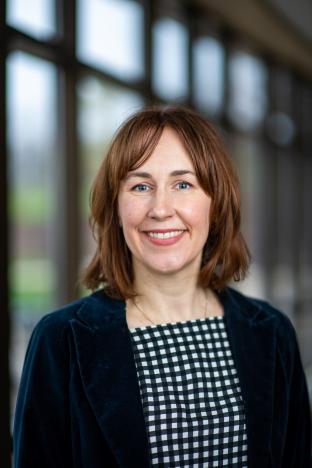
Associate Professor Laurianne Sitbon is an ARC Future Fellow and Associate Professor at QUT's School of Computer Science. Her work focuses on human-computer interaction, natural language processing, and accessibility for people with intellectual disabilities. She leads projects like designing pictorial communication frameworks and human-machine teaming systems. She holds a PhD from the University of Avignon and collaborates with organizations like Endeavour Foundation. Research interests include co-design methodologies, assistive technologies, and inclusive system design. Awards include ARC Future Fellowship. Supervises PhD projects on topics like multimodal communication, social robots, and human-AI collaboration in healthcare. Key projects include: A Pictorial Communication Framework for Inclusion (ARC FT190100855) Human-Machine Teaming: Designing Synergistic Learning (ARC DP200103582) Publications span over 50 peer-reviewed papers, emphasizing participatory design with neurodiverse populations. Collaborates internationally on inclusive AI applications and disability-inclusive technology.
Dr Simon Lee is a Lecturer in Atmospheric Science at the University of St Andrews within the School of Earth and Environmental Sciences. He serves as Co-Editor-in-Chief of the Royal Meteorological Society's journal Weather . His research focuses on large-scale atmospheric and climate variability across subseasonal to decadal timescales, particularly stratospheric dynamics and weather regimes. Key areas include stratospheric polar vortex variability, sudden stratospheric warmings, and their impacts on tropospheric weather systems. PhD (2021): Stratosphere-Troposphere Coupling on Subseasonal Timescales , University of Reading MMet (2018): Meteorology and Climate , University of Reading Research highlights include advancing understanding of stratospheric polar vortex dynamics, developing frameworks for subseasonal prediction models, and creating a novel North American weather regime classification system. He actively collaborates with the APARC Stratospheric Network for the Assessment of Predictability (SNAP) steering committee, bridging weather and climate sciences. Public engagement is a priority, with contributions to media platforms like The Conversation . Teaching responsibilities include courses on oceans and atmosphere ( ES3013 ), Earth surface processes ( ES2003 ), and resource challenges ( ES1002 ). His work emphasizes translating scientific findings for stakeholders and the public, with a focus on actionable climate information.
Shengyi Wang is an Associate Research Scholar in the Department of Computer Science at Princeton University, School of Engineering and Applied Science. He is actively engaged in research on formal verification, programming languages, and mechanized reasoning, with a focus on verifying concurrent systems, C programs, and network packet processing. Research Interests: His work centers on foundational and compositional verification of low-level systems using interactive theorem proving. Key areas include separation logic, concurrency, data structure invariants, and certified systems programming. He applies these to real-world challenges in systems security and network correctness. Recent Research Trends: His recent publications (2020–2024) show a strong trajectory in verifying complex systems such as concurrent C programs, P4-based packet processors, and enclave filesystems. The work consistently uses Coq and mechanized proofs to ensure correctness, emphasizing scalability and compositional techniques. Scientific Awards: No awards or fellowships are mentioned in the provided text. Advising and Grants: No formal students or advisees are listed. No grants or funding sources are explicitly mentioned. Labs and Teams: While not explicitly stated, his collaborations with researchers like Andrew W. Appel, Lennart Beringer, and William Mansky suggest involvement in Princeton’s formal methods and systems verification research group, likely associated with the Department of Computer Science.
Björn Gambäck is a Professor of Language Technology at the Department of Computer Technology and Informatics, NTNU. His research focuses on computational creativity, computational linguistics, artificial intelligence, and machine learning, with a strong emphasis on natural language processing (NLP) and language technology. He actively contributes to the academic community through teaching courses such as 'Intelligent Text Analysis and Language Comprehension' and supervising master's theses. His work includes advancing techniques for sentiment analysis, code-mixed language processing, and computational creativity. Recent research highlights include developing deep learning models for code-mixed social media analysis and exploring coreference resolution in entity-level sentiment tasks. Gambäck’s contributions span interdisciplinary areas, such as applying evolutionary algorithms to media repositories and music composition. Notable collaborations include projects on hate speech detection, sarcasm annotation in tweets, and named entity recognition for low-resource languages like Amharic. His expertise bridges theoretical advancements and practical applications in NLP and computational systems.
Anjo Vahldiek-Oberwagner is a Research Scientist at Intel Labs and an Adjunct Lecturer at TU Munich, where he contributes to both industrial R&D and academic education in systems and security. His work bridges hardware and software security, focusing on confidential computing, in-process isolation, and secure cloud deployments. PhD in Computer Science, Max Planck Institute for Software Systems & Saarland University, 2019 B.Sc. in Applied Computer Science, Cooperative University State University Baden-Wuertemberg, 2009 His research centers on system security, particularly techniques for protecting data confidentiality and integrity at rest, in-flight, and in-memory. He explores operating systems, distributed systems, and hardware-assisted security mechanisms such as Intel MPK and SGX. His work on ERIM, HFI, Endokernel, and Graphene has advanced secure in-process isolation and trusted execution environments. He has published extensively in top venues like USENIX Security, ASPLOS, and IEEE S&P. His recent publications reflect a strong trend toward practical, deployable security solutions for modern computing environments, including secure AI/ML deployments, efficient in-process isolation, and hardware-accelerated sandboxing. Themes include memory safety, performance optimization, and real-world applicability of security primitives. Scientific awards include: Distinguished Paper Award and Internet Defense Prize, USENIX Security 2019 (ERIM) Distinguished Paper Award, ASPLOS 2023 (HFI) IEEE Micro Top Picks 2024 (HFI) Intel Hardware Security Academic Award (Honorable Mention) DARPA Riser 2022 Intel Labs Gordy Award Honorable Mention He actively mentors and serves on program committees (EuroSys, USENIX Security, ASPLOS), chairs artifact evaluation (USENIX Security, EuroSys, SC), and is an Associate Editor for ACM TOPS. He has advised no formal students listed, but collaborates widely across Intel and academia. His work is supported by Intel and DARPA, and he holds multiple patents in secure computing and TEEs. He leads research on memory-safe architectures and secure cloud deployments at Intel Labs. He is involved in several research projects, including: Secure In-Process Memory Isolation, Shielding Applications in Untrusted Clouds via SGX, Memory-Safe Hardware and Software Architecture, and Research Artifacts and Evaluation. He is also a key contributor to the Graphene Library OS and works on validation and endorsement services for confidential computing.
Andreas Haeberlen is a Professor in the Department of Computer and Information Science at the University of Pennsylvania, where he is a member of the Distributed Systems Lab (DSL) and co-director of the NETS program. He is currently on a leave of absence from Penn to lead the new systems group at Roblox Research, focusing on large-scale distributed systems in cloud and metaverse environments. University: University of Pennsylvania School: School of Engineering and Applied Science Department: Department of Computer and Information Science Academic Rank: Professor Email: ahae@cis.upenn.edu His research centers on distributed systems, networking, security, and privacy, with key interests in differential privacy, fault tolerance, secure network provenance, accountability in federated systems, and synchronous data center architectures. He aims to build practical systems that provide strong, provable privacy and security guarantees for real-world applications. The recent publications reflect a strong trend toward privacy-preserving distributed analytics, resilient cyber-physical systems, and secure, accountable federated infrastructures. His work combines techniques from programming languages, operating systems, and distributed computing to address fundamental challenges in scalability, security, and timing predictability. Key themes include bounded-time recovery, differential privacy in federated settings, and secure provenance for network diagnostics. Scientific Awards: Recipient of the Otto Hahn Medal from the Max Planck Society Recipient of the Ford Motor Company Award for Faculty Advising Recipient of the Lindback Award for Distinguished Teaching He has advised graduate students such as Karan Newatia and Robert Gifford, often in collaboration with Linh Thi Xuan Phan. His research is supported by active projects in differential privacy, synchronous data centers, resilient cyber-physical systems, secure network provenance, and accountability. He leads or co-leads major research initiatives that bridge academic innovation with industrial-scale deployment, particularly in cloud and metaverse platforms.
Lonneke van der Plas is an Associate Professor at the Institute of Argumentation, Linguistics and Semiotics within the Faculty of Communication, Culture and Society at Università della Svizzera italiana (USI), and an Adjunct Professor at the Faculty of Informatics, USI, since October 2024. She also serves as the group leader of the Computation, Cognition & Language research group at the Idiap Research Institute in Martigny, a position she has held since February 2021. Her academic background includes: PhD in Humanities Computing, University of Groningen M.Phil in Computer Speech and Language Processing, University of Cambridge Postdoctoral research at the University of Geneva (CLASSiC project) Junior Professor at the University of Stuttgart (IMS, SFB 732) Associate Professor at the University of Malta (2014–2020) Her research interests span Natural Language Processing , Computational Linguistics , Distributional Semantics , Multilingual NLP , Computational Creativity , and Low-Resource Languages . She integrates insights from cognitive science, linguistics, and computer science to model language as a tool for creative thinking and reasoning. Her work includes semantic role labeling, cross-lingual transfer, medical question answering, and lexical innovation. The 15 most recent publications reflect a strong trend in interdisciplinary NLP research, combining linguistic theory with machine learning. Topics include lexical innovation, multilingual financial NLP, skill extraction, multi-modal fact checking, and cognitive modeling. The articles demonstrate expertise in both theoretical and applied NLP, with applications in healthcare, finance, education, and AI ethics. Key subfields include semantic role labeling, cross-lingual transfer, bootstrapping for low-resource languages, and structured knowledge integration. Scientific recognitions include: DSI Fellow, University of Zurich (2019–2020) Erasmus Mundus LCT Visiting Scholar at Shanghai Jiao Tong University and University of Melbourne (2016) Visiting Academic at Macquarie University, Sydney (2007) She has advised multiple PhD students including Stefan Müller, Patrick Ziering, Molly Petersen, Mete Ismayilzada, and Diego Rossini. She currently leads several major funded projects: NCCR Evolving Language (SNSF, PI), C-LING (SNSF, PI), SEM24 (Innosuisse, PI), and FactCheck (Hasler Foundation, co-PI). These grants support postdoctoral researchers, developers, and PhD students, and involve collaborations with institutions like EPFL, EHL, and ARCA24. Her research bridges academia and industry, with applications in HR, finance, and healthcare. Lonneke leads the Computation, Cognition & Language group at Idiap, which conducts highly interdisciplinary research involving collaborations with social scientists, cognitive scientists, linguists, and professionals in health, finance, and business. The group focuses on modeling language as a cognitive and creative tool, using computational methods to explore lexical innovation, diachronic change, and reasoning. Open PhD positions are available in areas such as NLP for cognitive modeling, multilingual NLP, and mental health applications.
Nakul Garg is an Assistant Professor in the Department of Electrical & Computer Engineering at Rice University. He leads research in ambient intelligence, wireless sensing, and embedded AI, focusing on energy-efficient and scalable solutions for IoT systems, robotics, and healthcare. His work bridges the gap between sensing, computing, and communication in everyday environments. Education includes a PhD in Computer Science from the University of Maryland, College Park, and a B.Tech in Electronics & Communication Engineering from Indraprastha University, Delhi. His research has been recognized with awards such as the Marconi Society Young Scholar Award (2024) and the Best Paper Award at MobiSys 2022. Research interests span spatial sensing, low-power IoT localization, and integrating AI into wearable devices. Key projects include LiTEfoot (cellular-based asset tracking), FreshSense (food quality monitoring), and SPiDR (acoustic navigation for micro-robots). He actively collaborates with industry (e.g., Microsoft Research, NEC) and has advised multiple students in developing innovative systems. Awards and recognitions include the Cyber-Physical Systems Rising Star (2024), NSF I-Corps support, and multiple best paper/demo awards at top conferences. His work has been featured in ACM GetMobile and highlighted by the ACM SIGMOBILE community.
Dr. Yonghao (Leo) Wang is an Associate Professor at Birmingham City University's Department of Computer Science and Creative Technologies. His research focuses on Networking, Cybersecurity, Blockchain Technology, Digital Signal Processing (DSP), and Cloud/Edge Computing. He actively contributes to international standards bodies like ETSI and AES, and has authored over 60 peer-reviewed publications. His work emphasizes ethical technology integration, particularly in blockchain for inclusive finance and AI, as well as low-latency networking for beyond-5G systems. Research interests include blockchain security, multimedia steganography, AI-driven network optimization, and time-deterministic systems. Dr. Wang also explores how advanced information systems can enhance knowledge acquisition across domains. His recent articles span topics from smart contract security to video steganography in HEVC, reflecting his interdisciplinary approach to technology and societal impact. He serves as a journal reviewer, guest editor, and conference chair, fostering academic collaboration. No specific scientific awards are listed, but his extensive publication record and committee roles highlight his impactful contributions to the field.
Dr. Silvio Savarese is an Adjunct Professor in the Department of Computer Science at Stanford University. His research focuses on advancing artificial intelligence, particularly in multimodal models, autonomous agents, and large language models (LLMs). He has contributed to foundational work in vision-language models like BLIP3 and XGen, as well as frameworks for training action models and optimizing AI agents. His projects emphasize practical applications such as CRM systems, code generation, and ethical AI. Current interests include scalable reasoning in LLMs, efficient model architectures, and multimodal pretraining for 3D understanding. Key research directions include developing unified multimodal models capable of handling vision, language, and point cloud data, as seen in projects like ULIP and Merlion. He explores agent systems through benchmarks like Behavior-1K and BOLAA, aiming to improve real-world interaction capabilities. Recent work addresses challenges in data generation (Text2Data), agent optimization (PRACT), and safety through methods like LZ Penalty for text repetition control. His contributions span open-source libraries (LAVIS, OMNIXAI) and datasets (DialogStudio, Eye-BEHAVIOR), emphasizing reproducibility and community impact. While no formal awards are listed, his extensive publication record and industry collaborations highlight academic and industrial relevance. Current projects include high-fidelity video synthesis (xGen-videosyn-1), time series forecasting (Moirai-MoE), and lightweight agent frameworks (AgentLite).
Anne Fernandez, Ph.D. is an Associate Professor in the Department of Psychiatry at the University of Michigan Medical School. She serves as Director of Clinical Programming for both the U-M Addiction Treatment Services and the U-M Multidisciplinary Alcohol-Related Liver Disease Clinic. Additionally, she is the Director of Clinical Research for MI-ACRE (Michigan Integrated Center for Health Analytics and Reasoning Engine) and works as a practicing Clinical Psychologist with U-M Addiction Treatment Services. Dr. Fernandez received her doctoral degree in clinical psychology from University of Rhode Island with a focus in health psychology. Her training includes a clinical psychology residency in Behavioral Medicine at Yale New Haven Hospital and a post-doctoral fellowship at the Center for Alcohol and Addiction Studies at Brown University. Her research focuses on two primary areas: surgical optimization for patients with alcohol use disorders and prevention of opioid misuse among patients prescribed opioids for pain management after surgery. The overarching goal of this work is to improve surgical outcomes through early pre-operative intervention that addresses addiction and other behavioral health risk factors. She employs innovative methodologies including machine learning and natural language processing to identify patient cohorts in need of addiction prevention and intervention at key time points in clinical care. Dr. Fernandez's recent publications demonstrate a strong focus on alcohol use disorders, alcohol-associated liver disease, and perioperative substance use. Her work spans clinical trial design, diagnostic methodologies, risk prediction, and implementation of behavioral interventions in medical settings. She has made significant contributions to understanding gender differences in alcohol-related conditions and developing frameworks for psychosocial evaluation in liver transplantation. National Institute of Alcohol Abuse and Alcoholism career development grant University of Michigan Precision Health Award Dr. Fernandez leads several research initiatives funded by prestigious grants, with a particular focus on integrating behavioral health interventions into surgical care pathways. Her work bridges clinical psychology, hepatology, and surgical specialties to address critical gaps in care for patients with substance use disorders. She is actively involved in developing and testing interventions that leverage technology to improve identification and treatment of substance use issues in medical settings. As Director of Clinical Programming for the U-M Multidisciplinary Alcohol-Related Liver Disease Clinic, Dr. Fernandez oversees a team that provides integrated care for patients with alcohol-associated liver conditions. Her leadership in this clinic exemplifies her commitment to creating innovative care models that address the complex interplay between addiction and medical conditions.
Gábor Kiss is an Associate Professor in the Department of Atomic Physics at Budapest University of Technology and Economics (BME). His research focuses on applied physics, surface physics, gas sensors, electrolytic capacitors, and hydrogen storage in metals. He has contributed to studies on metal hydride alloys, titanium-based medical implants, and gas detection technologies. His work involves advanced analytical methods like XPS, SIMS, and AES. Notable collaborations include investigations into hydrogen absorption/desorption processes and the effects of surface contaminations on hydrogen storage materials. Recent work extends to speech-based medical diagnostics, leveraging machine learning for depression and Parkinson’s disease detection. Education details are not explicitly listed, but his research expertise spans materials science and interdisciplinary applications. His publications emphasize surface analysis techniques and their biomedical and energy storage applications. He has co-authored influential papers in journals like Analytical and Bioanalytical Chemistry and Sensors and Actuators B. Research trends in his recent articles focus on computational linguistics (e.g., Hungarian speech data analysis), clinical diagnostics via speech processing, and optimization in wireless sensor networks. These reflect a shift towards AI-driven healthcare solutions while maintaining core strengths in materials physics. No awards or grants are explicitly mentioned, but his extensive publication record and cross-disciplinary collaborations indicate significant contributions to both fundamental and applied research.
Prof. Xiaoming Fu is a Professor at the Institute of Computer Science, University of Göttingen, and Head of the Computer Networks Group. He also holds a secondary membership in the Center for Statistics. His research focuses on AI-driven networking, edge computing, federated learning, and video analytics. He teaches courses such as 'AI-Empowered Networking and Mobile Communications' and oversees multiple seminars and internships on topics like smart cities and network optimization. His work spans technical innovations in multi-agent systems, low-latency services, and resource-efficient machine learning. Recent articles highlight contributions to neural-optimized video streaming, privacy-preserving MARL, and cross-modal social media analysis. He collaborates on interdisciplinary projects involving mobility data, socioeconomic analysis, and quantum networks. Prof. Fu’s research integrates reinforcement learning, network architecture design, and distributed systems to address challenges in 5G/6G, IoT, and smart cities. His lab develops solutions for edge-cloud orchestration, video quality adaptation, and resilient resource allocation, with applications in both academia and industry.
Nizar Habash is a Professor of Computer Science at New York University Abu Dhabi (NYUAD) and a Global Network Professor at the Courant Institute of Mathematical Sciences. He is the director of the Computational Approaches to Modeling Language (CAMeL) Lab, where he leads research in natural language processing, computational linguistics, and Arabic language technologies. His educational background includes a BS in Computer Engineering and a BA in Linguistics and Languages from Old Dominion University, and MS and PhD degrees in Computer Science from the University of Maryland, College Park. Habash's research focuses on artificial intelligence, particularly natural language processing for Arabic and its dialects. His work spans machine translation, morphological and syntactic analysis, sentiment analysis, dialogue systems, and dialect identification. He has developed foundational resources such as the MADAR corpus, CODA orthography, and tools like MADAMIRA and CamelParser. His publications reflect a strong emphasis on creating robust, multilingual, and dialect-aware NLP systems for low-resource and complex linguistic environments. Habash has been involved in over 20 research grants and has authored more than 150 publications, including the influential book Introduction to Arabic Natural Language Processing . His recent work centers on improving machine translation, modeling Arabic orthography and morphology, and building large-scale annotated corpora for dialectal Arabic. His scientific recognition includes the ELRA Antonio Zampolli Prize in 2024 for outstanding contributions to language resources and evaluation in human language technologies. Habash advises numerous research projects and capstone theses at NYUAD. He has taught courses such as Natural Language Processing, Arabic Computational Linguistics, Discrete Mathematics, and the Computer Science Research Seminar. He has secured significant grant funding, particularly through projects like QALB and MADAR, which have advanced Arabic NLP research globally. He leads the CAMeL Lab, a vibrant research group focused on AI-driven language modeling, with active projects in Arabic readability (SAMER), dialect identification (ADIDA), dialogue systems (TOIA, BOTTA), and corpus development (GUMAR, Curras, Arab-Acquis).
Zhuowen Tu is a Professor in the Department of Cognitive Science at the University of California, San Diego (UCSD), with an affiliate appointment in the Department of Computer Science and Engineering. He leads the Machine Learning, Perception, and Cognition Lab (mlPC), where his research lies at the intersection of computer vision, machine learning, deep learning, natural language processing, and neural computation, focusing on statistical models for structured, large-scale, and multi-modal data. He received his Ph.D. from The Ohio State University and held faculty positions at UCLA before joining UCSD in 2013. He also served as a Lead Researcher at Microsoft Research Asia (2011–2013) and was an Amazon Scholar (2021–2022). His academic trajectory includes progression from Assistant to Associate and then Full Professor at UCSD. His research interests span computer vision , deep learning , generative modeling , vision-language models , diffusion models , and structured prediction . He has made seminal contributions to image parsing, auto-context models, introspective neural networks, and holistically-nested edge detection. His recent work emphasizes Bayesian diffusion models, panoptic 3D parsing, and multimodal learning. The analysis of his recent publications shows a strong trend toward diffusion-based generative modeling , particularly in 3D vision, image restoration, and vision-language tasks. He also continues to advance work in multimodal understanding, continual learning, and efficient transformers. His lab actively publishes in top venues such as CVPR, ICCV, NeurIPS, and TPAMI. Selected Scientific Awards and Honors: IEEE Fellow David Marr Prize (2003) David Marr Prize Honorable Mention (2015) NSF CAREER Award (2009) Test-of-Time Award, AISTATS 2025 (for Deeply-Supervised Nets) First Prize, MICCAI Grand Challenge on Caudate Segmentation (2007) Talbert Abrams Award Honorable Mention (2003) Advising and Grants: He has advised numerous PhD students who are now faculty at NYU, CMU, and Stanford, or research scientists at Apple, Microsoft, Intel, and Facebook. His lab has been supported by significant grants from the National Science Foundation (NSF) , Office of Naval Research (ONR) , Intel , Qualcomm , Samsung , and Northrop Grumman . Current and recent grants include NSF IIS-2433768 on Bayesian Diffusion Models and NSF IIS-2127544 on Panoptic 3D Parsing. Laboratories and Teams: He leads the Machine Learning, Perception, and Cognition Lab (mlPC) at UCSD, which brings together students and researchers working on fundamental and applied problems in AI, vision, and cognition. The lab has strong collaborations with industry and other academic institutions.