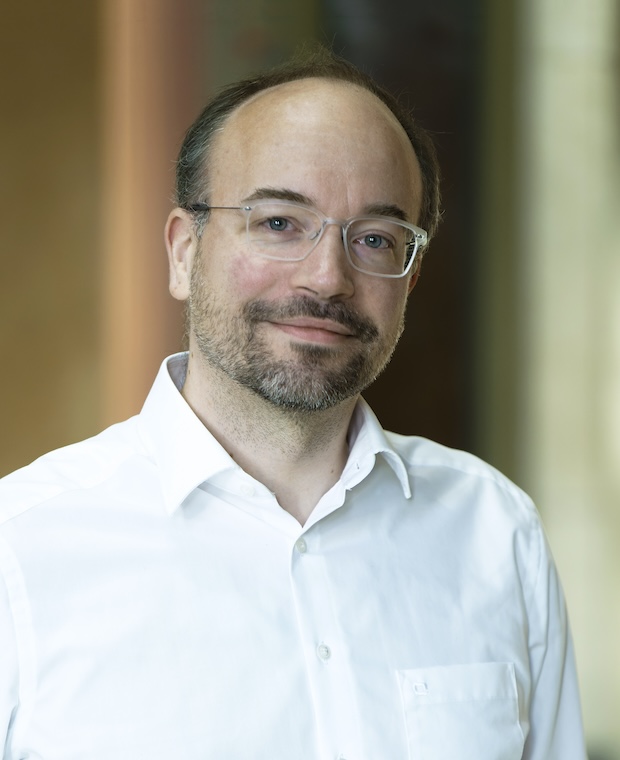
Leslie Ann Goldberg is a Senior Research Fellow at St Edmund Hall and Professor of Computer Science at the University of Oxford. She currently serves as Head of the Department of Computer Science (on sabbatical 2025-26) and focuses on foundational problems in Algorithms and Complexity Theory , particularly randomised algorithms for network communication, machine learning, and statistical physics models. Her research includes solving Aldous' 1987 conjecture on backoff protocol instability (with John Lapinskas), developing rigorous mathematical analysis frameworks for algorithmic efficiency, and advancing approximate counting techniques via Markov Chain Monte Carlo methods (with Andreas Galanis and collaborators). Key projects involve graph homomorphisms , Moran process dynamics , and #BIS complexity class analysis. Recent publications (2023-2024) span topics like Sybil defense mechanisms, low-temperature sampling on random graphs, and parameterised subgraph counting modulo 2. Her work demonstrates cross-disciplinary impact in computational biology, statistical physics, and database theory. Scientific Awards include Best Paper Prizes at ICALP 2016, ICALP 2010, and IPEC 2017. She supervises PhD student Paulina Smolarova and collaborates extensively with researchers in Oxford and beyond.
Professor Wayne Luk is a Professor of Computer Engineering at the Department of Computing, Faculty of Engineering, Imperial College London. He leads the Programming Languages and Systems Section and the Custom Computing Research Group, and directs the EPSRC Centre for Doctoral Training in High-performance Embedded and Distributed Systems and the Centre for Advanced Financial Engineering. He previously served as a Visiting Professor at Stanford University from 2006 to 2009. His research spans FPGA acceleration, quantum computing, deep learning optimization, and algorithm-hardware co-design, with affiliations to the CRUK Convergence Science Centre and the Engineering Secure Software Systems group. His research interests include computational modeling for particle physics, causal discovery in agent-based systems, and high-throughput digital electronics. Notable contributions include FPGA-accelerated algorithms for neural networks, quantum circuit simulation, and Bayesian optimization frameworks. His work emphasizes practical applications of reconfigurable hardware in fields like medical imaging, high-energy physics, and financial systems. Professor Luk is a Fellow of the Royal Academy of Engineering, IEEE, and BCS. His publications focus on advancing hardware-aware machine learning, FPGA-based acceleration techniques, and scalable design methodologies. His research bridges theoretical computer science with applied engineering, addressing challenges in real-time systems, embedded computing, and next-generation computing architectures. His academic leadership includes directing interdisciplinary centers and training programs, fostering collaboration across computing, engineering, and physics. Current projects explore quantum computing tools, causal inference systems, and high-performance graph neural networks for particle physics applications.
Nati Srebro is a Professor at the Toyota Technological Institute at Chicago with a cross-appointment as a Part-Time Professor in the Department of Computer Science and Committee on Computational and Applied Mathematics at the University of Chicago. He earned his PhD from MIT in 2004 and has held previous positions including post-doctoral fellow at the University of Toronto, Visiting Scientist at IBM, and Associate Professor at the Technion. Professor Srebro's research focuses on methodological, statistical and computational aspects of Machine Learning and Optimization. His work spans foundational contributions to learning theory, matrix reconstruction, and optimization techniques. He is particularly known for introducing the use of nuclear norm for machine learning, work on wider Markov networks, and advancing our understanding of the relationship between learning and optimization. His current research interests include understanding deep learning through optimization, distributed and federated learning systems, algorithmic fairness, and practical adaptive data analysis. His publication record shows consistent contributions to core machine learning conferences and workshops, with recent work focusing on symmetric and asymmetric hashing techniques, matrix parameter learning, and optimization methods. The publications demonstrate a strong theoretical foundation with practical applications across various machine learning domains. Professor Srebro has been actively involved in several research programs including the Federated and Collaborative Learning program (Spring 2026, as Visiting Scientist and Program Organizer), Modern Paradigms in Generalization (Fall 2024), and multiple summer clusters on Deep Learning Theory and Fairness. His program participation reflects his leadership in emerging areas of machine learning research. Contact: nati@ttic.edu | (773) 834-7493 | Toyota Technological Institute at Chicago, 6045 S. Kenwood Ave., Chicago, IL 60637
Stephen A. Vavasis is a Professor in the Department of Combinatorics and Optimization at the University of Waterloo, part of the Faculty of Mathematics. He holds a PhD in Computer Science from Stanford University (1989) and has held academic positions at Cornell University (1989–2006) before joining Waterloo. His research focuses on continuous optimization, data science, first-order methods, scientific computing, and computational mechanics. Current teaching includes courses on convex optimization and portfolio optimization methods. He has served as Associate Dean of Computing (2017–2020) and Interim Director of Data Science graduate programs. His work is supported by NSERC grants. Notable awards include the Hertz Fellowship, Churchill Scholarship, and Guggenheim Fellowship. Vavasis's research emphasizes applications of optimization to clustering, machine learning, and fracture mechanics. His publications span convex optimization frameworks, algorithmic analysis of gradient methods, and numerical methods in mechanics. Recent work explores unifying analyses of first-order optimization algorithms and robust optimization techniques for high-dimensional data problems.
Andrea Montanari is a Professor of Mathematics and Statistics at Stanford University, affiliated with the Department of Mathematics and Statistics. His research focuses on high-dimensional statistics, machine learning theory, optimization algorithms, and statistical physics, with applications to neural networks and complex systems. He has contributed extensively to understanding generalization in overparametrized models, spin glass theory, and algorithmic methods like approximate message passing. His work bridges theoretical computer science and mathematical physics, addressing challenges in data analysis and learning from high-dimensional datasets. Notable themes include analyzing neural network dynamics, optimizing high-dimensional landscapes, and developing efficient algorithms for sparse and low-rank matrix estimation. Montanari’s publications explore topics such as the interplay between statistical and computational limits, the behavior of gradient-based methods, and the theoretical foundations of modern machine learning. His recent research demonstrates a focus on fundamental questions in learning theory, including the study of phase transitions in statistical estimation, the role of overparametrization in generalization, and the mathematical underpinnings of contemporary algorithms. While no specific awards are listed here, his contributions reflect significant impact in interdisciplinary fields.
Vladimir Kazeev is an Assistant Professor at the Faculty of Mathematics, University of Vienna , where he has held a faculty position since 2019. He also held previous academic appointments as a Szegő Assistant Professor at Stanford University (2017–2019), a postdoctoral researcher at the University of Geneva (2015–2017), and research positions at ETH Zurich (2011–2015), Russian Academy of Sciences (2008–2011), and Moscow Institute of Physics and Technology (2009). His research focuses on adaptive, data-driven numerical methods for differential equations, nonlinear low-parametric approximation, and numerical linear algebra. His work intersects computational mathematics, tensor methods, and high-dimensional problem-solving, particularly in the context of partial differential equations (PDEs) and stochastic modeling. The 15 most recent publications reveal a strong emphasis on quantized tensor-structured methods for PDEs, low-rank approximations, and high-dimensional numerical analysis. His research spans theoretical advancements in tensor decomposition, practical applications in chemical reaction networks, and novel discretization techniques for multiscale and degenerate diffusion problems. Scientific awards include the prestigious ETH Medal for outstanding doctoral theses (2016) Russian Academy of Sciences Medal for outstanding student works in mathematics (2011) Advising and teaching activities include supervising Jason Zhu (Stanford, 2019) and Simon Etter (ETH Zurich, 2014), as well as teaching advanced courses in tensor methods, numerical analysis, and PDEs at the University of Vienna, Stanford University, and the University of Geneva. His service to the community includes peer review for 15+ journals and co-organizing minisymposia at SIAM meetings.
Esteban G. Tabak is a Professor of Mathematics at the Courant Institute of Mathematical Sciences, New York University. He holds a Ph.D. in Mathematics from MIT (1992) and a Hydraulic Engineer degree from the University of Buenos Aires (1988). His research spans fluid dynamics, data science, and optimization, with notable contributions to optimal transport theory, atmospheric and ocean modeling, and machine learning methodologies. He leads the Research and Training Group in Mathematical Modeling and Simulation at NYU. Research Interests include Data Analysis, Optimal Transport, Applied Mathematics, and Physics, particularly in fluid dynamics and geophysical flows. His work bridges theoretical advancements with practical applications, such as sea ice dynamics, internal waves, and turbulence modeling. Publications highlight innovations in density estimation, constrained optimization, and energy spectrum analysis of oceanic internal waves. Collaborations span disciplines, including biomedical applications (e.g., heart transplant diagnostics) and climate science. His methodologies, such as dual ascent algorithms and prototypal analysis, emphasize data-driven solutions to complex systems. Teaching includes courses on partial differential equations, fluid dynamics, and mathematical modeling. His work has been supported by grants addressing stratified flows, internal wave energy spectra, and turbulent mixing.
Euiwoong Lee is an Assistant Professor in the Computer Science and Engineering Division at the University of Michigan. He holds a PhD from Carnegie Mellon University, advised by Venkatesan Guruswami, and has held postdoctoral positions at New York University and the Simons Institute for the Theory of Computing. His research focuses on approximation algorithms, hardness of approximation, and parameterized complexity. **Education:** PhD in Computer Science, Carnegie Mellon University (2017), advised by Venkatesan Guruswami Postdoctoral Fellowships: NYU (2017–2020), Simons Institute (2017–2020) **Research Interests:** Approximation Algorithms & Hardness of Approximation Convex Hierarchies (e.g., Sum-of-Squares) Clustering Algorithms (e.g., Correlation Clustering) Parameterized Complexity Facility Location & Metric Optimization **Awards:** Edmund M. Clarke Doctoral Dissertation Award (2017) Simons Award for Graduate Students in Theoretical Computer Science **Advising & Grants:** PhD Students: Anthony Della Pella, Aditya Anand, Amatya Sharma, Ian DeHaan Co-organizes the Michigan Theory Seminar **Labs/Teams:** Collaborates with researchers in approximation algorithms, optimization, and theoretical computer science at the University of Michigan and beyond.
Prof. Dan Jiao is the Synopsys Professor of Electrical and Computer Engineering at Purdue University's Elmore Family School. She leads the Rapid-Heterogeneous Integration (Rapid-HI) Design Institute and serves as Editor-in-Chief of the IEEE Journal on Multiscale and Multiphysics Computational Techniques. Her research focuses on computational electromagnetics, multiphysics modeling, and AI-driven design automation for advanced integrated circuits and quantum systems. She has held academic positions since 2005, progressing from Assistant to Full Professor, and has extensive industry experience at Intel Corporation (2001–2005). Education: PhD in Electrical Engineering, University of Illinois at Urbana-Champaign (2001) Senior Staff Engineer at Intel Corporation (2001–2005) Research Interests: Fast numerical methods for large-scale electromagnetic analysis AI/ML integration in design automation (EDA/MDA) Quantum circuits and spin qubit systems Heterogeneous integration and advanced packaging Multiphysics co-simulation for nano-scale devices Signal/power integrity in high-speed systems Key Projects: Leads the NSTC AIDRFIC program (first NSTC R&D Jump Start project), the DARPA NGMM Rapid-HI Design Institute, and the GENIE-RFIC generative design tool initiative. Also directs the Consortium for Electromagnetic Science and Technology. Awards & Honors: 2022 ACES Computational Electromagnetics Award IEEE Fellow (2016) Intel Outstanding Researcher Award (2019) MTT-S Distinguished Microwave Lecturer (2020–2023) 2013 Schelkunoff Prize Paper Award Advising & Grants: Advised over 30 PhD/master's students and led projects funded by NSF, DARPA, Intel, SRC, and industry partnerships. Key grants include NSF CAREER (2008), ONR Young Investigator (2006), and multiple industry-sponsored initiatives. Labs & Teams: Rapid-HI Design Institute (DARPA NGMM) Quantum device co-design group Multiphysics modeling team
Dr. Susana Castro-Kemp is an Associate Professor in Psychology and Human Development at University College London's Institute of Education (IOE), where she serves as Director of the Centre for Inclusive Education (CIE) since September 2023. Previously, she was a Reader in Education at the University of Roehampton for eight years. Her work focuses on inclusive education policy and practice globally, with particular expertise in special educational needs and disabilities (SEND), early childhood intervention, and mental health in schools. The IOE has been ranked number one in the world for Education for several consecutive years, providing an ideal environment for her impactful research. Dr. Castro-Kemp holds a PhD in Psychology jointly awarded in 2012 by the University of Porto (Portugal) and the University of North Carolina at Chapel Hill (USA). Her doctoral research was fully funded by the Foundation for Science and Technology/European Commission and the Global Education and Development Studies scholarships. She is a Chartered Psychologist with the British Psychological Society, a Senior Fellow of Advance HE, and a Recognised Research Supervisor by the UK Council for Graduate Education. Dr. Castro-Kemp's research centers on policy regulating education, health, and welfare services for children, particularly those with support needs. She examines inclusive education practices from users' perspectives, policy models leading to effective inclusive pedagogy, and country-level policy impacts on outcomes for children with special educational needs. Her work moves away from diagnostic labels toward engagement and civic participation as educational outcomes. She also investigates inclusion and early intervention in low- and middle-income countries, mental health in schools, and quality of early childhood education. Her recent publications reveal several key trends in inclusive education research. There's growing emphasis on understanding educational experiences through the voices of children and families rather than diagnostic labels. Much of her work examines the implementation gap between inclusive education policy and classroom practice. She has conducted significant research on how children with special educational needs experienced the pandemic, revealing both challenges and unexpected "silver linings" for some groups. Her corpus analysis of Ofsted reports shows narrow focus in early childhood education inspections, while her work on SEND policy increasingly takes an international comparative approach. Dr. Castro-Kemp has received recognition for her impactful work, including: Best Digital Humanities Project for Community Engagement Prize (2023) from the National Institute of Humanities and Social Sciences of South Africa for her project "Optimising collaborations and reducing inequalities of Early Childhood Intervention in post-Covid-19 South Africa" Dr. Castro-Kemp has secured approximately £1.3 million in research funding from various sources including ESRC, British Academy/Leverhulme Trust, European Commission, and private sponsors. Her current major project is 'ScopeSEND' (2024-2026), funded by the Nuffield Foundation (£250,000), examining international SEND policies. She has led numerous projects including "Transdisciplinary provision for children with disabilities in the Global South" (£3,500), "Optimising collaborations in South Africa" (£47,200), and "Froebel meets Ofsted" (£19,185). As a supervisor, she mentors MA/MSc and PhD students in education policy, early childhood, and inclusive education, having been nominated for student choice awards for excellent feedback and outstanding research supervision. As Director of the UCL Centre for Inclusive Education since 2023, Dr. Castro-Kemp leads a team focused on advancing knowledge exchange and research in inclusion and special needs. The Centre works with schools, educators, parents, and early years settings to translate research into practice. Her international collaborations include work with the World Health Organization as a technical advisor on the use of the International Classification of Functioning, Disability and Health (ICF) system in educational contexts. She also serves on the SEN Policy Research Forum and has provided oral evidence to the House of Commons Education Select Committee.
Rayan Saab is an Assistant Professor in the Department of Mathematics at the University of California, San Diego. His research focuses on the mathematics of information, data science, and signal processing, with an emphasis on quantization, compressed sensing, and machine learning algorithms. Education: Ph.D. in Electrical and Computer Engineering from the University of British Columbia (2010). His work bridges theoretical mathematics and practical applications in data acquisition, digitization, and processing. Recent publications analyze quantization methods for neural networks and compressed sensing systems. He has taught graduate and undergraduate courses in numerical analysis, optimization, and mathematical methods in data science. Research trends include: Developing quantization algorithms with provable guarantees. Applications in high-dimensional data and machine learning. Stochastic frameworks for neural network compression. Scientific awards: Banting Postdoctoral Fellowship (2011-2013). Hellman Fellowship. Advising and grants: Advised students in thesis projects related to signal processing and data science. Received funding for research in mathematical data acquisition. Contact: rsaab@ucsd.edu | Office: AP&M 5157.
Yuxin Chen is a Professor at the University of Pennsylvania , holding joint appointments in the Department of Statistics and Data Science and the Department of Electrical and Systems Engineering . Prior to UPenn, he was an Assistant Professor at Princeton University (2017-2021) and a Postdoctoral Researcher at Stanford University (2015-2017). His research spans statistics, optimization, reinforcement learning theory, diffusion models, and information theory , with a focus on theoretical foundations and practical algorithms for machine learning. Education : Ph.D. in Electrical Engineering (Stanford, 2015), M.S. in Statistics (Stanford, 2013), M.S. in Electrical and Computer Engineering (UT Austin, 2010), B.E. in Electrical/Microelectronics (Tsinghua, 2008). Research Interests encompass theoretical and applied aspects of machine learning, including nonconvex optimization , sample complexity analysis , low-dimensional adaptation , and generative modeling . His work bridges mathematical rigor with real-world applications, particularly in scientific imaging and high-dimensional data analysis. Scientific Awards include the SIAM Activity Group on Imaging Science Best Paper Prize (2024) Alfred P. Sloan Fellowship (2022) NSF Career Award (2022) Google Research Scholar Award (2022) IEEE Transactions on Power Electronics Prize Paper Award (2024) Advising and Grants : He has mentored numerous students who have transitioned to academic roles at institutions like UIUC and UW-Madison. His research is supported by grants from the NSF , Amazon , and Google , with recent projects focusing on controllable diffusion models and efficient reinforcement learning algorithms .
Lili Zheng is an Assistant Professor in the Department of Statistics at the University of Illinois. Her research focuses on statistical methodology, machine learning, and high-dimensional data analysis with applications in neuroscience and network science. Key areas of expertise include graphical models, stochastic processes, and algorithmic optimization. She collaborates extensively on projects involving functional connectivity analysis, neuronal data imputation, and interpretable machine learning frameworks. Her work bridges statistical theory and computational practice, addressing challenges in model inference, feature importance assessment, and low-rank tensor completion. Notable contributions include techniques for distribution-free inference, spectral clustering in patchwork learning, and Gaussian process parameter estimation using mini-batch stochastic gradient descent. Dr. Zheng's research emphasizes interdisciplinary applications, particularly in neuroimaging (calcium imaging, functional connectivity) and multi-modal data integration. She actively explores statistical challenges in big data contexts, emphasizing robust methodologies for real-world datasets.
Andrew Li is an Associate Professor of Operations Research at Carnegie Mellon University's Tepper School of Business since 2024, previously serving as Assistant Professor since 2018. His research bridges statistics, optimization, and machine learning with applications to healthcare operations and retail management. Current teaching: Optimization, Business Analytics Capstone, and Topics in Optimization and Statistics PhD from MIT's Operations Research Center (2018), BS in Operations Research/Applied Mathematics from Columbia University (2012) Research Focus: Dr. Li develops data-driven decision frameworks for complex systems. Key areas include: Experience-based learning models with fairness constraints (organ allocation) Anomaly detection in low-rank matrices (retail inventory accuracy) Nanoparticle-based diagnostic systems for CAD and Alzheimer's Nonstationary demand forecasting in supply chains Publication Trends: Recent work combines bandit algorithms with healthcare applications (split liver transplants, CAD detection) and retail operations (inventory accuracy). Theoretical contributions include regret-optimal policies and entrywise anomaly detection guarantees. Scientific Honors: INFORMS Nicholson Award (2018) INFORMS Pierskalla Award (2021) NSF CAREER Award (2023) Professional Leadership: Active in INFORMS and CMU committees including MBA Analytics Curriculum, Thompson Award, and ENAiBLE AI-driven retail collaborative co-founder since 2021.
Prof. Dr. Markus Bachmayr is a full professor at the Institute for Geometry and Practical Mathematics, RWTH Aachen University, holding the chair for Applied Mathematics. His research focuses on nonlinear approximation, high-dimensional partial differential equations (PDEs), uncertainty quantification, and numerical methods in quantum chemistry. He leads the ERC Consolidator Grant project Computational Complexity of Highly Nonlinear Approximations (COCOA) and contributes to CRC 1481 Sparsity and Singular Structures, and RTG 2326 Energy, Entropy, and Dissipative Dynamics. His recent work emphasizes adaptive low-rank and sparse approximation techniques for parametric and stochastic PDEs, including applications in radiative transfer and poroviscoelastic flow modeling. He serves as Editor-in-Chief of Foundations of Computational Mathematics and Associate Editor for multiple journals. Scientific Awards: John Todd Award 2013 Borchers Plakette 2014 Erwin Wenzl Preis 2007 He has taught courses such as Numerische Analysis I/II, Numerische Mathematik für Elektrotechniker, and seminars on numerical methods and approximation theory.