Yao-Hong Liu is a researcher at the Department of Electrical Engineering, Eindhoven University of Technology. His work spans interdisciplinary domains including neuromorphic computing, biomedical engineering, and integrated circuits design. Affiliation: Eindhoven University of Technology Department: Electrical Engineering Research Focus: Liu contributes to neuromorphic computing benchmarks, brain-computer interface technologies, and energy-efficient analog circuits. His work intersects with UN Sustainable Development Goals in health technologies and energy conservation. Recent Trends: 2024 publications highlight advancements in neural telemetry systems with loss-less data reduction (>11×), spatially diverse transdural communication architectures, and benchmarking frameworks for neuromorphic algorithms. Earlier work (2023) explores material science applications in Mg-Zn-Er alloys. Collaborations: Active in international networks with co-authors from academic institutions and research labs across Europe and Asia.
Fariba Moghaddam is an Ordinary Professor at HES-SO Valais-Wallis - Haute Ecole d'Ingénierie, leading the Power & Control orientation under the Institut Systèmes industriels. She specializes in renewable energy systems, control engineering, and educational technology, with a focus on solar energy optimization, remote laboratories, and sustainable development initiatives in the Global South. Her work spans academic leadership, research, and pedagogical innovation. Education: PhD in Control Engineering from École Polytechnique Fédérale de Lausanne (EPFL), 1996. Additional academic background in electrical and mechanical engineering. Research Interests: Solar tracking systems, photovoltaic-thermal (PVT) integration, machine learning applications in energy systems, remote experimentation platforms, and collaborative educational infrastructure. Recent projects include the Solar Energy Optimization via Remote Platforms and DEAR MENA (Digital Education & Research for MENA). Grants & Projects: Solar Energy Optimization (2022-2026): Swiss National Science Foundation-funded project developing cost-effective sun tracking solutions. DEAR MENA (2019-2024): Cluster fostering digital education partnerships between Swiss and MENA institutions. Sustainable Laboratories (2020-2021): Platform for redistributing lab equipment to emerging economies. MOOLs (2018-2021): Massive Open Online Laboratories for global engineering education. Labs & Infrastructure: Spearheaded the Remote Real-Time Research Platform for control engineering, enabling global access to lab equipment via secure web interfaces. Collaborates on IoT-integrated systems for remote experimentation and industrial automation. Awards: None explicitly listed, but recognized for contributions to sustainable energy and educational equity through numerous funded projects.
Professor Andrey Miroshnichenko is a leading researcher at UNSW Canberra , specializing in Nanophotonics , Metamaterials , and Nonlinear Optics . A UNSW Scientia Fellow since 2017 and Highly Cited Researcher (Web of Science, 2019-2023), his work bridges fundamental physics and applied technologies for smart optical devices. His research interests focus on resonant light-matter interactions in nanoscale systems, including: Bound states in the continuum (BICs) for ultra-efficient photonics Exciton-photon coupling in 2D materials Topological polarization singularities Nonlinear optical responses in metasurfaces Thermal radiation control via photonic crystals Recent publications highlight trends in: 2D photodetector materials (e.g., Mo2C/SiC, TaC/SiC heterostructures) Active tuning of toroidal and anapole resonances Monte Carlo optimization for medical imaging systems Non-Hermitian acoustic resonators Scientific awards include: Australian Postdoctoral Fellowship (2007) Future Fellowship (Australian Research Council, 2011) UNSW Scientia Fellowship (2017) Web of Science Highly Cited Researcher (2019-2023)
Professor Jang-Kyo Kim is a distinguished academic and researcher in advanced materials, currently affiliated with the University of New South Wales (UNSW) since 2022. Previously, he spent 26 years at the Hong Kong University of Science and Technology (HKUST) in the Department of Mechanical and Aerospace Engineering, holding leadership roles such as Associate Dean of Engineering (Research & Graduate Studies) and Director of Advanced Engineering Materials Facilities . He began his career as a Lecturer at the Australian National University. Research Interests Development of multifunctional composites with low-dimensional fillers (e.g., CNTs, graphene, MXene). Electronic skins (E-skins) mimicking human tactile sensing. Electrode/electrolyte design for rechargeable batteries and supercapacitors. Advanced materials for thermal insulation, energy-efficient buildings, and smart textiles. Scientific Awards Tan Chin Tuan Exchange Fellowship Best Paper Awards (multiple, with students) HKUST President Cup Silver Medal Reviewer Awards (multiple) Life-long Achievement Award Fellow of Hong Kong Academy of Engineering Sciences, Royal Aeronautical Society, Royal Society of Chemistry, and Hong Kong Institution of Engineers Clarivate Analytics Highly Cited Researcher (since 2018) Publications & Recognition Over 470 journal papers and book chapters Co-authored 3 monographs, edited 10 books 60,000+ citations (h-index: 128) 18 international/regional patents Former Editor of Composites Part A (2012–2023), current Associate Editor of Energy Materials & Devices and Aerospace Science & Technology , and editorial board member of 12 journals. Leadership & Collaboration President of Asian-Australasian Association for Composite Materials Collaborations span energy storage, composites, and flexible electronics.
Roles & Affiliations: Kyriakis-Bitzaros Efstathios is a Lecturer in the Department of Electrical and Electronic Engineering at the University of West Attica, part of the School of Engineering. He is affiliated with the Electronics and Computer Technologies Laboratory (ECTLab) and teaches courses like Digital System Design and Operating Systems. His office is located at ZB206, Building Z, Ancient Eleonas Campus. Holds a PhD in Electrical Engineering and a Physics degree from the University of Patras (1994 and 1987, respectively). Research Interests: Focuses on high-energy physics detector electronics, FPGA-based digital systems, sensor array interfaces, energy harvesting for microcontrollers, and optoelectronic interconnects. His work includes contributions to the ATLAS experiment at CERN, including the New Small Wheel detector and MicroMegas electronics. Publications Overview: Over 30 publications spanning topics like high-luminosity LHC upgrades, reconfigurable embedded systems, and optoelectronic simulations. Recent work includes advancements in detector electronics for CERN experiments and energy-efficient sensor networks. Labs & Teams: Leads the ECTLab, focusing on electronics and computer technologies. Collaborates on projects like the ATLAS detector upgrades and smart sensor systems.
Dr. Tasmiat Rahman is an Associate Professor at the University of Southampton's Department of Electronic & Electrical Engineering, specializing in solar energy forecasting, photovoltaic systems, and low-cost air quality sensing. She leads the EPSRC New Investigator Award (EP/X033333/1) and co-leads the EPSRC Network Plus for Sustainable Solar Energy Systems (EP/Z533154/1). Her work includes outdoor photovoltaic testing at the Chilbolton Observatory, leveraging physics-informed AI for solar forecasting. Research interests span solar energy forecasting via machine learning/computer vision, applied photovoltaic systems (floating/agri-PV), and low-cost air quality sensors for low-middle income countries. Current projects include Bifi UK (bifacial/sun-tracking systems in temperate climates) and SESD (sustainable solar energy systems deployment). Teaching includes 'Green Electronics' (ELEC3202), 'Power System Operation' (ELEC6220), and 'Quantum Devices' (ELEC6207). She supervises 7 PhD students and chairs the PVSAT conference. Awards include HEA Fellowship and Chartered Engineer status.
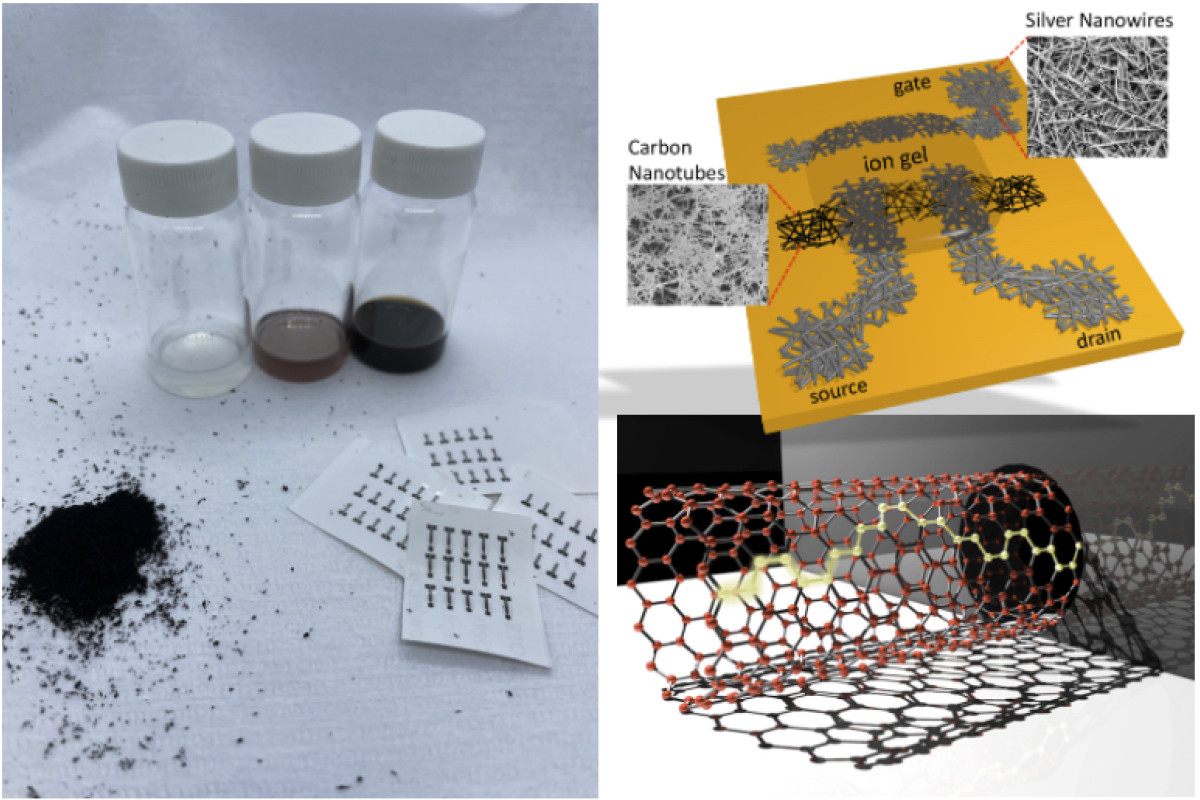
Aaron Franklin is the Addy Distinguished Professor in the Departments of Electrical & Computer Engineering and Chemistry at Duke University, where he also serves as Associate Dean for Faculty Affairs in the Pratt School of Engineering. He holds a Ph.D. in Electrical Engineering from Purdue University (2008) and a B.S.E. from Arizona State University (2004). Prior to Duke, he worked at IBM's T.J. Watson Research Center (2008–2014). His research focuses on nanomaterial-enabled electronics, including nanotransistors, printed electronics, and biomedical sensors. He leads the Franklin Group, exploring applications in high-performance devices, recyclable electronics, and IoT systems. Franklin has over 100 publications, 50+ patents, and co-founded two startups, one acquired by a Fortune 500 firm. He is an IEEE Fellow and NAI Fellow (2024). Education: B.S.E. Electrical Engineering, Arizona State University, 2004 Ph.D. Electrical Engineering, Purdue University, 2008 Research interests emphasize nanomaterials (carbon nanotubes, 2D materials) for next-gen electronics. His group develops ultra-sensitive biosensors, printed recyclable circuits, and scalable transistor technologies. Key areas include low-voltage transistors, flexible electronics, and energy-efficient neuromorphic systems. Recent work highlights include: 1) memcapacitive synapse arrays for motion detection; 2) symmetry-engineered 2D FETs; 3) recyclable LCD backplanes using printed carbon nanotubes. His 2024 Nature Electronics paper on carbon nanotube-coated transistors advances low-dimensional electronics. Awards: IEEE Fellow (2024) NAI Fellow (2024) National Institutes of Health grants Grants and startups: Active NSF-SNSF collaborations on 2D semiconductor thermal properties. Co-founded Tyrata (acquired by Bridgestone). Teaches courses like Foundations of Nanoscale Science and Emerging Nanoelectronic Devices. Labs/Teams: Franklin Group at Duke's Pratt School, collaborating with biomedical and materials science researchers. Focus areas include aerosol jet printing, electronic tattoos, and IoT sensor development.
Jun-Chau Chien is an Assistant Professor of Electrical Engineering and Computer Science at the University of California, Berkeley, and holds the Weber Family Engineering Faculty Fellowship. He is affiliated with the Berkeley Sensor & Actuator Center (BSAC) and the Berkeley Wireless Research Center (BWRC). His research bridges integrated circuits with bio- and quantum technologies, focusing on biosensors, molecular engineering, and mm-wave ICs for biomedical and quantum applications. Education: B.S. and M.S., National Taiwan University Ph.D. in Electrical Engineering, UC Berkeley (2015) Postdoctoral Training, Stanford University (2016–2017) Prior Experience: Research Engineer, Stanford EE (2017–2021) Assistant Professor, National Taiwan University Industrial roles at Xilinx, InvenSense, LifeSignals, and INanobio Research Interests: Analog/mixed-signal IC design for biomedical applications Bioelectronics and implantable/ wearable sensors RF/mm-wave circuits for quantum interfaces and medical imaging CMOS-microfluidics integration for point-of-care diagnostics Advanced calibration techniques for high-frequency devices Awards: 2022 IEEE BioCAS Best Paper Award 2019 IEEE CICC Outstanding Paper Award NSF CAREER Award (2025) MTT-S Graduate Fellowship (2014) Lab & Outreach: Chien Lab focuses on bio-IC convergence and quantum interfaces Develops wearable/implantable biosensors and mm-wave imagers Hosts community outreach programs for junior high/high school students He teaches EE 194 and EE 290 on integrated circuit testing and is actively involved in ISSCC technical committees.
Prabal Dutta is a Professor in the Department of Electrical Engineering and Computer Sciences at the University of California, Berkeley, with a joint appointment as a Faculty Scientist at Lawrence Berkeley National Laboratory. His academic journey includes a Ph.D. in Computer Science from UC Berkeley (2009), an M.S. in Electrical Engineering from The Ohio State University (2004), and a B.S. in Electrical and Computer Engineering from The Ohio State University (1997). His research spans Computer Architecture & Engineering, Cyber-Physical Systems, Power and Energy, and Operating Systems & Networking, with significant contributions to wireless sensor networks, embedded systems, and IoT technologies. He leads the Lab11 research group and is affiliated with the Center for Information Technology Research in the Interest of Society (CITRIS) and the Industrial Cyber-Physical Systems Center (iCyPhy). Dutta's recent publications reveal a strong focus on privacy-preserving IoT communications, embedded hardware design, and energy-efficient systems. His work bridges theoretical innovation with practical applications, particularly in power monitoring, infrastructure reliability, and secure wireless protocols. The consistent publication record across top venues like MobiSys, SenSys, and IPSN demonstrates sustained research excellence. Ohio State University COE Distinguished Alumni Award (2025) Okawa Foundation Research Grant (2022) ACM SenSys Test-of-Time Award (2022) Sloan Research Fellowship (2017) NSF CAREER Award (2014) Popular Science's Brilliant 10 (2014) Professor Dutta actively mentors a large cohort of graduate students and has founded multiple successful startups including CubeWorks, nLine, Gridware, and Vizi Metering, which commercialize his research innovations. His teaching portfolio includes foundational courses in embedded systems and specialized seminars on research-to-startup transitions, reflecting his commitment to translating academic research into real-world impact.
Vivek Subramanian is a professor of electrical engineering, currently affiliated with Ecole Polytechnique Federale de Lausanne (EPFL), Switzerland, while maintaining an adjunct appointment at UC Berkeley. He holds a B.S. from Louisiana State University (1994), and M.S./Ph.D. from Stanford University (1996/1998). He co-founded Matrix Semiconductor in 1998 and joined UC Berkeley’s EECS faculty in 2000, progressing through ranks of Assistant (2000–2005), Associate (2005–2011), and Full Professor (2011–2020) before his move to EPFL. His research focuses on physical electronics, power systems, and integrated circuits, particularly in printed electronics, semiconductor materials, and flexible devices. Notable contributions include gravure-printed transparent conductors, solution-processed transistors, and RFID technologies. He has authored/co-authored over 200 publications and patents, earning awards like the IEEE Kiyo Tomiyasu Award (2015), NSF CAREER Award, and MIT TR100 (2002). Education: Ph.D. Electrical Engineering, Stanford University, 1998 M.S. Electrical Engineering, Stanford University, 1996 B.S. Electrical Engineering, Louisiana State University, 1994 His publications span advanced materials, transistor fabrication, and sensor technologies, reflecting expertise in both fundamental science and applied engineering. He has supervised numerous students and holds leadership roles in interdisciplinary research teams.
Dr. Qian Liu is a Lecturer at the School of Chemistry & Physics , Queensland University of Technology . With a PhD from QUT, Dr. Liu specializes in organic semiconductor materials and their applications in photovoltaics, biosensors, and transistors . Current research focuses on diketopyrrolopyrrole-based polymers , alkyl chain engineering , and green electronics . Keywords : Organic Electronics, Materials Science, Environmental Sensing, Energy Conversion Selected Publications (2022-2025) reveal expertise in ambipolar transistors , perovskite solar cells , and optical chemosensors . Recent work explores carbon nanotube thermoelectric materials and universal biosensors for disease biomarkers. Awards : Recipient of ARC DECRA Fellowship Supervision opportunities available for Honours, Master’s, and PhD students in organic semiconductor research . Collaborations span Advanced Materials and ACS Applied Materials & Interfaces journals.
Associate Professor Torsten Lehmann is a faculty member in the School of Electrical Engineering and Telecommunications at the University of New South Wales (UNSW). He holds the position of Associate Professor in Microelectronics and maintains an active research program focused on advanced circuit design for biomedical applications and cryogenic systems. His work spans multiple disciplines at the intersection of electronics engineering, biomedical technology, and quantum computing interfaces. Dr. Lehmann's research interests encompass several cutting-edge areas of microelectronics: Solid-state circuits and systems CMOS circuits at cryogenic temperature Ultra low-power CMOS design Bio-medical microelectronics Cochlear implants and vision prostheses High-performance analogue circuits in deep sub-micron CMOS His recent publication record demonstrates a strong focus on neural interfaces and optrode technology, with significant contributions to the development of optical neural stimulation and recording systems. Over the past five years, his research has increasingly concentrated on optrode arrays, biopotential sensing, and charge-balanced stimulation techniques for neural applications. His work bridges the gap between traditional electronic circuit design and emerging biomedical applications, particularly in vision and hearing prostheses. A consistent theme throughout his publications is the development of specialized circuits for challenging environments, whether ultra-low temperatures for quantum computing or implantable medical devices requiring extreme power efficiency. Dr. Lehmann has made significant contributions to the field of microelectronics for biomedical applications, particularly in the development of circuits for vision prostheses and neural stimulation systems. His work on cryogenic circuits for quantum computing interfaces represents an important bridge between traditional electronics engineering and emerging quantum technologies. His research group appears to be actively involved in several collaborative projects related to neural engineering and biomedical implants, working with colleagues across UNSW and with clinical partners. The lab likely focuses on the design and testing of specialized integrated circuits for challenging applications where conventional electronics face significant limitations.
Deborah Chung, SUNY Distinguished Professor in the Department of Mechanical and Aerospace Engineering at the University at Buffalo, is a renowned materials scientist with expertise in multifunctional materials, electromagnetic shielding, and structural self-sensing technologies. Her research integrates advanced materials science with engineering applications, emphasizing practical solutions for smart infrastructure and energy systems. Dr. Chung holds a PhD in Materials Science from MIT (1977) and MS/BS degrees in Engineering from Caltech (1973). She leads the Composite Materials Research Lab, focusing on innovations in carbon-based composites, thermal interface materials, and 3D-printed polymers. Her work has been recognized with prestigious awards, including the 2024 President’s Medal from UB and election to the American Academy of Arts and Sciences (2023). Her research interests span functional materials for structural health monitoring (e.g., self-sensing concretes, piezoelectric metals), electromagnetic interference mitigation, and energy-efficient thermal management. Key contributions include discovering piezoelectricity in metals like aluminum and solder, and developing capacitance-based stress-sensing techniques for infrastructure. Education: PhD, Materials Science, MIT (1977) MS & BS, Engineering, Caltech (1973) Awards: Ranked #1 living researcher at UB (Stanford, 2021–2023) Charles E. Pettinos Award (2004) Chancellor’s Excellence Award (2002–2003) Labs/Teams: Composite Materials Research Lab, collaboration with industry on structural materials and sensors. Her recent articles emphasize advancements in self-sensing materials, EMI shielding for 5G, and dielectric properties of conductive materials. Ongoing work explores solder-based electronics and electret behaviors in metals, pushing boundaries in low-power sensor systems.
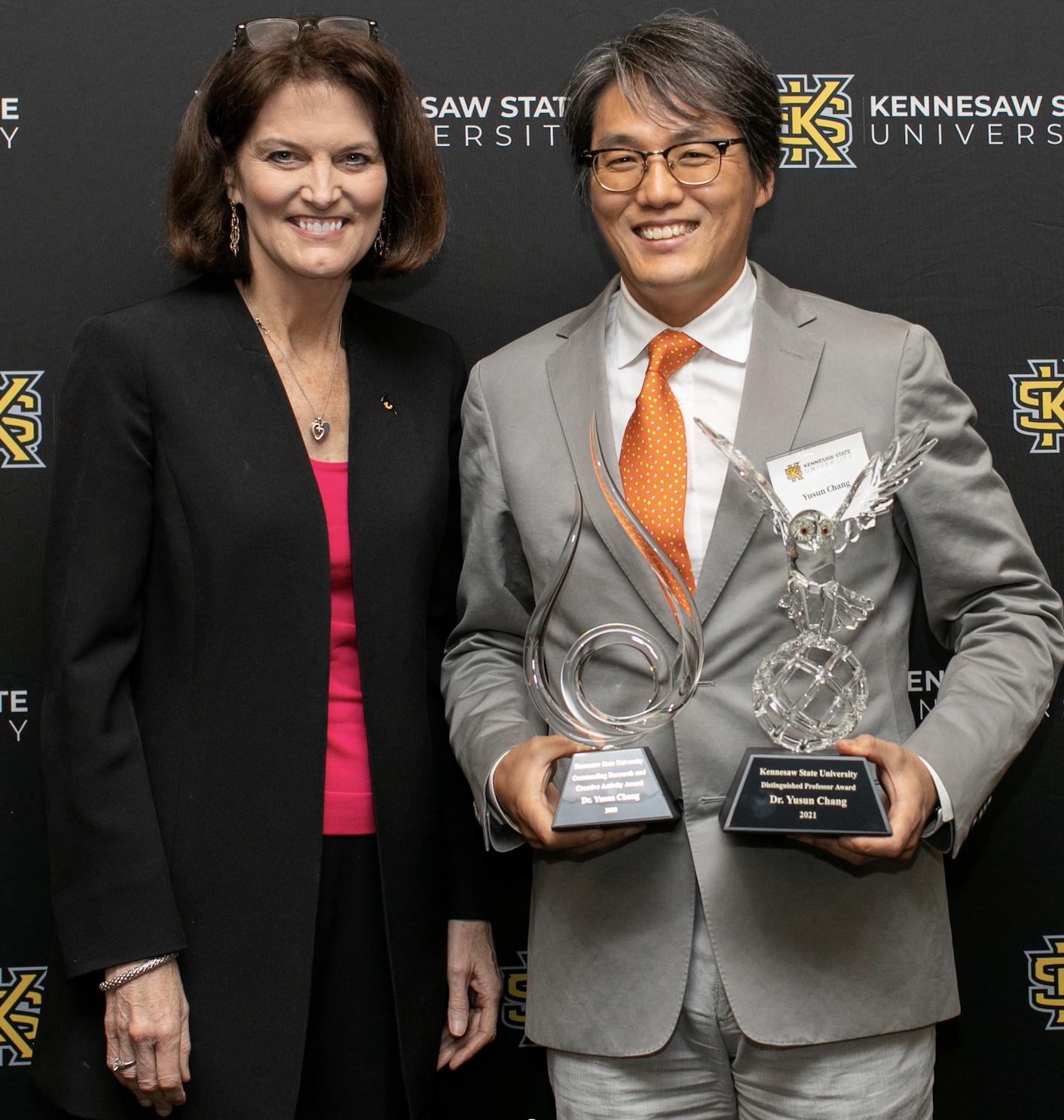
Dr. Yusun Chang is Professor and Chair of the Robotics and Mechatronics Engineering department at Kennesaw State University, with a joint appointment as Adjunct Professor in Electrical and Computer Engineering at Georgia Tech. He directs the Vehicular Ad-hoc Networking (VANET) research laboratory, a collaborative initiative between both institutions established in 2010. Education Ph.D. Electrical and Computer Engineering, Georgia Institute of Technology (2007) M.S. Electrical Engineering, Columbia University (2002) M.S. Electrical Engineering, Korea Aerospace University (1995) B.S. Electrical Engineering, Korea Aerospace University (1993) Research Focus Dr. Chang's research encompasses wireless mobile networks with emphasis on protocol design and optimization for Wireless Multimedia Communications, Vehicular Ad Hoc Networks (VANETs), and Intelligent Transportation Systems (ITS). He pioneered the "Sustainable Mobile Networking" paradigm, leveraging intelligent communication technology to reduce traffic congestion, improve transportation safety, and support autonomous mobility solutions. His interdisciplinary work spans robotics, sustainable energy systems, and biomedical applications. Publication Trends Recent publications (2022-2025) demonstrate expanding research horizons into biologically inspired networking, context-aware systems, assistive robotics, and sustainable technology. Key innovations include modular robotic platforms, solar-powered underwater exploration vehicles, gesture-controlled exosuits, biomedical sensing systems, and programmable network architectures. The work consistently integrates machine learning with practical engineering solutions. Awards and Honors KSU Distinguished Professor Award (2021) - Highest faculty honor KSU Outstanding Research and Creative Activity Award (2020) Distinguished Scholarship Award from College (2020) Distinguished Professor Award from College (2021) Laboratory Leadership As director of the VANET research laboratory since 2010, Dr. Chang leads joint research between Kennesaw State University and Georgia Tech, focusing on vehicular networks, intelligent transportation, and mobile communication systems. The lab serves as a hub for interdisciplinary projects bridging networking, robotics, and biomedical applications.
Steven Fenton is a Senior Lecturer and Subject Area Leader in Engineering at the Department of Engineering & Technology, School of Computing and Engineering, University of Huddersfield. He holds a 1st Class Honours degree in Electronic & Information Engineering from the University of Huddersfield and has extensive industry experience in audio engineering, DSP, and embedded systems design. Current research focuses on low power systems, remote health monitoring, audio signal processing, and immersive audio technology. Active member of the Audio Engineering Society and Centre for Audio and Psychoacoustic Engineering. His work spans audio quality measurement , dynamic range optimization , and assistive technologies for the visually impaired. Recent publications highlight innovations in immersive audio mixing and ultra-low energy distributed monitoring systems. Scientific contributions include a Fellow of the Higher Education Academy and an h-index of 67. Available for PhD supervision in engineering and audio technology domains.