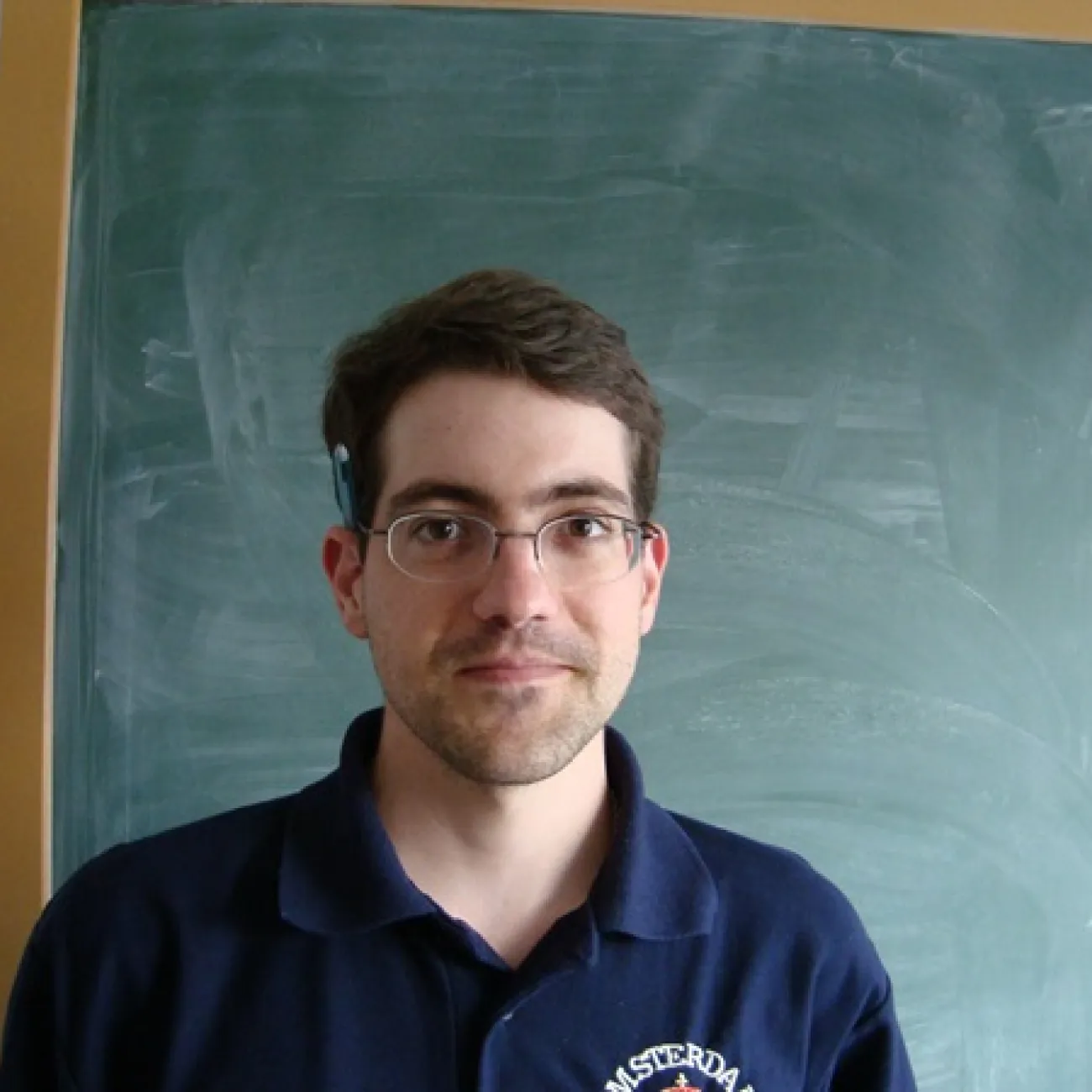
Thomas Tradler is a Professor of Mathematics at New York City College of Technology, a constituent college of the City University of New York. He received his Ph.D. in Mathematics from The Graduate Center, CUNY. His research focuses on Algebraic Topology, with applications spanning operads, K-theory, homotopy theory, and mathematical physics. Education: Ph.D. in Mathematics, The Graduate Center, City University of New York His work explores advanced mathematical structures including operads, K-theory extensions, factorization algebras, and connections between topology and quantum field theory. Research employs techniques from homological algebra, differential geometry, and combinatorial methods to investigate algebraic and topological invariants. Recent publications (15 most recent from 2006-2018) primarily appear in specialized mathematics journals. The articles demonstrate consistent focus on algebraic topology, K-theory, and mathematical physics, with evolving applications to quantum backgrounds, factorization algebras, and geometric structures. Later works show increased emphasis on differential extensions of K-theory and interactions with physics.
Germán Rodrigo is a tenured Research Professor at the Instituto de Física Corpuscular (IFIC) , a joint centre of the Spanish National Research Council (CSIC) and the University of Valencia . After earning his PhD in 2003 under Arcadi Santamaria, he held post-doctoral positions at KIT Karlsruhe and CERN before returning to Valencia in 2008. He currently leads the quantum–phenomenology group within the theoretical physics department. His research straddles high-energy collider phenomenology and quantum computing. Rodrigo is internationally recognised for turning multi-loop Feynman integrals into causal, loop-tree-dual forms and for implementing the resulting algorithms on real quantum hardware. Key achievements include the first quantum calculation of loop integrals, quantum jet clustering at the LHC, and quantum amplitude estimation with error mitigation. Recent work (2022-2025) focuses on: Quantum integration of decay rates and fragmentation functions Graph-based quantum algorithms for causal multi-loop configurations Adaptive importance sampling on quantum annealers and gate-based devices Factorisation-breaking studies in triple-collinear splitting with massive partons He advises three doctoral students and is PI on a national Spanish grant supporting the group’s quantum-technologies programme. No personal e-mail is publicly listed; contact is handled through the IFIC secretariat.
Ioan Manolescu is a professor in the Department of Mathematics at the University of Fribourg, Switzerland. His research focuses on probability theory and statistical mechanics, particularly percolation, random-cluster models, Potts models, and self-avoiding walks. He obtained his PhD from the University of Cambridge under Geoffrey Grimmett in 2012 and was a postdoc at the University of Geneva (2012-2015). Education ENS Paris (student) University of Cambridge (PhD, 2012) Supervisors: Geoffrey Grimmett Research Specializes in critical phenomena in statistical mechanics Key techniques: FKG inequality, Russo-Seymour-Welsh methods, star-triangle transformations Focus on universality and scaling relations across models His recent publications analyze arm exponents in FK-percolation, crossing widths in Poisson Boolean models, and universality in loop O(n) models. He teaches Analyse I & II at University of Fribourg, supported by assistants. Contact: ioan.manolescu@unifr.ch
Zhengwen Liu is an Assistant Professor at the Niels Bohr Institute, University of Copenhagen, specializing in Theoretical High Energy, Astroparticle and Gravitational Physics. He joined the Niels Bohr International Academy on October 1, 2022, and maintains his office at Blegdamsvej 17, 2100 Copenhagen Ø. His research focuses on the intersection of gravitational physics, high-energy theory, and astroparticle phenomena, with particular emphasis on binary black hole dynamics and gravitational wave physics. His work centers on post-Minkowskian theory for binary systems, employing scattering amplitudes, effective field theory, and computational techniques to model gravitational dynamics at high precision. Recent publications demonstrate expertise in conservative dynamics, radiation reaction, and soft emission theorems across quantum field theory and general relativity. He frequently collaborates with leading researchers including Dlapa, Kälin, and Porto, producing high-impact work in journals like Physical Review Letters and Journal of High Energy Physics . Analysis of his 2023-2025 publications reveals a dominant focus on fourth and fifth post-Minkowskian orders in binary dynamics, with significant contributions to gravitational self-force calculations and machine learning applications for gravitational integrals. His research bridges theoretical high-energy physics with gravitational wave astronomy, addressing both foundational aspects of general relativity and practical waveform modeling. No scientific awards were mentioned in the provided materials. No information regarding student advising or research grants was available in the source texts. Liu operates within the Theoretical High Energy, Astroparticle and Gravitational Physics research group at the Niels Bohr Institute, which forms part of the broader Cosmic Dawn Center (DAWN) collaboration. This group specializes in gravitational wave theory, high-energy scattering in curved spacetime, and connections between quantum field theory and gravity through amplitude techniques.
Bill Spence is a Professor of Theoretical Physics at Queen Mary University of London, affiliated with the School of Physical and Chemical Sciences. He is a founder of the Centre for Fundamental Physics and has held leadership roles including Vice-Principal (Research) and Head of the Department of Physics. His research focuses on string theory, quantum gravity, twistor theory, and celestial amplitudes. Spence earned his PhD from King's College London and a B.Sc. from the Australian National University. His work bridges cutting-edge theoretical physics with interdisciplinary applications, including contributions to climate policy through DivestUSS and the Centre for Climate Crime and Climate Justice. Education : PhD in Mathematics, King's College London (1985) B.Sc. (First Class Honours), Australian National University (1981) Research Interests : String theory and its applications in physics and mathematics Celestial amplitudes and twistor theory Double copy formalism and M theory Topological field theories and manifolds of exceptional holonomy Recent Articles : Spence’s recent work emphasizes advancements in celestial amplitudes, twistor theory, and double copy frameworks. His 2024 paper on self-dual fields and 2023 study on celestial twistor amplitudes highlight his exploration of symmetry principles and spacetime structures. Earlier contributions include seminal papers on supersymmetric Yang-Mills and Wilson loops. Labs/Teams : He leads the Centre for Fundamental Physics and collaborates with the Centre for Climate Crime and Climate Justice on ethical investment and climate policy.
Dr. Andrea Pelloni is a Researcher at the ETH Zurich's Theoretical Particle Physics department, specializing in precision calculations in Quantum Chromodynamics (QCD) and Higgs boson phenomenology. Their work focuses on higher-order corrections, infrared singularities, and advanced computational methods for particle physics. Research Areas: Quantum Field Theory, High Energy Physics, Precision Calculations, and Infrared Singularities in Feynman Diagrams. Contact: apelloni@ethz.ch | +41 44 633 05 30 Publication Trends: Andrea's research centers on four-loop QCD splitting functions, Higgs boson differential cross-sections at third order, and innovative approaches like Local Unitarity and Loop-Tree Duality to eliminate infrared singularities in perturbative calculations. Subfields include Renormalization Group Equations, Parton Distribution Functions, and Monte Carlo Simulations for LHC phenomenology.
Jacob Bourjaily is a Professor of Physics at the Pennsylvania State University (Penn State) and maintains an affiliation with the Niels Bohr International Academy of the University of Copenhagen. His research focuses on theoretical physics, particularly particle physics and quantum field theory, with emphasis on scattering amplitudes, supersymmetric Yang-Mills theory, and mathematical methods in high-energy physics. Education: PhD in Physics, Princeton University (2011) Master of Advanced Study (MaSt) in Mathematics, University of Cambridge (2006) BS in Physics and Mathematics, University of Michigan (2005) Research Interests: Bourjaily explores advanced theoretical frameworks to understand particle interactions, including the geometry of scattering amplitudes, loop integrands, and the interplay between gauge theories and gravity. His work integrates algebraic geometry, elliptic functions, and computational tools to address challenges in perturbative quantum field theory. Grants & Awards: European Research Council Starting Grant (€1.5M, 2018) Villum Foundation Young Investigator Award (2017) Harvard Society of Fellows Membership (2011–2014) Research Group: Bourjaily collaborates with postdoctoral researchers and students on topics like elliptic amplitudes, Calabi-Yau geometries, and non-planar contributions. Current advisees include PhD students at Penn State and Copenhagen. Labs & Teams: He contributes to international projects such as the FalconD collaboration for high-field magnets and maintains ties with the Niels Bohr Institute’s theoretical physics group.
Kalle Kytölä is an Associate Professor at Aalto University's Department of Mathematics and Systems Analysis, part of the School of Science. His research focuses on mathematical physics, conformal field theory, and probability theory with applications to statistical mechanics. He has contributed to areas such as discrete complex analysis, quantum groups, and Schramm-Loewner evolutions (SLE). His work bridges the gap between discrete lattice models and continuous field theories, with notable contributions to boundary correlation functions and Virasoro algebra structures. Academic Rank: Associate Professor Affiliations: Department of Mathematics and Systems Analysis, School of Science, Aalto University Key Research Groups: Mathematical Physics, Analysis, Algebra and Discrete Mathematics His research interests include the interplay between probability theory and mathematical physics, particularly in contexts such as Ising models, conformal field theory, and quantum group symmetries. He has explored topics like boundary behaviors in stochastic processes and the discrete-to-continuum limits of lattice models. Recent work emphasizes quantum group structures in Virasoro modules and conformal covariance in boundary correlation functions. His publications span over two decades, with impactful contributions to understanding discrete holomorphicity and SLE processes.
Professor Marc Goerigk holds the Chair of Business Decisions and Data Science at the Faculty of Economics, University of Passau, a position he has held since 2023. He previously held academic positions at TU Kaiserslautern, Lancaster University Management School, and the University of Siegen. He earned his doctorate in applied mathematics from the University of Göttingen and is recognized as a leading researcher in robust optimization. PhD in Applied Mathematics, University of Göttingen Research and teaching at TU Kaiserslautern, Lancaster University, University of Siegen His research centers on robust combinatorial optimization, focusing on decision-making under uncertainty. He develops mathematical models and algorithms that yield solutions resilient to data uncertainties, with applications in traffic, logistics, and corporate planning. He emphasizes abstract problem structures over specific instances, seeking generalizable optimization frameworks. His work bridges operations research, data science, and algorithm design, aiming to enhance decision robustness in complex systems. The recent publications highlight a strong trend in robust optimization, particularly in multi-stage and recoverable models, data-driven scenario generation, and interpretable optimization. His work increasingly integrates machine learning concepts with classical optimization, especially in explainability and preference modeling. Applications span scheduling, routing, project management, and logistics, demonstrating both theoretical depth and practical relevance. Scientific Awards: Most research-intensive business professor under 40 in the German-speaking world (WirtschaftsWoche, 2024) Professor Goerigk leads a research group focused on optimization under uncertainty. He supervises doctoral and master's students in seminars on optimization and data science. He teaches courses such as Decision Making Under Uncertainty, Combinatorial Optimization, and Artificial Intelligence and Optimization. His work is supported by ongoing research in robust modeling and algorithm development, with future directions likely involving deeper integration of AI and optimization for real-world decision support systems. No specific grants are mentioned, but his prolific output suggests active funding. He leads the Chair of Business Decisions and Data Science at the University of Passau, where his team works on theoretical and applied aspects of robust optimization, scenario modeling, and decision support systems.
Dr. Carlos Mafra is a Royal Society University Research Fellow and Principal Research Fellow at the University of Southampton since 2016. His research focuses on the pure spinor formalism of superstring theory , particularly in computing scattering amplitudes and exploring connections to quantum gravity . He also teaches Differential Geometry to fourth-year undergraduates and supervises PhD students in the School of Mathematics. PhD from São Paulo, Brazil (2008) Postdoc at Albert Einstein Institute, Germany (2008-2011) Postdoc at DAMTP, Cambridge (2011-2014) Research Fellow at Institute for Advanced Study, Princeton (2014-2016) His research spans string theory , supersymmetry , and mathematical physics , with recent work on massive amplitudes , non-minimal pure spinors , and algebraic structures in scattering calculations. Funded by the Royal Society and STFC, his work aims to unify quantum gravity and particle physics . Key trends in his publications include pure spinor methods , amplitude duality , and mathematical identities in string theory. Awards include the Royal Society University Research Fellowship. He supervises PhD students Radu-Nicolae Moga, Chen Huang, and Jan Philip Becker.