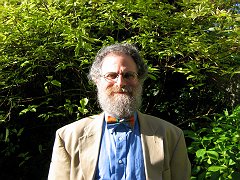
Dominique Devriese is a professor at the Department of Computer Science, KU Leuven, and a member of the DistriNet research group. His work bridges computer security, programming languages, and formal verification. Research interests: Functional Programming, Object Capabilities, Secure Compilation, Dependently-typed Programming, Modal Type Theory Teaching: Formal Systems, Object-Oriented Programming, CyberSecurity, Secure Software His research focuses on rigorous software systems security through capability machines and secure compilation techniques. He actively contributes to formal verification using Agda and Haskell, with recent work on multimode type theory and effect parametricity. Key publication trends include: multimode/presheaf type theory, capability-based security models, formal verification of hardware/software abstractions, and parametricity applications in programming languages. Contact: Email: dominique.devriese@kuleuven.be ORCID: 0000-0002-3862-6856
Irena Koprinska is a prominent researcher at the University of Sydney with over 150 publications from 1996 to 2025. Her work spans multiple interdisciplinary domains with significant contributions to machine learning applications in educational technology, time series forecasting, and health informatics. She maintains strong research collaborations, particularly with Kalina Yacef (38 joint publications), Mashud Rana (26 papers), and Bryn Jeffries (22 papers), indicating leadership in her research group. Her research interests focus on practical applications of machine learning across diverse domains. In educational data mining, she has pioneered methods for predicting student performance in programming courses, analyzing syntax errors, and developing automated hint generation systems. Her work in time series forecasting has made significant contributions to solar power prediction using advanced neural network architectures. Additionally, she has applied machine learning techniques to medical domains, particularly in sleep disorder detection and analysis. The analysis of her 15 most recent publications (2022-2025) reveals a continued focus on educational technology and time series analysis, with increasing attention to interpretable methods and health applications. Her work demonstrates a consistent trajectory of applying sophisticated machine learning techniques to solve real-world problems across multiple domains, with particular emphasis on creating practical tools for education and renewable energy management. Notable Research Contributions: Development of the HINTS framework for automated programming hint generation Innovative approaches to multistep-ahead time series forecasting Applications of deep learning to sleep disorder detection Methods for predicting student performance in programming education Her publication record in top venues including Machine Learning journal, AIED, EDM, and IJCNN demonstrates significant impact in both machine learning and educational technology communities. The consistent output of high-quality research over nearly three decades indicates sustained scholarly productivity and leadership in her fields of expertise.
Dmitriy Traytel is an Associate Professor at the University of Copenhagen's Department of Computer Science since August 2020, where he currently heads the Software, Data, People & Society (SDPS) section. Prior to this position, he worked as a senior researcher (Oberassistent) in the Information Security Group led by David Basin at ETH Zürich. He completed his PhD at TU München under Tobias Nipkow's supervision in 2015. His research focuses on formal methods, particularly logic, automata theory, runtime verification and monitoring, decision procedures, (co)induction and (co)recursion, and interactive theorem proving. Traytel develops formally verified tools for runtime monitoring including VeriMon, TimelyMon, and WhyMon, emphasizing correctness and efficiency in monitoring complex temporal properties. His recent publications (2021-2025) demonstrate a strong focus on first-order temporal logic monitoring, with particular attention to explainable verdicts, scalable parallel implementations, and formal verification of monitoring algorithms. The work spans theoretical foundations in logic and category theory while maintaining practical applications in runtime verification systems. Distinguished Paper Award at POPL 2025 for 'Barendregt Convenes with Knaster and Tarski' Best Student Paper Award at FSCD 2016 Distinguished Paper Award at ATVA 2018 Traytel has supervised numerous PhD, Master's, and Bachelor's students in areas spanning formal verification, runtime monitoring, and theorem proving. His research has been supported through collaborations with major institutions including ETH Zürich and TU München. He actively contributes to the academic community by serving on program committees for major conferences including ITP 2025 and RV 2025. He leads the Software, Data, People & Society section at the University of Copenhagen, focusing on developing formally verified tools for runtime verification that bridge theoretical computer science with practical applications in security and system monitoring.
Riccardo Tommasini is an Associate Professor at INSA Lyon , a leading engineering institution in France. He leads the Stream Processing and Knowledge Graphs research within the DB Team at LIRIS laboratory under Professor Angela Bonifati. His academic journey began with a PhD in Computer Science from Politecnico di Milano under Emanuele Della Valle, with a dissertation titled Velocity on the Web to be published as a Springer book. Research Interests : Advancing stream processing for real-time data systems Extending knowledge graphs with dynamic data Designing graph databases for big data applications Creating query languages for heterogeneous data environments Building data engineering pipelines with Apache Airflow Enabling big graph processing in distributed settings Key Contributions : Developed Zodiac framework for Datalog reasoning under rule amendments (ICDE 2025) Co-authored foundational Streaming Linked Data book with Springer (2023) Created RSP4J API for RDF stream processing (ESWC 2021) Designed challenge-based learning curriculum for Data Engineering courses Scientific Recognition : Received ANR JCJC grant for POLYFLOW project (2024) Awarded Best Resource at ESWC 2021 Managed industrial collaborations with Neo4j, InfluxData, and Confluent Advising & Teaching : Supervises Mohamed Ragab (PhD candidate at University of Tartu) Course Leadership : Foundational Data Engineering course at INSA Lyon and University of Tartu Structured around Apache Airflow , Docker, and graph databases
Martín Hötzel Escardó is a Professor of Theoretical Computer Science in the School of Computer Science at the University of Birmingham, UK. He has been a faculty member since 2000, following previous academic positions at Imperial College London, the University of Edinburgh, and the University of St Andrews. His research bridges theoretical computer science and pure mathematics, with a strong emphasis on foundational aspects of computation. His educational background includes a BSc and MSc from Universidade Federal do Rio Grande Sul (Brazil) and a PhD from Imperial College London (1997) under Michael B. Smyth. Escardó's research interests center on topology in computation , constructive mathematics , dependent and univalent type theory (including Homotopy Type Theory and Cubical Type Theory), domain theory , locale theory , and exact real-number computation . His work explores deep connections between logic, topology, and programming, often using functional languages like Haskell and Agda to formalize and experiment with theoretical ideas. He is particularly known for his discoveries on exhaustively searchable infinite sets and the topological nature of computability. The trend in his recent publications reflects a sustained focus on univalent foundations, constructive domain and order theory, game semantics with dependent types, and the logical structure of type universes. His work consistently advances the formalization and understanding of higher-type computation and constructive mathematics within modern type theories. He has no listed scientific awards in the provided text, but his influence is evident through his extensive publication record and software developments like TypeTopology. Escardó has advised several students and collaborators, though specific names are not listed. He has been involved in significant research projects, particularly in the formalization of mathematics in type theory and the semantics of programming languages. His work often involves developing Agda libraries to formalize new mathematical results constructively. He leads and contributes to a vibrant research group in theoretical computer science at Birmingham, with a focus on logic, semantics, and type theory. His public research blog, lecture notes, and open-source Agda code (e.g., TypeTopology, HoTT-UF-in-Agda) serve as important resources for the community.
Anna C. Balazs is Distinguished Professor and John A. Swanson Chair of Engineering in the Department of Chemical Engineering at the University of Pittsburgh, with an adjunct appointment in Chemistry and visiting professorships at Scripps Research Institute, UT-Austin and Oxford University. In 2025 she receives the €10,000 Gutenberg Research Award from Johannes Gutenberg University Mainz (JGU) for her pioneering theoretical work on smart soft materials. She earned an A.B. in Physics from Bryn Mawr College (1975) and a Ph.D. in Materials Science from MIT (1981), followed by post-doctoral research at Brandeis, MIT and UMass. Research interests span theoretical and computational soft-matter physics, focusing on: Statistical-mechanical modelling of polymer blends and composites Self-oscillating and chemo-responsive hydrogels Active matter, enzyme-powered swimmers and self-propelling sheets Self-healing, shape-morphing and bio-inspired materials Computer simulation of colloidal and interfacial phenomena Recent publications (2023-2025) demonstrate a clear trend toward integrating chemistry, fluid mechanics and elasticity to create life-like, autonomous soft machines. Key contributions include: Harnessing enzyme pumps to drive macroscopic sheet locomotion Designing chemically communicating micro-post arrays Creating dissipative materials with programmable, hierarchical 3-D architectures Scientific awards include: Gutenberg Research Award 2025 Polymer Physics Prize, American Physical Society SF Boys-A. Rahman Award, Royal Society of Chemistry Langmuir Lectureship Award, American Chemical Society Election to the U.S. National Academy of Sciences (2021) She serves on the Advisory Board of the DOE-BES Materials Council and on editorial boards for Langmuir , Soft Matter and Polymer Reviews . Her group collaborates closely with experimental teams world-wide, including the DFG-NSF “Confine” partnership with JGU and the CoM2Life Cluster of Excellence initiative.
Dr. Farzaneh Derakhshan is an Assistant Professor in the Computer Science Department at Illinois Institute of Technology (Illinois Tech), where she explores logical foundations of concurrency and develops formal methods for program verification. She earned her Ph.D. in Pure and Applied Logic from Carnegie Mellon University in 2021 under Frank Pfenning, followed by a postdoctoral fellowship at CMU with Limin Jia and Stephanie Balzer. Current affiliation: Illinois Tech (since ~2021) Previous affiliation: Carnegie Mellon University (Ph.D. and postdoc) Research focus: Type theory, logical verification, and security for concurrent systems Teaching: Courses on programming languages, type systems, and security Her research addresses fundamental challenges in concurrent programming, including: Developing modal logic frameworks for system verification Designing type systems for intermittent computing Creating behavioral type systems for security guarantees Applying relational logic to GPU security and secure compilation Investigating logical foundations of session-typed processes Formal verification of cyclic process networks Current research trends include: Hybrid dynamic verification for parallel systems Logical approaches to side-channel security Formal methods for cyber-physical systems Crash-resilient computing models Security verification in decentralized applications Noninterference proofs in session-typed concurrency Scientific recognition: NSF SaTC CORE Collaborative Award #2350217 Organizing committee member at Dagstuhl Seminar 26071 Professional leadership: Program committee co-chair for PLACES 2025 Committee roles at LICS 2026, ESOP 2026, ICFP 2025, and ECOOP 2025 Regular reviewer for ACM Transactions journals Laboratory involvement: Co-director of behavioral types research at Illinois Tech Collaboration with Carnegie Mellon's formal verification group Key participant in the FACCT workshop
Steve Zdancewic is the Schlein Family President's Distinguished Professor and Associate Chair in the Department of Computer and Information Science at the University of Pennsylvania's School of Engineering and Applied Science. He is a leading researcher in programming languages, formal methods, and computer security with over two decades of impactful contributions to the field. His research interests span programming languages, type theory, logic, computer security, quantum programming, and formal verification. Zdancewic has made significant contributions to information-flow security, memory safety, program synthesis, and the verification of low-level systems. His work often bridges theoretical foundations with practical applications, particularly through the development of verified systems using Coq and other proof assistants. Analysis of his recent publications reveals a strong focus on formal verification techniques, particularly using Interaction Trees and the Coq proof assistant. His research trajectory shows consistent evolution from foundational work on information-flow security toward increasingly sophisticated verification of complex systems including LLVM, quantum computing, and distributed systems. His work demonstrates a commitment to building practically useful verification tools while maintaining rigorous theoretical foundations. Distinguished Paper Award for Semantics for Noninterference with Interaction Trees (ECOOP 2023) Schlein Family President's Distinguished Professor (2021) Distinguished Paper Award for Interaction Trees (POPL 2020) Christian R. and Mary F. Lindback Foundation Award for Distinguished Teaching (2018) IEEE MICRO top picks (2013) Alfred P. Sloan Fellow (2009-2010) NSF CAREER award (2004) Zdancewic has advised numerous PhD students who have gone on to successful careers in academia and industry. His research has been supported by significant grants from NSF, including the NSF Expedition on the Science of Deep Specification. He is actively involved in multiple major research projects including Vellvm (verified LLVM), DeepSpec, and quantum programming verification. Zdancewic also co-organizes Penn's PL Club programming languages research group with Benjamin Pierce and Stephanie Weirich.
Alexander Reutlinger is Professor of Philosophy of Science at LMU Munich, where he coordinates the Master program in Logic and Philosophy of Science. His research examines scientific skepticism, objectivity, and non-causal forms of explanation. He develops philosophical frameworks for distinguishing legitimate scientific critique from strategic skepticism, while exploring how scientific knowledge maintains objectivity through invariant properties. Research Interests: Demarcation of scientific skepticism Invariance theories of objectivity Counterfactual approaches to explanation Role of values in scientific inquiry Honors: Teaching Award for 2016/17 academic year
Ori Lahav is a faculty member in the School of Computer Science at Tel Aviv University. His research is generously supported by an ERC Starting Grant and an ISF Grant. He actively supervises PhD and MSc students, and seeks highly motivated candidates for postdoc, PhD, and MSc positions in programming language theory, concurrency, and formal methods. Dr. Lahav completed his PhD at Tel Aviv University under the supervision of Arnon Avron. In 2014, he was a postdoctoral researcher at Tel Aviv University hosted by Mooly Sagiv. From 2014 to September 2017, he was a postdoctoral researcher at MPI-SWS in Germany hosted by Viktor Vafeiadis and Derek Dreyer. His primary research areas focus on programming languages and verification, with specialization in concurrency and relaxed memory models. He also has significant interests in proof-theory, semantics of non-classical logics, and automated reasoning. His work bridges theoretical foundations with practical applications in programming language design and implementation. Dr. Lahav's publication record shows a consistent trajectory of high-impact research in top-tier conferences including PLDI, POPL, OOPSLA, and ESOP. His recent work (2023-2025) demonstrates continued leadership in memory models, concurrency semantics, and verification techniques. His research spans both theoretical contributions in denotational semantics and practical tools for verification. Best Paper Award DISC 2024 Best Student Paper Award DISC 2024 Distinguished Artifact Award ESOP 2022 Distinguished Paper Award OOPSLA 2021 Kleene Award for Best Student Paper LICS 2013 Dr. Lahav actively advises students including Yoav Ben Shimon, Yotam Dvir, Amir Karniel, and Roy Margalit (PhD students), Yuval Katsman Ezra (MSc student), and has alumni including Ori Saporta (MSc) and Abhishek Kr Singh (postdoc, now Assistant Professor at IIIT Hyderabad). He has organized significant events including VMCAI 2024 and Dagstuhl Seminars on persistent programming. His teaching portfolio includes courses on Shared Memory Concurrency Semantics, Programming Language Foundations, and Software Foundations in Coq.
Tej Chajed is an Assistant Professor in the Department of Computer Science at the University of Wisconsin-Madison, where he conducts research in formal verification of systems software. His work focuses on building and proving the correctness of critical systems, particularly file systems and concurrent software. Dr. Chajed earned his PhD from MIT in the PDOS group, followed by a one-year postdoc at VMware Research before joining UW-Madison. His academic journey reflects a strong commitment to bridging theoretical formal methods with practical systems implementation. Chajed's research centers on formal verification techniques for systems software, with particular emphasis on concurrent and crash-safe systems . His work aims to eliminate bugs in critical software through mathematical proofs of correctness. Key contributions include DaisyNFS (a verified concurrent file system), the Perennial framework for reasoning about crash safety, and Goose for connecting proofs to Go code. His research spans the intersection of programming languages, operating systems, and formal methods, developing practical tools that bring verification to real-world systems. His recent publications demonstrate a consistent trajectory toward more practical and scalable verification techniques for increasingly complex systems. The research shows progression from foundational verification frameworks to applied work on specific systems like file systems, journaling, and distributed protocols. A notable trend is the focus on making verification more accessible and practical for systems developers, bridging the gap between theoretical formal methods and real-world software engineering. Dr. Chajed serves on numerous program committees including OSDI 2025 PC, PLDI 2024 PC, SySDW 2023 PC, ECOOP 2023 ERC, CPP 2023 PC, POPL 2023 PC, PLDI 2022 PC, POPL 2022 AEC, EuroDW 2021 PC, POPL 2021 AEC, PLDI 2020 AEC, POPL 2020 AEC, and SOSP 2019 AEC, reflecting his standing in the systems and programming languages research community. In teaching, Chajed has developed and instructed courses on systems verification, operating systems, and protocol verification. He previously helped create MIT's 6.826 (Principles of Computer Systems) during his PhD. His passion for technical communication was cultivated during his time as a Communication Fellow in the EECS Communication Lab at MIT, where he continues to offer guidance to students on writing and presentation skills. His research group at UW-Madison focuses on advancing the state of the art in systems verification, with current projects centered around practical verification frameworks for concurrent and crash-safe systems.
Allison Sullivan is an Assistant Professor of Computer Science at the University of Texas at Arlington (UTA), where she also serves as the Undergraduate Software Engineering Program Director. She is a member of the Software Engineering Research Center (SERC) at UTA and serves as faculty advisor for UTA's Society of Women Engineers (SWE) club. Dr. Sullivan received her PhD in Software Verification, Validation and Testing (SVVAT) from the University of Texas at Austin in 2017 under Sarfraz Khurshid. Her educational background includes: PhD in Software Verification, Validation and Testing, University of Texas at Austin (2017) M.S. in Software Engineering, University of Texas at Austin (2014) B.S. in Software Engineering, University of Texas at Dallas (2012) Dr. Sullivan's research focuses on two primary areas: Automated Software Engineering : Test/Oracle Generation, Automated Bug Localization and Repair, Mutation Testing, and Regression Testing Formal Methods and Programming Languages : Abstractions, Finite Model Finders, Program Synthesis, and SAT/SMT Solvers She leads the SCOPE lab which focuses on 'showing the correctness of all program executions' and has published extensively on Alloy modeling language applications. Her recent publications demonstrate a strong focus on applying formal methods to software engineering problems, with a growing emphasis on the intersection of large language models and software development practices. Her work spans theoretical foundations, tool development, and empirical studies of how developers use modeling languages. Her scientific achievements have been recognized with: NSF CAREER Award (2024) UTA CSE department Rising Star Research Award (2024) UTA College of Engineering Outstanding Early Career Faculty Award (2025) NSF grant for building an educational tool for software modeling ($400k) Dr. Sullivan has successfully advised two PhD students to completion: Dr. Ana Jovanovic (defended November 2024) and Dr. Anahita Samadi (defended February 2025). She actively mentors undergraduate researchers and has secured significant research funding including the NSF CAREER grant. Her service includes committee roles for major conferences including ASE, ISSRE, and FormaliSE. She leads the SCOPE lab at UTA, which brings together graduate and undergraduate researchers to develop techniques for improving software verification and validation, with particular emphasis on making formal methods more accessible to practitioners.
Professor Tobias Nipkow is a leading researcher in formal methods and interactive theorem proving at the Technical University of Munich (TUM), affiliated with the School of Computation, Information and Technology and the Department of Computer Science. He is a core developer of the Isabelle proof assistant and leads the Theorem Proving Group. His work has profoundly influenced program verification, semantics, and formalized mathematics. University: Technical University of Munich School: School of Computation, Information and Technology Department: Department of Computer Science Research Group: Theorem Proving Group Key Projects: Isabelle, Archive of Formal Proofs, Concrete Semantics His research focuses on formal verification, higher-order logic, semantics of programming languages, and verified algorithms. He has pioneered the formalization of textbook algorithms, data structures like B+-trees and quadtrees, and logical systems. His work bridges theoretical foundations with practical tools for software correctness. The most recent publications show a strong trend in verifying classical algorithms (e.g., Gale-Shapley, Earley parser), data structures (B+-trees, deques), and decision procedures, primarily using Isabelle/HOL. His contributions span foundational logic, program analysis, and educational approaches to formal methods. Best Paper Award at CADE 28 (2021) Tobias Nipkow has made extensive contributions to advising and collaborative research, co-authoring with numerous researchers and students. He has secured support for large-scale formalization efforts and contributed to major projects like the Flyspeck proof of the Kepler conjecture. His work is supported by ongoing development of the Isabelle framework and the Archive of Formal Proofs. He leads the Theorem Proving Group at TUM, which is central to the development and application of Isabelle. The group fosters international collaboration, contributes to the Archive of Formal Proofs, and advances research in automated reasoning, semantics, and verified systems.
Philip Wadler is Professor of Theoretical Computer Science at the University of Edinburgh and Senior Research Fellow at IOHK. He is an ACM Fellow, Fellow of the Royal Society, and Fellow of the Royal Society of Edinburgh. His work spans programming language design, type systems, and formal verification, with significant contributions to Haskell, Java, and XQuery. He has held leadership roles in ACM SIGPLAN and served on editorial boards for major journals. Research Interests: Wadler's research focuses on the foundations of programming languages , including Gradual and session typing Language-integrated query Functional and logic programming XML data models Parametricity and free theorems Verification of smart contracts Publication Trends: Recent articles emphasize type safety, formal verification, and blockchain applications. Key themes include gradual typing (blame calculus), session types for concurrency, and logical foundations of programming. His 2015–2025 papers show sustained focus on type theory and language design . Awards & Recognition: POPL Most Influential Paper (2003 for 1993 work) SIGPLAN Distinguished Service Award Best Paper SBMF 2018 Royal Society-Wolfson Fellowship (2004–2009) ACM Fellow (2007) Fellow of Royal Society of Edinburgh (2005) Advising & Grants: He has supervised numerous PhD students in programs like the Centre for Doctoral Training in Pervasive Parallelism. His EPSRC Programme Grant "From Data Types to Session Types" (2013–2020) funded major advances in concurrency theory. Current work with IOHK explores blockchain verification using Haskell-based Plutus.
Kihong Heo is an Associate Professor in the School of Computing and Graduate School of Information Security at KAIST (Korea Advanced Institute of Science and Technology) in South Korea. His academic career includes serving as an Assistant Professor at KAIST from 2017-2019 before being promoted to Associate Professor in 2020, following his postdoctoral research at the University of Pennsylvania. He earned both his Ph.D. and B.S. in Computer Science & Engineering from Seoul National University. Dr. Heo's research focuses on developing program reasoning systems for safe and reliable software, with specific interests in AI-based program analysis systems for detecting deep semantic software bugs, general-purpose program simplification systems for secure and efficient software, and scalable program synthesis systems for automatic software generation and repair. His work bridges the gap between programming languages, program analysis, and machine learning techniques to create next-generation programming systems. Analysis of his recent publications reveals a strong trend toward integrating machine learning techniques with traditional program analysis methods, with significant contributions in compiler validation, software security, fault localization, and program debloating. His research has practical impact, with some of his work incorporated into Facebook's Infer static analyzer. ACM SIGSOFT Distinguished Paper Award, FSE 2025 Amazon Research Award, 2024 The Soo-Young Lee Teaching Innovation Award, KAIST, 2024 Prize for Excellence in Teaching, KAIST, 2024 Best Artifact Award, ICSE 2022 ACM SIGPLAN Distinguished Paper Award, PLDI 2019 ACM SIGSOFT Distinguished Paper Award, ICSE 2019 Dr. Heo actively mentors graduate students, currently advising several Ph.D. candidates including Yeonhee Ryou, Taeeun Kim, and Sujin Jang, as well as master's students. He has served on program committees for major software engineering and programming language conferences including PLDI, ICSE, POPL, and SPLASH, demonstrating his active role in the academic community. His laboratory, the Programming Systems Laboratory at KAIST, focuses on creating innovative programming systems that leverage both semantic-based program analysis and AI techniques.