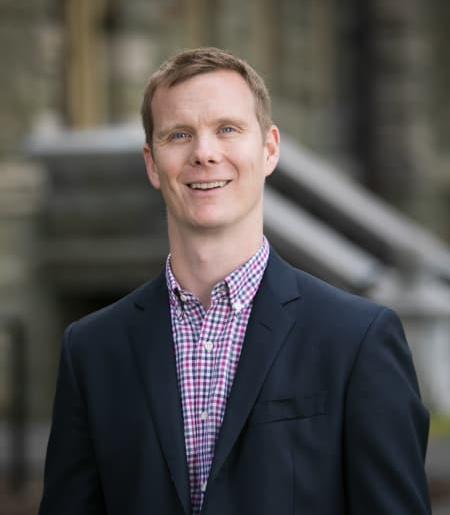
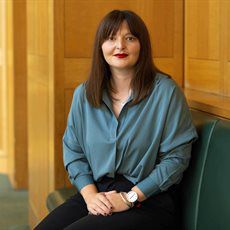
Mads Leth Jakobsen is an Associate Professor at the Department of Political Science , Aarhus University, specializing in Public Leadership , Leadership Development , and Bureaucracy and Debureaucratization . He serves as a member of the King Frederik Center for Public Leadership management team, focusing on leadership for public value creation and handling complex social challenges like the climate crisis. Academic Rank: Associate Professor Primary Research: Public Leadership, Distributed Leadership, Climate Governance Teaching: Public Leadership and Governance on political science programs Key Projects: Public Value Leadership (2022), Distributed Leadership (2012-2016) His research explores paradox leadership , organizational responses to climate challenges, and leadership credibility. Recent publications examine municipal climate strategies, bureaucratic dynamics, and leadership development frameworks. He emphasizes the interplay between leadership practices and employee outcomes in public sector organizations. Scientific awards and student supervision details are not listed in the available information. His articles highlight a strong focus on reconciling performance regimes with organizational learning, leadership credibility, and innovative governance models in public sector contexts.
Douglas L. Kriner is the Clinton Rossiter Professor in American Institutions at Cornell University, affiliated with the College of Arts and Sciences and Department of Government. His work bridges American political institutions , separation of powers , and U.S. foreign and health policy . He has authored five influential books, including The Myth of the Imperial Presidency (2020) on public opinion’s constraints on executive power, and Investigating the President (2016) on congressional oversight. His research spans military policymaking , executive particularism , and vaccine trust dynamics , published in top journals like American Political Science Review and New England Journal of Medicine . Email: kriner@cornell.edu Scientific awards include the D.B. Hardeman Prize (2013), Richard F. Fenno Jr. Prize (2017), and Richard E. Neustadt Award (2015). His articles explore congressional investigations , presidential particularism , and pandemic-related health behavior . He teaches courses on American government , presidency , and quantitative methods . Recent work examines emerging technology’s impact on democracy and biofuels policy , with a focus on partisan dynamics and public trust in science .
Professor Damian Grimshaw is Professor of Employment Studies at King's College London's King's Business School, where he serves as Associate Dean for Research Impact. He is also London & South Forum Co-Lead for the Productivity Institute. Previously, he was Director of the Research Department at the International Labour Organisation (Geneva, 2018-19) and Professor at the University of Manchester, where he served as Head of the HR and Employment Relations and Law group and Director of the European Work and Employment Research Centre. Professor Grimshaw's research spans multiple disciplines including labour market analysis, comparative employment relations, feminist economics, sociology of work, and management. His work focuses on international comparisons of low-wage labour markets, outsourcing and HRM, technology and the future of work, precarious work, collective bargaining, and gender inequality. His research has strong policy impact across UK, European and international arenas. Recent publications reveal a clear trend toward examining the future of work through multiple lenses: collective bargaining structures, digital labor platforms, gendered impacts of pandemic policies, and regional approaches to decent work. His work consistently addresses how institutional frameworks shape employment outcomes across different national contexts and sectors. Professor Grimshaw has received significant research funding from major organizations including the British Academy, ESRC, European Commission, International Labour Organisation, Leverhulme Trust, Low Pay Commission, OECD, and Russell Sage Foundation. He coordinates a major UKRI research programme on human capital and productivity and leads the Regional Productivity Forum for London and the South alongside Marcela Miozzo and Mario Gruber. His ongoing research projects include precarious work in Europe and the gender inequalities of the Covid-19 pandemic and recession. During 2021-22, he taught 'Globalisation and Employment' on the MSc in HRM and Employment Relations and 'International HRM' to undergraduates. His research team is actively engaged in projects examining automation in knowledge-intensive business services and artificial intelligence's impact on occupations, with particular focus on the UK and US contexts.
John Infranca is an Associate Professor of Law at Suffolk University School of Law , where he serves as Director of Faculty Scholarship & Research. His work bridges land use regulation , affordable housing policy , property theory , and law and religion , with a focus on urban legal frameworks and regulatory innovation. Education: JD from New York University School of Law, MTS in Moral Theology from Notre Dame, BA in Liberal Studies from Notre Dame. His research examines zoning reforms , sharing economy regulation , and religious liberty-adjacent land use issues . He co-edited the Cambridge Handbook on the Law of the Sharing Economy (2018) and the Elgar Research Agenda for Land Use and Planning Law (2023). Recent articles analyze exclusionary zoning , development rights transfers , and state-level preemption in housing crises . His work has been recognized in leading journals and forums, including the Stanford/Harvard/Yale Junior Faculty Forum (2020). Notably, he has served as a Florence Rogatz Visiting Professor at Yale Law School (Spring 2024, returning 2026) and teaches courses in Property Law , Land Use , and Religion & Law . Scientific Recognition: Differentiating Exclusionary Tendencies selected for Stanford/Harvard/Yale Junior Faculty Forum (2020) Multiple articles featured in Land Use & Environmental Law Review as top land use law works
Catherine Panter-Brick is the Bruce A. and Davi-Ellen Chabner Professor of Anthropology, Health, and Global Affairs at Yale University, with appointments at the Jackson School of Global Affairs and Department of Anthropology. She directs the Global Health Studies Multidisciplinary Academic Program and the Program on Conflict, Resilience, and Health, focusing on biocultural analyses of adversity, resilience, and peacebuilding. Key affiliations: Yale Institute for Global Health, Social and Behavioral Sciences, African Studies, South Asian Studies Her research examines: Health impacts of poverty, armed conflict, and social marginalization Intergenerational trauma and epigenetic signatures Refugee mental health and psychosocial interventions Gender roles in post-conflict recovery Systems-level approaches to peacebuilding Publications since 2022 demonstrate sustained focus on: Conflict-related stress biomarkers (cortisol, telomere length) Community-based mental health programs for refugees Cultural dimensions of resilience and wellbeing Humanitarian policy innovation and science diplomacy Scientific Recognition: Lucy Mair Medal (2011) for anthropological applications to poverty alleviation Keynote speaker at UN, WHO, and World Bank As Senior Editor of Social Science & Medicine 's Medical Anthropology section, she bridges academic research with policy implementation through fieldwork in Afghanistan, Syria, Jordan, and Brazil.
Catherine Durose is an Honorary Professor of Public Policy at the University of Birmingham's Department of Public Administration and Policy, part of the College of Social Sciences. Her research focuses on urban governance, co-production, decentralization, and institutional design, with a particular emphasis on how government interacts with citizens and communities to drive policy change. She has secured over £3 million in research funding and serves as Chair of the Editorial Board for Local Government Studies. Educations: PhD, University of Manchester (2007) MA (Research) in Governance and Public Policy, University of Manchester (2004) BA (Hons) in Politics, University of Sheffield (2001) Her research interests span interdisciplinary areas including co-production theory, governance of the commons (housing, energy, data), feminist institutionalism, and participatory policymaking. She has held visiting fellowships at institutions such as the Great Cities Institute (UIC, Chicago) and Tilburg University, and consults for UK government bodies like the Equality and Human Rights Commission. Publications and Awards: Recipient of the Joni Lovenduski Prize (2020) Author of Designing Public Policy for Co-production (2016) Published in Political Studies , Urban Studies , and Nature Teaching and Mentorship: Catherine teaches on INLOGOV's MSc Public Management and Executive Apprenticeship programs. She mentors doctoral students in areas like social accountability in Colombia, blame avoidance in UK governance, and decentralization in Cameroon. Current research projects include studies on urban governance assemblages (with Tilburg and Edinburgh Universities) and feminist institutionalism in hate crime policy (collaboration with University of Birmingham's Vivien Lowndes). She actively contributes to civic initiatives like Citizens UK and co-founded Win: Win, a network for women in higher education, earning her recognition as a 'Woman of Action' in 2017.
Daanika Gordon is an Associate Professor of Sociology at Tufts University, with a secondary appointment in Studies in Race, Colonialism, and Diaspora. Her research explores the intersection of racial inequality, urban governance, and policing through organizational and interactional lenses. PhD, University of Wisconsin–Madison (2018) MS, University of Wisconsin–Madison (2013) BA, Development Studies & Sociology, UC Berkeley (2009) Her work connects theories of race and racism with urban political economy and organizational behavior, focusing on how: Policing functions as a tool for urban governance Racial inequalities emerge from race-neutral policies Segregation is dynamically produced through relational processes Recent publications analyze police funding debates, data science applications in policing, and the bureaucratic dissociation of race. Her groundbreaking 2022 book Policing the Racial Divide won the 2023 Edwin H. Sutherland Book Award. She teaches sociology of race, criminal legal systems, and research design while serving on the advisory committee for the Tufts University Prison Initiative. Her research has been funded by: Institute for Citizens & Scholars Bernstein Faculty Fellowship Neubauer Faculty Fellowship National Science Foundation
Jedidiah Crandall is an Associate Professor at Arizona State University's School of Computing and Augmented Intelligence, with an affiliation to the Biodesign Center for Biocomputing, Security and Society. His research focuses on Internet censorship, network security, and privacy-preserving technologies. Crandall collaborates with journalists and activists to expose surveillance mechanisms, particularly in politically sensitive regions like Russia and China. His work includes analyzing VPN vulnerabilities , decentralized censorship systems , and cross-border data flows . He teaches advanced courses in computer network security and advises graduate students on thesis/dissertation research. Research trends in his publications emphasize measuring state-level information control , attack vectors in modern networks , and secure communication technologies . Notable work includes TSPU: Russia's censorship infrastructure and Hidden Links: Analyzing Secret Families of VPN Apps . Crandall's teaching spans courses like Advanced Computer Network Security and Applied Cryptography , reflecting his commitment to preparing the next generation of security professionals. His Censored Planet project tracks global Internet censorship patterns through large-scale measurements.
Lisa Saum-Manning is the Associate Director of the International Security and Defense Policy Program, a Senior Political Scientist, and Professor of Policy Analysis at the RAND School of Public Policy, RAND Corporation. She is actively engaged in research that bridges defense policy, international security, and public administration. RAND Corporation – Associate Director, International Security and Defense Policy Program RAND Corporation – Senior Political Scientist RAND School of Public Policy – Professor of Policy Analysis Her educational background includes a Ph.D. in Political Science from the University of California, Los Angeles. Ph.D., Political Science – University of California, Los Angeles Lisa Saum-Manning's research focuses on strategic planning for the U.S. Armed Forces and Department of State, particularly in the areas of security cooperation, conflict prevention in fragile states, WMD nonproliferation, and unconventional warfare. She has also led field research on building sustainable security capacity in Africa, Central and South America, and disaster recovery in Puerto Rico. Her work frequently addresses diversity and inclusion in the military, homeland security policy, and U.S. foreign military sales accountability. She recently served as a senior advisor to the Assistant Secretary of State for Conflict Stabilization Operations during implementation of the Global Fragility Act. Her recent publications span topics such as Foreign Military Sales (FMS) accountability, Army readiness, disaster recovery in Puerto Rico, and diversity in military personnel. The body of her work demonstrates a consistent focus on policy-relevant research that informs national security decision-making, with an interdisciplinary approach combining political science, security studies, and public policy analysis. Scientific Awards and Recognitions: No specific awards listed in the provided text. Lisa Saum-Manning has advised on major defense and homeland security initiatives, including FEMA’s terrorism risk formula, U.S. Army personnel policy, and Coast Guard diversity strategies. She has received funding for multiple RAND studies from U.S. government agencies, including the Department of Defense and Department of Homeland Security. Her advisory roles include direct engagement with senior officials in the State Department and Congress, particularly through her testimony before the U.S. Senate Committee on Armed Services. She leads and contributes to research teams at RAND focused on international security, defense policy, and stability operations. Her projects often involve interdisciplinary collaboration, field data collection, and policy implementation analysis, particularly in complex operational environments such as post-conflict zones and disaster-affected regions.
Peter Driessen is a full Professor of Environmental Governance at the Copernicus Institute of Sustainable Development (Utrecht University) since 2004. His research focuses on governance strategies for sustainability transitions , particularly in climate adaptation , water management , and science-policy interfaces . He leads the Environmental Governance research group and contributes to global debates on resilient governance and institutional reform . Key research themes include: Sustainable Urban Development : Analyzing institutional frameworks for climate-resilient cities Water Governance : Exploring legal and social conditions for effective water policy Science-Policy Interfaces : Enhancing decision-making through interdisciplinary collaboration His recent publications emphasize anticipatory governance in the Global South, city-to-city learning for water management, and institutional shifts in flood risk governance. Driessen’s work bridges theoretical analysis with practical policy recommendations, focusing on legitimacy , efficiency , and effectiveness of sustainability governance models. Contact: p.driessen@uu.nl
Professor Mark Howells is a Principal Research Fellow at the Centre for Environmental Policy within Imperial College London's Faculty of Natural Sciences. His work focuses on energy systems modelling and policy analysis for sustainable development in low and middle-income countries, with a particular emphasis on open-source frameworks and context-specific transition pathways. His research spans energy transition modelling, environmental policy, and sustainable development, utilizing tools like OSeMOSYS and CLEWs to address energy trilemma challenges across Africa, Asia, and South America. Key interests include integrating qualitative factors into quantitative models, green hydrogen planning, power sector reliability, and resource nexus management, with significant contributions to country-specific energy planning in Ghana, Nigeria, Kenya, Egypt, and Indonesia. Analysis of his 2023-2025 publications reveals a strong focus on open-source energy modelling applications for decarbonization, with recurring themes of data kit development, grid flexibility solutions, and water-energy-land nexus assessments. His work consistently bridges technical modelling with policy implementation needs, particularly in contexts of infrastructure constraints and climate vulnerability. No scientific awards were mentioned in the source materials. Professor Howells operates within Imperial College London's Centre for Environmental Policy, an interdisciplinary hub conducting research on global environmental challenges through integrated systems approaches that connect technical, economic, and policy dimensions of sustainability transitions.
John Rand is a Professor in Development Economics at the Department of Economics, University of Copenhagen, where he has been employed since 2021. He previously served as Professor (mso) at the Faculty of Social Sciences (2015-2020) and Faculty of Science (2011-2014), Associate Professor (2008-2011), and Assistant Research Professor (2005-2008) at the same institution. He is currently Vice-chair of The Consultative Research Committee for Development Research (FFU) and co-director of the Development Economics Research Group (DERG). Professor Rand's research focuses primarily on development economics, with specific expertise in applied econometrics, impact measurement, industrial economics, and interdisciplinary methods. His work spans topics including climate-smart agriculture, economic policy in developing countries, trade and productivity, and governance issues. He leads multiple externally funded research projects including 'Energy transition and climate-smart agriculture in Vietnam', 'Economic Research and Policy Making in Kenya', and 'Sedentarization and climate change resilience in Nigeria'. His extensive publication record shows a strong focus on empirical research in developing countries, particularly in Africa and Southeast Asia. His recent work demonstrates consistent attention to practical policy implications, with a growing emphasis on climate change adaptation, resource allocation efficiency, and the intersection of economic development with environmental sustainability. His research often employs rigorous quantitative methods to address real-world development challenges. Professor Rand is actively involved in several research networks including the Copenhagen Center for Disaster Research (COPE) as part of the steering group and the UCPH Migration Research Platform. He serves as Head of Studies for Global Development and teaches Development Economics (BA) and Theories, Facts and Current Issues (MSc Global Development). He has presented his research at numerous international conferences including UNU WIDER conferences, Nordic Conference in Development Economics, and various country-specific development forums. His work has been referenced in policy sources and picked up by news outlets, indicating its relevance to current development debates.
Dr. Barbara Spector is a Professor of Science Education at the University of South Florida (USF) College of Education, where she has served since 1985. Her work focuses on educational change, qualitative research methods, and science education reform through innovative course development and community engagement. Research Interests: Science Education Reform Inquiry-Based Teaching and Learning Integration of Science, Technology, and Society (STS) Marine Science Education Qualitative Research Methodologies Professional Development for Educators Scientific Awards & Leadership: National Institute for Science Education Fellow NSTA Research Director NASTS Research Director AETS Director-At-Large Consultant to Federal, State, and Local Education Agencies Contributor to National and State Science Standards Dr. Spector has developed 25 graduate-level science education courses and co-created nationally recognized preservice teacher education courses. Her career spans NSF-funded initiatives like the Center for Ocean Sciences Education Excellence Florida and leadership in multiple university research centers.
Louise Reardon is Professor of Governance and Public Policy at the University of Birmingham's School of Government, Department of Public Administration and Policy. She serves as School Deputy Director of Research (Impact) and is Thematic Research Lead for Transport at UK Parliament. Her internationally recognized expertise spans transport policy and governance, with research focusing on institutional collaboration across scales to advance local transport goals, technological innovation, and sustainability. Louise earned her PhD in Political Science from the University of Sheffield (2014), MA in Governance and Public Policy from the University of Sheffield (2009), and BA (hons) in Philosophy, Politics and Economics from the University of Durham (2008). She holds a Post-Graduate Certificate in Higher Education (2018) and is a Senior Fellow of the Higher Education Academy (2020). Her research interests center on transport policy and governance, with specific focus on multilevel governance, agenda setting, policy implementation, smart mobility transitions, urban governance, and wellbeing. As a political scientist, she advances theoretical understanding of policy processes through transport analysis, examining how local dynamics influence issue recognition, agenda setting, policy change, and approaches to wicked problems. Her work consistently bridges academic theory with practical policy application. Louise's research portfolio demonstrates a clear trajectory toward increasingly complex, interdisciplinary climate-related transport research. Her recent publications show strong emphasis on net-zero transitions, smart city governance, and pandemic recovery implications for transport systems, with growing international collaboration particularly with Indian and Australian institutions. The trend indicates deepening engagement with practical policy implementation challenges alongside theoretical contributions. Senior Fellow of the Higher Education Academy, 2020 Louise regularly provides scientific advice to diverse stakeholders and serves on the UK Department for Transport's Transport Research Innovation Grant advisory board. She co-edited the Handbook of Transportation and Public Policy (2025) and previously co-chaired the Governance and Decision-Making Processes Special Interest Group for the World Conference on Transport Research Society. She serves on editorial boards for Research in Transportation Business & Management and Local Government Studies. As an educator, Louise led the College of Social Science's first Degree Apprenticeship programme and specializes in blended teaching approaches. She has supervised PhD students on evidence use in local policymaking, center-local government relations, and walking's role in climate change agendas. She actively seeks new doctoral students interested in multi-level governance, policy change, sustainable transitions, and urban governance topics.
Caroline Kuzemko is a Reader in International Political Economy (IPE) at the University of Warwick's School of Politics and International Studies (PaIS). She serves as Course Director for the new MA in the Politics of Climate Change and Co-Director of UKERC. Previously, she worked as a Senior Research Fellow at the University of Exeter and held roles in finance with UBS. Her research focuses on sustainable energy transitions, climate change politics, and energy geopolitics, blending constructivist IPE frameworks with empirical case studies. She teaches modules on climate governance at both undergraduate and postgraduate levels. Education: MSc in IPE and PhD in Energy & Climate Politics from the University of Warwick. Research interests include rethinking energy geopolitics, energy security, and the political economy of net-zero transitions. She leads UKERC's Theme 3 on 'Geopolitics, Energy Security, and Resilience of Net Zero', analyzing fossil fuel phase-out and low-carbon expansions. Prior projects include assessing Brexit's impact on UK energy policy and exploring municipal authority roles in sustainable energy governance. Her publications span books like Climate Politics: Can't Live With it, Can't Mitigate Without it and articles in Geopolitics , New Political Economy , and Energy Research & Social Science . She co-edits the Review of International Political Economy 's IPE of Energy series and contributes to policy briefings for UK institutions like UK100 and DESNZ. She advises PhD students researching geopolitics of renewable transitions in the UK, Brazil, and EU-MENA sustainable finance. She chairs the ECPR Energy Politics Research Network and sits on the editorial board of Energy Research and Social Science .